Anaphylaxis
Anaphylaxis is a severe, life-threatening systemic allergic (hypersensitivity) reaction that is rapid in onset and may cause death. [1] The incidence in the United States is approximately 2.1 per 1,000 person-years, with most reactions occurring outside the hospital setting. [2] The diagnosis is clinical, and intramuscular epinephrine is the only first-line treatment. [3-4]
History
- Exposure history: Identify the suspected trigger — foods (peanut, tree nuts, shellfish, milk, egg), medications (antibiotics, NSAIDs, anesthetics), insect stings (Hymenoptera), latex, contrast dye, or unknown [2][5]
- Timing: Onset typically within minutes to 1–2 hours of exposure; alpha-gal reactions may be delayed up to 10 hours [3]
- Symptom progression: Rapid onset of multisystem involvement — skin (urticaria, flushing, angioedema), respiratory (dyspnea, stridor, wheeze), GI (cramping, vomiting), cardiovascular (dizziness, syncope) [6-7]
- Cofactors that lower threshold: Exercise, alcohol, concurrent illness, fever, menstruation, NSAIDs, aspirin [8]
- Prior episodes: History of previous anaphylaxis, severity, triggers, and response to treatment
- Important negatives: Absence of skin findings does not exclude anaphylaxis — up to 10–20% of cases lack cutaneous involvement [8]
Alarm Features
- Stridor, hoarseness, tongue/uvula swelling → impending airway obstruction
- Hypotension (SBP <90 mmHg in adults, or >30% decrease from baseline) [6-7]
- Hypoxemia, cyanosis, respiratory arrest
- Altered mental status, syncope, incontinence → end-organ hypoperfusion
- Rapid progression of symptoms despite initial treatment
- Refractory anaphylaxis: Failure to respond to appropriate epinephrine dosing — accounts for <0.5% of severe cases but carries a 26.2% fatality rate [9]
Medications
- First-line: Intramuscular epinephrine (see Treatment Plan below) [3-4]
- Adjunctive only (after epinephrine):
- Corticosteroids: No proven benefit in acute anaphylaxis; do not reliably prevent biphasic reactions [6][8]
- Medications that increase risk of severe/fatal anaphylaxis: Beta-blockers (blunt epinephrine response), ACE inhibitors [2]
- Contraindicated: Do NOT substitute antihistamines or corticosteroids for epinephrine as initial treatment [6][11]
Diet
- Common food triggers: Peanuts, tree nuts, shellfish, fish, cow's milk, egg, wheat, soy, sesame [2][5]
- Alpha-gal syndrome: Red meat allergy following tick bite — delayed onset (3–6 hours); consider in recurrent idiopathic anaphylaxis with tick exposure history [3]
- Food-dependent exercise-induced anaphylaxis (FDEIA): Occurs when exercise follows ingestion of culprit food (commonly wheat) within 4–6 hours [8]
- Long-term: Strict avoidance of identified food allergens; label reading education; cross-contamination awareness
Review of Systems
- Skin: Urticaria, flushing, pruritus, angioedema (most common presenting feature)
- Respiratory: Dyspnea, wheeze, stridor, cough, chest tightness, throat tightness, hoarseness
- Cardiovascular: Lightheadedness, presyncope/syncope, palpitations, chest pain
- GI: Nausea, vomiting, abdominal cramping, diarrhea
- Neurologic: Anxiety, sense of impending doom, confusion, altered consciousness
- Genitourinary: Incontinence (sign of end-organ dysfunction)
Collateral History and Family History
- Witnesses to the event can clarify timing, exposure, and symptom progression
- Prior allergy testing results, previous anaphylaxis episodes, and prior ED visits
- Family history: Atopy, asthma, hereditary alpha-tryptasemia (HαT — autosomal dominant, associated with elevated baseline tryptase and increased anaphylaxis risk) [3][9]
- Mast cell disorders: Family or personal history of mastocytosis [12]
- Social context: Occupation (food handlers, healthcare workers with latex exposure), outdoor activities (insect sting risk)
Risk Factors
- Severe/fatal anaphylaxis risk factors: [2]
- Coexisting asthma (especially poorly controlled)
- Mast cell disorders (systemic mastocytosis, elevated baseline tryptase)
- Older age and underlying cardiovascular disease
- Peanut/tree nut allergy
- Drug-induced reactions
- Concurrent beta-blocker or ACE inhibitor use
- Biphasic reaction risk factors: [9][13]
- Severe initial presentation (hypotension, hypoxia)
- Multiple doses of epinephrine required
- Delayed epinephrine administration
- Unknown trigger
- Wide pulse pressure
- History of prior biphasic reaction
Differential Diagnosis
- Acute asthma exacerbation — isolated lower airway; no urticaria/angioedema/hypotension
- Vasovagal syncope — bradycardia (vs. tachycardia in anaphylaxis), no urticaria/angioedema
- Panic attack/hyperventilation — no objective findings (urticaria, hypotension, wheeze)
- Hereditary angioedema — recurrent angioedema without urticaria; does NOT respond to epinephrine or antihistamines
- ACE inhibitor–induced angioedema — isolated angioedema, no urticaria
- Carcinoid syndrome — episodic flushing, diarrhea; elevated 5-HIAA
- Systemic mastocytosis — recurrent flushing, hypotension; elevated baseline tryptase [12]
- Vocal cord dysfunction — inspiratory stridor, no urticaria
- Septic/cardiogenic shock — fever, infection source; or cardiac history
- Foreign body aspiration — acute onset, no systemic features
- Scombroid fish poisoning — histamine-mediated; flushing, urticaria after fish ingestion [8][14]
Past Medical History
- Prior anaphylaxis episodes (triggers, severity, treatment response)
- Asthma — strongest risk factor for fatal food-induced anaphylaxis
- Atopic dermatitis, allergic rhinitis, food allergies
- Mast cell disorders, elevated baseline tryptase
- Cardiovascular disease (limits hemodynamic reserve)
- Medications: beta-blockers, ACE inhibitors, NSAIDs
- Prior allergy testing and immunotherapy history
Physical Exam
- Vitals: Tachycardia, hypotension, tachypnea, hypoxemia; note that bradycardia may occur in patients on beta-blockers
- Skin: Generalized urticaria, flushing, angioedema (lips, tongue, uvula, periorbital)
- HEENT: Tongue/uvula swelling, oropharyngeal edema, rhinorrhea, conjunctival injection
- Lungs: Wheeze, stridor, decreased air movement, accessory muscle use
- Cardiovascular: Tachycardia, weak pulses, delayed capillary refill, hypotension
- Abdomen: Diffuse tenderness (mast cell–mediated GI involvement)
- Neuro: Altered mental status, agitation, obtundation (late sign of shock)
- Pediatric pearl: Hypotension may be a late finding in children — tachycardia alone may indicate shock [15]
Lab Studies
- Serum tryptase (most important lab): [3][9][16]
- Draw within 2 hours of symptom onset (peaks at 30–60 min, returns to baseline by ~2–4 hours)
- Elevated if >11.4 ng/mL, but more sensitive: acute tryptase ≥ (1.2 × baseline) + 2 ng/mL
- An acute/baseline ratio of ≥1.685 may optimize sensitivity and specificity (94.4% each) [17]
- Draw a baseline tryptase at follow-up when patient is well
- If baseline tryptase ≥8 ng/mL → evaluate for hereditary alpha-tryptasemia and clonal mast cell disease [3]
- CBC: May show hemoconcentration from capillary leak
- BMP: Assess renal function, electrolytes
- Lactate: If concern for shock
- ABG/VBG: If respiratory compromise
- Tryptase has pooled sensitivity of only ~49% and specificity of ~82% — a normal tryptase does NOT rule out anaphylaxis [16]
Imaging
- Imaging is generally NOT required for the diagnosis of anaphylaxis — it is a clinical diagnosis
- Chest X-ray: Consider if persistent respiratory symptoms, concern for pneumothorax, or alternative diagnosis (pulmonary edema, aspiration)
- CT neck/soft tissue: If concern for deep-space airway edema not responding to treatment
- Chest CT/CTA: Only if pulmonary embolism is in the differential
Special Tests
- NIAID/FAAN diagnostic criteria (3-criteria clinical tool) — validated and widely used [6-7]
- Serum tryptase with the "Rule of Twos" (see Lab Studies above) [9]
- Allergy testing (outpatient, after recovery):
- Skin prick testing and/or serum-specific IgE to suspected triggers
- Performed ≥4 weeks after the event to avoid false negatives during the refractory period [9]
- Alpha-gal IgE: If delayed-onset anaphylaxis after red meat ingestion [3]
- Bone marrow biopsy: Consider in recurrent idiopathic anaphylaxis, severe insect sting anaphylaxis, or elevated baseline tryptase — to evaluate for systemic mastocytosis [9]
- REMA score: Predictive tool for clonal mast cell disease in patients with Hymenoptera anaphylaxis [9]
ECG
- Obtain ECG in all patients with cardiovascular symptoms (hypotension, syncope, chest pain) or those receiving IV epinephrine
- Findings to watch for:
- ST-segment changes (epinephrine-induced demand ischemia or Kounis syndrome — allergic acute coronary syndrome)
- Arrhythmias (tachyarrhythmias, bradycardia in beta-blocker users)
- QTc prolongation
- Arrhythmia and acute coronary syndrome after IM epinephrine are rare (only 7 case reports in the literature) [8]
- Continuous cardiac monitoring recommended for patients receiving IV epinephrine or with refractory anaphylaxis [18]
Assessment
- Anaphylaxis is a clinical diagnosis — there are no pathognomonic symptoms, exam findings, or lab results [3]
- Diagnosis is highly likely when any 1 of 3 NIAID/FAAN criteria is met: [6-7]
- Acute skin/mucosal involvement + respiratory compromise OR hypotension
- ≥2 organ systems involved rapidly after exposure to a likely allergen
- Hypotension after exposure to a known allergen
- Severity stratification: Laryngeal, respiratory, or cardiovascular involvement carries the highest mortality risk [3]
- Biphasic reactions occur in ~1–7% of cases (up to 20% in some series), typically within 12 hours [9][13][19]
- Complications: Airway obstruction, cardiovascular collapse, cardiac arrest, hypoxic brain injury, death
Treatment Plan
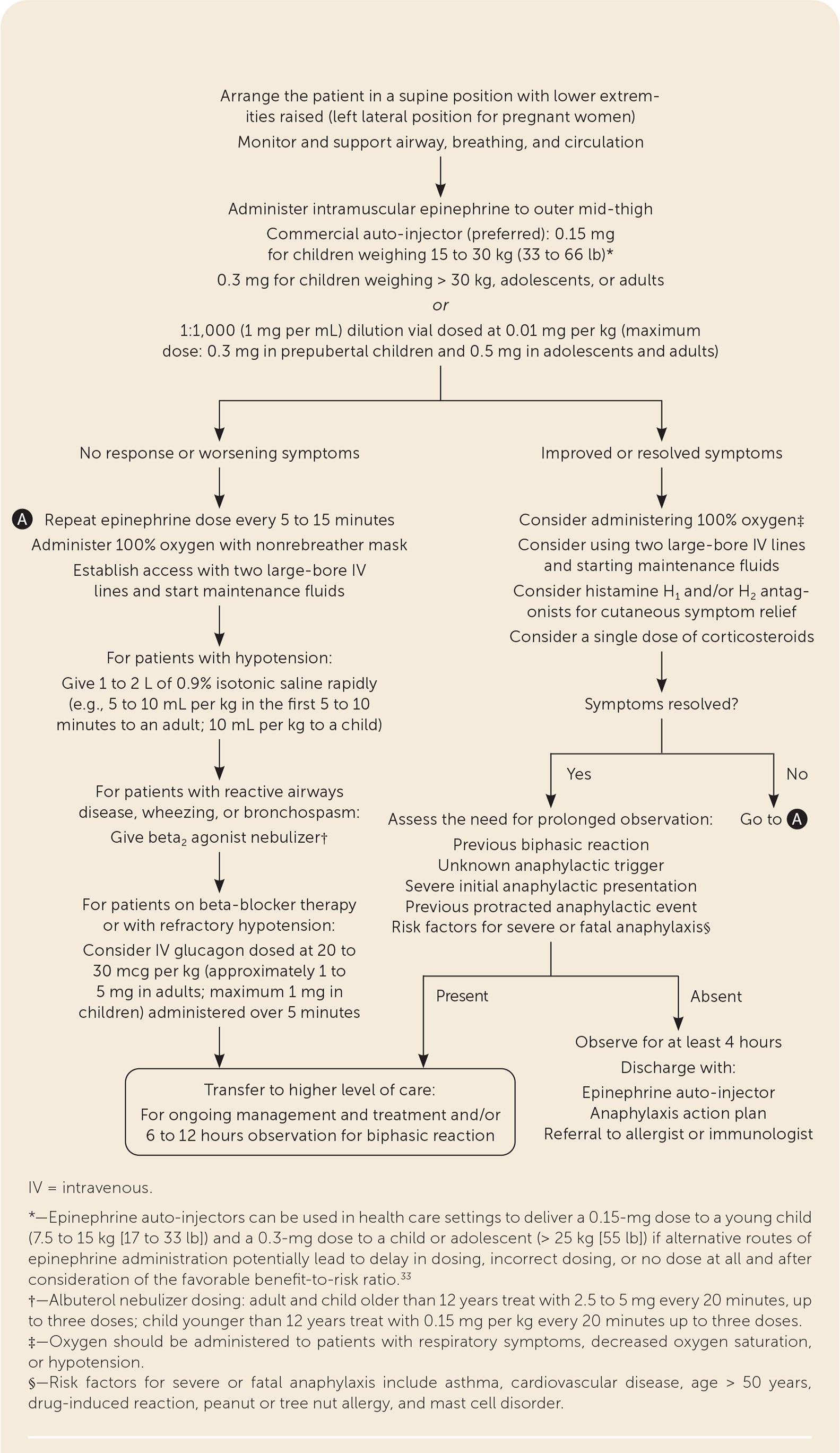
The following algorithm outlines the outpatient management approach:
Initial Stabilization
- Remove/discontinue the trigger
- Position supine with legs elevated (if tolerated); do NOT sit upright (risk of "empty ventricle" syndrome)
- Assess and support airway, breathing, circulation
Epinephrine (first-line, do NOT delay): [3-4][7][14]
- Adults: IM epinephrine 0.3–0.5 mg (1 mg/mL concentration) into the mid-anterolateral thigh
- Pediatrics: IM epinephrine 0.01 mg/kg (max 0.3 mg for children <14 years)
- Repeat every 5–15 minutes if no improvement; no cumulative maximum dose
- Intranasal epinephrine (2 mg single dose): FDA-approved in 2024; may repeat after 5 minutes [4][6]
Refractory Anaphylaxis: [14][18]
- IV epinephrine infusion: 1 mg in 1 L NS (1 mcg/mL), start at 0.1 mcg/kg/min, titrate to effect
- IV fluid resuscitation: NS 20 mL/kg bolus, repeat as needed
- Vasopressors for refractory hypotension
- Glucagon 1–5 mg IV for patients on beta-blockers [10]
- Emergency cricothyroidotomy if complete upper airway obstruction [18]
Adjunctive Therapies (only AFTER epinephrine): [2][6]
- H1 antihistamine (cetirizine 10 mg PO or diphenhydramine 25–50 mg IV/IM)
- H2 antihistamine (famotidine 20 mg IV)
- Albuterol nebulizer for persistent bronchospasm
- Corticosteroids: Not routinely recommended; no proven benefit for acute treatment or biphasic prevention [6][8]
Disposition
- Observation minimum: [2][14][20]
- Nonsevere, prompt response, low risk: Observe ≥1 hour (some guidelines recommend ≥4 hours)
- Moderate severity: Observe 4–6 hours
- Severe (respiratory compromise): Observe 6–8 hours
- Hypotension or cardiovascular compromise: Observe 12–24 hours
- Admission criteria: [7]
- Refractory anaphylaxis requiring multiple epinephrine doses or IV epinephrine
- Persistent hypotension despite treatment
- Severe respiratory compromise requiring intubation
- Significant comorbidities (asthma, cardiovascular disease, mast cell disorder)
- Lack of access to epinephrine or emergency services after discharge
- ICU admission: Refractory anaphylaxis, hemodynamic instability requiring vasopressors, intubation
- Allergy/immunology consultation: Recurrent anaphylaxis, idiopathic anaphylaxis, elevated baseline tryptase, suspected mast cell disorder [9]
Follow Up / Return Precautions
- At discharge: [3][7]
- Prescribe 2 epinephrine autoinjectors with hands-on training for patient and caregivers
- Provide a written anaphylaxis action plan
- Educate on trigger avoidance
- Follow-up timing:
- Primary care: Within 1–2 weeks to document allergy history, ensure EAI prescription, and review prevention strategies [3]
- Allergist referral: Within 4–6 weeks for formal allergy testing (skin prick/specific IgE) and consideration of immunotherapy (e.g., venom immunotherapy) [9]
- Baseline tryptase should be drawn at follow-up when patient is well [8]
- Return precautions — seek immediate care for:
- Recurrence of any symptoms (urticaria, swelling, breathing difficulty, dizziness) — biphasic reaction can occur up to 72 hours [2]
- Use of epinephrine autoinjector
- Any new exposure to the suspected trigger
- Expected course: Most uniphasic reactions resolve within hours with appropriate treatment; ~90% respond to 1–2 doses of epinephrine [8]
References
1. Anaphylaxis Definition, Overview, and Clinical Support Tool: 2024 Consensus Report-a GA2LEN Project. — Dribin TE, Muraro A, Camargo CA, et al. The Journal of Allergy and Clinical Immunology. 2025.
2. Anaphylaxis: Recognition and Management. — Pflipsen MC, Vega Colon KM. American Family Physician. 2020.
3. Anaphylaxis: Guidelines From the Joint Task Force on Allergy-Immunology Practice Parameters. — Rubin S, Drowos J, Hennekens CH. American Family Physician. 2024.
4. Peanut Allergy. — Anagnostou A, Brough HA, Abrams EM. The Journal of the American Medical Association. 2026.
5. Recent Insights Into the Mechanisms of Anaphylaxis. — Stevens WW, Kraft M, Eisenbarth SC. Current Opinion in Immunology. 2023.
6. Preparation for Pediatric Emergencies in the Office: Technical Report. — Cantrell P, Hoffmann J, Yuknis M, et al. Pediatrics. 2026.
7. A Clinical Practice Guideline for the Emergency Management of Anaphylaxis (2020). — Li X, Ma Q, Yin J, et al. Frontiers in Pharmacology. 2022.
8. Management of Food Allergies and Food-Related Anaphylaxis. — Iglesia EGA, Kwan M, Virkud YV, Iweala OI. The Journal of the American Medical Association. 2024.
9. Anaphylaxis: A 2023 Practice Parameter Update. — Golden DBK, Wang J, Waserman S, et al. Annals of Allergy, Asthma & Immunology : Official Publication of the American College of Allergy, Asthma, & Immunology. 2024.
10. Food Allergies: Diagnosis, Treatment, and Prevention. — Bright DM, Stegall HL, Slawson DC. American Family Physician. 2023.
11. Clinical Practice Guideline: Immunotherapy for Inhalant Allergy. — Gurgel RK, Baroody FM, Damask CC, et al. Otolaryngology--Head and Neck Surgery : Official Journal of American Academy of Otolaryngology-Head and Neck Surgery. 2024.
12. Systemic Mastocytosis. — Updated 2026-04-09. National Comprehensive Cancer Network.
13. Risk Factors and Characteristics of Biphasic Anaphylaxis. — Kraft M, Scherer Hofmeier K, Ruëff F, et al. The Journal of Allergy and Clinical Immunology. In Practice. 2020.
14. Wilderness Medical Society Clinical Practice Guidelines on Anaphylaxis. — Gaudio FG, Johnson DE, DiLorenzo K, et al. Wilderness & Environmental Medicine. 2022.
15. NIAID-sponsored 2010 Guidelines for Managing Food Allergy: Applications in the Pediatric Population. — Burks AW, Jones SM, Boyce JA, et al. Pediatrics. 2011.
16. Diagnostic Utility of Biomarkers in Anaphylaxis: A Systematic Review and Meta-Analysis. — Khalaf R, Prosty C, Davalan W, et al. The Journal of Allergy and Clinical Immunology. In Practice. 2025.
17. Defining Baseline Variability of Serum Tryptase Levels Improves Accuracy in Identifying Anaphylaxis. — Mateja A, Wang Q, Chovanec J, et al. The Journal of Allergy and Clinical Immunology. 2022.
18. Part 3: Adult Basic and Advanced Life Support: 2020 American Heart Association Guidelines for Cardiopulmonary Resuscitation and Emergency Cardiovascular Care. — Panchal AR, Bartos JA, Cabañas JG, et al. Circulation. 2020.
19. Epidemiology, Risk Factors, and Management of Biphasic Anaphylaxis. — Giannetti MP. Current Allergy and Asthma Reports. 2024.
20. Evaluating Practice Patterns of Observation Periods Status Post Epinephrine Administration for Anaphylaxis. — Walters B, Short HB, Ravida N, et al. The Journal of Emergency Medicine. 2025.
Figure
More from Deep Dive
Reviewed by Dr. Lucas Mastropaolo. SymptomDx is an educational tool for medical professionals — it does not replace clinical judgment. Verify all clinical data and drug dosages with authoritative sources.