Appendicitis
Acute appendicitis is the most common abdominal surgical emergency worldwide, with an annual incidence of 96.5–100 per 100,000 adults and a lifetime risk of ~8.6% in males and ~6.7% in females. [1-2] The following is a structured clinical summary for emergency medicine and primary care.
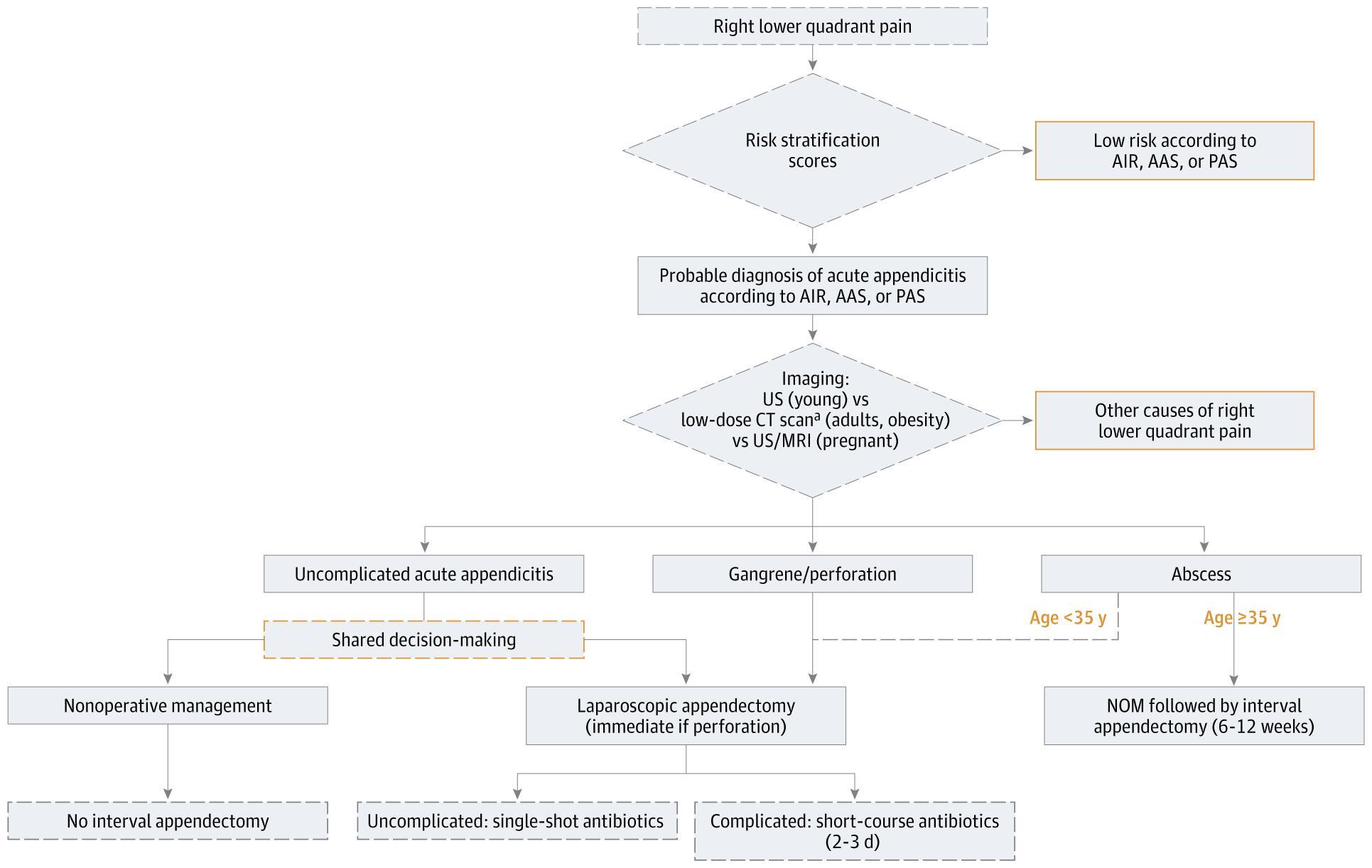
The 2025 WSES Jerusalem Guidelines provide an updated diagnostic and treatment algorithm:
History
- Classic pain sequence: Vague periumbilical pain → migration to the right lower quadrant (RLQ) within 24 hours (occurs in ~50–60% of patients) [1]
- Anorexia follows pain onset in 80–85%; nausea ± vomiting in 40–60% [1]
- Low-grade fever is typical; high fever suggests perforation or abscess
- Symptom duration: patients with appendicitis tend to have a shorter duration of pain than those with other diagnoses [4]
- Ask about timing, progression, aggravating factors (movement, cough), and prior similar episodes
- Important negatives: vaginal discharge, urinary symptoms, last menstrual period, sexual history (in women of reproductive age) [4]
Alarm Features
- Diffuse peritonitis (rigidity, guarding, rebound tenderness) — suggests perforation
- Hemodynamic instability (tachycardia, hypotension) — suggests sepsis from perforation
- High fever (>38.5°C/101.3°F) with markedly elevated WBC — gangrenous or perforated appendicitis
- Symptom duration >24 hours is a risk factor for perforation, though perforation can occur in <24 hours [1]
- Elderly and immunocompromised patients may present atypically with generalized pain and lack of leukocytosis [1]
Medications
- Preoperative prophylaxis: Single dose of broad-spectrum antibiotics (cefoxitin, cefotetan, or cefazolin + metronidazole) given 0–60 min before incision [5]
- Antibiotics-first approach (uncomplicated): IV ertapenem or ceftriaxone + metronidazole → transition to oral cefdinir/fluoroquinolone + metronidazole for a total of 7–10 days [1][6]
- Complicated appendicitis: Piperacillin-tazobactam or ertapenem monotherapy; 4 days of antibiotics adequate after source control [1]
- Pain control: NSAIDs + acetaminophen scheduled; opioids PRN — analgesics do not delay diagnosis or lead to unnecessary intervention [2][6]
- Antiemetics as needed (ondansetron)
- Avoid: Ampicillin-sulbactam and amoxicillin-clavulanate are not recommended due to high E. coli resistance rates [6]
Diet
- NPO if surgical intervention is planned
- If nonoperative management is chosen, a standard diet can be resumed once tolerated [6]
- No specific dietary triggers for appendicitis, though low-fiber diets have been associated with increased risk [7]
- Adequate hydration with IV fluids during acute illness
Review of Systems
- GI: Anorexia, nausea, vomiting, diarrhea or constipation, bloating
- GU: Dysuria, frequency, hematuria (to rule out UTI/nephrolithiasis)
- GYN (women): Vaginal discharge, menstrual history, possibility of pregnancy, dyspareunia
- Constitutional: Fever, chills, malaise
- Vascular: Assess for signs of mesenteric ischemia in elderly patients
Collateral History and Family History
- Prior episodes of similar abdominal pain (recurrent appendicitis occurs in ~20–40% of nonoperatively managed patients)
- Family history of appendicitis (genetic/environmental factors play a role) [8]
- Social context: recent travel (parasitic causes), immunosuppression, pregnancy status
- In elderly patients, collateral from caregivers is critical given atypical presentations
Risk Factors
- Age: Peak incidence in teens and young adults (10–30 years) [7]
- Sex: Male-to-female ratio ~2:1 [7]
- Low-fiber diet [7]
- Luminal obstruction: Fecalith (35%), lymphoid hyperplasia (55–65%), foreign body, parasites, tumors [7]
- Winter season and smoking have been reported as risk factors [7]
- Appendicolith on CT predicts higher risk of complicated disease and antibiotic treatment failure [1]
Differential Diagnosis
- Cannot-miss diagnoses:
- Ectopic pregnancy (all women of reproductive age — get β-hCG)
- Ovarian torsion
- Mesenteric ischemia (elderly)
- Perforated peptic ulcer
- Small bowel obstruction
- Common mimics:
- Pelvic inflammatory disease — vaginal discharge, cervical motion tenderness [4]
- Ruptured ovarian cyst/follicle
- Gastroenteritis — typically diarrhea precedes pain
- Urinary tract infection/nephrolithiasis — dysuria, hematuria
- Mesenteric adenitis — often post-viral in younger patients
- Right-sided diverticulitis (especially in Asian populations)
- Crohn disease (terminal ileitis)
- Epiploic appendagitis — self-limited, CT diagnosis
- In women of reproductive age, the most common misdiagnoses are PID, gastroenteritis, UTI, ruptured ovarian follicle, and ectopic pregnancy [1][4]
Past Medical History
- Prior abdominal surgeries (adhesions, altered anatomy)
- History of IBD (Crohn's can mimic appendicitis)
- Prior episodes of RLQ pain or prior nonoperative management of appendicitis
- Immunosuppression (blunted inflammatory response, atypical presentation)
- Pregnancy status — appendicitis is the most common nonobstetric surgical emergency in pregnancy [2]
- Comorbidities affecting surgical fitness (cardiac, pulmonary, frailty)
Physical Exam
- Vital signs: Low-grade fever typical; tachycardia and hypotension suggest perforation/sepsis
- McBurney point tenderness: Sensitivity 50–94%, specificity 75–86% [1]
- Rovsing sign (RLQ pain with LLQ palpation): Sensitivity 22–68%, specificity 58–96% [1]
- Psoas sign (RLQ pain with passive hip extension): Sensitivity 13–42%, specificity 79–97% — suggests retrocecal appendix [1]
- Obturator sign (RLQ pain with hip flexion/internal rotation): Sensitivity 8%, specificity 94% — suggests pelvic appendix [1]
- Peritoneal signs: Guarding, rigidity, rebound tenderness — suggest perforation
- Absent/decreased bowel sounds in advanced cases
- Pelvic exam in women of reproductive age to evaluate for cervical motion tenderness, adnexal masses
Lab Studies
- CBC with differential: Leukocytosis (WBC >10,000/μL) in 67–90%; left shift in ~80% [1]
- CRP: Elevated in most cases; a combination of normal WBC, normal neutrophil count, and normal CRP makes appendicitis less likely [9]
- Urinalysis: Rule out UTI; mild pyuria/hematuria can occur with appendicitis due to proximity
- β-hCG: All women of reproductive age to rule out ectopic pregnancy [1]
- Lactate: If concern for perforation, sepsis, or mesenteric ischemia
- BMP/LFTs: Baseline if surgical candidate or concern for alternative diagnoses
Imaging
- CT abdomen/pelvis with IV contrast — first-line in most U.S. centers
- Ultrasound — first-line in children, pregnant patients, and young/thin adults
- Sensitivity 78%, specificity 83% [1]
- Operator-dependent; noncompressible appendix >6 mm is diagnostic
- MRI — preferred second-line in pregnant patients and children when US is inconclusive [10]
- When imaging is unnecessary: Alvarado score <4 makes appendicitis unlikely; very high clinical suspicion may warrant direct surgical consultation without imaging [11]
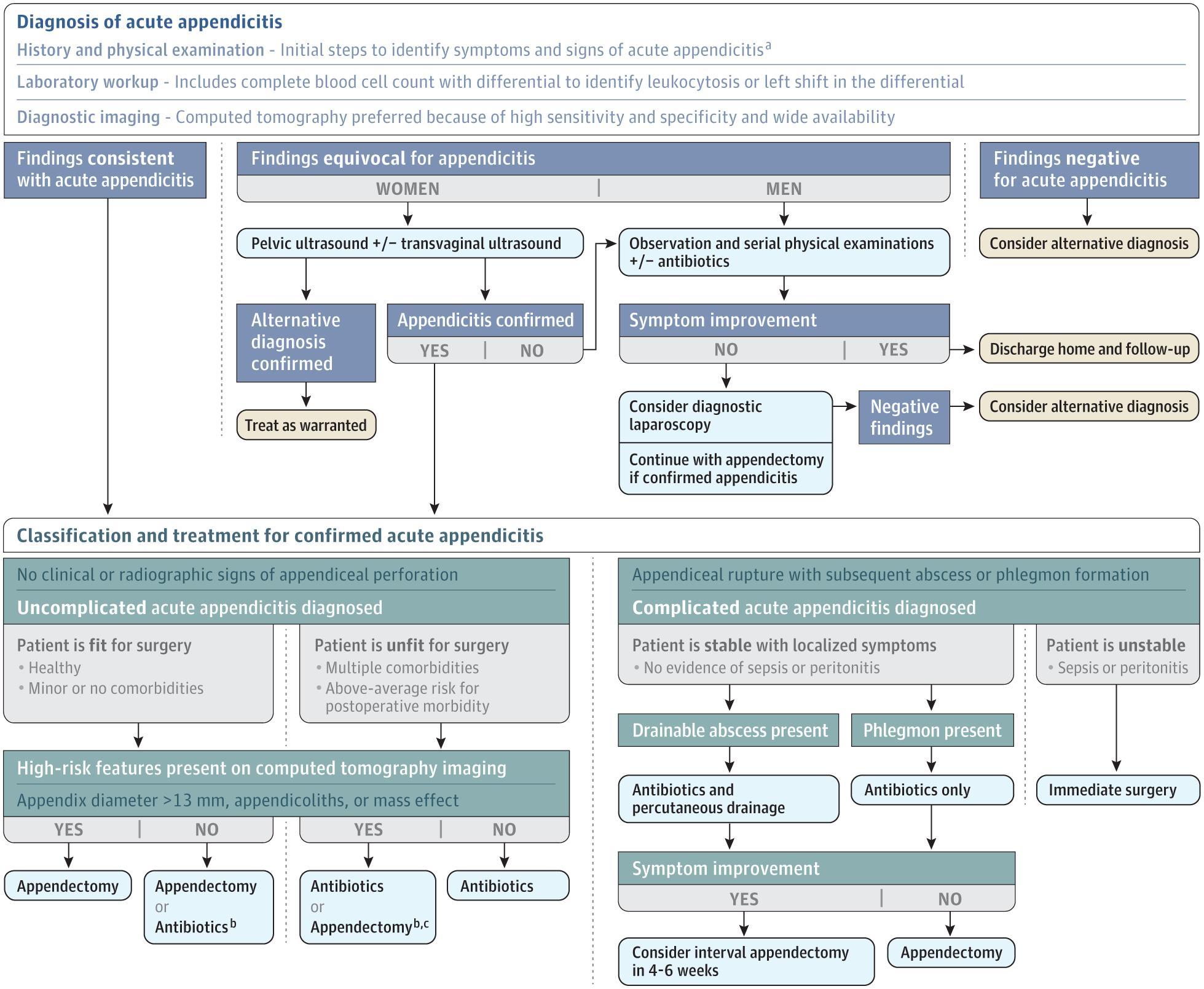
The JAMA review provides a comprehensive diagnostic and management algorithm:
Special Tests
- Clinical scoring systems:
- Alvarado Score (MANTRELS): Score <4 effectively rules out appendicitis; ≥7 in males has positive likelihood ratio comparable to CT. ACEP notes insufficient data to use alone in adults [5][11-12]
- AIR Score (Appendicitis Inflammatory Response): Incorporates CRP; current evidence and guidelines suggest AIR, AAS, and RIPASA have the highest diagnostic accuracy [9]
- Adult Appendicitis Score (AAS): Best performance for women (cutoff ≤8, failure rate 3.7%) [5]
- Point-of-care ultrasound (POCUS): Graded compression technique; useful for rapid bedside assessment
- Diagnostic laparoscopy: Both diagnostic and therapeutic, especially useful in young women with equivocal presentations [1]
ECG
- Not routinely indicated for appendicitis
- Obtain in elderly patients or those with cardiac comorbidities as part of preoperative evaluation
- Rule out inferior MI presenting as epigastric/abdominal pain in older patients
- Identify arrhythmias or ischemia that may affect anesthetic risk
Assessment
- Severity stratification:
- Typical presentation: Periumbilical pain → RLQ migration, anorexia, nausea, low-grade fever, leukocytosis — present in ~90% of classic cases [1]
- Atypical presentations: Elderly (generalized pain, no leukocytosis), pregnant (RUQ pain in later trimesters), retrocecal appendix (flank/back pain), pelvic appendix (suprapubic/urinary symptoms) [1]
- Complications: Perforation (17–32%), abscess, phlegmon, peritonitis, sepsis, portal pyemia (pylephlebitis) [2]
Treatment Plan
Initial stabilization
- IV access, fluid resuscitation, NPO status
- Analgesia: scheduled NSAIDs + acetaminophen; opioids PRN [6]
- Antiemetics PRN
- Broad-spectrum antibiotics initiated in the ED once diagnosis is reasonably established [6]
Surgical management (standard of care)
- Laparoscopic appendectomy is the treatment of choice [1]
Nonoperative management (select patients with uncomplicated appendicitis):
- Appropriate in patients without appendicolith, mass effect, or appendiceal diameter >13 mm on CT [1]
- ~60–70% success rate at 1 year; ~20–40% recurrence rate [1][6]
- IV ertapenem or ceftriaxone + metronidazole → oral fluoroquinolone/cephalosporin + metronidazole for 7–10 days [6]
- Endorsed by ACS, WSES, AAST, and EAST as a safe alternative [6]
Complicated appendicitis
- Unstable patients with peritonitis: Emergent surgical exploration after resuscitation [1]
- Stable patients with drainable abscess: Percutaneous drainage + IV antibiotics → interval appendectomy in 6–8 weeks [1]
- Patients >40 years should undergo colonoscopy before interval appendectomy to exclude cecal neoplasm [1]
Disposition
- Admission criteria:
- All patients undergoing appendectomy
- Complicated appendicitis (perforation, abscess, phlegmon)
- Hemodynamic instability, sepsis, diffuse peritonitis
- Failed nonoperative management
- Inability to tolerate oral intake or medications
- Observation indications:
- Equivocal clinical/imaging findings — serial exams q6–8h
- Atypical presentations in women of reproductive age
- Discharge criteria (nonoperative management):
- Post-appendectomy discharge: Typically day 1 postoperatively for laparoscopic cases [6]
- Surgical consultation triggers: All confirmed or highly suspected appendicitis; equivocal cases not improving after 24–48 hours of observation [1]
Follow Up / Return Precautions
- Post-appendectomy: Return to normal activities within 1–2 weeks (laparoscopic) or 2–3 weeks (open); avoid strenuous activity for 3–5 days (laparoscopic) or 10–14 days (open) [6]
- Nonoperative management follow-up:
- Contact or telemedicine visit within 1–2 days after discharge [6]
- Improvement expected within 48 hours; if no improvement, return to ED for reassessment and likely appendectomy [6]
- Discuss interval appendectomy at 4–6 weeks if symptoms resolved [1]
- Patients ≥40 years should have colonoscopy or contrast-enhanced CT within 3 months to rule out neoplasm [6]
- Return precautions (counsel patients):
- Worsening or spreading abdominal pain
- Fever, persistent vomiting, inability to tolerate fluids
- Wound redness, swelling, or drainage (post-surgical)
- Symptoms suggesting recurrence (recurrent RLQ pain) [6]
- Recurrence: If appendicitis recurs after nonoperative management, surgery is commonly performed; antibiotic retreatment may be reasonable in younger patients [6]
References
1. Diagnosis and Management of Acute Appendicitis in Adults: A Review. — Moris D, Paulson EK, Pappas TN. The Journal of the American Medical Association. 2021.
2. Acute Appendicitis: Efficient Diagnosis and Management. — Snyder MJ, Guthrie M, Cagle S. American Family Physician. 2018.
3. Diagnosis and Treatment of Acute Appendicitis. — Podda M, Ceresoli M, De Simone B, et al. JAMA Surgery. 2026.
4. Suspected Appendicitis. — Paulson EK, Kalady MF, Pappas TN. The New England Journal of Medicine. 2003.
5. Diagnosis and Treatment of Acute Appendicitis: 2020 Update of the WSES Jerusalem Guidelines. — Di Saverio S, Podda M, De Simone B, et al. World Journal of Emergency Surgery : WJES. 2020.
6. Treatment of Acute Uncomplicated Appendicitis. — Talan DA, Di Saverio S. The New England Journal of Medicine. 2021.
7. Gastrointestinal Surgical Emergencies Textbook. — Ashley E. Aaron, Andrea Amabile, Ciro Andolfi, et al American College of Surgeons (2021). 2021.
8. Computed Tomography for Diagnosis of Acute Appendicitis in Adults. — Rud B, Vejborg TS, Rappeport ED, Reitsma JB, Wille-Jørgensen P. The Cochrane Database of Systematic Reviews. 2019.
9. Emergency Medicine Updates: Acute Appendicitis in the Adult Patient. — Long B, Gottlieb M. The American Journal of Emergency Medicine. 2025.
10. Magnetic Resonance Imaging (MRI) for Diagnosis of Acute Appendicitis. — D'Souza N, Hicks G, Beable R, Higginson A, Rud B. The Cochrane Database of Systematic Reviews. 2021.
11. Acute Appendicitis — Appendectomy or the “Antibiotics First” Strategy. — Flum DR. The New England Journal of Medicine. 2015.
12. Clinical Policy: Critical Issues in the Evaluation and Management of Emergency Department Patients With Suspected Appendicitis: Approved by ACEP Board of Directors February 1, 2023. — Diercks DB, Adkins EJ, Harrison N, et al. Annals of Emergency Medicine. 2023.
13. Nonoperative Treatment of Appendicitis and Implications for Emergency Department Management: A Narrative Review. — Talan DA, Moran GJ, Machado-Aranda D, et al. Annals of Emergency Medicine. 2025.
Figures
More from Deep Dive
Reviewed by Dr. Lucas Mastropaolo. SymptomDx is an educational tool for medical professionals — it does not replace clinical judgment. Verify all clinical data and drug dosages with authoritative sources.