Cyanide Poisoning
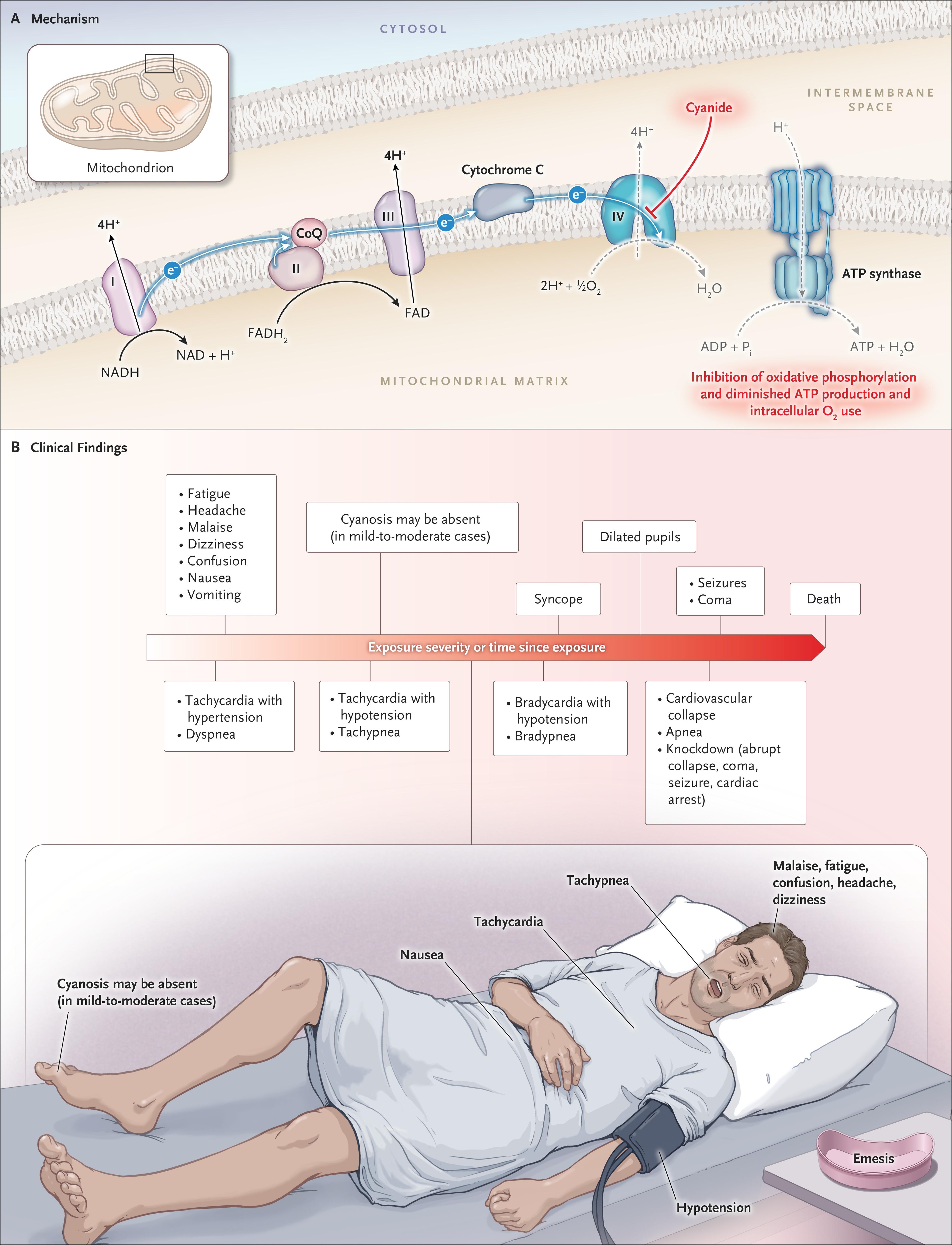
Cyanide is one of the most rapidly lethal poisons, inhibiting mitochondrial cytochrome oxidase and blocking cellular respiration (oxidative phosphorylation), leading to cellular hypoxia despite normal arterial oxygen levels. [1-2] The most common source of exposure in clinical practice is smoke inhalation from structure fires, where concomitant carbon monoxide poisoning is frequent. [1][3-4] Diagnosis is clinical — there is no widely available rapid confirmatory test — and empirical antidote administration should not be delayed. [3][5]
The following figure from the NEJM illustrates the mechanism of cyanide toxicity at the mitochondrial level and the clinical progression from early symptoms to cardiovascular collapse:
History
- Exposure context: Structure fire/smoke inhalation in enclosed space, industrial/laboratory accident (electroplating, metallurgy, jewelry cleaning), ingestion of cyanide salts or cyanogenic compounds (amygdalin, acetonitrile, apricot pits), sodium nitroprusside infusion, intentional self-harm [1-2]
- Route: Inhalation (most rapid onset — seconds to minutes), ingestion, dermal absorption [5]
- Timing: Inhalation → symptoms within seconds; ingestion of salts → minutes; ingestion of cyanogenic compounds (e.g., acetonitrile) → delayed onset up to hours [2]
- Symptom progression: Headache, confusion, dizziness, nausea/vomiting → dyspnea, chest tightness → altered mental status, seizures → cardiovascular collapse, apnea [5-6]
- Important negatives: Ask about co-exposures (CO, other toxic gases), duration in enclosed space, presence of soot in airway
Alarm Features
- Cardiac arrest (OR 36.4 for fatal outcome) [7]
- Hypotension (OR 15.8 for fatal outcome) [7]
- Coma/unresponsiveness (OR 10.8 for fatal outcome) [7]
- Lactic acidosis (OR 7.8 for fatal outcome); lactate >10 mmol/L in smoke inhalation strongly associated with cyanide toxicity [2][7]
- Seizures — indicate severe poisoning [1]
- Apnea/bradypnea — late finding indicating imminent arrest [5]
- Rapid progression from initial symptoms to cardiovascular collapse can occur within minutes [8]
Medications
Antidotes (see Treatment Plan for dosing)
- Hydroxocobalamin (Cyanokit) — first-line, preferred agent [1][3]
- Sodium nitrite + sodium thiosulfate (Cyanide Antidote Kit) — alternative when hydroxocobalamin unavailable [1][6]
- Sodium thiosulfate alone — too slow for monotherapy in life-threatening cases but may be used adjunctively [1]
Medication contributors to cyanide toxicity
- Sodium nitroprusside[2]
Contraindications/cautions
- Sodium nitrite is relatively contraindicated in smoke inhalation with suspected CO co-poisoning (methemoglobin formation further reduces O₂-carrying capacity) [1]
- Sodium nitrite dosing must be precise in children and anemic patients to avoid excessive methemoglobinemia [1][3]
- Hydroxocobalamin and sodium thiosulfate are chemically incompatible — do not administer through the same IV line [6]
Diet
- Cyanogenic foods: Cassava (linamarin), bitter almonds, apricot/peach/cherry pits (amygdalin), lima beans — chronic ingestion can cause subacute cyanide toxicity [1][9]
- Not applicable in the acute ED setting; relevant for chronic/subacute exposure history and public health counseling
Review of Systems
- Neuro: Headache, dizziness, confusion, agitation, seizures, loss of consciousness
- Cardiovascular: Chest tightness, palpitations, syncope
- Respiratory: Dyspnea, tachypnea (early), apnea (late)
- GI: Nausea, vomiting
- Skin: Ask about burns, soot exposure (smoke inhalation context)
- Psychiatric: Suicidal ideation (intentional ingestion)
Collateral History and Family History
- Critical collateral: Bystanders, EMS, fire department — nature of fire, enclosed vs. open space, duration of exposure, materials burning (plastics, vinyl, wool = higher cyanide risk) [1]
- Coworkers in industrial/laboratory exposures — identify the specific cyanide compound
- Family/friends for intentional ingestion — access to cyanide salts, suicide note, psychiatric history
- Family history is generally not relevant in acute poisoning
Risk Factors
- Smoke inhalation in enclosed-space fires — most common clinical scenario [1][4]
- Occupational exposure: Electroplating, metallurgy, jewelry cleaning, photography, laboratory work, mining [1-2]
- Intentional self-harm or criminal poisoning (rare) [1]
- Sodium nitroprusside therapy — especially prolonged infusions [2]
- Ingestion of cyanogenic plants/compounds — most common in children <5 years (plant material ingestion), though usually mild [7]
Differential Diagnosis
- Carbon monoxide poisoning — overlapping presentation in fire victims; check COHb level; can coexist with cyanide [2][4]
- Hydrogen sulfide poisoning — occupational (sewers, enclosed spaces); rotten-egg odor; "gas eye" corneal ulcerations [2]
- Methemoglobinemia — cyanosis, chocolate-brown blood; check co-oximetry
- Severe sepsis/septic shock — lactic acidosis, hypotension, altered mental status; but different exposure history
- Other mitochondrial toxins: Azide poisoning, metformin-associated lactic acidosis
- Opioid overdose — CNS depression, apnea, miosis (vs. mydriasis in cyanide) [1]
- Cardiac arrest from other causes — in fire victims, consider thermal airway injury, hypoxia from O₂ displacement
Key distinguishing feature: Cyanide causes elevated mixed venous O₂ saturation (cells cannot extract oxygen) — this is uncharacteristic of most other causes of shock [2]
Past Medical History
- Anemia — increases risk from sodium nitrite (reduced O₂-carrying capacity reserve) [1][3]
- Cardiac disease — lower threshold for cardiovascular collapse
- Chronic cyanide exposure — may cause thyroid dysfunction [8]
- Psychiatric history — relevant for intentional ingestion
- Previous episodes of poisoning or self-harm
Physical Exam
Vital signs
- Early: Tachycardia, hypertension, tachypnea/hyperpnea [5-6]
- Late: Bradycardia, hypotension, bradypnea/apnea [5-6]
Focused exam
- Neuro: GCS, pupil exam (mydriasis is suggestive), seizure activity [5-6]
- Airway: Soot around mouth/nose/oropharynx (smoke inhalation), stridor, hoarseness [6]
- Skin: Burns, soot; cherry-red skin is classically described but rare (11% of cases) and unreliable; cyanosis may be absent in mild-moderate cases [2][10]
- Odor: Bitter-almond breath odor — described but uncommon (15% of cases), and ~40% of the population cannot detect it genetically [10]
- Most patients in published case series were unresponsive (78%), had respiratory failure (73%), and were hypotensive (54%) [10]
Lab Studies
- ABG/VBG: Severe high-anion-gap metabolic acidosis — the most consistent laboratory finding [1-2][10]
- Lactate: The single most useful lab value
- ≥8 mmol/L — sensitive (94%) for toxic cyanide levels; moderately specific (70%), improved to 85% in patients not on vasopressors [11]
- >10 mmol/L in smoke inhalation — strongly associated with cyanide toxicity [2]
- >11 mmol/L — associated with fatal outcome (sensitivity 74%, specificity 80%) [7]
- Serial lactate monitoring is useful for tracking treatment response [12]
- Co-oximetry: COHb level (rule out concomitant CO poisoning); note hydroxocobalamin interferes with colorimetric COHb measurement [2][5]
- BMP: Anion gap, electrolytes, renal function
- Mixed venous O₂ saturation: Elevated (narrowed arteriovenous O₂ gap) — cells cannot utilize oxygen [2]
- Blood cyanide level: Confirmatory but not available in real time in most hospitals; >1.0 mg/L is toxic. Do not delay treatment awaiting results [3][5][11]
- CBC: Baseline hemoglobin (relevant for sodium nitrite dosing)
Imaging
- CXR: Evaluate for concomitant inhalation injury, pulmonary edema, aspiration (especially in smoke inhalation)
- CT head: Consider if prolonged altered mental status persists after treatment — evaluate for anoxic brain injury
- Imaging is generally not diagnostic for cyanide poisoning itself; it is used to evaluate complications and co-injuries
Special Tests
- Point-of-care lactate — most critical bedside test for supporting diagnosis and monitoring treatment [11-12]
- Co-oximetry — essential in smoke inhalation to assess COHb and methemoglobin levels
- Poison Control Center consultation (1-800-222-1222 in the US) — recommended for all suspected cases [1][5]
- Whole blood cyanide level — send if available, but results are typically delayed hours to days [3]
ECG
- Obtain ECG on all patients — cardiac complications are common (reported in 84% of fire-related cyanide cases) [13]
- Findings:
- Sinus tachycardia (early) → bradycardia (late/ominous) [5]
- Supraventricular tachycardia — most common rhythm disturbance (35% in one series) [13]
- Repolarization abnormalities (ST-T wave changes) [13]
- Conduction delays [13]
- Asystole — most common arrest rhythm (95% of cardiac arrests in one series were asystole, 5% VF) [13]
- Pulseless electrical activity (PEA) — described at higher levels of intoxication [14]
- Cyanide itself may prolong APD and depolarize resting membrane potential at the cellular level [15]
Assessment
Severity stratification
- Mild: Headache, dizziness, nausea, anxiety, tachypnea — may mimic panic symptoms [5]
- Moderate: Confusion, disorientation, mydriasis, vomiting, tachycardia, hypertension
- Severe: Coma, seizures, cardiovascular collapse, apnea, cardiac arrest, lactate ≥8 mmol/L [5-6]
Key clinical pearls
- Diagnosis is clinical and presumptive — do not wait for confirmatory testing [3][5]
- Cherry-red skin and bitter-almond odor are unreliable — absent in the majority of cases [10]
- The presence of altered mental status and/or mydriasis is more suggestive of true cyanide poisoning than panic-related tachypnea/vomiting [5]
- In smoke inhalation, always consider dual CO + cyanide poisoning [1][4]
- Survivors of significant poisoning can have long-term neurologic dysfunction [16]
Treatment Plan
Initial stabilization (do not delay for antidote)
- Airway: Intubate if GCS depressed, apneic, or airway compromise (66% of cases required intubation) [10]
- 100% FiO₂: Administer to all patients — beneficial despite normal PaO₂ [1]
- Decontamination: Remove from exposure, remove clothing, dermal decontamination for liquid exposure [2]
- GI decontamination: Consider for cyanide/cyanogenic compound ingestion [2]
- Vasopressors: 39% of cases required vasopressor support for refractory hypotension [10]
- Seizure management: Benzodiazepines
Antidote therapy
- Redosing: If signs recur, repeat half the original dose of sodium nitrite and sodium thiosulfate [6]
- Hydroxocobalamin may be repeated at full dose (5 g) for severe cases [2][5]
- Monitor blood pressure during all antidote administration [6]
Disposition
Admit to ICU
- Cardiac arrest, hemodynamic instability, or vasopressor requirement
- Seizures, coma, or persistent altered mental status
- Severe lactic acidosis (lactate ≥8 mmol/L)
- Required antidote administration
- Concomitant significant CO poisoning or inhalation injury
Observation
- Mild symptoms with rapid resolution after decontamination and supportive care
- Asymptomatic patients with concerning exposure history — observe minimum 4–6 hours (longer for cyanogenic compound ingestion due to delayed metabolism)
Discharge considerations
- Asymptomatic after observation period with normal lactate and no acidosis
- Psychiatric evaluation mandatory before discharge for intentional ingestions
Consult triggers
- Toxicology/Poison Control (1-800-222-1222) — all suspected cases [1]
- Burn surgery — concomitant burns
- Pulmonology/critical care — inhalation injury
- Hyperbaric medicine — if significant concomitant CO poisoning [2]
- Psychiatry — intentional ingestion
Prognosis: Mortality is high once cardiac arrest occurs — only 13% survival in patients who received hydroxocobalamin while in cardiac arrest. [3] Among non-arrest patients treated with hydroxocobalamin, survival is approximately 72–78%. [3]
Follow Up / Return Precautions
- Survivors of significant poisoning should be monitored for delayed neurologic sequelae (parkinsonian features, cognitive deficits, personality changes) — similar to post-anoxic injury [16]
- Follow-up timing: Neurology follow-up within 1–2 weeks for patients with any period of altered consciousness
- Occupational exposure: Ensure workplace safety evaluation and OSHA reporting before return to work
- Return precautions: Return immediately for recurrent headache, confusion, dizziness, chest pain, shortness of breath, or any neurologic symptoms
- Thyroid function: Consider monitoring in patients with chronic/subacute cyanide exposure [8]
- Psychiatric follow-up: Mandatory for intentional ingestions
References
1. 2023 American Heart Association Focused Update on the Management of Patients With Cardiac Arrest or Life-Threatening Toxicity Due to Poisoning: An Update to the American Heart Association Guidelines for Cardiopulmonary Resuscitation and Emergency Cardiovascular Care. — Lavonas EJ, Akpunonu PD, Arens AM, et al. Circulation. 2023.
2. Hazardous Chemical Emergencies and Poisonings. — Henretig FM, Kirk MA, McKay CA. The New England Journal of Medicine. 2019.
3. Part 10: Adult and Pediatric Special Circumstances of Resuscitation: 2025 American Heart Association Guidelines for Cardiopulmonary Resuscitation and Emergency Cardiovascular Care. — Cao D, Arens AM, Chow SL, et al. Circulation. 2025.
4. Smoke-Inhalation Victims in a Tertiary ED: Prevalence of Presumed Hydrogen-Cyanide Co-Poisoning and Clinical Correlates. — Lobo-Antuña V, Lobo-Antuña M, Fernández-Soro A, et al. Internal and Emergency Medicine. 2026.
5. FDA Drug Label. — Updated date: 2023-04-27. Food and Drug Administration.
6. FDA Drug Label. — Updated date: 2025-10-06. Food and Drug Administration.
7. Potential Cyanide Poisoning Reported to the UK National Poisons Information Service: 2008-2019. — Haden M, Wheatley N, Gray LA, et al. Clinical Toxicology. 2022.
8. Cyanide Toxicity. Agency for Toxic Substances and Disease Registry. — American Family Physician. 1993.
9. Cyanide and Cyanogenic Compounds-Toxicity, Molecular Targets, and Therapeutic Agents. — Lachowicz JI, Alexander J, Aaseth JO. Biomolecules. 2024.
10. Challenges in the Diagnosis of Acute Cyanide Poisoning. — Parker-Cote JL, Rizer J, Vakkalanka JP, Rege SV, Holstege CP. Clinical Toxicology. 2018.
11. Value of Lactic Acidosis in the Assessment of the Severity of Acute Cyanide Poisoning. — Baud FJ, Borron SW, Mégarbane B, et al. Critical Care Medicine. 2002.
12. A Case Report of Acute Cyanide Poisoning Treated With Lactate as an Indicator. — Suzuki M, Takeda S, Sugaya K, et al. Medicine. 2025.
13. Cyanide Poisoning and Cardiac Disorders: 161 Cases. — Fortin JL, Desmettre T, Manzon C, et al. The Journal of Emergency Medicine. 2010.
14. Circulatory Failure During Noninhaled Forms of Cyanide Intoxication. — Haouzi P, Tubbs N, Rannals MD, et al. Shock. 2017.
15. Methylene Blue Counteracts Cyanide Cardiotoxicity: Cellular Mechanisms. — Cheung JY, Wang J, Zhang XQ, et al. Journal of Applied Physiology. 2018.
16. Cyanides. — Morocco AP. Critical Care Clinics. 2005.
Figure
More from Deep Dive
Reviewed by Dr. Lucas Mastropaolo. SymptomDx is an educational tool for medical professionals — it does not replace clinical judgment. Verify all clinical data and drug dosages with authoritative sources.