Hemorrhoids (Thrombosed)
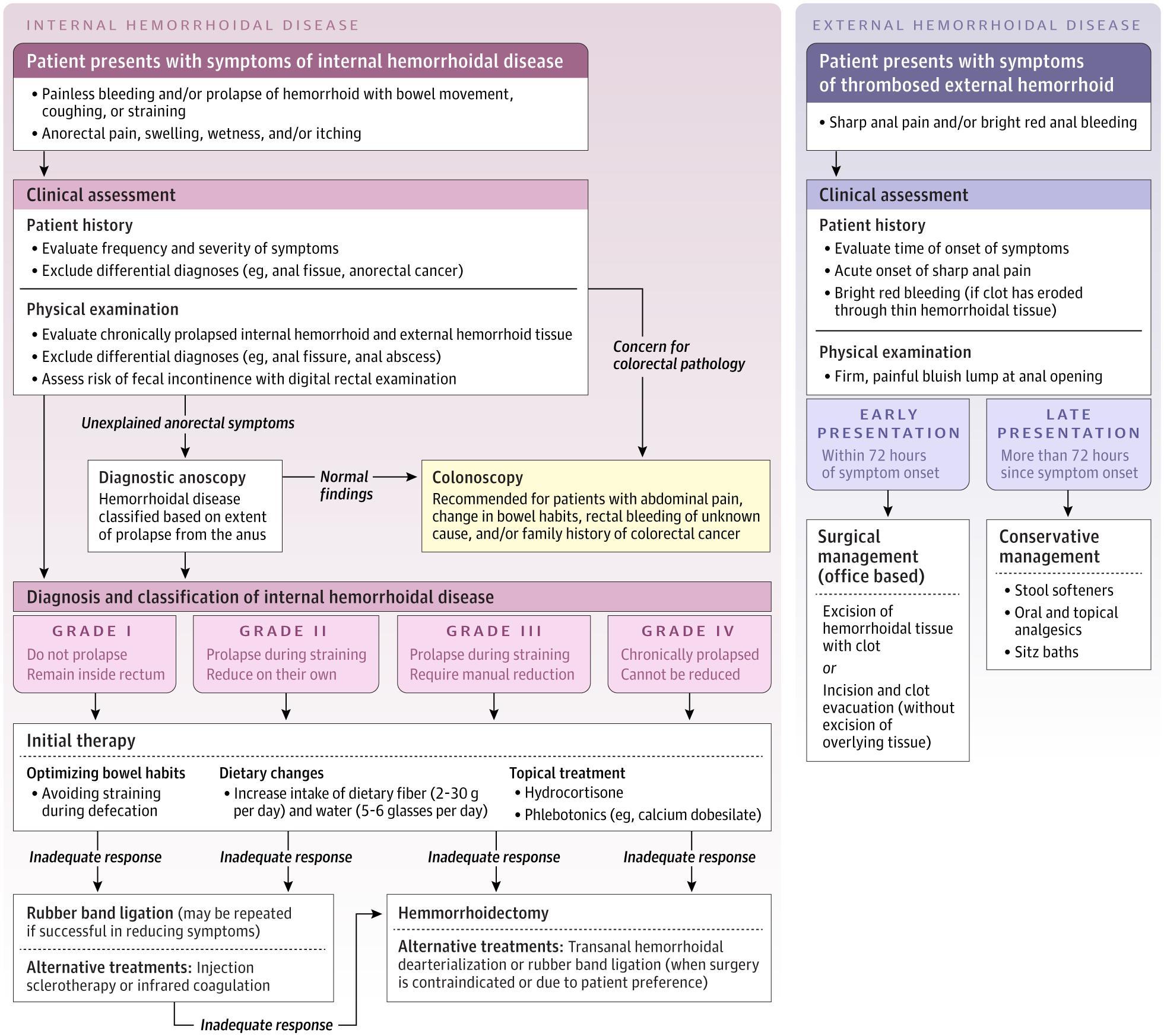
A thrombosed external hemorrhoid is an acute clot within the vascular tissue of an external hemorrhoid, presenting with sudden-onset severe perianal pain and a firm, bluish-purple mass at the anal verge. The critical management decision hinges on timing: within 72 hours of symptom onset, excision is preferred; beyond 72 hours, conservative management is standard. [1-3]
The following treatment algorithm from a 2025 JAMA review illustrates the management pathway:
History
- Acute onset of severe, constant perianal pain — ask precisely when it started (the 72-hour window drives management) [1][3]
- Character: throbbing, pressure-like, worsened by sitting, walking, and defecation
- Preceding straining, constipation, heavy lifting, prolonged sitting, or recent pregnancy/delivery [2][4]
- Prior episodes of hemorrhoidal disease or thrombosis
- Bleeding: bright red blood on tissue or dripping — may occur if thrombus erodes through skin [1]
- Bowel habits: frequency, consistency, straining, prolonged toilet time, fiber/fluid intake [2]
- Anticoagulant or antiplatelet use (affects procedural planning and bleeding risk)
Alarm Features
- Fever, perianal erythema/induration, or purulent drainage → consider perianal/ischiorectal abscess [3][5]
- Irreducible prolapsing tissue with signs of ischemia/necrosis → incarcerated/strangulated internal hemorrhoids (surgical emergency) [1]
- Severe uncontrolled bleeding or hemodynamic instability
- Pain disproportionate to exam findings → necrotizing soft tissue infection (Fournier gangrene)
- Bleeding mixed with stool or melena → proximal GI source [1][5]
- New rectal mass, weight loss, change in bowel habits → concern for anorectal malignancy [2]
- Pelvic sepsis (rare but life-threatening complication post-procedure) — fever, urinary retention, severe pain [6]
Medications
- Conservative management (>72 hours or patient preference):
- Phlebotonics (e.g., micronized purified flavonoid fraction/diosmin): may reduce bleeding, pain, and swelling, though symptom recurrence reaches ~80% within 3–6 months of cessation [1][8]
- Topical 0.2% nitroglycerin has been studied but showed inferior results compared with excision [2][9]
- Cautions: Avoid prolonged topical steroid use (>2 weeks); topical anesthetics/antiseptics can cause allergic sensitization with prolonged use [6][8]
- In patients on anticoagulants, weigh bleeding risk of excision vs. conservative management; coagulopathy (platelets <50K or INR >2.0) warrants extra caution [6]
Diet
- Increase dietary fiber to 20–30 g/day — reduces persistent hemorrhoidal symptoms by ~53% (Cochrane review) [2][7-8]
- Increase fluid intake to 6–8 glasses daily [7]
- High-fiber foods: fruits, vegetables, whole grains, legumes; fiber supplements (psyllium, methylcellulose) if dietary intake is insufficient
- Avoid excessive caffeine and alcohol (can worsen constipation/dehydration)
- Long-term dietary fiber maintenance is the cornerstone of recurrence prevention [1-2]
Review of Systems
- GI: Constipation, diarrhea, change in bowel habits, blood mixed with stool, melena, abdominal pain
- GU: Urinary retention (can occur with severe perianal pain or post-procedure)
- Constitutional: Fever, chills, weight loss (red flags for abscess, malignancy)
- OB/GYN: Pregnancy status, recent delivery (hemorrhoid thrombosis affects 8% in third trimester, 20% postpartum) [4]
- Dermatologic: Perianal rash, drainage, pruritus (consider dermatitis, fistula)
Collateral History and Family History
- Prior anorectal procedures or surgeries
- Family history of colorectal cancer or inflammatory bowel disease (important if bleeding is the presenting symptom) [2]
- Occupational factors: prolonged sitting (truck drivers, office workers)
- Social history: heavy lifting, exercise habits
- In pregnancy: trimester, delivery plans, prior obstetric hemorrhoid complications [4][10]
Risk Factors
- Constipation and straining — OR 2.09 for hemorrhoidal disease vs. controls [2]
- Prolonged sitting on the toilet (reading, phone use) [2][7]
- Low-fiber diet and inadequate fluid intake
- Pregnancy (especially third trimester and postpartum) [4]
- Obesity
- Heavy lifting / chronic Valsalva
- Chronic diarrhea
- Advanced age
- Prior hemorrhoidal disease or thrombosis
- Portal hypertension/cirrhosis (though rectal varices must be distinguished from hemorrhoids) [5-6]
Differential Diagnosis
- Perianal abscess — erythema, fluctuance, fever, purulent drainage; may require I&D [3][5]
- Anal fissure — sharp, "knife-like" pain during/after defecation; posterior midline tear on exam [1][4][6]
- Prolapsed/incarcerated internal hemorrhoids — circumferential mucosal prolapse, may be ischemic [1]
- Perianal Crohn's disease — skin tags, fissures, fistulae in IBD patients [6]
- Anorectal cancer — firm mass, bleeding independent of bowel movements, weight loss [1]
- Rectal prolapse — circular mucosal folds (vs. radial folds of prolapsed hemorrhoids) [4]
- Rectal varices (in cirrhosis) — must not be confused with hemorrhoids [5-6]
- Pilonidal cyst/abscess — more posterior/coccygeal location
- Perianal dermatitis/condylomata — pruritus, skin changes
Past Medical History
- Prior hemorrhoidal episodes, thromboses, or procedures (banding, sclerotherapy, hemorrhoidectomy)
- History of constipation, IBS, or IBD [6]
- Cirrhosis or portal hypertension [6]
- Coagulopathy or anticoagulant/antiplatelet therapy
- Pregnancy history
- Prior anorectal or pelvic surgery
- Colorectal cancer screening status
Physical Exam
- Inspection (key): Firm, tender, bluish-purple perianal mass at the anal verge — pathognomonic [1-2]
- Position: prone jackknife preferred; lateral decubitus acceptable [3]
- Assess for surrounding erythema, induration, fluctuance (abscess), purulent drainage (fistula) [1]
- Look for anal fissure (posterior midline tear with gentle eversion of anal canal) [5]
- Assess for prolapsing internal hemorrhoids (radial folds vs. circular folds of rectal prolapse) [4]
- Digital rectal exam: Evaluate sphincter tone, rule out other anorectal pathology, assess for masses [1-2]
- Note skin tags from prior thromboses
- Vital signs: fever suggests infectious complication
Lab Studies
- Routine labs are generally not needed for uncomplicated thrombosed external hemorrhoids
- CBC if significant bleeding or concern for anemia from chronic hemorrhoidal disease
- Coagulation studies (PT/INR, platelets) if on anticoagulants or liver disease suspected
- Type and screen only if hemodynamically significant bleeding
- Consider CRP/WBC if concern for abscess or septic complication
Imaging
- Imaging is generally unnecessary — diagnosis is clinical [2]
- CT pelvis or MRI only if concern for deep perianal/ischiorectal abscess, fistula, or pelvic pathology
- Endoanal ultrasound: rarely needed; may help characterize complex fistulae or sphincter integrity
- Colonoscopy indicated if bleeding is unexplained by exam, or if risk factors for colorectal cancer are present (family history, age-appropriate screening overdue, change in bowel habits) [2][8]
Special Tests
- Anoscopy: Should be performed when symptoms are unexplained by external exam or to evaluate for concurrent internal hemorrhoidal disease [1-2][6]
- Colonoscopy: Indicated for patients with bleeding not explained by hemorrhoids, abdominal pain, new constipation, or continued hematochezia despite treatment [2][8]
- No validated scoring systems specific to thrombosed external hemorrhoids
- Internal hemorrhoid grading (I–IV) applies to internal disease and guides procedural management [1]
ECG
- Not routinely indicated
- Consider if procedural sedation is planned (rare — most excisions are under local anesthesia)
- Standard pre-procedural ECG if significant cardiac history and operative hemorrhoidectomy is planned
Assessment
Thrombosed external hemorrhoids are a clinical diagnosis based on the classic presentation of acute-onset perianal pain with a visible, firm, bluish-purple mass at the anal verge. [1-2] The critical assessment point is timing of symptom onset, which determines the management pathway:
- ≤72 hours: Excision of the thrombosed hemorrhoid (not simple incision/thrombectomy) is associated with faster symptom resolution (3.9 vs. 24 days), lower recurrence (6.3% vs. 25.4%), and longer remission intervals. The ACG extends this window to 4 days. [1-2][7][9]
- >72 hours: Symptoms are typically improving; conservative management is preferred. [1][3]
Complications include thrombus erosion with bleeding, residual skin tags, and recurrence (up to 25% with conservative management). [1-2]
Treatment Plan
If presenting ≤72 hours (procedural management preferred)
- Excision (not simple incision) of the entire thrombosed hemorrhoid under local anesthesia (1% lidocaine with epinephrine) [1-2][7][9]
- Position: left lateral decubitus or prone
- Wound left open to heal by secondary intention
- Post-procedure: sitz baths, topical lidocaine, NSAIDs, stool softeners
If presenting >72 hours (conservative management)
- Stool softeners (docusate 100 mg BID) [7]
- Oral analgesics: NSAIDs ± acetaminophen
- Topical 5% lidocaine ointment [1]
- Sitz baths 2–3 times daily and after bowel movements [7]
- Fiber supplementation (25–30 g/day) and increased fluids [2][7]
- Median symptom improvement at 5 days, resolution at 8 days with conservative management [1]
Special populations
- Pregnancy: Conservative management preferred; excision under local anesthesia is safe if within 72 hours [4][10]
- Anticoagulated patients: Weigh bleeding risk; conservative management may be safer [6]
- IBD patients: Delay hemorrhoid interventions until disease is in complete remission [6]
Disposition
- Discharge is appropriate for the vast majority — this is an outpatient condition [1][3]
- Admission criteria:
- Hemodynamic instability from hemorrhoidal bleeding (rare)
- Incarcerated/strangulated prolapsed hemorrhoids with necrosis
- Suspected perianal sepsis or Fournier gangrene
- Inability to control pain as outpatient
- Surgical consultation triggers:
Follow Up / Return Precautions
- Follow-up: Primary care or surgical follow-up in 1–2 weeks post-excision or if conservative management is initiated
- Return precautions — instruct patients to return immediately for:
- Fever, chills, or worsening perianal erythema/swelling (concern for infection/sepsis) [6]
- Uncontrolled or worsening bleeding
- Urinary retention
- Worsening pain despite treatment
- Inability to have bowel movements
- Expected course:
- Long-term counseling: Maintain high-fiber diet, adequate hydration, avoid straining and prolonged toilet sitting to prevent recurrence [2][7-8]
- Colonoscopy referral if age-appropriate screening is overdue or if bleeding persists after hemorrhoid treatment [2][8]
References
1. Hemorrhoidal Disease. — Ashburn JH. The Journal of the American Medical Association. 2025.
2. The American Society of Colon and Rectal Surgeons Clinical Practice Guidelines for the Management of Hemorrhoids. — Hawkins AT, Davis BR, Bhama AR, et al. Diseases of the Colon and Rectum. 2024.
3. Hemorrhoids. — Jacobs D. The New England Journal of Medicine. 2014.
4. Constipation, Hemorrhoids, and Anorectal Disorders in Pregnancy. — Rao SSC, Qureshi WA, Yan Y, Johnson DA. The American Journal of Gastroenterology. 2022.
5. American Gastroenterological Association Technical Review on the Diagnosis and Treatment of Hemorrhoids. — Madoff RD, Fleshman JW, Clinical Practice Committee, American Gastroenterological Association. Gastroenterology. 2004.
6. American Gastroenterological Association Clinical Practice Update on Diagnosis and Treatment of Hemorrhoids: Expert Review. — Qureshi W, Hoang S, Frye J, Rao SS. Clinical Gastroenterology and Hepatology : The Official Clinical Practice Journal of the American Gastroenterological Association. 2026.
7. ACG Clinical Guidelines: Management of Benign Anorectal Disorders. — Wald A, Bharucha AE, Limketkai B, et al. The American Journal of Gastroenterology. 2021.
8. Management of Hemorrhoids: Guidelines From the ASCRS. — Arnold MJ, Smith D. American Family Physician. 2025.
9. Anorectal Emergencies: WSES-AAST Guidelines. — Tarasconi A, Perrone G, Davies J, et al. World Journal of Emergency Surgery : WJES. 2021.
10. Surgery in Pregnancy. — Lightner AL, Mathis KL. The American Journal of Gastroenterology. 2022.
Figure
More from Deep Dive
Reviewed by Dr. Lucas Mastropaolo. SymptomDx is an educational tool for medical professionals — it does not replace clinical judgment. Verify all clinical data and drug dosages with authoritative sources.