Kawasaki Disease
Kawasaki disease (KD) is an acute, self-limited medium-vessel vasculitis predominantly affecting children <5 years old and is the leading cause of acquired heart disease in children in developed countries. [1-2] Without treatment, ~25% develop coronary artery aneurysms (CAA); with timely IVIG, this drops to ~3–5%. [2-3] Incidence in the US is 18–25 per 100,000 children <5 years, with higher rates in children of Asian descent. [1][3]
History
- Duration and character of fever: ≥5 days is the classic criterion; diagnosis can be made at 4 days with ≥4 principal features, or 3 days by experienced clinicians [1][4]
- Sequence of mucocutaneous features: rash, red eyes, lip/mouth changes, hand/foot swelling, neck lump — features may appear sequentially, not simultaneously [5-6]
- Irritability: often extreme and disproportionate to fever, especially in infants; a hallmark clinical pearl
- GI symptoms: abdominal pain, vomiting, diarrhea (more prominent → consider MIS-C) [1]
- Joint pain/swelling: arthritis can occur in up to 30%
- Perineal rash with early desquamation: highly suggestive of KD [6]
- BCG inoculation site redness: particularly useful in populations where BCG is given [5]
- Important negatives: exudative pharyngitis, oral ulcers, vesicular rash, exudative/unilateral conjunctivitis — these argue against KD [1][7]
Alarm Features
- KD shock syndrome: vasodilatory shock, hypotension, poor perfusion ± myocardial dysfunction — rare but life-threatening [1]
- Coronary artery aneurysms: especially giant aneurysms (Z-score ≥10 or ≥8 mm), risk of thrombosis and MI [8]
- Macrophage activation syndrome (MAS): secondary HLH with cytopenias, ferritin spike, coagulopathy [2]
- Myocarditis/pericarditis: reduced LV function seen in ~20% at diagnosis [1]
- Infants <6 months: highest risk for CAA, often present with fever and irritability alone — maintain a very low threshold [4][7]
- Delayed diagnosis >10 days of fever: significantly increases CAA risk [7]
- IVIG resistance (persistent/recrudescent fever ≥36 hours post-IVIG): independent risk factor for CAA [4]
Medications
Standard treatment
- IVIG 2 g/kg as a single infusion over 8–12 hours — standard of care, administer as soon as diagnosis is made [1][7]
- Aspirin:
Adjunctive/rescue therapies
- Adjunctive corticosteroids (prednisolone 2 mg/kg/day, max 60 mg, tapered over 15 days) for high-risk patients — conditionally recommended by ACR [2][10]
- IVIG-resistant KD: second dose of IVIG, or infliximab, anakinra, cyclosporine, or IV methylprednisolone pulse [2]
- Giant aneurysms (Z ≥10): systemic anticoagulation (LMWH or warfarin) + antiplatelet agent [8]
Contraindications/cautions
- NSAIDs inhibit aspirin's antiplatelet effect — avoid concurrent use during aspirin therapy [1]
- Live vaccines (MMR, varicella) must be deferred 11 months after IVIG [1]
- Reye syndrome risk: monitor for influenza/varicella while on aspirin; consider holding aspirin during active influenza or varicella and substituting clopidogrel if needed
- Hemolytic anemia with IVIG: dose-dependent, higher risk in blood types A, B, AB; consider lean body mass dosing in obese patients [1-2]
Diet
- No specific dietary triggers or restrictions
- Ensure adequate hydration during the acute febrile phase
- Soft foods may be better tolerated given oral mucositis and lip cracking
- Long-term: heart-healthy diet counseling for patients with coronary involvement
Review of Systems
- Constitutional: fever pattern, irritability, lethargy
- HEENT: red eyes (bilateral, non-exudative), lip cracking/bleeding, strawberry tongue, neck mass
- Skin: rash distribution (trunk/extremities, perineal), hand/foot swelling, periungual peeling
- GI: abdominal pain, vomiting, diarrhea, jaundice (hepatic involvement)
- MSK: joint pain/swelling
- GU: sterile pyuria (dysuria, frequency)
- Neuro: irritability (especially in infants), headache, aseptic meningitis signs
- Cardiac: chest pain, tachycardia, signs of heart failure
Collateral History and Family History
- Prior KD episodes: recurrence rate ~3%; siblings have 10× increased risk [3]
- Family history of KD in parents or siblings — increased incidence in families [3]
- Ethnicity: highest incidence in children of Japanese, Korean, and East Asian descent [3]
- Vaccination history: rule out measles in unimmunized children; note BCG status [7]
- Recent illness contacts: concurrent viral infection does not exclude KD [6-7]
- Daycare/school exposures: relevant for excluding other febrile illnesses
Risk Factors
- Age <5 years (peak 6 months–2 years) [3]
- Male sex (1.5:1 male-to-female ratio) [3]
- Asian descent (especially Japanese, Korean) [3][11]
- Age <6 months or >8 years: higher risk of CAA and atypical/incomplete presentations [7-8]
- Elevated baseline coronary Z-score ≥2.0 at diagnosis [11]
- CRP ≥13 mg/dL [11]
- IVIG resistance [4]
- Delayed treatment (>10 days of illness) [7]
- Winter/spring seasonality in nontemperate climates [7]
Differential Diagnosis
- Viral exanthems (measles, adenovirus, enterovirus): exudative conjunctivitis and pharyngitis favor viral; adenovirus is the most challenging mimic [7][12]
- Scarlet fever / streptococcal infection: exudative pharyngitis, sandpaper rash; responds to antibiotics
- Staphylococcal/streptococcal toxic shock syndrome: hypotension, diffuse erythroderma, desquamation; culture-positive
- MIS-C (multisystem inflammatory syndrome in children): prominent GI symptoms, thrombocytopenia, lymphopenia, elevated troponin/BNP, LV dysfunction; associated with prior SARS-CoV-2 [1]
- Drug hypersensitivity / Stevens-Johnson syndrome: temporal relationship to medication, mucosal erosions, target lesions
- Juvenile idiopathic arthritis (systemic onset): quotidian fever, evanescent salmon-colored rash, arthritis
- Bacterial cervical lymphadenitis / retropharyngeal abscess: unilateral neck mass not responding to antibiotics → consider KD [7]
- Rocky Mountain spotted fever: petechial rash, tick exposure
- Mercury poisoning (acrodynia): painful erythematous extremities, desquamation
Key distinguishing features against KD: oral ulcers, exudative pharyngitis, exudative/unilateral conjunctivitis, vesicular/bullous rash, generalized lymphadenopathy, splenomegaly [1][6]
Past Medical History
- Prior KD episode: recurrence possible (~3%)
- History of coronary artery aneurysms from prior KD
- Immunodeficiency: may alter presentation
- Cardiac history: baseline cardiac function relevant for comparison
- Vaccination status: MMR, varicella (relevant for differential and post-IVIG vaccine deferral)
Physical Exam
Vital signs
- High fever (often ≥39–40°C), typically remitting-relapsing
- Tachycardia; hypotension in KD shock syndrome
Focused exam findings
- Eyes: bilateral bulbar conjunctival injection, limbus-sparing, non-exudative [2][6]
- Oral: erythematous, cracked/fissured lips; strawberry tongue; diffuse oropharyngeal erythema [2]
- Skin: polymorphous rash (maculopapular, erythroderma, or erythema multiforme–like); perineal erythema with early desquamation is highly suggestive [6]
- Extremities (acute): erythema and edema of hands/feet, painful induration of palms/soles
- Extremities (subacute, weeks 2–3): periungual desquamation of fingers and toes [2]
- Neck: unilateral cervical lymphadenopathy ≥1.5 cm [2]
- Cardiac: gallop rhythm, murmur of mitral regurgitation, distant heart sounds (effusion)
- BCG site: erythema/induration at inoculation site [5]
Lab Studies
Recommended initial labs
- CBC with differential: leukocytosis (WBC ≥15,000), neutrophil predominance; thrombocytosis (platelets ≥450,000) typically after day 7; anemia for age [3][6]
- CRP and ESR: elevated (CRP ≥3 mg/dL, ESR ≥40 mm/hr); note ESR is unreliable after IVIG [1][7]
- CMP: hypoalbuminemia (≤3 g/dL), elevated ALT/AST, hyponatremia [3]
- Urinalysis: sterile pyuria (≥10 WBC/hpf, leukocyte esterase negative) [6]
- BNP/NT-proBNP: elevated in myocardial involvement; higher levels more suggestive of MIS-C [1][4]
- Troponin: if myocarditis suspected
- Blood type: important before IVIG — types A, B, AB at higher risk for hemolytic anemia [1]
For incomplete KD evaluation (AHA algorithm): ≥3 of the following supportive labs: anemia, thrombocytosis after day 7, hypoalbuminemia, elevated ALT, leukocytosis ≥15,000, sterile pyuria [6]
Monitoring
- CRP every 3 days until normalization (especially if on corticosteroids) [10]
- CBC post-IVIG to monitor for hemolytic anemia
- Repeat labs if IVIG-resistant
Imaging
First-line: Echocardiography
- Obtain at diagnosis — should not delay treatment initiation [1]
- Assess coronary artery dimensions (LAD, RCA, LMCA), Z-scores, LV function, mitral regurgitation, pericardial effusion [1]
- Normal baseline echo does not exclude KD or later CAA development [1]
Repeat echocardiography schedule
- During hospitalization and before discharge if high-risk features or IVIG resistance [1]
- 1–2 weeks post-discharge [1]
- 4–6 weeks after onset if prior echos abnormal [1]
- If CA Z-score ≥2.5: at least twice weekly until dimensions stabilize [1]
Advanced imaging (for established CAA)
- CT coronary angiography or cardiac MRI for older children/adolescents with known aneurysms
- Invasive coronary angiography for giant aneurysms or suspected stenosis [1]
When imaging is unnecessary: patients with normal echos at diagnosis and 1–2 weeks post-discharge who responded to therapy — 98.6% remain normal at 4–6 weeks, and further cardiac follow-up may not be needed [1]
Special Tests
Diagnostic scoring/criteria
The AHA diagnostic criteria calculator can assist in classification:
- Kobayashi score, Egami score, Sano score: Japanese risk scores for IVIG resistance prediction — poor sensitivity/specificity in non-Japanese populations [2][4]
- North American CAA risk score (Son et al.): baseline Z-score ≥2.0 (2 points), age <6 months (1 point), Asian race (1 point), CRP ≥13 mg/dL (1 point) — low (0–1), moderate (2), high (3–5) risk groups [11]
Point-of-care considerations
- Bedside echocardiography for coronary assessment in the ED
- IL-17 family cytokines (IL-17A, IL-17C, IL-17F) show promise as diagnostic biomarkers distinguishing KD from other febrile illnesses (AUC 0.91–0.95), though not yet widely available clinically [13]
ECG
- Indications: all patients with suspected KD at baseline
- Expected findings: sinus tachycardia, nonspecific ST-T wave changes
- Concerning patterns:
- ST-segment elevation/depression → myocardial ischemia/infarction (thrombosed aneurysm)
- Prolonged PR interval (first-degree AV block) — seen in ~20%
- Low voltage → pericardial effusion
- Arrhythmias (rare in acute phase, more relevant in long-term follow-up of patients with CAA)
Assessment
Clinical summary: KD is a clinical diagnosis requiring a high index of suspicion, particularly in infants <6 months (who may present with fever alone) and older children/adolescents (who are frequently diagnosed late). [7] The critical concern is coronary artery aneurysm formation, which drives all urgency in diagnosis and treatment.
Severity stratification
- Complete KD: ≥5 days fever + ≥4/5 principal features [2][4]
- Incomplete KD: ≥5 days fever + 2–3 features + supportive labs or echo findings — carries equal or greater CAA risk [2]
- KD shock syndrome: hemodynamic instability requiring volume resuscitation ± vasopressors [1]
- IVIG-resistant KD: persistent/recrudescent fever ≥36 hours post-IVIG (~10–20% of patients) [4]
Complications: CAA (including giant aneurysms), coronary thrombosis, MI, myocarditis, valvulitis (mitral regurgitation), MAS, hydrops of the gallbladder, sensorineural hearing loss
Treatment Plan
Initial stabilization
- IV access, fluid resuscitation if dehydrated or in shock
- Antipyretics (acetaminophen preferred over ibuprofen to avoid NSAID-aspirin interaction)
Standard therapy (administer as soon as diagnosis is made — do not wait for echo):
- IVIG 2 g/kg single infusion over 8–12 hours [1][7]
- Aspirin 30–50 mg/kg/day divided q6h until afebrile 48–72 hours, then 3–5 mg/kg/day once daily for minimum 6–8 weeks [1-2][4]
High-risk patients (age <6 months, baseline Z-score ≥2.0, CRP ≥13):
IVIG-resistant KD (fever ≥36 hours post-IVIG)
- Second IVIG dose (2 g/kg) — but consider hemolysis risk in non-type O blood [2]
- Alternatives: infliximab (5 mg/kg IV), IV methylprednisolone pulse (30 mg/kg × 1–3 days), anakinra, cyclosporine [2]
Giant aneurysms (Z ≥10 or ≥8 mm)
- Systemic anticoagulation (LMWH or warfarin) + antiplatelet therapy [8]
- Frequent echocardiograms for thrombus surveillance [8]
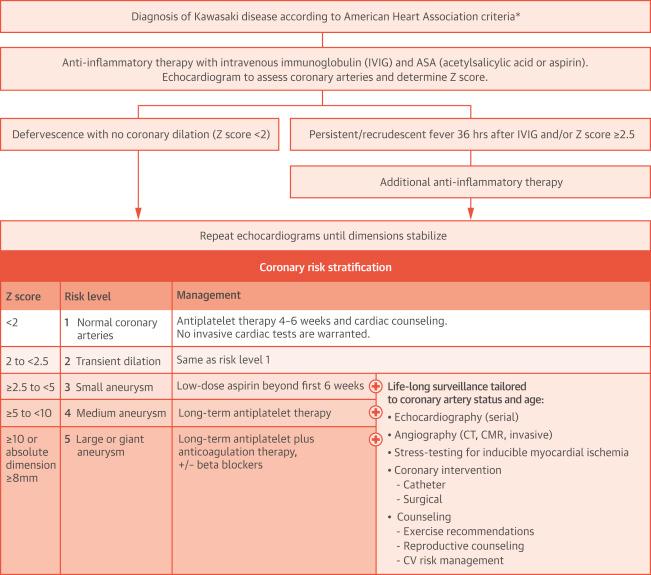
The following figure from Newburger et al. illustrates the comprehensive management algorithm from diagnosis through long-term risk-stratified follow-up:
Disposition
All patients with confirmed or suspected KD require hospital admission for IVIG infusion, monitoring, and echocardiography.
Admission criteria
- All patients meeting complete or incomplete KD criteria
- Unexplained prolonged fever in infants <6 months
- KD shock syndrome → ICU admission
Discharge criteria
- Afebrile ≥48 hours after IVIG completion
- Clinically improving, tolerating oral intake
- Echocardiogram obtained and follow-up plan established
- Parents educated on fever monitoring and return precautions
Specialist consultation triggers
- Pediatric cardiology: all confirmed/suspected KD cases for echocardiography [2]
- Pediatric rheumatology: IVIG-resistant or refractory KD, suspected MAS [2]
- Pediatric infectious disease: diagnostic uncertainty, concern for MIS-C or other mimics
Follow Up / Return Precautions
Follow-up timing
- 1–2 weeks post-discharge: repeat echocardiogram and clinical assessment [1]
- 4–6 weeks: echocardiogram if prior imaging abnormal; if all echos normal and patient responded to therapy, further cardiac follow-up may not be needed [1]
- Patients with CAA: follow-up per AHA risk stratification — ranges from annual to biannual cardiology visits with advanced imaging for those with persistent aneurysms [7][14]
Daily fever monitoring for 1–2 weeks post-discharge — parents should be instructed on proper temperature measurement and told to contact the physician immediately if fever recurs [2]
Return precautions — seek immediate care for
- Recurrence of fever (>38°C) after discharge → urgent echocardiogram needed [1-2]
- New rash, conjunctival injection, or mucocutaneous changes
- Chest pain, shortness of breath, or signs of heart failure
- Pallor, jaundice, dark urine (hemolytic anemia post-IVIG)
- Excessive irritability or lethargy
Patient/parent counseling
- KD is part of the child's permanent medical history — ensure it is documented [7]
- Low-dose aspirin continues for minimum 6–8 weeks; avoid ibuprofen while on aspirin
- Defer live vaccines (MMR, varicella) for 11 months after IVIG [1]
- Contact physician if child is exposed to influenza or varicella while on aspirin (Reye syndrome risk)
- Expected recovery: most children recover fully; periungual desquamation in weeks 2–3 is expected and not a sign of worsening
- Long-term: patients with no coronary involvement can be discharged from cardiology at 4–6 weeks; those with aneurysms require lifelong cardiology follow-up [7][14]
References
1. Update on Diagnosis and Management of Kawasaki Disease: A Scientific Statement From the American Heart Association. — Jone PN, Tremoulet A, Choueiter N, et al. Circulation. 2024.
2. 2021 American College of Rheumatology/Vasculitis Foundation Guideline for the Management of Kawasaki Disease. — Gorelik M, Chung SA, Ardalan K, et al. Arthritis & Rheumatology. 2022.
3. Intravenous Immunoglobulin for the Treatment of Kawasaki Disease. — Broderick C, Kobayashi S, Suto M, Ito S, Kobayashi T. The Cochrane Database of Systematic Reviews. 2023.
4. Kawasaki Disease: Contemporary Perspectives. — Day-Lewis M, Son MBF, Lo MS. The Lancet. Child & Adolescent Health. 2024.
5. Corticosteroids for the Treatment of Kawasaki Disease in Children. — Green J, Wardle AJ, Tulloh RM. The Cochrane Database of Systematic Reviews. 2022.
6. Kawasaki Disease and Multisystem Inflammatory Syndrome in Children: An Overview and Comparison. — Darby JB, Jackson JM. American Family Physician. 2021.
7. Diagnosis, Treatment, and Long-Term Management of Kawasaki Disease: A Scientific Statement for Health Professionals From the American Heart Association. — McCrindle BW, Rowley AH, Newburger JW, et al. Circulation. 2017.
8. Kawasaki Disease. — Newburger JW, Takahashi M, Burns JC. Journal of the American College of Cardiology. 2016.
9. Intravenous Immunoglobulin Alone for Coronary Artery Lesion Treatment of Kawasaki Disease: A Randomized Clinical Trial. — Kuo HC, Lin MC, Kao CC, et al. JAMA Network Open. 2025.
10. Randomized Trial of Adjunctive Prednisolone for Kawasaki Disease. — Lin S, He Y, He L, et al. The New England Journal of Medicine. 2026.
11. Risk Model Development and Validation for Prediction of Coronary Artery Aneurysms in Kawasaki Disease in a North American Population. — Son MBF, Gauvreau K, Tremoulet AH, et al. Journal of the American Heart Association. 2019.
12. Kawasaki Disease, Multisystem Inflammatory Syndrome in Children, and Adenoviral Infection: A Scoring System to Guide Differential Diagnosis. — Fabi M, Dondi A, Andreozzi L, et al. European Journal of Pediatrics. 2023.
13. Elevation of IL-17 Cytokines Distinguishes Kawasaki Disease From Other Pediatric Inflammatory Disorders. — Brodeur KE, Liu M, Ibanez D, et al. Arthritis & Rheumatology. 2024.
14. Falling Through the Cracks: The Current Gap in the Health Care Transition of Patients With Kawasaki Disease: A Scientific Statement From the American Heart Association. — Dahdah N, Kung SC, Friedman KG, et al. Journal of the American Heart Association. 2021.
Figure
More from Deep Dive
Reviewed by Dr. Lucas Mastropaolo. SymptomDx is an educational tool for medical professionals — it does not replace clinical judgment. Verify all clinical data and drug dosages with authoritative sources.