Large Bowel Obstruction
Large bowel obstruction is an abdominal emergency defined as interruption of the forward flow of intraluminal contents of the colon or rectum, accounting for 25–36% of all intestinal obstructions. [1-2] The three most common causes are colorectal cancer (most common overall), volvulus, and diverticulitis. [1][3] Unlike small bowel obstruction, approximately 75% of LBOs require surgical intervention during the same admission. [1] Mortality ranges from 5–14% depending on etiology and complications. [1][4-5]
History
- Onset and progression: Gradual vs. acute — malignant LBO typically has an insidious onset over days to weeks with progressive constipation and self-medication with OTC laxatives; volvulus may present more acutely [1][3]
- Cardinal symptoms: Obstipation (absence of flatus and stool — present in ~90%), abdominal pain (colicky → constant), abdominal distension, nausea/vomiting [5-6]
- Vomiting character: Late-onset and feculent vomiting suggests distal or long-standing obstruction; vomiting is less prominent in LBO than SBO [1]
- Timing: Duration of symptoms — hours (volvulus) vs. days to weeks (malignancy, stricture) [3]
- Bowel habit changes: Progressive narrowing of stool caliber, alternating constipation/diarrhea, hematochezia or melena (suggests malignancy) [7]
- Weight loss, anorexia: Suggests underlying malignancy or chronic process
- Prior episodes: Recurrent episodes of bloating/obstipation suggest volvulus or chronic stricture [3]
- Important negatives: Passage of flatus (argues against complete obstruction), bilious vs. feculent emesis, presence of diarrhea (overflow around partial obstruction)
Alarm Features
- Peritonitis: Guarding, rebound tenderness, rigidity — suggests perforation or ischemia → emergent surgery [1][5]
- Hemodynamic instability: Tachycardia, hypotension — suggests sepsis, perforation, or severe dehydration [1]
- Fever with leukocytosis: Concerning for bowel ischemia, necrosis, or perforation [6]
- Cecal diameter >9 cm on imaging: High risk of perforation per Laplace's law [1]
- Pneumatosis intestinalis or portal venous gas on CT: Signs of tissue ischemia with impending perforation [1]
- Closed-loop obstruction (competent ileocecal valve with distal obstruction): Rapid progression to ischemia and perforation [1]
- Feculent emesis: Indicates long-standing or complete distal obstruction [1]
- Rapidly worsening, constant pain replacing colicky pain: Suggests transition from simple obstruction to strangulation [1]
Medications
Contributing medications
- Opioids, anticholinergics, calcium channel blockers, iron supplements — can worsen constipation and contribute to pseudo-obstruction [3]
- Anticholinergics (oxybutynin, benztropine) should be discontinued in suspected pseudo-obstruction [3]
Acute treatment medications
- IV fluid resuscitation and electrolyte correction [1]
- Broad-spectrum antibiotics (gram-negative and anaerobic coverage) if fever, leukocytosis, or concern for ischemia/perforation [6]
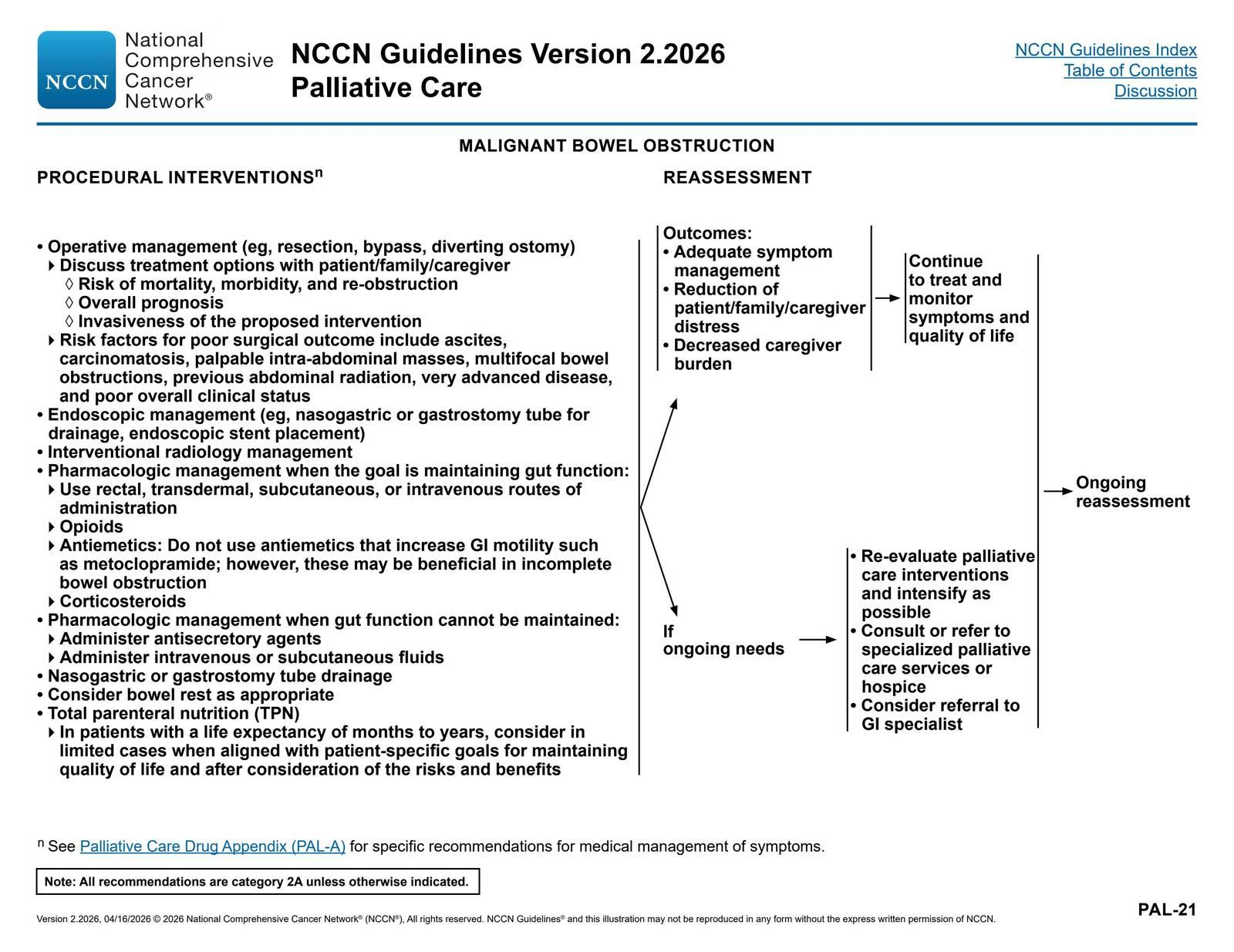
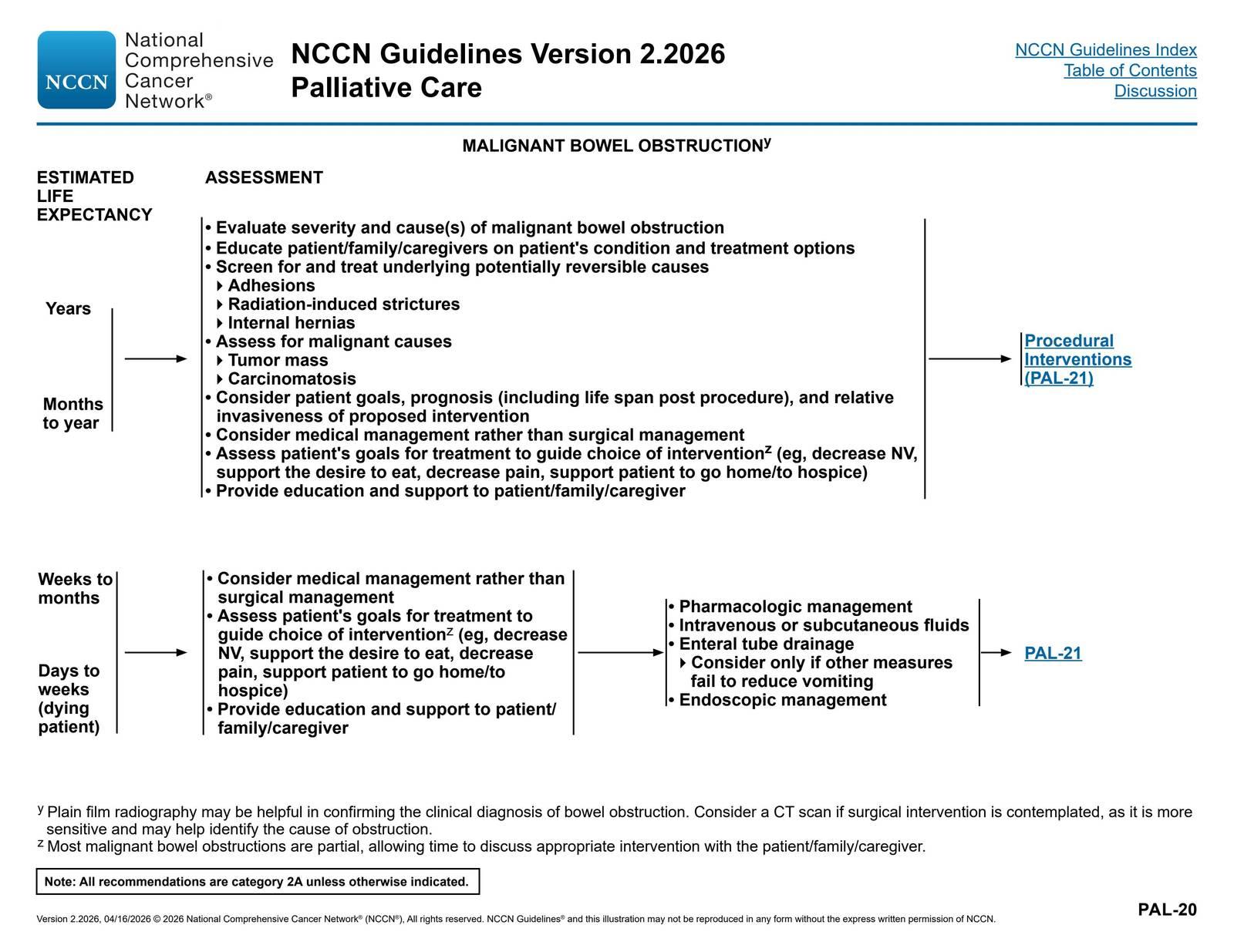
- Antiemetics — avoid prokinetics (metoclopramide) in complete obstruction; may be beneficial in partial obstruction [8]
- Opioids for pain — use judiciously; avoid excessive doses that worsen ileus
- Neostigmine 2 mg IV over 3–5 min — for acute colonic pseudo-obstruction (ACPO) refractory to conservative management; requires cardiac monitoring [2]
- Corticosteroids — considered in malignant bowel obstruction for edema reduction [8]
Contraindicated
- Laxatives and enemas in complete mechanical obstruction
- Barium contrast (use water-soluble contrast only) [1]
Diet
- NPO in acute setting — bowel rest is a cornerstone of initial management [1]
- Gradual reintroduction of clear liquids → low-residue diet after resolution
- Long-term: Low-residue diet in patients with strictures or partial obstruction; high-fiber diet may be beneficial for prevention of diverticular disease but should be avoided in acute obstruction
- Hydration: Aggressive IV hydration to correct dehydration from vomiting, third-spacing, and poor oral intake [1]
Review of Systems
- GI: Nausea, vomiting (character and timing), last bowel movement, last flatus, hematochezia, melena, change in stool caliber
- Constitutional: Fever, chills, weight loss, fatigue, anorexia
- GU: Urinary symptoms (pelvic mass effect), hematuria (fistula)
- Gynecologic: Pelvic masses, endometriosis (uncommon cause of LBO) [9]
- Neuropsychiatric: Cognitive impairment, psychiatric medications (risk factor for volvulus) [3]
Collateral History and Family History
- Collateral: Nursing home/institutional status (high risk for volvulus and pseudo-obstruction), baseline functional status, medication list, recent hospitalizations or surgeries [3]
- Family history: Colorectal cancer, Lynch syndrome, familial adenomatous polyposis, inflammatory bowel disease [7]
- Social context: Chronic constipation, laxative dependence, immobility, dietary habits
Risk Factors
- Colorectal cancer: Age >50, family history of CRC, personal history of polyps, IBD, obesity, smoking, processed meat consumption [7]
- Volvulus: Advanced age, neuropsychiatric disorders, institutionalization, chronic constipation, redundant sigmoid colon, diabetes, prior abdominal surgery [2-3]
- Diverticular stricture: History of recurrent diverticulitis, prior pelvic radiation [10-11]
- Pseudo-obstruction (Ogilvie syndrome): Recent surgery/trauma, hospitalization, electrolyte abnormalities, opioid/anticholinergic use, sepsis, cardiac disease [3]
- General: Prior abdominal/pelvic surgery (adhesions — rare cause of LBO), prior radiation therapy, inflammatory bowel disease [1]
Differential Diagnosis
- Colorectal carcinoma — most common cause of mechanical LBO in adults (~60%) [1][3]
- Sigmoid volvulus — "coffee bean" sign on AXR; more common in elderly, institutionalized patients [3]
- Cecal volvulus — younger patients, female predominance; requires surgical management [2]
- Diverticular stricture — history of recurrent diverticulitis; can be difficult to distinguish from malignancy [10-11]
- Acute colonic pseudo-obstruction (Ogilvie syndrome) — no mechanical cause on imaging; critical to differentiate as treatment is medical, not surgical [1][3]
- Fecal impaction — especially in elderly, immobile, or opioid-dependent patients
- Incarcerated hernia — inguinal, incisional, or internal; highest risk of strangulation [5]
- Inflammatory bowel disease (Crohn's stricture) — rare in colon; should prompt suspicion for malignancy [1]
- Extrinsic compression — pelvic tumors (ovarian, uterine), peritoneal carcinomatosis, endometriosis [9][12]
- Ischemic colitis with stricture — history of vascular disease, watershed distribution [9]
Past Medical History
- Prior colorectal cancer, polyps, or cancer screening history
- History of diverticulitis or diverticular disease
- Prior abdominal/pelvic surgery (adhesions, anastomotic stricture)
- Prior abdominal/pelvic radiation
- Inflammatory bowel disease
- Neuropsychiatric conditions (risk for volvulus)
- Chronic constipation and laxative use
- Hernia history
Physical Exam
Vital signs
- Tachycardia, hypotension (dehydration, sepsis, perforation)
- Fever (ischemia, perforation, infection)
Abdominal exam
- Distension — often marked and diffuse (most common finding, ~65%) [5]
- Tympany to percussion [6][13]
- Bowel sounds — initially high-pitched and hyperactive, progressing to absent [6][13]
- Tenderness — diffuse vs. localized; peritoneal signs (guarding, rebound, rigidity) indicate ischemia or perforation [1]
- Visible peristalsis in thin patients
Focused maneuvers
- Digital rectal exam: Empty rectal vault (classic in volvulus), rectal mass, blood on glove, fecal impaction [3]
- Hernia exam: Inguinal, femoral, incisional, and umbilical hernias — assess for incarceration
- Abdominal wall skin changes: Erythema overlying hernia suggests strangulation [1]
Lab Studies
- CBC: Leukocytosis with neutrophil predominance — concerning for ischemia/sepsis [1][6]
- BMP/CMP: Electrolyte derangements (hypokalemia, hypochloremia from vomiting), prerenal azotemia (elevated BUN/Cr), metabolic alkalosis [1]
- Serum lactate: Elevated in bowel ischemia — though may be falsely normal in closed-loop obstruction [1]
- VBG: Acid-base status assessment [1]
- Coagulation profile [1]
- Type and screen if surgical intervention anticipated
- CEA: Low sensitivity for primary CRC diagnosis (~46%); not useful acutely but may be drawn for baseline if malignancy suspected [7]
- Blood cultures if sepsis suspected
Imaging
First-line: Abdominal radiograph (upright and supine) — often the initial study; may show dilated colon (>6 cm, cecum >9 cm), air-fluid levels, absence of rectal gas [14]
Gold standard: CT abdomen/pelvis with IV contrast — imaging modality of choice [1][9][14]
- Sensitivity 90–96%, specificity ~91% for mechanical LBO [1][15-16]
- Identifies transition point, etiology (mass, volvulus, stricture), and complications
- Key findings: transition point ± mass, "whirl sign" (volvulus), pneumatosis intestinalis, portal venous gas, free fluid, pneumoperitoneum [1][3][9]
- Differentiates mechanical LBO from pseudo-obstruction [9][14]
Adjunctive
- Water-soluble contrast enema — "bird's beak" sign in volvulus; can confirm or exclude LBO when CT is equivocal [3][14]
- Avoid barium in suspected obstruction or perforation [1]
When imaging is unnecessary: Imaging should not delay surgery in patients with peritonitis or hemodynamic instability [1]
Special Tests
- Colonoscopy: Diagnostic and potentially therapeutic — can localize lesions, obtain biopsies, place stents, and perform endoscopic detorsion of sigmoid volvulus; not recommended in unstable patients or those with peritonitis [1-2]
- Neostigmine challenge: For ACPO — 2 mg IV over 3–5 min with cardiac monitoring (risk of bradycardia); success rate ~80–90% [2]
- Water-soluble contrast enema: Therapeutic and diagnostic in partial obstruction
ECG
- Indications: Baseline ECG in elderly patients, pre-operative assessment, and before neostigmine administration (risk of symptomatic bradycardia) [2]
- Relevant findings: Electrolyte-related changes — peaked T waves or U waves (hypo/hyperkalemia), QT prolongation (hypomagnesemia, hypocalcemia)
- Pre-neostigmine: Must have cardiac monitoring; atropine at bedside
Assessment
Clinical summary: LBO is a surgical emergency until proven otherwise. The majority are caused by colorectal cancer (most common), volvulus, and diverticulitis. [1][3] Critical early decisions include distinguishing mechanical obstruction from pseudo-obstruction and identifying signs of ischemia, perforation, or closed-loop obstruction.
Severity stratification
- Simple/partial obstruction: Some passage of gas/stool, no signs of ischemia
- Complete obstruction: No passage of flatus or stool, progressive distension
- Complicated obstruction: Evidence of ischemia, necrosis, perforation, or closed-loop physiology — requires emergent surgery [5]
Complications
- Bowel ischemia (~14%), necrosis (~9%), perforation (~5%) [5]
- Sepsis, multiorgan failure
- Cecal perforation (highest risk when diameter >9–12 cm) [1-2]
- Aspiration from feculent vomiting
Treatment Plan
Initial stabilization ("suck and drip"): [1]
- NPO, nasogastric tube decompression
- Aggressive IV fluid resuscitation
- Electrolyte correction
- Foley catheter for urine output monitoring
- Broad-spectrum antibiotics if signs of infection/ischemia
Etiology-specific definitive management
- Malignant obstruction:
- Emergent surgery if peritonitis, perforation, or hemodynamic instability [1]
- Colonic stenting as bridge to surgery (conditionally recommended by EAST guidelines) — allows bowel prep and single-stage elective resection; primarily for left-sided obstructions [17]
- Palliative stenting for unresectable disease [8]
- Standard oncologic resection when feasible [1]
- Sigmoid volvulus:
- Endoscopic detorsion (flexible sigmoidoscopy) as initial treatment in uncomplicated cases, with decompression tube placement [2]
- Surgical consultation during index admission — high recurrence rate without definitive surgery [2]
- Emergent surgery if peritonitis, perforation, or failed endoscopic reduction [2]
- Cecal volvulus:
- Surgical management[2]
- Pseudo-obstruction (Ogilvie syndrome):
- Diverticular stricture:
Disposition
Admission criteria (all patients with confirmed LBO should be admitted): [1]
- Complete mechanical LBO — surgical admission
- Partial LBO with inability to tolerate oral intake
- Any signs of ischemia, perforation, or hemodynamic compromise — ICU consideration
- Pseudo-obstruction requiring monitoring and potential neostigmine
Observation indications
Specialist consultation triggers
- Surgery — all confirmed mechanical LBOs [1]
- GI/Endoscopy — sigmoid volvulus for endoscopic detorsion, stent placement, pseudo-obstruction management [2]
- Oncology — if malignancy identified or suspected
- Interventional radiology — percutaneous drainage of abscess, cecostomy in select cases
Discharge criteria: LBO patients are generally not discharged from the ED. Discharge is only appropriate if obstruction is definitively ruled out.
Follow Up / Return Precautions
Post-discharge (after resolution/surgery)
- Surgical follow-up within 1–2 weeks
- If malignancy identified: oncology referral and staging workup
- After sigmoid volvulus detorsion: semi-elective sigmoid colectomy recommended during same admission or within weeks to prevent recurrence [2-3]
- Colonoscopy for cancer screening if not recently performed and obstruction has resolved
Return precautions — instruct patients to return immediately for:
- Recurrence of abdominal distension, pain, or inability to pass gas/stool
- Fever, chills, or rigors
- Persistent vomiting
- Bloody stool
- Lightheadedness, dizziness, or fainting
Expected recovery
- Post-operative ileus typically resolves in 3–5 days
- Full recovery from uncomplicated resection: 4–6 weeks
- Patients with stomas require ostomy education and follow-up
Images
References
1. Gastrointestinal Surgical Emergencies Textbook. — Ashley E. Aaron, Andrea Amabile, Ciro Andolfi, et al American College of Surgeons (2021). 2021.
2. American Society for Gastrointestinal Endoscopy Guideline on the Role of Endoscopy in the Management of Acute Colonic Pseudo-Obstruction and Colonic Volvulus. — Naveed M, Jamil LH, Fujii-Lau LL, et al. Gastrointestinal Endoscopy. 2020.
3. The American Society of Colon and Rectal Surgeons Clinical Practice Guidelines for the Management of Colonic Volvulus and Acute Colonic Pseudo-Obstruction. — Alavi K, Poylin V, Davids JS, et al. Diseases of the Colon and Rectum. 2021.
4. Etiology, Clinical Profile, Management, and Outcomes of Intestinal Obstruction in a Resource-Limited Setting: A Prospective Study. — Alashaby SS, Gilan WM, Al-Absy TA, Al-Magedi AAS. Scientific Reports. 2026.
5. Acute Mechanical Bowel Obstruction: Clinical Presentation, Etiology, Management and Outcome. — Markogiannakis H, Messaris E, Dardamanis D, et al. World Journal of Gastroenterology. 2007.
6. Intestinal Obstruction: Evaluation and Management. — Jackson P, Vigiola Cruz M. American Family Physician. 2018.
7. Colorectal Cancer. — Eng C, Yoshino T, Ruíz-García E, et al. Lancet. 2024.
8. Palliative Care. — Updated 2026-04-16. National Comprehensive Cancer Network.
9. Large-Bowel Obstruction: CT Findings, Pitfalls, Tips and Tricks. — Verheyden C, Orliac C, Millet I, Taourel P. European Journal of Radiology. 2020.
10. The Diagnosis of Colonic Obstruction. — Jackson BR. Diseases of the Colon and Rectum. 1982.
11. Diverticular Disease of the Colon. — Stollman N, Raskin JB. Lancet. 2004.
12. Imaging of Uncommon Causes of Large-Bowel Obstruction. — Somwaru AS, Philips S. AJR. American Journal of Roentgenology. 2017.
13. Evaluation and Management of Intestinal Obstruction. — Jackson PG, Raiji MT. American Family Physician. 2011.
14. Large-Bowel Obstruction in the Adult: Classic Radiographic and CT Findings, Etiology, and Mimics. — Jaffe T, Thompson WM. Radiology. 2015.
15. From Obstruction to Ischaemia: A Systematic Review and Meta-Analysis on the Diagnostic Accuracy of CT Scans in Identifying Small and Large Bowel Obstruction, Underlying Causes and Predicting Critical Complications in Adults. — Ahmad SJS, Drvaric I, Ahmed AR, et al. BMJ Open. 2025.
16. Computed Tomography in the Assessment of Suspected Large Bowel Obstruction. — Beattie GC, Peters RT, Guy S, Mendelson RM. ANZ Journal of Surgery. 2007.
17. Surgery or Stenting for Colonic Obstruction: A Practice Management Guideline From the Eastern Association for the Surgery of Trauma. — Ferrada P, Patel MB, Poylin V, et al. The Journal of Trauma and Acute Care Surgery. 2016.
Figures
More from Deep Dive
Reviewed by Dr. Lucas Mastropaolo. SymptomDx is an educational tool for medical professionals — it does not replace clinical judgment. Verify all clinical data and drug dosages with authoritative sources.