Septic Arthritis
Septic arthritis is an orthopedic emergency caused by bacterial infection of a joint space, most commonly via hematogenous spread. Staphylococcus aureus is the most common pathogen, followed by Streptococcus species.[1-2] Incidence is 4–29 per 100,000 person-years, with rising trends over time.[1][3] Irreversible cartilage destruction and permanent joint dysfunction can occur if antibiotics are not initiated within 24–48 hours of onset.[1] The 90-day mortality rate is approximately 7%, rising to 22–69% in patients ≥80 years.[1][4]
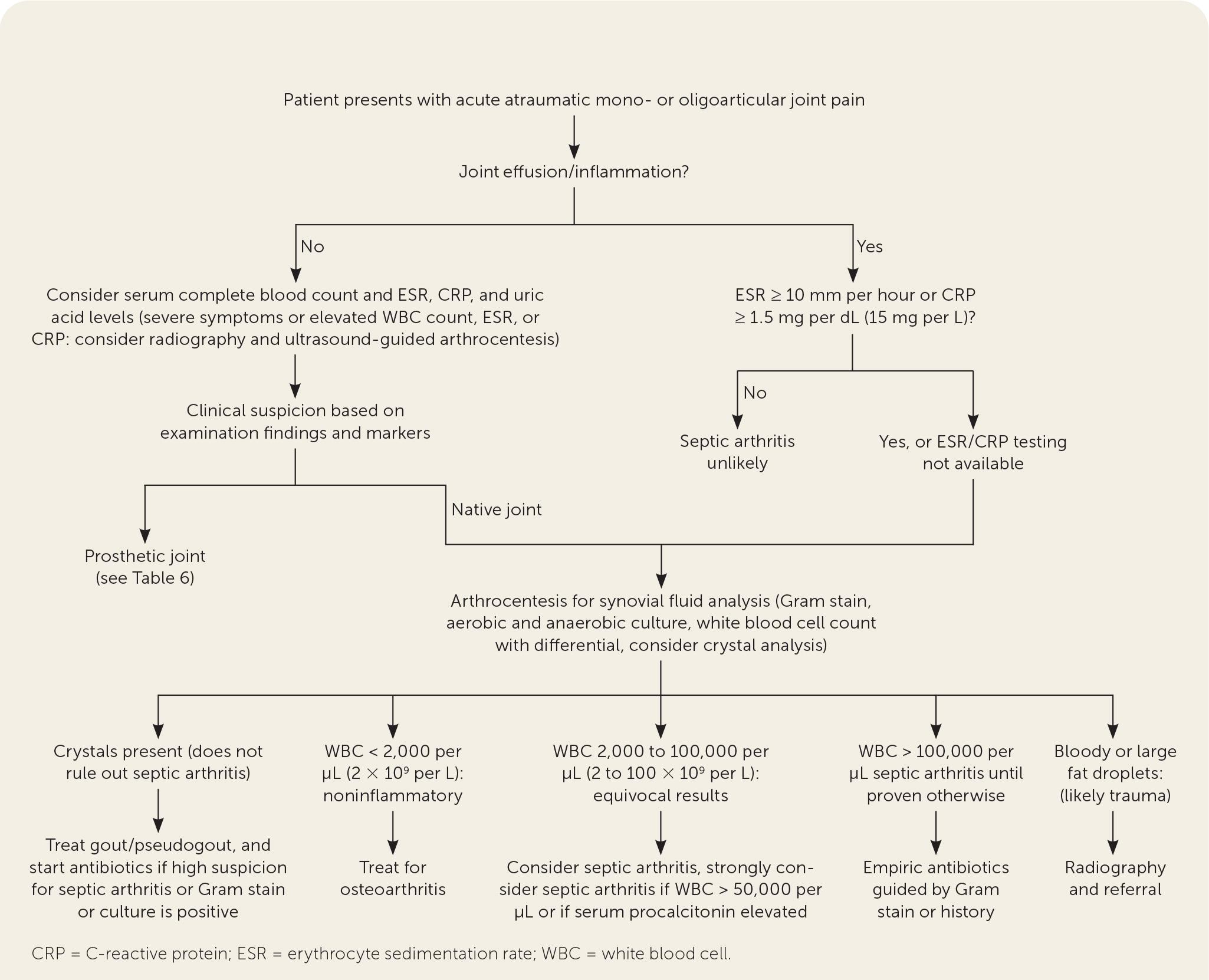
The following diagnostic algorithm outlines the approach to differentiating septic arthritis from other causes of acute mono- or oligoarthropathy:
History
- Onset and timing: Acute onset (hours to days) of atraumatic joint pain, swelling, and decreased range of motion; rapid progression is typical[1][5]
- Symptom characterization: Joint pain (sensitivity 85%), joint swelling (sensitivity 78%), fever (sensitivity 57%); sweats (27%) and rigors (19%) are less common[6]
Key HPI questions
- Which joint(s)? Monoarticular in ~80%; knee most common, followed by hip, shoulder, ankle, elbow, wrist[1]
- Any recent joint surgery, arthroscopy, injection, or arthrocentesis? (LR 6.9 for recent joint surgery)[6]
- Any skin wounds, cellulitis, or ulcers overlying the joint?[7]
- IV drug use? Sexual history (gonococcal arthritis in young adults)?[1-2]
- Recent bacteremia, UTI, or GI infection as a potential hematogenous source?[1]
- Tick exposure or travel to Lyme-endemic areas?[1]
- Important negatives: Absence of trauma, absence of crystal arthritis history, no recent gout flare
Alarm Features
- Sepsis or septic shock (tachycardia, hypotension, altered mental status) — do not delay antibiotics for arthrocentesis[8]
- Hip or shoulder involvement — higher rates of surgical intervention (~50%) and higher mortality[1][9]
- Oligoarticular (multiple joint) involvement — associated with higher mortality and more systemic illness[1]
- Confusion on admission — independent risk factor for mortality[10]
- Bacteremia with positive blood cultures — consider echocardiography for endocarditis, especially with S. aureus, oral streptococci, or enterococci[11-12]
- Grossly purulent synovial fluid — immediate surgical drainage should be considered[8]
- Immunocompromised patients — may present subtly with lower WBC counts and atypical organisms[1][13]
Medications
Relevant contributors
- Immunosuppressants (corticosteroids, DMARDs, anti-TNF agents — incidence 4.2/1,000 patient-years with anti-TNF vs. 1.8 with nonbiologic DMARDs)[1]
- Recent intra-articular corticosteroid injection (risk ~4 per 10,000 injections)[7]
Empiric treatment (adults)
- Gram-positive cocci on Gram stain → vancomycin or daptomycin ± cephalosporin/carbapenem/fluoroquinolone; alternative: oral clindamycin + fluoroquinolone[1]
- Gram-negative cocci → ceftriaxone (consider gonococcal)[1]
- Gram-negative rods → ceftazidime, cefepime, piperacillin-tazobactam, or carbapenem[1]
- Negative Gram stain with high suspicion → vancomycin + ceftazidime or aminoglycoside[1]
- Oral antibiotics are not inferior to IV when started within one week of surgery/arthrocentesis[1]
- Duration: 2–6 weeks depending on organism and joint; MRSA requires drainage + 3–4 weeks total[1]
- Contraindicated: Do not use intra-articular corticosteroids in suspected septic arthritis; adjunctive systemic corticosteroids are not recommended[8]
Diet
- No specific dietary triggers or recommendations unique to septic arthritis
- Hydration is important in the setting of sepsis and antibiotic therapy
- Adequate nutrition supports immune function and wound healing during prolonged treatment courses
Review of Systems
- Constitutional: Fever, chills, rigors, night sweats, malaise, weight loss
- Musculoskeletal: Pain with any joint movement, inability to bear weight, joint stiffness
- Skin: Overlying erythema, warmth, wounds, cellulitis, ulcers, rashes (disseminated gonococcal infection presents with dermatitis-arthritis syndrome)
- GU: Urethral discharge, dysuria (gonococcal source); urinary symptoms (gram-negative bacteremia source)
- Cardiac: New murmur, dyspnea (endocarditis screening)[12]
- Neurologic: Focal deficits (septic emboli if endocarditis present)[14]
Collateral History and Family History
- Collateral: Confirm timeline of symptom onset, recent procedures, medication compliance (immunosuppressants), IV drug use, sexual contacts
- Family history: Generally not a major contributor; however, hereditary conditions predisposing to gout (a key mimic) or rheumatoid arthritis may be relevant
- Social context: IV drug use, alcohol abuse, homelessness/low socioeconomic status, nursing home residence (MRSA risk)[7]
Risk Factors
- Export Risk Factor Likelihood Ratio / Notes References Recent joint surgery LR 6.9 (95% CI 3.8–12.0)[1]
- Skin infection + joint prosthesis LR 15.0 (95% CI 8.1–28.0)[1]
- Hip or knee prosthesis LR 3.1 (95% CI 2.0–4.9)[1]
- Age >80 years LR 3.5 (95% CI 1.8–7.0)[1]
- Skin infection LR 2.8 (95% CI 1.7–4.5)[1]
- Diabetes mellitus LR 2.7 (95% CI 1.0–6.9); OR 4.4 for complicated DM[1-2]
- Rheumatoid arthritis LR 2.5 (95% CI 2.0–3.1); OR 4.7[1-2]
- Hemodialysis ~500/100,000 patients[3]
- IV drug use / substance abuse OR 4.5[2]
- Immunosuppression (anti-TNF, steroids) Increased incidence[4]
- Tobacco smoking Increased risk[4]
- Low socioeconomic status Increased risk[4]
Differential Diagnosis
- Crystal arthropathies (gout, pseudogout) — most common mimic; crystals on polarized microscopy, but crystals do NOT exclude coexisting septic arthritis[1][15]
- Reactive arthritis — post-infectious, typically sterile joint; history of preceding GI or GU infection
- Rheumatoid arthritis flare — particularly dangerous overlap; RA patients are at high risk for septic arthritis[1]
- Cellulitis / periarticular abscess — overlying soft tissue infection without true intra-articular involvement[5]
- Osteomyelitis — contiguous or hematogenous; MRI differentiates; may coexist with septic arthritis[1]
- Lyme arthritis — endemic areas, knee most common, less acute/toxic appearance, serology + PCR[1][8]
- Gonococcal arthritis — young, sexually active patients; migratory polyarthralgia, tenosynovitis, dermatitis[1-2]
- Transient synovitis — primarily pediatric (hip); Kocher criteria help differentiate[16]
- Avascular necrosis — insidious onset, risk factors (steroids, alcohol, sickle cell)
- Hemarthrosis — trauma or coagulopathy; bloody aspirate
- Malignancy — atypical presentation, chronic course
Past Medical History
- Key conditions: Rheumatoid arthritis, osteoarthritis, gout/pseudogout, diabetes, chronic kidney disease, liver cirrhosis, malignancy, HIV[7][17]
- Previous episodes of septic arthritis or joint infections
- Surgical history: Prior joint surgery, arthroplasty, arthroscopy, recent intra-articular injections
- Prosthetic joints — periprosthetic joint infection has a more subtle presentation[1]
Physical Exam
- Vital signs: Fever (present in ~57%; often low-grade), tachycardia, hypotension if septic[6]
Joint exam
- Severely painful joint with any passive or active motion — most sensitive finding[18]
- Obvious effusion, warmth, erythema, swelling
- Limited range of motion
- Inability to bear weight (especially hip/knee)
- Skin: Inspect for overlying cellulitis, wounds, ulcers, injection sites, track marks, gonococcal skin lesions (pustules on erythematous base)
- Subtle presentations: Periprosthetic infections, small joint infections, immunosuppressed patients, and atypical organisms (fungal, TB, Lyme) may lack classic inflammatory signs[1]
- Cardiac: Auscultate for new murmurs (endocarditis)[14]
- Spine: Assess for tenderness (vertebral osteomyelitis as concurrent source)[14]
Lab Studies
- Export Test Expected Findings / Utility References Synovial fluid WBC count >50,000/μL suggestive (LR 7.7); >100,000/μL highly suggestive (LR 28); lower counts do NOT exclude SA[1-2]
- Synovial fluid %PMN ≥90% suggests SA (LR 3.4)[1]
- Synovial fluid Gram stain Positive in ~50% of bacterial SA; guides empiric therapy[2-3]
- Synovial fluid culture (aerobic + anaerobic blood culture bottles) Gold standard for pathogen identification[2]
- Crystal analysis Rule out gout/pseudogout; crystals do NOT exclude SA[3]
- Serum CRP ≥2.0 mg/dL: 92% sensitive; useful for ruling out and monitoring[3]
- Serum ESR ≥15 mm/hr: 94% sensitive[3]
- Procalcitonin ≥0.5 ng/mL: higher specificity than CRP (LR+ 10.97)[3]
- Blood cultures Obtain before antibiotics; positive in sporadic cases; essential if bacteremia suspected[2]
- CBC WBC often elevated but nonspecific[2]
- BMP/Cr Assess renal function (prognostic, dosing)[4]
- Synovial fluid lactate, LDH, glucose Emerging composite score: low glucose, high lactate, high LDH support SA diagnosis[5]
- Multiplex PCR (synovial fluid) At least as effective as culture with faster turnaround (~5 hrs); essential for K. kingae in children[2-3]
- Pearl: If antibiotics were given before arthrocentesis, the optimal synovial WBC cutoff drops to >16,000 cells/μL (sensitivity 82%, specificity 76%) vs. >33,000 in antibiotic-naïve patients.[20]
Imaging
- Plain radiography: First-line; establishes baseline, rules out fracture, may show soft tissue swelling or joint space widening; no pathognomonic findings for SA in adults[1]
- Ultrasound: Detects joint effusion (sensitivity 81% overall); guides arthrocentesis for deep joints (hip) and small joints[1][8]
- MRI (with and without contrast): Best for assessing concurrent osteomyelitis, soft tissue abscess, and extent of synovial inflammation; sensitivity 83%, specificity ≥93% for differentiating SA from transient synovitis at the hip[1][8]
- CT: Limited role; uncertain accuracy; radiation exposure; may be used when MRI is unavailable[8]
- When imaging is unnecessary: If clinical suspicion is high and the joint is accessible, proceed directly to arthrocentesis — imaging should not delay diagnosis or treatment[21]
Special Tests
- Kocher Criteria (pediatric hip): Fever >101.3°F, ESR ≥40, WBC ≥12,000, inability to bear weight — meeting all 4 criteria approaches 99% probability of SA[16]
- Modified Kocher Criteria: Addition of CRP >2.0 mg/dL improves diagnostic accuracy[16]
Gächter Classification (arthroscopic staging)
- Stage I: Opaque fluid, synovial erythema
- Stage II: Fibrinous deposits, purulent material
- Stage III: Synovial thickening, compartment formation
- Stage IV: Aggressive pannus, cartilage/subchondral bone erosion
- Stages III–IV predict treatment failure with arthroscopy alone and may require more aggressive debridement[22-23]
- Synovial fluid NLR (neutrophil-to-lymphocyte ratio): Threshold of 25 has 78% sensitivity and 81% specificity — more accurate than traditional WBC >50,000 cutoff[24]
- Bedside ultrasound: Point-of-care detection of effusion and guided aspiration
ECG
- ECG is not routinely indicated for isolated septic arthritis
Obtain ECG if
- Sepsis or septic shock is present — common ECG abnormalities include sinus tachycardia (39%), atrial fibrillation/flutter (8.8%), and QT prolongation (54.4% in sepsis patients)[25]
- Concern for endocarditis (S. aureus bacteremia) — new conduction abnormalities may suggest perivalvular abscess[14]
- Demand ischemia in elderly or comorbid patients with sepsis[26]
- Dangerous patterns: New atrial fibrillation/flutter (OR 2.19 for poor outcomes), QT prolongation, ST changes in the setting of sepsis[25]
Assessment
- Clinical summary: Septic arthritis is an acute monoarticular (occasionally oligoarticular) infection requiring emergent diagnosis via arthrocentesis and prompt antibiotic therapy. The most common pathogen is S. aureus across all age groups.[1-2]
Severity stratification
- Low risk: Single small joint, young patient, no comorbidities, rapid presentation
- High risk: Hip/shoulder involvement, age ≥65, oligoarticular, bacteremia, immunosuppression, MRSA, delayed presentation[1][9]
- Atypical presentations: Immunosuppressed patients, periprosthetic infections, fungal/TB/Lyme arthritis — may lack fever, have lower synovial WBC counts, and follow an indolent course[1]
- Complications: Cartilage destruction, osteomyelitis, joint ankylosis, need for arthroplasty (~9% at 15 years), amputation (0.4% at 1 year), endocarditis (3.7% of SA patients), death[1][4][12]
- Mortality: 90-day mortality ~7% overall; 1-year mortality 11–17%; significantly higher with age ≥80, chronic renal disease (OR 2.80), malignancy (OR 3.40), and heart failure (OR 2.62)[1][3][17]
Treatment Plan
Initial stabilization
- IV access, fluid resuscitation if septic, pain management
- Arthrocentesis before antibiotics when feasible; do not delay antibiotics in septic/toxic patients[8][21]
Empiric antibiotics (adults)
- Vancomycin (MRSA coverage) + 3rd/4th-generation cephalosporin (gram-negative coverage) is a common ED regimen[1][22]
- Narrow based on Gram stain, then culture/sensitivity results
- Oral step-down (e.g., clindamycin + fluoroquinolone) is non-inferior to prolonged IV therapy[1]
Duration
- Nongonococcal: 2–6 weeks (at least 2 weeks for small joints; commonly 4–6 weeks for large joints)[1]
- MRSA: Drainage + 3–4 weeks total[1]
- Gonococcal: IV ceftriaxone → oral switch after 2 days, ≥7 days total[1]
- Pediatric (uncomplicated): 10–14 days with monitoring of CRP[8][27]
Joint drainage
- Arthrocentesis (serial aspirations) vs. arthroscopic lavage vs. open arthrotomy[1][23]
- Cohort studies suggest medical management (antibiotics + serial aspirations) is not inferior to surgical management, but ~30% ultimately require surgery[1]
- Hip and shoulder infections more often require surgical drainage (~50%)[1]
- Grossly purulent fluid or Gächter stage III–IV → consider early surgical intervention[8][23]
- Echocardiography: Indicated for S. aureus, oral streptococci, S. gallolyticus, or E. faecalis bacteremia, or when endocarditis is clinically suspected[11]
Disposition
Admission criteria
- All confirmed or highly suspected septic arthritis cases require admission for IV antibiotics, joint drainage, and monitoring[1][5]
- Sepsis, hemodynamic instability → ICU
- Need for surgical intervention (hip/shoulder involvement, failed aspiration, Gächter III–IV)
- Orthopedic surgery consultation: Obtain early for all cases; urgent for hip, shoulder, prosthetic joints, and failed medical management[5][22]
- Infectious disease consultation: Recommended for culture-directed therapy, MRSA, atypical organisms, prosthetic joint infections[21]
- Discharge criteria: Septic arthritis is not a discharge diagnosis from the ED; patients require inpatient management until clinical improvement, culture results, and transition to oral therapy are established
Follow Up / Return Precautions
Follow-up timing
- Orthopedics: 1–2 weeks post-discharge for wound/joint reassessment
- Infectious disease: Within 1–2 weeks for antibiotic management and duration decisions
- Primary care: 2–4 weeks; monitor CRP trending to normalization[21]
Symptoms requiring immediate reassessment
- Recurrent fever, worsening joint pain/swelling, new joint involvement
- Signs of sepsis (confusion, tachycardia, hypotension)
- Wound drainage or erythema at surgical/aspiration site
Patient counseling
- Complete the full antibiotic course; do not stop early even if feeling better
- Early physical therapy and range-of-motion exercises are important to prevent stiffness and functional loss[11]
- Poor functional outcomes (amputation, arthrodesis, arthroplasty, severe deterioration) occur in 24–33% of patients, particularly with older age and preexisting joint disease[1]
- Expected recovery: Clinical improvement typically within 48–72 hours of appropriate therapy; CRP should trend downward within the first week; full recovery may take weeks to months depending on severity and joint involved
References
1. Septic Arthritis: Diagnosis and Treatment. — Earwood JS, Walker TR, Sue GJC. American Family Physician. 2021.
2. Guide to Utilization of the Microbiology Laboratory for Diagnosis of Infectious Diseases: 2024 Update by the Infectious Diseases Society of America (IDSA) and the American Society for Microbiology (ASM). — Miller JM, Binnicker MJ, Campbell S, et al. Clinical Infectious Diseases : An Official Publication of the Infectious Diseases Society of America. 2024.
3. Longitudinal Incidence of Native Septic Arthritis in France: A 13-Year Analysis of the National Health Data System Database. — Couderc M, Gomez S, Mathieu S, et al. Rheumatology. 2026.
4. Mortality and Adverse Joint Outcomes Following Septic Arthritis of the Native Knee: A Longitudinal Cohort Study of Patients Receiving Arthroscopic Washout. — Abram SGF, Alvand A, Judge A, Beard DJ, Price AJ. The Lancet. Infectious Diseases. 2020.
5. Evaluation and Management of Septic Arthritis and Its Mimics in the Emergency Department. — Long B, Koyfman A, Gottlieb M. The Western Journal of Emergency Medicine. 2019.
6. Does This Adult Patient Have Septic Arthritis?. — Margaretten ME, Kohlwes J, Moore D, Bent S. The Journal of the American Medical Association. 2007.
7. Bacterial Septic Arthritis in Adults. — Mathews CJ, Weston VC, Jones A, Field M, Coakley G. Lancet. 2010.
8. Acute Bacterial Arthritis in Children: Guidelines From the Pediatric Infectious Diseases Society and Infectious Diseases Society of America. — Jobi-Odeneye AO. American Family Physician. 2024.
9. Site-Specific Mortality in Native Joint Septic Arthritis: A National Population Study. — Huang YC, Ho CH, Lin YJ, et al. Rheumatology. 2020.
10. Morbimortality in Adult Patients With Septic Arthritis: A Three-Year Hospital-Based Study. — Ferrand J, El Samad Y, Brunschweiler B, et al. BMC Infectious Diseases. 2016.
11. 2020 French Recommendations on the Management of Septic Arthritis in an Adult Native Joint. — Couderc M, Bart G, Coiffier G, et al. Joint Bone Spine. 2020.
12. Clinical Features of Patients With Septic Arthritis and Echocardiographic Findings of Infective Endocarditis. — Lieber SB, Tishler O, Nasrullah K, et al. Infection. 2019.
13. Assessment for Septic Arthritis in Immunocompetent and Immunocompromised Patients: A Single-Institution Study. — Brown CR, Samade R, Turnquist E, et al. The Journal of the American Academy of Orthopaedic Surgeons. 2022.
14. Management of Staphylococcus aureus Bacteremia. — Tong SYC, Fowler VG, Skalla L, Holland TL. The Journal of the American Medical Association. 2025.
15. Gout. — Dalbeth N, Gosling AL, Gaffo A, Abhishek A. Lancet. 2021.
16. ACR Appropriateness Criteria® Osteomyelitis or Septic Arthritis-Child (Excluding Axial Skeleton). — Shet NS, Iyer RS, Chan SS, et al. Journal of the American College of Radiology : JACR. 2022.
17. Survival and Risk Factor Analysis in Patients With Septic Arthritis: A Retrospective Study of 192 Cases. — Schindler M, Huber L, Walter N, et al. BMC Infectious Diseases. 2025.
18. Current Approach to the Evaluation and Management of Septic Arthritis. — Gottlieb M, Holladay D, Rice M. Pediatric Emergency Care. 2019.
19. A New Biochemical Score From Synovial Fluid for Diagnosing Septic Arthritis. — Sacco I, Saadan C, Pina Vegas L, et al. Joint Bone Spine. 2026.
20. Optimal Synovial Fluid Leukocyte Count Cutoff for Diagnosing Native Joint Septic Arthritis After Antibiotics: A Receiver Operating Characteristic Analysis of Accuracy. — Massey PA, Clark MD, Walt JS, et al. The Journal of the American Academy of Orthopaedic Surgeons. 2021.
21. Current Concepts in Pediatric Septic Arthritis. — Erkilinc M, Gilmore A, Weber M, Mistovich RJ. The Journal of the American Academy of Orthopaedic Surgeons. 2021.
22. Bacterial Septic Arthritis of the Adult Native Knee Joint: A Review. — Elsissy JG, Liu JN, Wilton PJ, et al. JBJS Reviews. 2020.
23. Efficacy of Arthroscopic Treatment for Resolving Infection in Septic Arthritis of Native Joints. — Aïm F, Delambre J, Bauer T, Hardy P. Orthopaedics & Traumatology, Surgery & Research : OTSR. 2015.
24. Synovial Fluid and Serum Neutrophil-to-Lymphocyte Ratio: Novel Biomarkers for the Diagnosis and Prognosis of Native Septic Arthritis in Adults. — Varady NH, Schwab PE, Kheir MM, et al. The Journal of Bone and Joint Surgery. American Volume. 2022.
25. Association of Electrocardiogram Abnormalities With Clinical Outcomes in Emergency Department Sepsis Patients. — Kotruchin P, Chuehongthong M, Tangpaisarn T, et al. The Western Journal of Emergency Medicine. 2026.
26. Acute Infection and Myocardial Infarction. — Musher DM, Abers MS, Corrales-Medina VF. The New England Journal of Medicine. 2019.
27. Clinical Practice Guideline by the Pediatric Infectious Diseases Society (PIDS) and the Infectious Diseases Society of America (IDSA): 2023 Guideline on Diagnosis and Management of Acute Bacterial Arthritis in Pediatrics. — Woods CR, Bradley JS, Chatterjee A, et al. Journal of the Pediatric Infectious Diseases Society. 2024.
Figure
More from Deep Dive
Reviewed by Dr. Lucas Mastropaolo. SymptomDx is an educational tool for medical professionals — it does not replace clinical judgment. Verify all clinical data and drug dosages with authoritative sources.