Serotonin Syndrome
Serotonin syndrome is a potentially life-threatening toxidrome caused by excessive serotonergic activity in the central nervous system, characterized by the classic triad of neuromuscular excitation, autonomic dysfunction, and altered mental status.[1-2] It represents a spectrum of toxicity from mild to severe, with most cases occurring within 6 hours of medication initiation, overdose, or dosage change.[3] The Hunter Serotonin Toxicity Criteria are the preferred diagnostic tool (sensitivity 84%, specificity 97%), with clonus being the single most important diagnostic finding.[1][4]
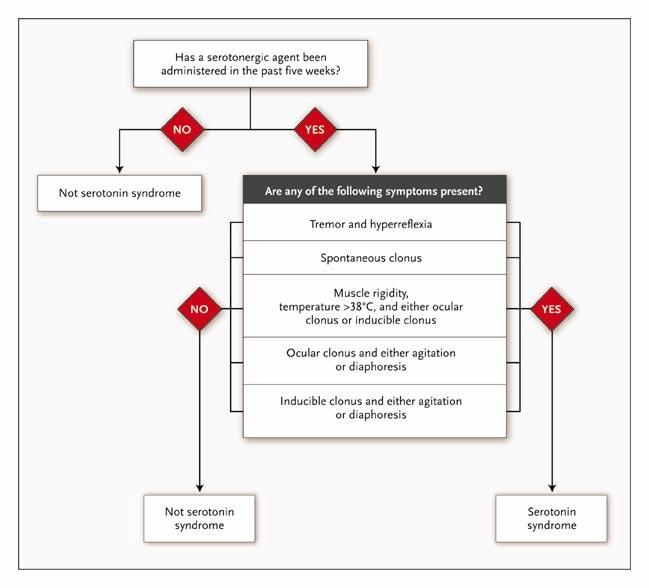
The following diagnostic algorithm from Boyer and Shannon's landmark NEJM review illustrates the clinical decision rules:
View full figure Figure 4. Algorithm for Diagnosis. The Serotonin Syndrome. N Engl J Med. March 16, 2005.
History
- What serotonergic medications are currently prescribed (SSRIs, SNRIs, TCAs, MAOIs, triptans, opioids, etc.)?
- Any recent medication changes — new drug started, dose increased, or drug switched within the past 5 weeks?[1]
- Intentional overdose or accidental ingestion?
- Over-the-counter medications: dextromethorphan-containing cough medicines, St. John's Wort, tryptophan supplements?[1]
- Illicit drug use: MDMA ("ecstasy"), cocaine, amphetamines?[1]
- Time of symptom onset relative to medication change — 60% present within 6 hours, 74% within 24 hours[3]
- Symptom characterization: tremor, shivering, restlessness, diarrhea, muscle twitching, confusion
- Was a serotonergic drug recently discontinued (e.g., fluoxetine has a 5-week washout due to norfluoxetine)?[1]
Alarm Features
- Hyperthermia >41.1°C — hallmark of severe/life-threatening serotonin syndrome[1]
- Muscular rigidity (especially lower extremities) — may mask clonus and cloud diagnosis[1]
- Rapidly deteriorating mental status: agitated delirium → coma[1]
- Hemodynamic instability: severe hypertension deteriorating into shock[1]
- Seizures[5]
- Signs of end-organ damage: rhabdomyolysis, metabolic acidosis, DIC, renal failure[1]
- Any MAOI + serotonin reuptake inhibitor combination — highest risk for severe/fatal toxicity[1-2]
Medications
Causative agents (by mechanism)
- Serotonin reuptake inhibitors: SSRIs (fluoxetine, sertraline, paroxetine, citalopram, escitalopram), SNRIs (venlafaxine, duloxetine, desvenlafaxine), TCAs (especially clomipramine), tramadol, meperidine, fentanyl, dextromethorphan, cyclobenzaprine
- MAO inhibitors: phenelzine, tranylcypromine, isocarboxazid, selegiline, rasagiline, linezolid, IV methylene blue[7-8]
- Serotonin releasers: MDMA, amphetamines, mirtazapine
- Serotonin precursors: tryptophan, 5-HTP
- Other: triptans, lithium, metoclopramide, ondansetron (controversial), St. John's Wort, bupropion (in overdose)[9-10]
- Highest-risk combinations: MAOI + SSRI/SNRI, MAOI + meperidine, MAOI + dextromethorphan.[1][11] Concomitant SSRI-opioid use carries a strong pharmacovigilance signal (ROR 95.94).[12]
- Contraindicated in treatment: Bromocriptine and dantrolene — associated with worsening hyperthermia and death in serotonin syndrome (these are NMS treatments, not SS treatments).[1] Avoid indirect sympathomimetics (e.g., dopamine) for hypotension in MAOI-related cases.[1]
Treatment medications
- Cyproheptadine: 5-HT2A antagonist; initial dose 12 mg PO, then 2 mg q2h if symptoms persist; maintenance 8 mg q6h; max 32 mg/24h. Available only in oral form (can crush and give via NGT). Evidence for efficacy is limited to case reports.[1][13-14]
- Benzodiazepines: First-line for agitation control (e.g., diazepam, lorazepam)[1]
- Chlorpromazine: 50–100 mg IM for severe cases requiring parenteral therapy (avoid if hypotensive)[1]
Diet
- Avoid tyramine-rich foods if on MAOIs (aged cheeses, cured meats, fermented foods, draft beer) — can precipitate hypertensive crisis and compound serotonergic toxicity
- Avoid tryptophan-containing supplements[7]
- Aggressive IV fluid hydration is critical in acute management to prevent renal injury from rhabdomyolysis[1]
Review of Systems
- Neuro: Tremor, myoclonus, restlessness, confusion, agitation, seizures, headache
- GI: Diarrhea, nausea, vomiting, hyperactive bowel sounds (distinguishing feature from anticholinergic toxidrome)[1]
- Autonomic: Diaphoresis, shivering, flushing, palpitations
- Psych: Anxiety, hypervigilance, pressured speech, hallucinations, delirium
- MSK: Muscle twitching, stiffness (especially lower extremities)
- Ophthalmologic: Blurred vision (mydriasis)
Collateral History and Family History
- Confirm complete medication list from pharmacy records, family, EMS — patients may not recall all serotonergic agents
- Inquire about recent prescriber changes, multiple prescribers, or recent ED visits with new prescriptions
- Recreational drug use history from friends/family (MDMA, cocaine)
- Intentional self-harm assessment — overdose is a common precipitant[15]
- Family history of pharmacogenomic variants (CYP2D6 poor/intermediate metabolizers) may increase susceptibility[8]
Risk Factors
- Polypharmacy with multiple serotonergic agents — most common scenario[11]
- Recent initiation, dose increase, or switch of serotonergic medication[15]
- Intentional overdose of serotonergic drugs (moderate serotonin toxicity in ~14% of SSRI overdoses)[15]
- MAOI use (especially combined with SRIs — 50% develop at least moderate toxicity)[15]
- CYP2D6/CYP3A4 inhibitor co-administration (e.g., fluoxetine, paroxetine inhibiting CYP2D6)[1]
- Elderly patients — higher reporting odds ratios for serotonin syndrome[10][16]
- Perioperative setting — concomitant opioid + antidepressant use[12]
Differential Diagnosis
- Export Condition Key Distinguishing Features Refs Neuroleptic malignant syndrome (NMS) Slow onset (days), "lead-pipe" rigidity, bradyreflexia, bradykinesia, caused by dopamine antagonists; low serum iron[1-3]
- Anticholinergic toxidrome Dry skin, dry mucosa, urinary retention, decreased bowel sounds, normal reflexes[2-3]
- Malignant hyperthermia Occurs under anesthesia (inhalational agents/succinylcholine), rigor mortis-like rigidity, hyporeflexia, mottled skin[2-3]
- Sympathomimetic toxidrome Cocaine/amphetamine use, no clonus or hyperreflexia[4]
- Sepsis/meningoencephalitis Infectious source, no clonus, CSF abnormalities[4]
- Decompensated hyperthyroidism Thyroid history, goiter, elevated thyroid hormones[4]
- Lethal catatonia Stereotypy, waxy flexibility, psychiatric history[1]
- Key distinguishing pearl: Serotonin syndrome features hyperreflexia and clonus (especially lower extremities), hyperactive bowel sounds, diaphoresis with normal skin color, and rapid onset (<12 hours). NMS features bradyreflexia, lead-pipe rigidity, and slow onset (1–3 days).[1][3][17]
Past Medical History
- Psychiatric history: depression, anxiety, OCD, PTSD (all treated with serotonergic agents)
- Prior episodes of serotonin syndrome (recurrence risk with re-exposure)
- Chronic pain conditions (tramadol, fentanyl, meperidine use)
- Migraine (triptan use, especially with concurrent SSRI/SNRI)[19]
- Parkinson's disease (rasagiline, selegiline — MAO-B inhibitors can precipitate SS with SSRIs)[8]
- Infections requiring linezolid in patients on antidepressants[7]
- Hepatic/renal impairment (impaired drug metabolism)
Physical Exam
- Vitals: Tachycardia, hypertension (may progress to hypotension in severe cases), tachypnea, hyperthermia (>38°C moderate; >41.1°C severe/life-threatening)[1]
- Neuro: Clonus (inducible > spontaneous > ocular) — most diagnostically important finding; hyperreflexia (greater in lower extremities than upper); tremor; myoclonus; agitation[1][4]
- Eyes: Mydriasis, ocular clonus (slow continuous lateral eye movements)[1]
- Skin: Diaphoresis, normal skin color (vs. dry/flushed in anticholinergic)[1]
- Oral: Sialorrhea (vs. dry mucosa in anticholinergic)[1]
- Abdomen: Hyperactive bowel sounds (key distinguishing feature)[1]
- Musculoskeletal: Increased tone predominantly in lower extremities; in severe cases, generalized rigidity that may mask clonus[1]
- Mental status: Ranges from hypervigilance and pressured speech (moderate) to agitated delirium and coma (severe)[1]
Lab Studies
- There is no confirmatory laboratory test for serotonin syndrome — it is a clinical diagnosis.[1]
- CBC: Leukocytosis may be present but nonspecific
- BMP/CMP: Evaluate for metabolic acidosis, renal function (creatinine elevation in rhabdomyolysis), electrolytes
- CK (creatine kinase): Elevated in rhabdomyolysis from sustained muscle hyperactivity[1][20]
- LFTs: Elevated aminotransferases in severe cases[1]
- Coagulation studies: PT/INR, fibrinogen, D-dimer — DIC can occur in severe cases[1]
- Lactate: Elevated from muscle hyperactivity and metabolic acidosis
- Urinalysis: Myoglobinuria
- TSH: Rule out thyroid storm
- Blood/urine toxicology screen: Identify co-ingestants
- Serum iron: May help distinguish from NMS (low in NMS)[21]
Imaging
- No specific imaging is diagnostic for serotonin syndrome
- CT head: Consider if altered mental status to rule out intracranial pathology (hemorrhage, mass)
- Chest X-ray: If concern for aspiration (agitated/obtunded patients) or respiratory failure
- Imaging is generally unnecessary if clinical presentation and medication history are consistent with serotonin syndrome
Special Tests
- Hunter Serotonin Toxicity Criteria — preferred diagnostic decision rules (sensitivity 84%, specificity 97%). Requires a serotonergic agent AND one of:[4]
- Spontaneous clonus
- Inducible clonus + agitation or diaphoresis
- Ocular clonus + agitation or diaphoresis
- Tremor + hyperreflexia
- Hypertonia + temperature >38°C + ocular or inducible clonus[4][19][22]
- Sternbach Criteria — older, less specific; requires ≥3 of 10 features (agitation, tremor, myoclonus, hyperreflexia, diaphoresis, shivering, diarrhea, incoordination, fever)[19]
- Poison control consultation — recommended for complex polypharmacy cases
- Pharmacogenomic testing (CYP2D6) — consider in recurrent or unexpectedly severe cases on standard doses[8]
ECG
- Sinus tachycardia — most common finding[1]
- Evaluate for QTc prolongation — many serotonergic drugs (especially citalopram, escitalopram, TCAs) prolong QT
- Rule out wide-complex arrhythmias in TCA co-ingestion (sodium channel blockade)
- Continuous cardiac monitoring recommended for moderate-to-severe cases
Assessment
Serotonin syndrome exists on a severity spectrum
- Mild: Tremor, hyperreflexia, tachycardia, diaphoresis, mydriasis — afebrile. May be overlooked or attributed to anxiety.
- Moderate: Above features plus hyperthermia (up to 40°C), clonus (especially lower extremities), ocular clonus, agitation, hyperactive bowel sounds, hypertension
- Severe: Temperature >41.1°C, muscular rigidity (may mask clonus), agitated delirium → coma, hemodynamic instability → shock, rhabdomyolysis, metabolic acidosis, DIC, seizures, multi-organ failure
- Most cases are mild and self-limited with drug discontinuation.[22-23] Severe cases are most commonly associated with MAOI + serotonin reuptake inhibitor combinations.[2] Complications of poorly treated hyperthermia drive mortality (rhabdomyolysis, renal failure, DIC).[1]
Treatment Plan
Initial stabilization (all severities)
- Discontinue all serotonergic agents immediately[1]
- ABCs, IV access, continuous monitoring
- Avoid physical restraints — isometric contractions worsen lactic acidosis and hyperthermia[1]
Mild cases
- Supportive care + observation
- Benzodiazepines for agitation/tremor (e.g., diazepam 5–10 mg IV, lorazepam 1–2 mg IV)[1]
- IV fluids
Moderate cases
- Aggressive correction of cardiorespiratory and thermal abnormalities
- Cyproheptadine: 12 mg PO initial dose → 2 mg PO q2h PRN → maintenance 8 mg PO q6h (max 32 mg/24h)[1]
- Active cooling measures
- Benzodiazepines for agitation
Severe cases (temp >41.1°C)
- Immediate sedation, neuromuscular paralysis (non-depolarizing agents — avoid succinylcholine), and endotracheal intubation[1]
- Aggressive cooling (evaporative cooling, ice packs, cooled IV fluids)
- Cyproheptadine via NGT
- Chlorpromazine 50–100 mg IM if parenteral 5-HT2A antagonism needed (avoid if hypotensive)[1]
- Treat hypotension with direct-acting vasopressors (norepinephrine, phenylephrine) — avoid indirect agents like dopamine in MAOI-related cases[1]
- Treat hypertension/tachycardia with short-acting agents (nitroprusside, esmolol)[1]
- Do NOT use: antipyretics (ineffective — hyperthermia is from muscle activity, not hypothalamic reset), bromocriptine, dantrolene[1]
Disposition
- Discharge: Mild cases (tremor, hyperreflexia, no fever) that resolve after observation (typically 6–8 hours), with offending agent discontinued and no ongoing serotonergic exposure[1][22]
- Observation/floor admission: Moderate cases requiring active treatment, hemodynamically stable but with persistent symptoms
- ICU admission: Severe cases with hyperthermia >40°C, hemodynamic instability, altered mental status, need for intubation/paralysis, evidence of rhabdomyolysis or end-organ damage[14][22]
- Toxicology/Poison Control consultation: Recommended for all moderate-to-severe cases and complex polypharmacy ingestions
- Psychiatry consultation: If intentional overdose or self-harm
Follow Up / Return Precautions
- Most cases resolve within 24 hours of drug discontinuation, but symptoms may persist longer with drugs that have long half-lives (e.g., fluoxetine → norfluoxetine, t½ ~1–2 weeks)[1]
- Return immediately for: recurrence of tremor/muscle twitching, fever, confusion, agitation, rapid heart rate, profuse sweating
- Outpatient follow-up with prescribing physician within 24–72 hours to review medication regimen and plan safe alternatives
- Educate patients: serotonin syndrome is predictable and preventable — it is a pharmacologic adverse reaction, not idiosyncratic[23]
- Ensure medication reconciliation across all prescribers to avoid inadvertent serotonergic polypharmacy
- If restarting antidepressant therapy, allow adequate washout (2 weeks for most agents; 5 weeks for fluoxetine before starting an MAOI)[1]
- Consider pharmacogenomic testing if severe reaction occurred on standard doses[8]
References
1. The Serotonin Syndrome. — Boyer EW, Shannon M. The New England Journal of Medicine. 2005.
2. Serotonin Toxicity: A Practical Approach to Diagnosis and Treatment. — Isbister GK, Buckley NA, Whyte IM. The Medical Journal of Australia. 2007.
3. The FDA Alert on Serotonin Syndrome With Use of Triptans Combined With Selective Serotonin Reuptake Inhibitors or Selective Serotonin-Norepinephrine Reuptake Inhibitors: American Headache Society Position Paper. — Evans RW, Tepper SJ, Shapiro RE, Sun-Edelstein C, Tietjen GE. Headache. 2010.
4. The Hunter Serotonin Toxicity Criteria: Simple and Accurate Diagnostic Decision Rules for Serotonin Toxicity. — Dunkley EJ, Isbister GK, Sibbritt D, Dawson AH, Whyte IM. QJM : Monthly Journal of the Association of Physicians. 2003.
5. Triptan and Ergotamine Overdoses in the United States: Analysis of the National Poison Data System. — Robblee JV, Butterfield RJ, Kang AM, Smith JH. Neurology. 2020.
6. FDA Drug Label. — Updated date: 2025-12-29. Food and Drug Administration.
7. Association of Linezolid With Risk of Serotonin Syndrome in Patients Receiving Antidepressants. — Bai AD, McKenna S, Wise H, Loeb M, Gill SS. JAMA Network Open. 2022.
8. Case Report: Pharmacogenetically-Triggered Fatal Serotonin Syndrome Following Sequential Serotonergic Therapy in Parkinson's Disease: A Case Highlighting the Role of CYP2D6*10/*10 Genotype and Multifactorial Drug Interactions. — Liu DY, Yi YH, Li N, Luo FM, Gong WJ. Frontiers in Psychiatry. 2025.
9. Two Cases of Serotonin Syndrome After Bupropion Overdose Treated With Cyproheptadine. — Murray BP, Carpenter JE, Sayers J, et al. The Journal of Emergency Medicine. 2021.
10. Serotonin Syndrome: A Pharmacovigilance Comparative Study of Drugs Affecting Serotonin Levels. — Elli C, Novella A, Pasina L. European Journal of Clinical Pharmacology. 2024.
11. Serotonin Syndrome: Analysis of Cases Registered in the French Pharmacovigilance Database. — Abadie D, Rousseau V, Logerot S, et al. Journal of Clinical Psychopharmacology. 2015.
12. Serotonin Syndrome Risk With Concomitant Opioid and Serotonergic Antidepressant Use: A Multinational Pharmacovigilance Study. — Zhang J, Wang W, Wang H, et al. Frontiers in Pharmacology. 2025.
13. Review Article: Efficacy of Cyproheptadine in the Management of Serotonin Toxicity Following Deliberate Self-Poisoning - A Systematic Review. — King E, Rotella JA. Emergency Medicine Australasia : EMA. 2025.
14. An 11-Year Retrospective Review of Cyproheptadine Use in Serotonin Syndrome Cases Reported to the California Poison Control System. — Nguyen H, Pan A, Smollin C, Cantrell LF, Kearney T. Journal of Clinical Pharmacy and Therapeutics. 2019.
15. The Serotonin Toxidrome: Shortfalls of Current Diagnostic Criteria for Related Syndromes. — Chiew AL, Buckley NA. Clinical Toxicology. 2022.
16. Drug-Associated Serotonin Syndrome in Elderly Patients: A Comprehensive Disproportionality Analysis Based on the FAERS Database. — Li X, Wen X, Fu H, et al. Frontiers in Pharmacology. 2025.
17. Neuroleptic Malignant Syndrome. — Wijdicks EFM, Ropper AH. The New England Journal of Medicine. 2024.
18. High Risk and Low Prevalence Diseases: Serotonin Syndrome. — Spadaro A, Scott KR, Koyfman A, Long B. The American Journal of Emergency Medicine. 2022.
19. Association of Coprescription of Triptan Antimigraine Drugs and Selective Serotonin Reuptake Inhibitor or Selective Norepinephrine Reuptake Inhibitor Antidepressants With Serotonin Syndrome. — Orlova Y, Rizzoli P, Loder E. JAMA Neurology. 2018.
20. HyperCKemia and Rhabdomyolysis in the Neuroleptic Malignant and Serotonin Syndromes: A Literature Review. — Kruijt N, van den Bersselaar LR, Wijma J, et al. Neuromuscular Disorders : NMD. 2020.
21. Serotonin Syndrome vs Neuroleptic Malignant Syndrome: A Contrast of Causes, Diagnoses, and Management. — Perry PJ, Wilborn CA. Annals of Clinical Psychiatry : Official Journal of the American Academy of Clinical Psychiatrists. 2012.
22. Prevention, Recognition, and Management of Serotonin Syndrome. — Ables AZ, Nagubilli R. American Family Physician. 2010.
23. Overview of Serotonin Syndrome. — Iqbal MM, Basil MJ, Kaplan J, Iqbal MT. Annals of Clinical Psychiatry : Official Journal of the American Academy of Clinical Psychiatrists. 2012.
Figure
More from Deep Dive
Reviewed by Dr. Lucas Mastropaolo. SymptomDx is an educational tool for medical professionals — it does not replace clinical judgment. Verify all clinical data and drug dosages with authoritative sources.