Small Bowel Obstruction
SBO is a common surgical emergency accounting for ~350,000 U.S. hospitalizations annually and 15% of acute surgical GI admissions.[1-2] The most critical distinction is between simple vs. complicated (strangulated/ischemic) obstruction, as ischemia increases mortality from 3% to 30%.[1-2]
History
- Prior abdominal surgery — single most important historical element; adhesions cause ~65% of SBO[1][3]
- Onset, character, and progression of abdominal pain: crampy/colicky → constant pain suggests ischemia[4-5]
- Nausea, vomiting (bilious early; feculent with distal obstruction), abdominal distension[1]
- Obstipation — cessation of flatus and stool; absence of flatus is a strong predictor of failed conservative management (OR 3.3)[6]
- Timing of symptom onset relative to presentation (1–2 days typical)[7]
- Prior episodes of SBO, prior radiation therapy, history of inflammatory bowel disease, known malignancy[3]
- Medication history: opioids and anticholinergics can cause ileus mimicking SBO[2]
- History of bariatric surgery (Roux-en-Y) — high risk for internal hernia/closed-loop obstruction[2]
- Important negatives: passage of flatus, bowel movements, ability to tolerate PO, fever, bloody emesis/stool
Alarm Features
- Peritonitis — involuntary guarding, rigidity, rebound tenderness[1][3]
- Hemodynamic instability — tachycardia, hypotension, SBP <100 mmHg[3][8]
- Fever (OR 2.8 for failed conservative management)[6]
- Continuous, non-colicky pain (suggests transition from obstruction to ischemia)[3]
- Bloody emesis or stool, bloody peritoneal aspirate[9]
- Rapidly progressive clinical deterioration despite resuscitation
- Signs of sepsis/SIRS: tachycardia, fever, leukocytosis, metabolic acidosis[3]
- Any of these features mandate timely surgical exploration (EAST Level 1 recommendation).[3]
Medications
- Contributors to ileus/pseudo-obstruction: opioids, anticholinergics, calcium channel blockers, phenothiazines[2]
Treatment medications
- IV crystalloid (Lactated Ringer preferred over NS to avoid acidemia)[2]
- Antiemetics (ondansetron)
- Analgesics — IV acetaminophen, ketorolac preferred; minimize opioids as they worsen dysmotility
- Antibiotics (gram-negative and anaerobic coverage) if fever/leukocytosis present[10]
- Gastrografin (water-soluble contrast) — both diagnostic and therapeutic; can accelerate resolution and shorten LOS[3][11]
- Cautions: avoid oral contrast in emergent CT setting due to aspiration risk in supine patients; avoid normal saline for resuscitation[2]
Diet
- NPO is mandatory during acute obstruction[1-2]
- Progressive refeeding after resolution: clear liquids → liquid diet → low-residue diet → regular diet[11]
- Long-term: low-residue diet may reduce recurrence risk in patients with adhesive disease
- Adequate hydration is critical — significant third-spacing and dehydration are common
Review of Systems
- GI: nausea, vomiting (character/volume), last flatus, last bowel movement, diarrhea (watery diarrhea can occur with partial SBO and mimic gastroenteritis)[12]
- Constitutional: fever, chills, weight loss (malignancy concern)
- GU: decreased urine output (dehydration/AKI)
- Cardiovascular: lightheadedness, syncope (hypovolemia)
- Pulmonary: dyspnea (aspiration risk, abdominal distension limiting diaphragmatic excursion)
Collateral History and Family History
- Obtain operative reports from prior surgeries when possible
- Collateral from family regarding symptom timeline, medication use, functional status
- Family history: inflammatory bowel disease, familial adenomatous polyposis, hereditary cancer syndromes (Lynch syndrome) — relevant when malignancy is suspected as etiology
- Social context: functional status, nutritional baseline, ability to manage post-discharge care
Risk Factors
- Prior abdominal/pelvic surgery — most significant risk factor; appendectomy, colorectal, hernia, and gynecologic surgeries carry highest adhesion risk[1-2]
- Prior episodes of SBO (38.7% of adhesive SBO patients have prior SBO history)[7]
- Prior abdominal/pelvic radiation
- Inflammatory bowel disease (Crohn's disease ~5% of SBO)[1]
- Intra-abdominal malignancy (~5% of SBO; 12% in virgin abdomen SBO)[1][13]
- Hernias (inguinal, incisional, internal) — ~10% of SBO[1]
- History of bariatric surgery (internal hernia at Petersen defect)[2]
Differential Diagnosis
- Postoperative ileus — no transition point on imaging; diffuse bowel dilation; history of recent surgery[2]
- Large bowel obstruction — colonic dilation, mass or transition point in colon; incompetent ileocecal valve may cause concurrent small bowel dilation[2]
- Colonic pseudo-obstruction (Ogilvie syndrome) — massive colonic dilation without mechanical cause; post-surgical, critically ill patients[2]
- Acute mesenteric ischemia — primary vascular event; pain out of proportion to exam; atrial fibrillation risk factor[2]
- Narcotic bowel/opioid-induced dysmotility[1]
- Gallstone ileus — intraluminal cause; pneumobilia + ectopic gallstone on CT (Rigler triad)[14]
- Crohn's stricture — known IBD, terminal ileum involvement
- Intussusception — lead point mass in adults[14]
- Bezoar/foreign body — psychiatric history, prior gastric surgery[14]
Past Medical History
- Prior abdominal surgeries — type, number, and timing are critical[3]
- Prior SBO episodes and management (operative vs. nonoperative)
- Inflammatory bowel disease, diverticular disease
- Malignancy history (primary GI or metastatic)
- Hernia history (inguinal, ventral, incisional)
- Bariatric surgery (especially Roux-en-Y)
- Radiation therapy to abdomen/pelvis
- Chronic conditions affecting management: heart failure, CKD, coagulopathy
Physical Exam
Abdomen
- Distension — hallmark finding (OR 2.43 for surgical intervention)[15]
- Tympany to percussion[10]
- Bowel sounds: high-pitched, tinkling (early/partial) → absent (late/complete)[1][5]
- Tenderness: diffuse vs. focal; peritoneal signs (guarding, rigidity, rebound) suggest strangulation[1]
- Asymmetric distension may suggest closed-loop obstruction[9]
- Hernia exam: thorough evaluation of all hernia sites — inguinal, femoral, umbilical, incisional, obturator[3][16]
- Rectal exam: empty rectal vault supports complete obstruction; occult blood (ischemia/malignancy)
- Dehydration signs: dry mucous membranes, poor skin turgor, orthostasis[1]
Lab Studies
- Export Lab Purpose Expected Abnormalities References CBC with differential Infection/ischemia screening Leukocytosis, neutrophilia, bandemia[1-2]
- BMP/CMP Electrolyte derangements, renal function Hypokalemia, hypochloremic metabolic alkalosis, elevated BUN/Cr (prerenal AKI)[3-4]
- Serum lactate Bowel ischemia marker Elevated in ischemia (low sensitivity; normal does not exclude ischemia)[4-5]
- Serum albumin Nutritional status, surgical predictor ≤34 g/L predicts need for surgery (OR 4.5)[6]
- CRP Inflammation/ischemia ≥50 mg/L associated with bowel necrosis[7]
- Lipase/amylase Rule out pancreatitis May be mildly elevated in SBO[5]
- Type and screen Surgical preparedness If surgery anticipated — Coagulation studies Preoperative assessment Coagulopathy in sepsis/DIC[4]
- Urinalysis AKI assessment, UTI exclusion Concentrated urine, prerenal pattern —
- Key pearl: Normal lactate and WBC do not exclude ischemia — sensitivity of clinical/lab indicators for strangulation is only ~40–50%.[3][16]
Imaging
- First-line: CT abdomen/pelvis with IV contrast
- Sensitivity 91%, specificity 89% for SBO diagnosis; negative predictive value ~100%[2][19]
- Identifies transition point (93%), etiology (80–91%), and complications[3]
- IV contrast recommended to assess bowel wall perfusion; even with allergy, pretreat and administer if possible[2]
- Oral contrast generally not recommended in the emergent setting (aspiration risk)[2]
CT findings of SBO
- Dilated small bowel >3 cm with transition point and decompressed distal bowel[2]
- Decompressed colon[3]
- Small bowel feces sign (particulate matter in dilated bowel — its absence predicts failure of conservative management, OR 5.23)[7][20]
- CT findings suggesting ischemia/strangulation (mandate urgent surgical consultation):[21-22]
- Reduced bowel wall enhancement (specificity 92%, DOR 15.8)[21]
- Increased unenhanced bowel wall attenuation (specificity 98%, DOR 30.5)[21]
- Diffuse mesenteric haziness (specificity 89%, DOR 22.3)[21]
- Closed-loop configuration (specificity 85%, DOR 19.6)[21]
- Mesenteric venous congestion, free fluid, pneumatosis, portal venous gas[3][5]
- Whirl sign (mesenteric volvulus)[3]
Plain radiographs (AXR)
- Sensitivity 60–93%; cannot exclude SBO[2][4]
- Useful for: air-fluid levels, free air (perforation), serial monitoring
- Adequate as initial screen if CT unavailable; free air warrants immediate surgical exploration[2]
- Ultrasound: Emerging role in ED; can identify dilated fluid-filled loops and peristalsis; operator-dependent[4]
Special Tests
- Gastrografin challenge: 100 mL undiluted via NGT → abdominal XR at 8–24 hours; contrast reaching colon/rectum predicts successful conservative management; both diagnostic and therapeutic (osmotic effect draws fluid into lumen, stimulates peristalsis)[3][11-12]
- Angers CT Score: Radiological scoring system incorporating beak sign, closed loop, intraperitoneal fluid, mesenteric haziness, mesenteric fluid, and bowel diameter >40 mm; score ≥5 predicts failure of conservative management (OR 2.39)[23]
- Point-of-care ultrasound (POCUS): Dilated, fluid-filled small bowel loops with back-and-forth peristalsis; can expedite ED diagnosis[4]
ECG
ECG is not diagnostic for SBO but should be obtained in
- Patients with tachycardia or hemodynamic instability
- Elderly patients to evaluate for atrial fibrillation (risk factor for mesenteric ischemia in the differential)
- Preoperative assessment
- Electrolyte abnormalities (hypokalemia, hypomagnesemia) from vomiting/NG losses may cause QT prolongation, U waves, or arrhythmias
- Rule out acute coronary syndrome in elderly patients presenting with epigastric pain
Assessment
Severity stratification — the key clinical distinctions
- Partial vs. complete obstruction: Complete obstruction has higher failure rate of conservative management (OR 4.1) and higher resection rates[3][6]
- Simple vs. complicated (strangulated/ischemic): Ischemia increases mortality from ~3% to 25–30%[1][5]
- Adhesive vs. non-adhesive etiology: Non-adhesive causes (hernia, malignancy, internal hernia) have higher strangulation rates (33% for hernia vs. 9% for adhesions)[2]
Predictors of failed conservative management
- Absence of flatus (OR 3.3), fever (OR 2.8), complete obstruction (OR 4.1), free fluid on CT (OR 3.7)
- Lack of small bowel feces sign, mesenteric haziness, transition point on CT[17][20]
- ≥3 risk factors predict failure with 84% sensitivity[6]
Typical vs. atypical presentations
- Classic tetrad: colicky abdominal pain + nausea/vomiting + distension + obstipation[1]
- Atypical: watery diarrhea (partial SBO mimicking gastroenteritis); minimal pain in elderly; absence of classic signs in post-Roux-en-Y internal hernia[2][12]
Treatment Plan
Initial stabilization (all patients)
- IV fluid resuscitation: Lactated Ringer preferred; replace NG output (0.5 mL crystalloid per 1 mL output above 1000 mL)[2]
- NGT decompression: For significant distension and vomiting; low intermittent suction[4][12]
- NPO/bowel rest[1]
- Electrolyte correction: Monitor and replace K⁺, Mg²⁺, PO₄³⁻ daily (deficiencies worsen hypoperistalsis)[2]
- Foley catheter for I&O monitoring[2]
- Analgesia: IV acetaminophen, ketorolac; minimize opioids
- DVT prophylaxis
- Nonoperative management (appropriate for hemodynamically stable patients without signs of ischemia/peritonitis):
- Successful in 65–85% of adhesive SBO[2-3]
- Most patients improve within 2–3 days[3][7]
- Gastrografin should be considered if partial SBO has not resolved in 48 hours — therapeutic and diagnostic[3]
- Serial abdominal exams and labs (q6–8h) to monitor for clinical deterioration[3]
- Conservative trial should not exceed 3 days — each day of delay increases odds of bowel resection by 20%[7]
Operative management — indications
- Peritonitis, hemodynamic instability, clinical deterioration (EAST Level 1)[3]
- CT findings of ischemia, closed-loop obstruction, volvulus[3][5]
- Suspected internal hernia, irreducible hernia, neoplasm[2]
- Failure of nonoperative management by days 3–5[3]
- Early surgery (<24 hours) in appropriately selected patients reduces mortality (RR 0.53), bowel resection rates (RR 0.56), and complications (RR 0.62)[6]
- Laparoscopic approach is viable in selected cases with decreased morbidity and shorter LOS[3]
- Antibiotics: Gram-negative and anaerobic coverage (e.g., piperacillin-tazobactam or cefazolin + metronidazole) if fever, leukocytosis, or suspected ischemia[10]
Disposition
Admission (virtually all SBO patients)
- Admit to a surgical service — associated with shorter LOS, lower charges, and lower mortality compared to medical service admission (EAST Level 3)[3]
- ICU admission for hemodynamic instability, sepsis, or perioperative management
Observation indications
- Partial SBO with mild symptoms, tolerating PO, no signs of complication — may be considered for short observation with close follow-up, though admission is standard practice
Surgical consultation triggers
- All confirmed SBO should have early surgical consultation[2][4]
- Emergent consultation: peritonitis, hemodynamic instability, CT evidence of ischemia/closed-loop/volvulus[3]
- Urgent consultation: complete obstruction, failure to improve with conservative management
Discharge criteria (rare from ED)
- Resolution of symptoms, tolerating PO, passage of flatus/stool, no concerning imaging findings
Follow Up / Return Precautions
Follow-up timing
- Surgical follow-up within 1–2 weeks after discharge
- Earlier if managed nonoperatively (higher recurrence rate and shorter time to readmission vs. operative management)[2]
- Return precautions — instruct patients to return immediately for:
- Recurrence of abdominal pain, vomiting, or distension
- Inability to pass gas or have bowel movements
- Fever or chills
- Bloody stool or vomit
Patient counseling
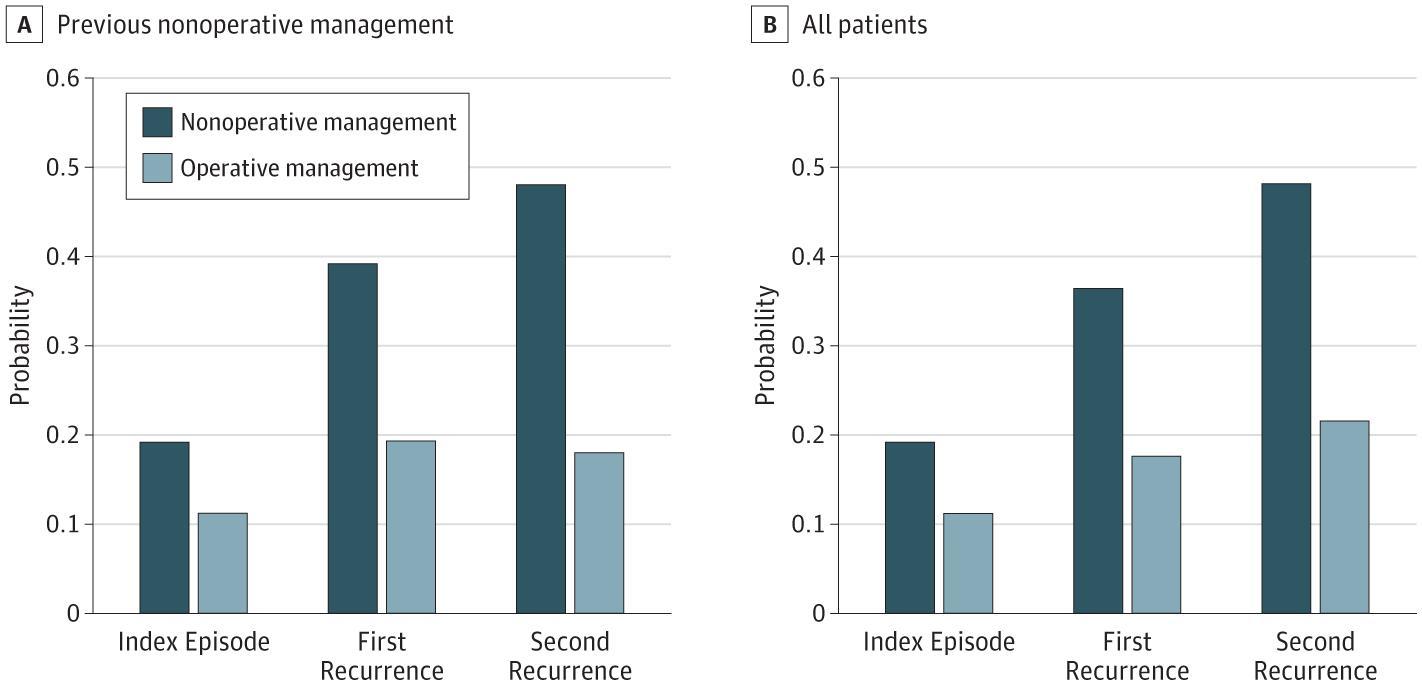
- Adhesive SBO recurrence rate is ~20% at 5 years with nonoperative management, increasing with each subsequent episode; operative management reduces recurrence by ~50%[24]
- Advance diet slowly; avoid large meals initially
- Stay well hydrated
- Avoid constipation-promoting medications when possible
- The following figure from Behman et al. illustrates the progressive increase in recurrence risk with nonoperative management versus the protective effect of surgical intervention across successive SBO episodes:
References
1. A Systematic Review of the Clinical Presentation, Diagnosis, and Treatment of Small Bowel Obstruction. — Rami Reddy SR, Cappell MS. Current Gastroenterology Reports. 2017.
2. Gastrointestinal Surgical Emergencies Textbook. — Ashley E. Aaron, Andrea Amabile, Ciro Andolfi, et al American College of Surgeons (2021). 2021.
3. Evaluation and Management of Small-Bowel Obstruction: An Eastern Association for the Surgery of Trauma Practice Management Guideline. — Maung AA, Johnson DC, Piper GL, et al. The Journal of Trauma and Acute Care Surgery. 2012.
4. Emergency Medicine Evaluation and Management of Small Bowel Obstruction: Evidence-Based Recommendations. — Long B, Robertson J, Koyfman A. The Journal of Emergency Medicine. 2019.
5. ACR Appropriateness Criteria® Suspected Small-Bowel Obstruction. — Expert Panel on Gastrointestinal Imaging, Chang KJ, Marin D, et al. Journal of the American College of Radiology : JACR. 2020.
6. Optimal Timing of Surgical Intervention in Small Bowel Obstruction: A Systematic Review and Meta-Analysis of Clinical Outcomes and Risk Predictors. — Kanani F, Messer N, Zahalka A, Dayan K, Zoabi N. The American Surgeon. 2025.
7. Predictive Factors for Operative Intervention and Ideal Length of Non-Operative Trial in Adhesive Small Bowel Obstruction. — van Veen T, Ramanathan P, Ramsey L, Dort J, Tabello D. Surgical Endoscopy. 2023.
8. Associations of the Need for Surgery in Emergency Department Patients With Small Bowel Obstructions. — Berman DJ, Mahler AW, Burke RC, et al. The Western Journal of Emergency Medicine. 2025.
9. [Retracted] Application of Laparoscopy Combined with Enhanced Recovery after Surgery (ERAS) in Acute Intestinal Obstruction and Analysis of Prognostic Factors: A Retrospective Cohort Study. — Miao X, Tao L, Huang L, Li J, Pan S. BioMed Research International. 2022.
10. Intestinal Obstruction: Evaluation and Management. — Jackson P, Vigiola Cruz M. American Family Physician. 2018.
11. Management of Adhesive Small Bowel Obstruction: The Results of a Large Retrospective Study. — Maienza E, Godiris-Petit G, Noullet S, Menegaux F, Chereau N. International Journal of Colorectal Disease. 2023.
12. Bologna Guidelines for Diagnosis and Management of Adhesive Small Bowel Obstruction (ASBO): 2017 Update of the Evidence-Based Guidelines From the World Society of Emergency Surgery ASBO Working Group. — Ten Broek RPG, Krielen P, Di Saverio S, et al. World Journal of Emergency Surgery : WJES. 2018.
13. Outcomes of Small Bowel Obstruction in Patients With No Prior Surgery: A Systematic Review. — Klingbeil KD, Hayashi A, Balians E, Johnson RE, Livingston E. The Journal of Surgical Research. 2026.
14. Intraluminal Causes of Mechanical Small Bowel Obstruction: CT Findings and Diagnostic Approach. — Wong L, Sivanesan U, Haider M, Chung AD. European Journal of Radiology. 2025.
15. Prognostic Factors to Identify Resolution of Small Bowel Obstruction Without Need for Operative Management: Systematic Review. — Eze VN, Parry T, Boone D, Mallett S, Halligan S. European Radiology. 2024.
16. Diagnosis and Management of Small Bowel Obstruction in Virgin Abdomen: A WSES Position Paper. — Amara Y, Leppaniemi A, Catena F, et al. World Journal of Emergency Surgery : WJES. 2021.
17. Prediction and Risk Evaluation for Surgical Intervention in Small Bowel Obstruction †. — Buniatov T, Maak M, Jacobsen A, et al. Journal of Clinical Medicine. 2025.
18. A New Clinical Severity Score for the Management of Acute Small Bowel Obstruction in Predicting Bowel Ischemia: A Cohort Study. — Wassmer CH, Revol R, Uhe I, et al. International Journal of Surgery. 2023.
19. Diagnostic Utility of CT for Small Bowel Obstruction: Systematic Review and Meta-Analysis. — Li Z, Zhang L, Liu X, Yuan F, Song B. PloS One. 2019.
20. Non-Strangulated Adhesive Small Bowel Obstruction: CT Findings Predicting Outcome of Conservative Treatment. — Kim J, Lee Y, Yoon JH, et al. European Radiology. 2021.
21. Diagnostic Performance of Individual CT Signs for Identifying Ischemia and Necrosis in Small Bowel Obstruction: A Systematic Review and Meta-Analysis. — Le Corre P, Youinou M, Chatellier G, Zins M. AJR. American Journal of Roentgenology. 2026.
22. Assessment of Strangulation in Adhesive Small Bowel Obstruction on the Basis of Combined CT Findings: Implications for Clinical Care. — Millet I, Boutot D, Faget C, et al. Radiology. 2017.
23. The Angers CT Score Is a Risk Factor for the Failure of the Conservative Management of Adhesive Small Bowel Obstruction: A Prospective Observational Multicentric Study. — Paisant A, Burgmaier J, Calame P, et al. World Journal of Surgery. 2023.
24. Association of Surgical Intervention for Adhesive Small-Bowel Obstruction With the Risk of Recurrence. — Behman R, Nathens AB, Mason S, et al. JAMA Surgery. 2019.
Figure
More from Deep Dive
Reviewed by Dr. Lucas Mastropaolo. SymptomDx is an educational tool for medical professionals — it does not replace clinical judgment. Verify all clinical data and drug dosages with authoritative sources.