Third-Degree AV Block
Third-degree (complete) AV block is defined as the complete absence of AV conduction, with no atrial impulses reaching the ventricles. The heart depends entirely on a junctional or ventricular escape rhythm for cardiac output. This is a potentially life-threatening conduction disturbance that almost always requires permanent pacemaker implantation unless attributable to a clearly reversible cause.[1-2]
History
- Syncope/presyncope: Most common presenting symptom; ask about sudden loss of consciousness, prodromal lightheadedness, or near-falls
- Exertional dyspnea, fatigue, exercise intolerance: Due to inability to augment heart rate
- Heart failure symptoms: Orthopnea, PND, lower extremity edema
- Chest pain: May indicate ischemic etiology (inferior or anterior MI)
- Palpitations: Awareness of slow or irregular heartbeat
- Timing: Acute onset (ischemia, drug toxicity) vs. insidious (degenerative, infiltrative)
- Medication history: Recent initiation or dose changes of AV nodal blocking agents
- Tick exposure, rash, travel: Lyme carditis in endemic areas[2]
- Recent cardiac surgery, catheter ablation, or TAVR[1]
Alarm Features
- Hemodynamic instability: Hypotension, altered mental status, signs of shock
- Ventricular escape rate <40 bpm or wide QRS escape rhythm (infra-Hisian origin — unreliable, may fail abruptly)[1-2]
- Asystolic pauses ≥3 seconds while awake[3-4]
- Associated acute MI (especially anterior — less likely to resolve)[1][5]
- Syncope or seizure-like activity (Stokes-Adams attacks)
- New heart failure or pulmonary edema
- Ventricular arrhythmias (pause-dependent VT/torsades)
Medications
Causative/contributing agents
- Beta-blockers, verapamil, diltiazem, digoxin
- Class I and III antiarrhythmics (flecainide, amiodarone, sotalol)
- Nutraceuticals (e.g., lily of the valley)
Acute treatment agents
- Atropine 0.5–1.0 mg IV (effective for AV nodal block; may worsen infranodal block — use judiciously with wide QRS)
- Epinephrine infusion (2–10 mcg/min) or push-dose (10–20 mcg boluses)
- Dopamine infusion (5–20 mcg/kg/min)
- Isoproterenol (enhances both nodal and His-Purkinje conduction)
- Aminophylline IV — may be considered in acute inferior MI[1]
- Glucagon — for beta-blocker toxicity
- Cautions: Atropine is unlikely to improve infranodal block and may paradoxically worsen conduction in patients with wide QRS complexes suggesting His-Purkinje disease.[1]
Diet
- No specific dietary triggers for complete heart block
- Ensure adequate hydration, especially in patients with low cardiac output
- Monitor potassium and magnesium — hyperkalemia can exacerbate conduction block[8]
- Digoxin toxicity risk increases with hypokalemia, hypomagnesemia, and hypercalcemia
Review of Systems
- Cardiovascular: Syncope, presyncope, dyspnea, chest pain, palpitations, exercise intolerance
- Neurologic: Dizziness, confusion, seizure-like episodes (Stokes-Adams)
- Pulmonary: Dyspnea on exertion, orthopnea (heart failure)
- Musculoskeletal: Muscle weakness (neuromuscular diseases — myotonic dystrophy, Kearns-Sayre)[1][9]
- Dermatologic: Erythema migrans (Lyme), malar rash (SLE)
- Constitutional: Fatigue, weight loss (sarcoidosis, malignancy)
- Rheumatologic: Joint pain, dry eyes/mouth (autoimmune etiologies)
Collateral History and Family History
- Family history: Sudden cardiac death, congenital heart block, cardiomyopathy, neuromuscular disease
- Maternal history: SLE or anti-Ro/La antibodies (congenital complete heart block)[1][9]
- Genetic conditions: SCN5A mutations, lamin A/C mutations, TRPM4[9]
- Social context: Outdoor activities in tick-endemic areas (Lyme), travel to Central/South America (Chagas)
- Collateral from witnesses: Observed syncope, seizure-like activity, duration of unresponsiveness
Risk Factors
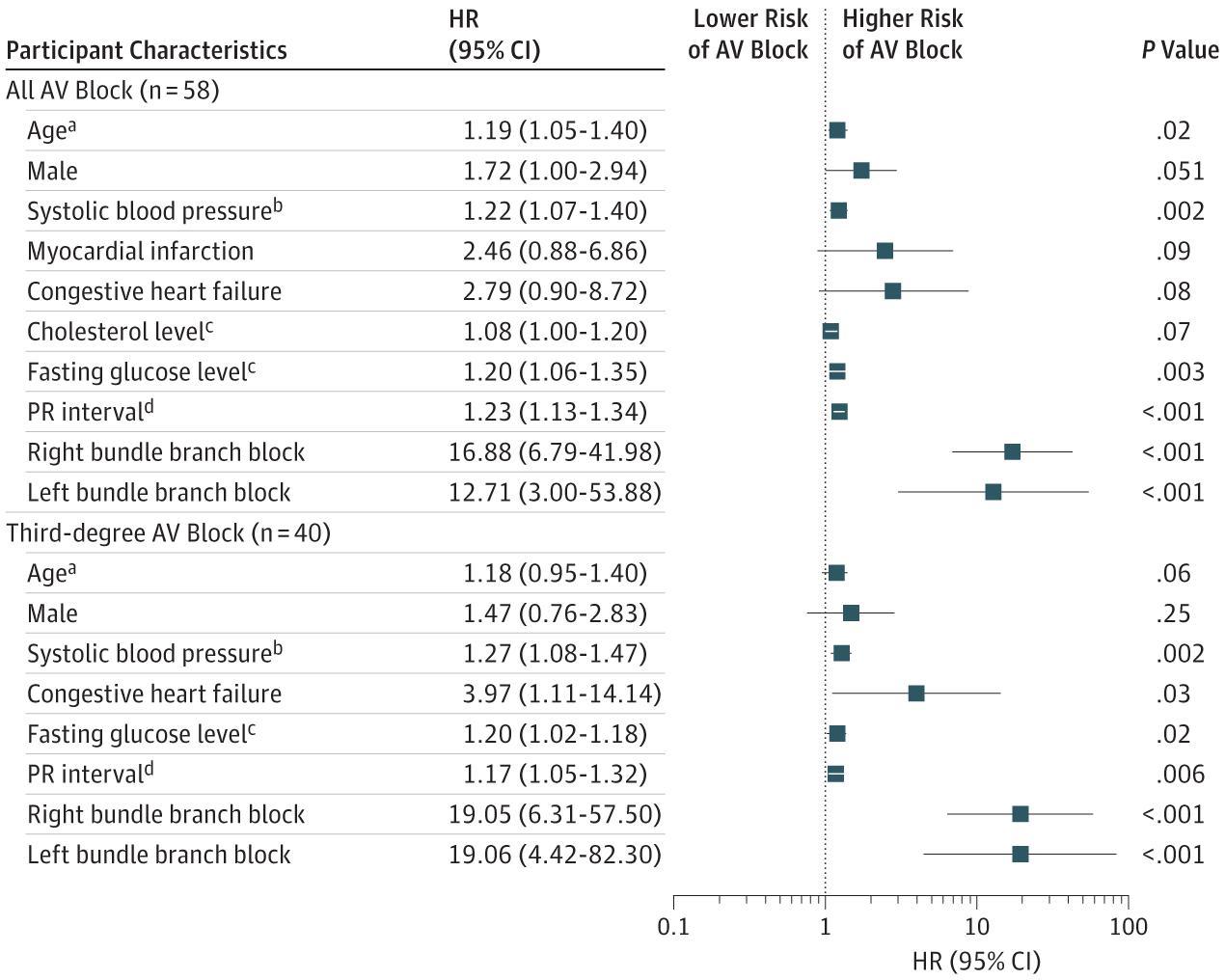
- A population-based study identified the following independent risk factors for AV block:[10]
- Advanced age (degenerative fibrosis — Lev's/Lenegre's disease)
- Chronic hypertension and elevated systolic blood pressure
- Diabetes mellitus / elevated fasting glucose
- Pre-existing bundle branch block (RBBB or LBBB — strongest ECG predictors)
- Coronary artery disease / prior MI
- Structural heart disease (valvular, cardiomyopathy)
- AV nodal blocking medications
- Infiltrative diseases: Sarcoidosis (AV block in 23–30%), amyloidosis[9]
- Post-cardiac surgery (especially valve surgery) or TAVR[1]
- Neuromuscular diseases: Myotonic dystrophy, Kearns-Sayre syndrome[1]
- The following figure illustrates multivariable-adjusted hazard ratios for risk factors associated with AV block:
Differential Diagnosis
- Isorhythmic AV dissociation: Atrial and ventricular rates are similar but independent — not true block (no treatment needed)[1-2]
- High-grade (advanced) second-degree AV block: ≥2 consecutive non-conducted P waves but some conduction preserved[1]
- Sinus bradycardia with junctional escape: Sinus rate slower than junctional rate — not AV block
- Drug-induced AV block: Beta-blockers, CCBs, digoxin, antiarrhythmics — may be reversible[2][6]
- Hyperkalemia: Can mimic or cause complete heart block
- Acute MI: Inferior MI (AV nodal block, often transient) vs. anterior MI (infranodal, worse prognosis)[1]
- Lyme carditis: Reversible with antibiotics; median resolution 6 days[1-2]
- Cardiac sarcoidosis: May present with AV block as initial manifestation[9]
Past Medical History
- Prior conduction abnormalities (first-degree AV block, bundle branch block)
- History of MI, coronary artery disease, heart failure
- Prior cardiac surgery or catheter ablation
- Autoimmune/rheumatologic disease (SLE, sarcoidosis, RA)
- Neuromuscular disease
- Thyroid disease (both hypo- and hyperthyroidism)[8]
- Prior Lyme disease or tick-borne illness
- Medication list — especially AV nodal blocking agents
Physical Exam
- Vital signs: Bradycardia (typically 25–50 bpm), hypotension, may have normal or low BP
- Irregular cannon A waves in JVP (atrial contraction against closed tricuspid valve)[11]
- Varying intensity of S1 (hallmark — due to changing PR relationship)[11]
- Varying pulse volume[11]
- Signs of heart failure: Elevated JVP, pulmonary crackles, peripheral edema
- Skin: Erythema migrans (Lyme), malar rash (SLE), erythema nodosum (sarcoidosis)
- Neurologic: Muscle wasting, myotonia (neuromuscular disease)
- Focused exam: Assess perfusion (capillary refill, mental status, urine output)
Lab Studies
- Troponin: Rule out acute MI as cause
- BMP/CMP: Potassium (hyperkalemia), calcium, magnesium, renal function
- TSH: Hypothyroidism or hyperthyroidism[8]
- Digoxin level: If on digoxin therapy
- Lyme serologies: In endemic areas or with suggestive history[2]
- ESR/CRP, ANA, anti-Ro/La: If autoimmune etiology suspected
- ACE level, lysozyme: If sarcoidosis suspected (low sensitivity)
- BNP/NT-proBNP: Assess for heart failure
- CBC: Infection workup
Imaging
- Transthoracic echocardiography (TTE): First-line — assess LV function, wall motion abnormalities, valvular disease, infiltrative cardiomyopathy[11]
- Chest X-ray: Cardiomegaly, pulmonary congestion, hilar lymphadenopathy (sarcoidosis)
- Cardiac MRI: Gold standard for sarcoidosis (late gadolinium enhancement), myocarditis, infiltrative disease
- Coronary angiography: If ischemic etiology suspected[11]
- PET scan: Cardiac sarcoidosis evaluation
- Imaging is unnecessary when the etiology is clearly degenerative in an elderly patient with known conduction disease
Special Tests
- Electrophysiology study (EPS): Determines site of block (supra-Hisian, intra-Hisian, infra-Hisian) when not apparent from ECG; HV interval ≥70 ms suggests infranodal disease[2][5]
- Exercise stress testing: AV block worsening with exercise suggests infranodal disease (poor prognosis); supra-Hisian block typically improves with exercise[12]
- Ambulatory ECG monitoring (Holter/event monitor): For paroxysmal complete heart block
- Carotid sinus massage: If carotid sinus hypersensitivity suspected (with caution)
ECG
Diagnostic criteria
- AV dissociation: P waves and QRS complexes march independently at different rates
- Atrial rate > ventricular rate (P-P interval < R-R interval)
- Regular R-R intervals (escape rhythm is regular)
- No consistent PR interval (varying PR relationship)
Key features to assess
- Narrow QRS escape (≤120 ms): Suggests junctional (AV nodal) origin — more stable, rate ~40–60 bpm, may respond to atropine
- Wide QRS escape (>120 ms): Suggests ventricular (infranodal) origin — less reliable, rate ~20–40 bpm, higher risk of asystole[1-2]
- QTc prolongation: Risk for torsades de pointes
- ST changes: Concurrent ischemia
- In atrial fibrillation: Complete heart block is suggested by a slow (<50 bpm) and regular ventricular response[1-2]
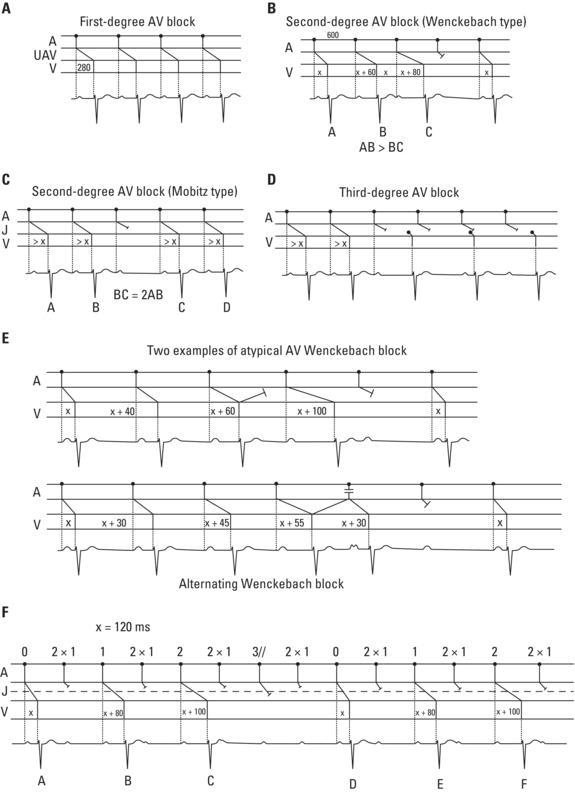
- The following figure illustrates the ECG patterns of different degrees of AV block, including third-degree block with AV dissociation (Panel D):
View full figure Figure 20. (A) First‐degree AV block. The PR interval is always prolonged (>200 ms); (B) second‐degree AV block 4 × 3 (Wenckebach type). The criterion AB > BC also applies in this case (see text and Figure B); (C) second‐degree AV block (Mobitz type) (BC = 2AB); (D) third‐degree AV block. A clear AV dissociation may be seen. After two QRS complexes have been conducted, there is a pause, followed by QRS (at slow frequencies) dissociated from P waves. In this case, the QRS complexes are junctional; (E) atypical Wenckebach blocks. Top: With abnormal lengthening of the increase preceding the pause (PR = x + 100) due to a concealed retrograde conduction of the preceding complex in the AV junction. Bottom: The abnormal PR shortening is due to the existence of a reciprocal complex in the AV junction; (F) example of an alternating Wenckebach block (see text). Mechanisms, Classification, and Clinical Aspects of Arrhythmias. Clinical Electrocardiography. December 31, 2020.
Assessment
Severity stratification depends on
- Hemodynamic stability: Stable vs. unstable (hypotension, altered mental status, shock)
- Escape rhythm characteristics: Narrow QRS (junctional) = more stable; wide QRS (ventricular) = high risk[1-2][14]
- Site of block: AV nodal block has slower progression and more reliable escape; infranodal block may progress rapidly and unpredictably[2][14]
- Etiology: Reversible (Lyme, drug toxicity, inferior MI) vs. irreversible (degenerative, post-surgical)
- Complications: Heart failure, ventricular arrhythmias, cardiogenic shock
- Third-degree AV block in the setting of anterior MI carries a worse prognosis than inferior MI, as it indicates extensive septal necrosis and infranodal block.[1][5]
Treatment Plan
Initial stabilization
- ABCs, IV access, continuous telemetry, transcutaneous pacing pads applied immediately
- Atropine 0.5–1.0 mg IV q3–5 min (max 3 mg) — for suspected AV nodal block (narrow QRS). Avoid or use cautiously with wide QRS escape
- If atropine fails: Transcutaneous pacing as bridge, or epinephrine/dopamine infusion
- Temporary transvenous pacing for refractory symptomatic bradycardia[7-8][15]
Definitive treatment
- Permanent pacemaker implantation is recommended (Class I) for acquired third-degree AV block not attributable to reversible or physiologic causes, regardless of symptoms[1-2]
- In patients with reversible causes (Lyme carditis, drug toxicity), treat the underlying cause first with temporary pacing support as needed; permanent pacing if block does not resolve[2][8]
- For cardiac sarcoidosis: Permanent pacing with consideration of ICD capability[2][8]
- For acute MI: Temporary pacing; permanent pacing only if block persists after revascularization[1]
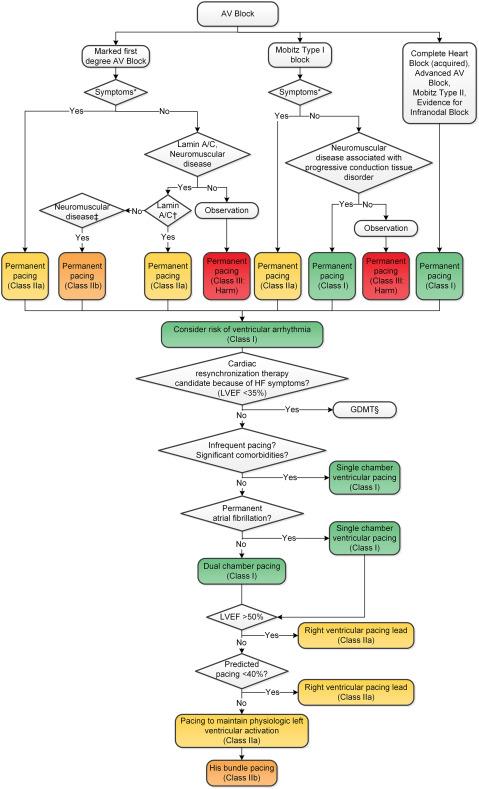
- The 2018 ACC/AHA/HRS guideline algorithm for management of chronic AV block is shown below:
View full figure Figure 7. Management of Bradycardia or Pauses Attributable to Chronic Atrioventricular Block Algorithm 2018 ACC/AHA/HRS Guideline on The Evaluation and Management of Patients With Bradycardia and Cardiac Conduction Delay: Executive Summary: A Report of the American College of Cardiology/American Heart Association Task Force on Clinical Practice Guidelines, and the Heart Rhythm Society. J Am Coll Cardiol. August 19, 2019.
Disposition
- All patients with third-degree AV block require admission with continuous telemetry monitoring[14]
- ICU/CCU admission: Hemodynamically unstable, requiring temporary pacing, or associated with acute MI
- Telemetry floor: Hemodynamically stable with reliable junctional escape, awaiting permanent pacemaker
- Cardiology/EP consultation: Required for all patients — for permanent pacemaker planning
- Discharge: Only after permanent pacemaker implantation or after confirmed resolution of a reversible cause with appropriate follow-up
- Distal (infranodal) block requires arrhythmia monitoring until pacemaker implantation, as it can progress rapidly and unpredictably and has been associated with sudden death[14]
Follow Up / Return Precautions
Post-pacemaker implantation
- Device check at 2–12 weeks, then every 6–12 months (or per remote monitoring schedule)
- Wound check at 1–2 weeks
- Activity restrictions for 4–6 weeks (avoid raising ipsilateral arm above shoulder)
- Return precautions (pre-pacemaker or if discharged with reversible cause):
- Return immediately for syncope, presyncope, severe dizziness, chest pain, or dyspnea
- New or worsening heart failure symptoms
- Palpitations or awareness of very slow heart rate
Expected course
- Lyme carditis: AV block typically resolves within 1–2 weeks of antibiotics (median 6 days, range up to 42 days)[1-2]
- Inferior MI: AV block often resolves within days to weeks[1]
- Degenerative/irreversible causes: Permanent pacemaker provides definitive treatment with excellent long-term outcomes[2]
References
1. 2018 ACC/AHA/HRS Guideline on The Evaluation and Management Of Patients With Bradycardia and Cardiac Conduction Delay: A Report of the American College of Cardiology/American Heart Association Task Force on Clinical Practice Guidelines and the Heart Rhythm Society. — Kusumoto FM, Schoenfeld MH, Barrett C, et al. Journal of the American College of Cardiology. 2019.
2. 2018 ACC/AHA/HRS Guideline on The evaluation and Management Of patients With Bradycardia and Cardiac conduction Delay: A Report of the American College of Cardiology/American Heart Association Task Force on Clinical Practice Guidelines and the Heart Rhythm Society. — Writing Committee Members, Kusumoto FM, Schoenfeld MH, et al. Heart Rhythm. 2019.
3. 2012 ACCF/AHA/HRS Focused Update Incorporated Into the ACCF/AHA/HRS 2008 Guidelines for Device-Based Therapy of Cardiac Rhythm Abnormalities: A Report of the American College of Cardiology Foundation/American Heart Association Task Force on Practice Guidelines and the Heart Rhythm Society. — Epstein AE, DiMarco JP, Ellenbogen KA, et al. Journal of the American College of Cardiology. 2013.
4. ACC/AHA/HRS 2008 Guidelines for Device-Based Therapy of Cardiac Rhythm Abnormalities: A Report of the American College of Cardiology/American Heart Association Task Force on Practice Guidelines (Writing Committee to Revise the ACC/AHA/NASPE 2002 Guideline Update for Implantation of Cardiac Pacemakers and Antiarrhythmia Devices) Developed in Collaboration With the American Association for Thoracic Surgery and Society of Thoracic Surgeons. — Epstein AE, DiMarco JP, Ellenbogen KA, et al. Journal of the American College of Cardiology. 2008.
5. Pacemakers. — Aldaas OM, Roberge-Lacharite AS, Birgersdotter-Green U. NEJM Evidence. 2025.
6. Clinical Significance and Management of Atrioventricular Block Associated With Bradycardic/Antiarrhythmic Drug Therapy: Drug‐Induced or Drug‐Revealed?. — Sfairopoulos D, Bazoukis G, Sideris S, et al. Journal of Cardiovascular Electrophysiology. 2025.
7. Part 9: Adult Advanced Life Support: 2025 American Heart Association Guidelines for Cardiopulmonary Resuscitation and Emergency Cardiovascular Care. — Wigginton JG, Agarwal S, Bartos JA, et al. Circulation. 2025.
8. 2018 ACC/AHA/HRS Guideline on The evaluation and Management of Patients With Bradycardia and Cardiac Conduction Delay: Executive Summary: A Report of the American College of Cardiology/American Heart Association Task Force on Clinical Practice Guidelines, and the Heart Rhythm Society. — Writing Committee Members, Kusumoto FM, Schoenfeld MH, et al. Heart Rhythm. 2019.
9. Etiology and device therapy in complete atrioventricular block in pediatric and young adult population: Contemporary review and new perspectives. — Cioffi GM, Gasperetti A, Tersalvi G, et al. Journal of Cardiovascular Electrophysiology. 2021.
10. Risk Factors Associated With Atrioventricular Block. — Kerola T, Eranti A, Aro AL, et al. JAMA Network Open. 2019.
11. An Unusual Cause of Atrioventricular Block. — Rajendran K, Alphonse AJ, Desabandhu V. JAMA Internal Medicine. 2025.
12. 2021 PACES Expert Consensus Statement on the Indications and Management of Cardiovascular Implantable Electronic Devices in Pediatric Patients. — Writing Committee Members, Shah MJ, Silka MJ, et al. Heart Rhythm. 2021.
13. Mechanisms, Classification, and Clinical Aspects of Arrhythmias. — Antoni Bayés De Luna, Miquel Fiol‐Sala, Antoni Bayés‐Genís, et al. Clinical Electrocardiography. 2021.
14. Update to Practice Standards for Electrocardiographic Monitoring in Hospital Settings: A Scientific Statement From the American Heart Association. — Sandau KE, Funk M, Auerbach A, et al. Circulation. 2017.
15. Part 3: Adult Basic and Advanced Life Support: 2020 American Heart Association Guidelines for Cardiopulmonary Resuscitation and Emergency Cardiovascular Care. — Panchal AR, Bartos JA, Cabañas JG, et al. Circulation. 2020.
16. 2018 ACC/AHA/HRS Guideline on The Evaluation and Management of Patients With Bradycardia and Cardiac Conduction Delay: Executive Summary: A Report of the American College of Cardiology/American Heart Association Task Force on Clinical Practice Guidelines, and the Heart Rhythm Society. — Kusumoto FM, Schoenfeld MH, Barrett C, et al. Journal of the American College of Cardiology. 2019.
Figures
More from Deep Dive
Reviewed by Dr. Lucas Mastropaolo. SymptomDx is an educational tool for medical professionals — it does not replace clinical judgment. Verify all clinical data and drug dosages with authoritative sources.