Tracheal Stenosis
Tracheal stenosis is a pathological narrowing of the tracheal lumen caused by neoplastic or nonneoplastic processes, most commonly iatrogenic (post-intubation/post-tracheostomy), but also arising from autoimmune, inflammatory, infectious, or idiopathic etiologies.[1-2] It is frequently misdiagnosed as asthma or COPD due to overlapping symptoms, with a median diagnostic delay of 12 months in inflammatory cases.[3]
History
- Onset and progression: Insidious vs. acute; post-intubation stenosis typically presents 4–6 weeks after extubation with delayed dyspnea[4]
- Symptom characterization: Exertional dyspnea (most common), inspiratory stridor, biphasic stridor, wheezing, chronic cough, hoarseness, exercise intolerance[1][5]
- Timing/triggers: Symptoms worsen with exertion, URI, or cold air; may be positional
- Severity: Quantify dyspnea (at rest vs. exertion), ability to perform ADLs, sleep-disordered breathing[6]
- Prior airway instrumentation: Duration of intubation, tracheostomy history, number of intubation attempts, cuff pressures used[7]
- Important negatives: Lack of response to bronchodilators or inhaled corticosteroids (distinguishes from asthma); absence of diffuse wheezing on auscultation[8]
Alarm Features
- Stridor at rest — indicates >50% luminal narrowing; critical stenosis typically at >70% obstruction[9-10]
- Acute respiratory distress, cyanosis, inability to lie flat
- Inability to pass suction catheter through tracheostomy[11]
- Rapid progression of dyspnea over hours to days
- Hemoptysis — raises concern for malignant etiology or erosion[5]
- Failed response to bronchodilators/steroids in a patient labeled as asthma — should prompt airway evaluation[8]
Medications
- Contributing medications: No specific medications directly cause tracheal stenosis, but prolonged corticosteroid use may impair wound healing; diabetes medications should be optimized as diabetes is a risk factor for stenosis[7]
Treatments
- Intralesional triamcinolone acetonide injection at time of dilation reduces recurrence (37% vs. 54.5% without)[12]
- Topical mitomycin C application — 75% success rate at 4 months vs. 15% for dilation alone[13]
- Post-procedural inhaled budesonide as recurrence prophylaxis[12]
- PPIs (e.g., omeprazole 80 mg/day) for GERD-associated stenosis[4][14]
- Systemic immunosuppression (glucocorticoids ± methotrexate) for GPA- or RP-related stenosis[3]
- Contraindicated: Avoid heat-based ablative therapies with FiO₂ >0.4 (airway fire risk)[13]
Diet
- GERD management: GERD is a recognized risk factor and potential contributor to tracheal stenosis recurrence. Anti-reflux dietary modifications (avoid late meals, acidic/spicy foods, caffeine, alcohol) are recommended as adjunctive therapy[1][4]
- Hydration: Adequate hydration to maintain airway secretion clearance, especially in stented patients
- Weight management: Obesity is associated with iatrogenic tracheal stenosis and may complicate airway management[4][7]
Review of Systems
- Pulmonary: Dyspnea, stridor, wheezing, cough, hemoptysis, exercise intolerance
- ENT: Hoarseness, voice changes, dysphagia, globus sensation, nasal crusting/epistaxis (GPA)
- GI: Heartburn, regurgitation, chronic throat clearing (GERD/LPR)
- Rheumatologic: Joint pain, skin rashes, ear/nose cartilage pain (relapsing polychondritis), sinusitis, renal symptoms (GPA)[3]
- Constitutional: Fevers, weight loss, night sweats (malignancy, vasculitis, TB)
Collateral History and Family History
- Collateral: ICU records — duration of intubation, cuff pressures, number of reintubations, tracheostomy details, ventilator settings[7]
- Family history: Generally not hereditary; however, congenital tracheal stenosis exists in pediatric populations[15]
- Social context: Occupational exposures (chemical/thermal inhalation), smoking history (predictor of need for resection), illicit drug use (inhalational injuries)[16]
Risk Factors
- Iatrogenic (most common, >80% of acquired cases): Prolonged intubation, tracheostomy, prior airway surgery[7][17]
- Duration of intubation and mechanical ventilation[7]
- Diabetes mellitus — independent risk factor for stenosis development and decannulation failure[4][7]
- Respiratory tract infection during intubation[7]
- High tracheostomy incision[7]
- Cuff-to-trachea diameter ratio (C/T) >150%[7]
- GERD/laryngopharyngeal reflux[1][4]
- Autoimmune diseases: GPA (41%), relapsing polychondritis (26%) among inflammatory causes[3]
- Idiopathic subglottic stenosis: Almost exclusively middle-aged white females[4][18]
- Obesity, vascular disease[4]
- Radiation therapy, infections (TB), sarcoidosis, amyloidosis[1][19]
Differential Diagnosis
- Asthma/reactive airway disease — most common misdiagnosis; distinguished by lack of bronchodilator response and fixed obstruction on PFTs[8][20]
- COPD — diffuse lower airway obstruction; coexisting COPD may mask tracheal stenosis on PFTs[5]
- Vocal cord dysfunction (VCD)/paradoxical vocal fold motion — episodic, inspiratory stridor, normal between episodes
- Tracheal/endobronchial malignancy — adenoid cystic carcinoma, squamous cell carcinoma, carcinoid[5][21]
- Tracheobronchomalacia — dynamic collapse rather than fixed stenosis; diagnosed on dynamic expiratory CT[13]
- Extrinsic compression — thyroid goiter, mediastinal mass, vascular ring
- Foreign body aspiration
- Angioedema — acute onset, associated urticaria
- Epiglottitis/croup — infectious, acute presentation
Past Medical History
- Prior intubation/tracheostomy (duration, number of episodes)
- Previous airway dilations or surgeries (number and type — critical for treatment planning)[16][22]
- Autoimmune conditions (GPA, relapsing polychondritis, sarcoidosis, Crohn's disease)[3]
- GERD history[4]
- Diabetes mellitus[7]
- Prior radiation therapy to head/neck/chest
- History of inhalational injury or external neck trauma
- Smoking history[16]
Physical Exam
- Vital signs: Tachypnea, hypoxia (late finding), use of accessory muscles
- Inspection: Stridor (inspiratory = extrathoracic; biphasic = fixed; expiratory = intrathoracic), tracheal tug, suprasternal/intercostal retractions[15]
- Auscultation: Monophonic wheeze or stridor loudest over the neck/central airways (vs. diffuse polyphonic wheezing in asthma); diminished air entry in severe stenosis
- Neck exam: Tracheostomy site/scar, tracheal deviation, thyroid enlargement, cervical lymphadenopathy
- ENT findings: Saddle nose deformity, nasal crusting (GPA); auricular chondritis, ear/nose tenderness (relapsing polychondritis)[3]
- Concerning findings: Stridor at rest, cyanosis, inability to speak in full sentences, tripod positioning
Lab Studies
- Baseline: CBC, BMP, coagulation studies (preoperative)
Autoimmune workup (when inflammatory etiology suspected)
- ANCA (c-ANCA/PR3 for GPA)[3][23]
- ESR, CRP
- ANA, anti-dsDNA (if lupus suspected)
- Infectious: AFB cultures, fungal cultures (if TB or fungal etiology suspected)
- GERD evaluation: Consider 24-hour pH monitoring or impedance testing[4][14]
- Biopsy at bronchoscopy: Histopathology to distinguish granulomatous, fibrotic, or malignant processes[1][24]
Imaging
- First-line: CT chest (with or without IV contrast) — the ACR Appropriateness Criteria rates CT as the initial imaging modality of choice for suspected tracheal stenosis. CT with IV contrast is preferred when malignancy or mediastinal pathology is suspected[21]
- Multiplanar reconstructions (MPR) and virtual bronchoscopy are helpful adjuncts for preprocedural planning[21]
- 3D volume rendering accurately predicts stenosis location, length, and severity[21]
- Dynamic expiratory CT: Useful to evaluate for concurrent tracheomalacia[21]
- Chest X-ray: May show tracheal narrowing; the "inverted steeple sign" has been described for lower tracheal stenosis; generally insufficient for definitive diagnosis[15]
- MRI: Limited role; a meta-analysis found critically low specificity (6–46%) for grading stenosis. May be useful for GPA-related SGS monitoring without radiation[25-26]
- Imaging unnecessary: Stable, known mild stenosis under surveillance with PFTs and clinical assessment
Special Tests
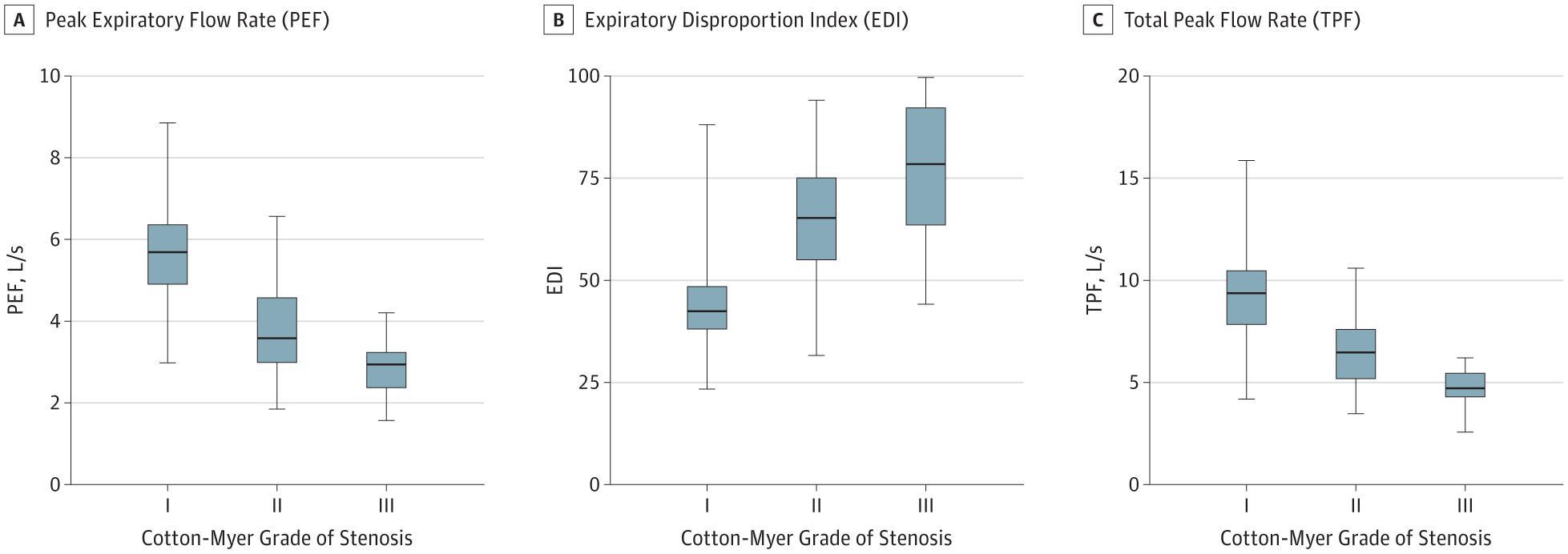
Myer-Cotton grading system
- Grade I: ≤50% obstruction
- Grade II: 51–70% obstruction
- Grade III: 71–99% obstruction
- Grade IV: No detectable lumen
- Higher grades (and pre-operative tracheostomy) are independent predictors of need for surgical resection[16]
Pulmonary function tests / Flow-volume loops
- Fixed obstruction: Plateau on both inspiratory and expiratory limbs (rectangular loop)
- Variable extrathoracic: Plateau on inspiratory limb with preserved expiratory flow
- Variable intrathoracic: Plateau on expiratory limb with preserved inspiratory flow
- FEV₁/PEF ratio >8 mL·L⁻¹·min⁻¹ suggests central/upper airway obstruction[28]
- Expiratory Disproportion Index (EDI): Highest sensitivity (88%) for predicting need for intervention[30]
- PEF, PIF, and EDI all significantly improve after stenosis is relieved[30]
- Bronchoscopy: Diagnostic gold standard — allows direct visualization, grading, biopsy, and simultaneous therapeutic intervention[1][5][24]
ECG
- ECG is not a primary diagnostic tool for tracheal stenosis
- Obtain ECG as part of preoperative assessment before bronchoscopy or surgical intervention
- Chronic hypoxia from severe stenosis may show signs of right heart strain (right axis deviation, P pulmonale, RV hypertrophy) in advanced cases
- Rule out cardiac causes of dyspnea in the differential
Assessment
- Clinical summary: Tracheal stenosis presents insidiously with progressive dyspnea, stridor, and exercise intolerance. Symptoms typically do not manifest until >50% luminal narrowing, and work of breathing increases rapidly beyond 70% obstruction[9-10]
- Severity stratification: Based on Myer-Cotton grade, PFT findings, and symptom burden[18][27]
- Typical presentation: Post-intubation — delayed onset 4–6 weeks after extubation; idiopathic SGS — middle-aged white female with progressive dyspnea misdiagnosed as asthma[4][18]
- Atypical presentations: Inflammatory stenosis may present as the first manifestation of systemic disease in 66% of cases[3]
- Complications: Respiratory failure, recurrent pneumonia, mucus plugging (especially with stents), airway fire during procedures, restenosis (76% relapse rate in inflammatory causes)[3][31]
Treatment Plan
Initial stabilization (ED)
- Secure airway — heliox (70:30 or 80:20) as temporizing measure to reduce work of breathing
- Humidified oxygen, upright positioning
- Racemic epinephrine nebulization for acute mucosal edema
- Dexamethasone IV for edema reduction
- If critical obstruction: emergent rigid bronchoscopy for debulking/dilation; if unavailable, endotracheal intubation with a smaller tube past the stenosis or emergent tracheostomy/cricothyrotomy[5][11]
Definitive management
- The ACCP 2025 guidelines recommend a comprehensive evaluation including CT chest and appropriate labs, followed by either therapeutic bronchoscopy or surgical resection for symptomatic stenosis:[13]
- Surgical resection with primary anastomosis: Preferred definitive treatment for focal benign stenosis in operable patients. Three-year recurrence rate of only 1.2% vs. 28% for dilation and 12.4% for endoscopic resection with medical therapy. Resection-anastomosis showed adjusted HR 2.0 for clinical resolution compared to stenting[13][32]
- Endoscopic interventions (for non-surgical candidates or as bridge to surgery):
- Balloon or rigid dilation ± adjunctive therapies[13]
- Laser (CO₂, Nd:YAG) or electrocautery ablation of scar tissue[13]
- Intralesional triamcinolone injection[12]
- Topical mitomycin C application[13]
- Airway stent placement — reserved for failed bronchoscopic/systemic treatments[13]
- Rigid bronchoscopy preferred over flexible for therapeutic interventions, under general anesthesia[13]
- Systemic therapy: Glucocorticoids + methotrexate for GPA/RP-related stenosis; anti-GERD therapy for reflux-associated stenosis[3][14]
Disposition
- Admission criteria: Stridor at rest, respiratory distress, hypoxia, need for emergent airway intervention, new diagnosis with significant obstruction (Myer-Cotton grade III–IV)
- ICU admission: Impending respiratory failure, post-emergent airway intervention, hemodynamic instability
- Observation: Post-dilation monitoring (typically 4–6 hours minimum), new stent placement
- Discharge criteria: Stable airway, no stridor at rest, adequate oxygenation, able to tolerate oral intake, reliable follow-up arranged
- Specialist consultation triggers: Interventional pulmonology, thoracic surgery, and otolaryngology — a multidisciplinary team approach is essential. Rheumatology for suspected autoimmune etiology[1][3][13]
Follow Up / Return Precautions
- Follow-up timing: Post-dilation — 4–6 weeks for reassessment; PFTs at regular intervals for surveillance (PEF is a simple, reliable monitoring parameter)[18][30]
- Symptoms requiring immediate reassessment: Worsening dyspnea, new or worsening stridor, inability to clear secretions, fever (if stented — concern for granulation tissue/infection), hemoptysis
Patient counseling
- Recurrence is common — 76% relapse rate in inflammatory causes; >85% of idiopathic SGS patients require repeat intervention within 5 years[3][18]
- Compliance with anti-reflux therapy if GERD is identified[14]
- Smoking cessation (smoking history predicts need for resection)[16]
- Diabetes optimization[7]
- Expected recovery: Post-dilation — immediate symptom improvement but high recurrence risk; post-surgical resection — excellent long-term outcomes with low recurrence in appropriately selected patients[13][32]
References
1. The Role of Bronchoscopy in the Multidisciplinary Approach to Benign Tracheal Stenosis. — Ravikumar N, Ho E, Wagh A, Murgu S. Journal of Thoracic Disease. 2023.
2. Tracheobronchial Stenosis: Causes and Advances in Management. — Puchalski J, Musani AI. Clinics in Chest Medicine. 2013.
3. Presentation, Diagnosis, and Management of Subglottic and Tracheal Stenosis During Systemic Inflammatory Diseases. — Catano J, Uzunhan Y, Paule R, et al. Chest. 2022.
4. Laryngotracheal stenosis: Mechanistic review. — Carpenter DJ, Hamdi OA, Finberg AM, Daniero JJ. Head & Neck. 2022.
5. Interventional Pulmonology. — Seijo LM, Sterman DH. The New England Journal of Medicine. 2001.
6. Acquired Tracheal Stenosis: Cervical Slide Tracheoplasty. — Li C, Rutter MJ. Seminars in Pediatric Surgery. 2021.
7. Risk Factors for Patients With Tracheal Stenosis: A Systematic Review and Meta-Analysis. — Hong S, Wu X, Feng H, et al. The Journal of International Medical Research. 2024.
8. Management of Postintubation Tracheal Stenosis in a Neurosurgical Patient With Tracheomalacia and Scarring Tendency: A Case Report. — Zhan Y, Zhang S, Chen M, Pu H. Medicine. 2026.
9. Subglottic Stenosis Position Affects Work of Breathing. — Yang MM, Higano NS, Gunatilaka CC, et al. The Laryngoscope. 2021.
10. Relationship Between Degree of Obstruction and Airflow Limitation in Subglottic Stenosis. — Lin EL, Bock JM, Zdanski CJ, Kimbell JS, Garcia GJM. The Laryngoscope. 2018.
11. Successful Rescue Using Tracheal Intubation Cannula for Severe Central Airway Stenosis After Tracheotomy: A CARE Compliant Case Report. — Li HF, Xing BP, Song LS, Wang W, Liu BH. Medicine. 2020.
12. Endoscopic Treatment of Benign Tracheal Stenosis: A Single-Centre Study. — Kather D, Steinack C, Franzen DP. Swiss Medical Weekly. 2024.
13. Management of Central Airway Obstruction: An American College of Chest Physicians Clinical Practice Guideline. — Mahmood K, Frazer-Green L, Gonzalez AV, et al. Chest. 2025.
14. Idiopathic Tracheal Stenosis: Successful Outcome With Antigastroesophageal Reflux Disease Therapy. — Terra RM, de Medeiros IL, Minamoto H, et al. The Annals of Thoracic Surgery. 2008.
15. The Inverted Steeple Sign, Tracheal Tug, and Biphasic Stridor: A Triad for Diagnosing Congenital Tracheal Stenosis. — Rajvanshi N, Ks A, Kumar TVV. Pediatric Pulmonology. 2025.
16. Management of Benign Airway Stenosis-Predictors of Tracheal Resection. — Patel AJ, Budacan AM, Kumar S, et al. Journal of Thoracic Disease. 2024.
17. Staged Laryngotracheoplasty in Adult Laryngotracheal Stenosis: Predictors of Long-term Decannulation. — Liu IY, Mendelsohn AH, Ching H, et al. JAMA Otolaryngology-- Head & Neck Surgery. 2015.
18. Utility of Routine Spirometry Measures for Surveillance of Idiopathic Subglottic Stenosis. — Carpenter DJ, Ferrante S, Bakos SR, et al. JAMA Otolaryngology-- Head & Neck Surgery. 2019.
19. Nonneoplastic Tracheal and Bronchial Stenoses. — Grenier PA, Beigelman-Aubry C, Brillet PY. Radiologic Clinics of North America. 2009.
20. Flow Volume Loops in the Evaluation of Upper Airway Obstruction. — Lunn WW, Sheller JR. Otolaryngologic Clinics of North America. 1995.
21. ACR Appropriateness Criteria® Tracheobronchial Disease. — Expert Panel on Thoracic Imaging, Little BP, Walker CM, et al. Journal of the American College of Radiology : JACR. 2024.
22. Predictors of Response to Endoscopic Management of Subglottic/Tracheal Stenosis in Patients Without Tracheostomy. — Ahmadian D, Gleadhill CM, Wehbi N, Bixby BA, Yip HT. American Journal of Otolaryngology. 2023.
23. Clinical Manifestations and Treatment of Idiopathic and Wegener Granulomatosis–Associated Subglottic Stenosis. — Taylor SC, Clayburgh DR, Rosenbaum JT, Schindler JS. JAMA Otolaryngology-- Head & Neck Surgery. 2013.
24. A Review on Diagnostic Assessments of Tracheal Stenosis. — Monjezi M, Rismanian M, Jamaati H. Biomedical Engineering Online. 2025.
25. Diagnostic Accuracy of Non-Invasive Modalities for Laryngotracheal Stenosis: A Systematic Review and Meta-Analysis. — Klopper GJ, Adeniyi OV. European Archives of Oto-Rhino-Laryngology : Official Journal of the European Federation of Oto-Rhino-Laryngological Societies : Affiliated With the German Society for Oto-Rhino-Laryngology - Head and Neck Surgery. 2026.
26. Accuracy of Magnetic Resonance Imaging for Grading of Subglottic Stenosis in Patients With Granulomatosis With Polyangiitis: Correlation With Pulmonary Function Tests and Laryngoscopy. — Henes FO, Laudien M, Linsenhoff L, et al. Arthritis Care & Research. 2018.
27. Endoscopic Management of Subglottic Stenosis. — Feinstein AJ, Goel A, Raghavan G, et al. JAMA Otolaryngology-- Head & Neck Surgery. 2017.
28. ERS/ATS Technical Standard on Interpretive Strategies for Routine Lung Function Tests. — Stanojevic S, Kaminsky DA, Miller MR, et al. The European Respiratory Journal. 2022.
29. Evaluation of Major Airway Lesions Using the Flow-Volume Loop. — Hyatt RE. The Annals of Otology, Rhinology, and Laryngology. 1975.
30. Spirometry in Laryngotracheal Stenosis: A Systematic Review and Meta-Analysis. — Alshareef W, Almutairi N, Sindi A, et al. European Archives of Oto-Rhino-Laryngology : Official Journal of the European Federation of Oto-Rhino-Laryngological Societies : Affiliated With the German Society for Oto-Rhino-Laryngology - Head and Neck Surgery. 2023.
31. Treatment of Benign Tracheal Stenosis Using Endoluminal Spray Cryotherapy. — Bhora FY, Ayub A, Forleiter CM, et al. JAMA Otolaryngology-- Head & Neck Surgery. 2016.
32. Stent and Resection Anastomosis in Patients With Complex Tracheal Stenosis: The Stars Retrospective Multicenter Trial. — Marchioni A, Moretti A, Tonelli R, et al. Interdisciplinary Cardiovascular and Thoracic Surgery. 2025.
Figure
More from Deep Dive
Reviewed by Dr. Lucas Mastropaolo. SymptomDx is an educational tool for medical professionals — it does not replace clinical judgment. Verify all clinical data and drug dosages with authoritative sources.