Transfusion-Related Acute Lung Injury (TRALI)
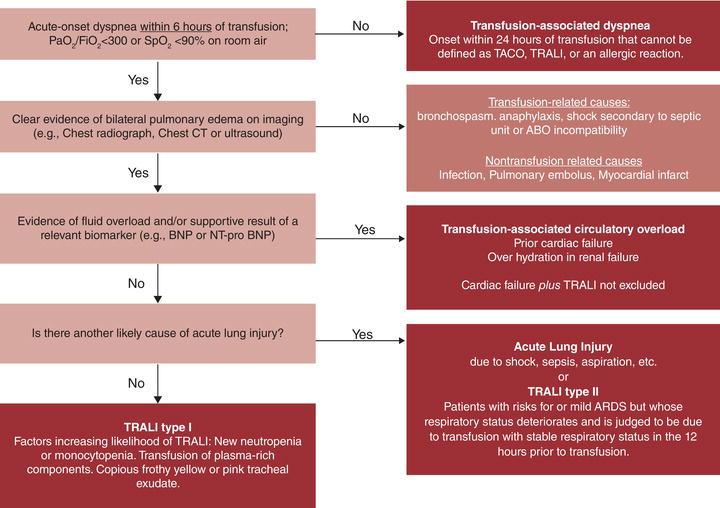
TRALI is a life-threatening, non-cardiogenic pulmonary edema occurring during or within 6 hours of blood product transfusion, representing a leading cause of transfusion-related mortality with an overall mortality rate of 6–12% (exceeding 40% in critically ill patients).[1-2] It is mediated primarily through a "two-hit" model: a recipient priming event (e.g., sepsis, surgery) followed by a transfusion-related trigger (donor anti-HLA/anti-HNA antibodies or bioactive lipids).[3-4] Current consensus distinguishes TRALI type I (no pre-existing ARDS risk factor) from TRALI type II (pre-existing ARDS risk factor with stable respiratory status in the 12 hours before transfusion).[5]
The following diagnostic algorithm illustrates the approach to acute dyspnea within 6 hours of transfusion:
History
- Temporal relationship: Onset of respiratory distress during or within 6 hours of any blood product transfusion (pRBCs, FFP, platelets, whole blood, cryoprecipitate)[3-4]
- Characterize dyspnea: acute onset, rapidly progressive, severity of hypoxia
- Ask about the type, volume, and number of blood products transfused and timing of symptom onset relative to transfusion
- Inquire about prior transfusion reactions or prior TRALI episodes
- Assess for pre-existing conditions that may serve as the "first hit": recent surgery (especially liver surgery), sepsis/infection, mechanical ventilation, trauma, massive transfusion[3][7]
- Important negatives: no prior heart failure symptoms, no recent volume overload, no known allergies to blood products
Alarm Features
- Acute hypoxemia (PaO₂/FiO₂ ≤ 300 mmHg) with rapid desaturation[4]
- Severe respiratory distress requiring intubation
- Hypotension — can progress to cardiovascular collapse
- Copious frothy pink-tinged secretions from the endotracheal tube[3]
- Fever with rigors (may mimic septic transfusion reaction)
- Transient leukopenia — a relatively specific finding that may help distinguish TRALI from TACO[3]
- Any respiratory deterioration during or shortly after transfusion should prompt immediate cessation of the transfusion
Medications
- No specific pharmacologic therapy is proven effective for TRALI[4][8]
- Diuretics are NOT indicated — TRALI is non-cardiogenic edema; diuresis may worsen hypotension[4][9]
- Corticosteroids: role is unproven; not routinely recommended[4][8]
- Vasopressors may be needed for refractory hypotension[9]
- Avoid further transfusions unless absolutely necessary; if transfusion is critical, use products from male-only donors or antibody-screened donors[3][7]
- Caution: if TACO is also suspected (overlap cases), diuretics may be considered, but this requires careful clinical judgment[10]
Diet
- Not directly applicable in the acute setting
- NPO if intubation is anticipated or the patient is hemodynamically unstable
- Fluid restriction is recommended as part of a restrictive fluid strategy consistent with ARDS management[3][8]
Review of Systems
- Pulmonary: dyspnea, cough, frothy sputum, chest tightness
- Cardiovascular: hypotension, tachycardia (distinguish from hypertension/JVD seen in TACO)
- Constitutional: fever, rigors, chills (present in ~30% of cases)[3]
- Skin: flushing, urticaria (if present, consider anaphylactic transfusion reaction)
- GI: nausea (nonspecific)
- Neurologic: altered mental status from hypoxia
Collateral History and Family History
- Donor history is critical: obtain information from the blood bank regarding donor sex, parity, and antibody status — plasma from multiparous female donors carries the highest risk due to HLA antibodies (prevalence ~24% in previously pregnant women)[4][7]
- Confirm blood product type, storage duration, and lot numbers for hemovigilance reporting
- Family history is not directly relevant to TRALI pathogenesis
- Social history: chronic alcohol abuse and current smoking are independent recipient risk factors[3][7]
Risk Factors
Recipient (first hit) risk factors
- Liver surgery
- Chronic alcohol abuse
- Sepsis/shock
- High peak airway pressures during mechanical ventilation
- Current smoking
- Positive fluid balance
- Elevated IL-8 levels
- ICU or perioperative setting
Transfusion (second hit) risk factors
- Plasma from female donors (especially multiparous) — OR 4.5 for TRALI
- High-volume plasma-rich components (FFP, apheresis platelets)
- Donor anti-HLA class I, class II, or anti-HNA antibodies (especially HNA-3a)
- Bioactive lipids accumulating during prolonged storage of cellular blood products
- Multiple transfusions / massive transfusion protocols
Differential Diagnosis
- Transfusion-associated circulatory overload (TACO) — the most important differential; characterized by hydrostatic (cardiogenic) edema, elevated BNP, hypertension, JVD, response to diuretics[11]
- Septic transfusion reaction — bacterial contamination of blood products; high fever, rigors, hypotension; blood cultures of product and patient are diagnostic
- Anaphylactic transfusion reaction — urticaria, angioedema, bronchospasm, hypotension; typically in IgA-deficient recipients
- Acute respiratory distress syndrome (ARDS) from other causes — pneumonia, aspiration, pancreatitis; distinguished by whether transfusion is the likely cause[5]
- Acute hemolytic transfusion reaction — flank pain, hemoglobinuria, DIC; ABO incompatibility
- Cardiogenic pulmonary edema — pre-existing heart failure exacerbation
- Pulmonary embolism — acute dyspnea and hypoxia but typically without bilateral infiltrates
Key distinguishing features of TRALI vs. TACO
- Export Feature TRALI TACO References Edema type Non-cardiogenic (permeability) Cardiogenic (hydrostatic)[1]
- BNP/NT-proBNP Normal or mildly elevated Significantly elevated[1-2]
- Blood pressure Often hypotensive Often hypertensive[1, 3]
- Fluid balance Variable Positive[1]
- Fever Common Uncommon[3]
- Response to diuretics No improvement Improvement[1, 4]
- Edema fluid protein High (exudative) Low (transudative)[1]
- Leukopenia May be present (transient) Absent[3]
Past Medical History
- Prior transfusion reactions or prior TRALI episodes (recurrence is possible if re-exposed to the same antibody)
- Chronic liver disease, cirrhosis
- Hematologic malignancies requiring frequent transfusions
- Recent surgery (especially hepatic, cardiac, or major abdominal)
- Chronic lung disease (may worsen presentation)
- Heart failure history (important to distinguish TACO)
- Renal disease (fluid management implications)
Physical Exam
- Vitals: Tachypnea, tachycardia, hypotension (distinguishes from TACO which tends toward hypertension), fever, hypoxemia on pulse oximetry[3]
- Pulmonary: Bilateral crackles/rales, decreased breath sounds, increased work of breathing
- Cardiovascular: Assess for JVD (absent in TRALI, present in TACO), S3 gallop (absent in TRALI), peripheral edema
- Airway: Frothy pink-tinged secretions if intubated[3]
- Skin: Cyanosis from hypoxemia; check for urticaria/angioedema (suggests allergic reaction instead)
- Abdomen: Assess for hepatomegaly (volume overload)
Lab Studies
- ABG: Assess PaO₂/FiO₂ ratio (≤300 mmHg consistent with acute lung injury)[4]
- CBC: Transient leukopenia is a relatively specific finding; also assess for hemolysis (hemolytic reaction)[3]
- BNP/NT-proBNP: Normal or mildly elevated in TRALI; significantly elevated in TACO — key differentiating biomarker[10-11]
- Comprehensive metabolic panel: Renal function, electrolytes
- Blood cultures (patient and implicated blood product): Rule out septic transfusion reaction
- Direct antiglobulin test (DAT): Rule out acute hemolytic transfusion reaction
- LDH, haptoglobin, bilirubin: Hemolysis workup if suspected
- Donor antibody testing: Anti-HLA class I/II and anti-HNA antibodies in donor plasma (coordinate with blood bank)[4][12]
- Recipient HLA/HNA typing: To confirm cognate antibody-antigen match
- Emerging biomarkers: IL-6 (pro-inflammatory, elevated in TRALI) and IL-10 (anti-inflammatory) may help differentiate TRALI from TACO[13]
Imaging
- Chest X-ray (first-line): Bilateral pulmonary infiltrates consistent with pulmonary edema, without cardiomegaly or vascular cephalization (which would suggest TACO)[3-4]
- Findings are non-specific and can be indistinguishable from ARDS or TACO on imaging alone
- CXR should improve within 96 hours in typical TRALI[9]
- CT chest: Not routinely required; may help if diagnosis is uncertain or alternative pathology is suspected (e.g., PE)
- Echocardiography: Useful to assess cardiac function and exclude cardiogenic edema; expected to show normal left ventricular function and normal filling pressures in TRALI[11]
- Lung ultrasound: Point-of-care tool to assess for B-lines (bilateral), pleural effusions, and cardiac function
Special Tests
- Pulmonary artery catheterization (if available): Pulmonary capillary wedge pressure (PCWP) ≤18 mmHg supports non-cardiogenic edema (TRALI); >18 mmHg suggests TACO[4][12]
- Edema fluid protein analysis (if intubated): Edema fluid-to-plasma protein ratio >0.65 indicates exudative (permeability) edema consistent with TRALI[11]
Donor antibody workup (coordinate with blood bank)
- HLA class I and class II antibody screening
- Granulocyte immunofluorescence test (GIFT) for anti-HNA antibodies
- Crossmatch of donor serum against recipient neutrophils/lymphocytes
- Hemovigilance reporting: Mandatory reporting to the blood bank and transfusion service for all suspected TRALI cases
ECG
- ECG is indicated to rule out acute cardiac pathology (MI, arrhythmia) as a cause of pulmonary edema
- TRALI itself does not produce specific ECG changes
- Sinus tachycardia is the most common finding
- Look for signs of right heart strain (acute cor pulmonale) in severe cases: right axis deviation, S1Q3T3, RV strain pattern
- Absence of LVH, atrial enlargement, or ischemic changes helps distinguish from cardiogenic edema
Assessment
TRALI is a clinical diagnosis based on
- Acute onset of hypoxemia (PaO₂/FiO₂ ≤ 300) and bilateral pulmonary edema
- Temporal association with transfusion (during or within 6 hours)
- No pre-existing acute lung injury before transfusion (TRALI type I) OR pre-existing ARDS risk factor with stable respiratory status in the prior 12 hours that acutely worsens (TRALI type II)
- Absence of circulatory overload as the primary cause
- Severity stratification: Ranges from mild (supplemental O₂ only) to severe (requiring intubation/mechanical ventilation or ECMO). Mortality is 6–12% overall but exceeds 40% in critically ill patients.[1-2] Most patients who survive recover within 48–96 hours.[9][14]
- Atypical presentations include delayed onset (up to 72 hours), isolated hypotension without significant respiratory symptoms, or overlap with TACO (TRALI/TACO overlap).[3][10][13]
Treatment Plan
Immediate actions
- Stop the transfusion immediately[9]
- Maintain IV access; do NOT discard the blood product — return it to the blood bank for investigation
- Notify the blood bank/transfusion service
Supportive care (mainstay of treatment)
- Supplemental oxygen: Titrate to maintain SpO₂ >92%
- Mechanical ventilation if needed: Use lung-protective ventilation (tidal volume 6 mL/kg ideal body weight, plateau pressure <30 cmH₂O, appropriate PEEP) per ARDS management protocols
- Restrictive fluid strategy: Avoid aggressive IV fluids; conservative fluid management as in ARDS[3][8]
- Vasopressors (norepinephrine preferred) for refractory hypotension[9]
- ECMO: Consider in refractory hypoxemia not responsive to conventional mechanical ventilation[9]
What NOT to do
- Do NOT give diuretics (non-cardiogenic edema; may worsen hypotension)[4]
- Do NOT give corticosteroids routinely (no proven benefit)[4][8]
Prevention for future transfusions
- Adopt a restrictive transfusion strategy — avoid unnecessary transfusions
- Use male-only donor plasma and screen female apheresis platelet donors for HLA antibodies
- If the implicated donor is identified with cognate antibodies, permanently defer that donor from donating plasma-containing products
- Consider alternatives to plasma (e.g., prothrombin complex concentrates, fibrinogen concentrate) when clinically appropriate
Disposition
- Admit to ICU if: intubation required, hemodynamic instability, severe hypoxemia, or ongoing clinical deterioration[8]
- Monitored bed/step-down: Mild cases with stable vitals responding to supplemental O₂ alone
- Observation: Minimum 24 hours of monitoring even for mild cases, given potential for delayed worsening
Specialist consultation triggers
- Pulmonary/critical care for ventilator management
- Transfusion medicine/hematology for donor workup and hemovigilance
- Blood bank notification is mandatory for all suspected cases
Follow Up / Return Precautions
- Expected recovery: Most patients improve within 48–96 hours; CXR should clear within 4 days. No permanent pulmonary sequelae are expected in survivors.[9][14]
- Hemovigilance: Ensure the case is reported to the institutional transfusion committee and national hemovigilance system (e.g., FDA in the US)[5]
- Future transfusion planning: Document the reaction in the medical record; if the patient requires future transfusions, use products from male donors or antibody-negative donors; avoid products from the implicated donor[3]
- Return precautions (if discharged): Return immediately for recurrent dyspnea, fever, chest pain, or any respiratory distress — especially if receiving further transfusions
- Follow-up: Pulmonary follow-up in 1–2 weeks to confirm radiographic resolution; repeat PFTs if symptoms persist beyond expected recovery window
References
1. Transfusion-Related Acute Lung Injury: From Mechanistic Insights to Therapeutic Strategies. — Fang X, Mo C, Zheng L, et al. Advanced Science. 2025.
2. Transfusion-Related Acute Lung Injury: Experimental Models to Study Pathogenesis and Therapeutic Strategies. — Rayatdoost F, Kapur R. Current Opinion in Immunology. 2025.
3. Transfusion Reactions: Prevention, Diagnosis, and Treatment. — Delaney M, Wendel S, Bercovitz RS, et al. Lancet. 2016.
4. Transfusion-Related Acute Lung Injury: Current Concepts for the Clinician. — Triulzi DJ. Anesthesia and Analgesia. 2009.
5. Transfusion-Related Acute Lung Injury: 36 Years of Progress (1985-2021). — Toy P, Looney MR, Popovsky M, et al. Annals of the American Thoracic Society. 2022.
6. Transfusion‐related acute lung injury and other respiratory‐related transfusion reactions. — E. Alexander Dent, H. Clifford Sullivan Rossi's Principles of Transfusion Medicine 6e. 2022.
7. Transfusion-Related Acute Lung Injury: Incidence and Risk Factors. — Toy P, Gajic O, Bacchetti P, et al. Blood. 2012.
8. State of the Art Management of Transfusion-Related Acute Lung Injury (TRALI). — Goldberg AD, Kor DJ. Current Pharmaceutical Design. 2012.
9. Transfusion related acute lung injury: A pediatric perspective. — Sanchez R, Toy P. Pediatric Blood & Cancer. 2005.
10. How I Diagnose and Treat Cardiorespiratory Complications of Transfusion. — Vlaar APJ, Zwaginga JJ, Wiersum-Osselton JC. Blood. 2025.
11. Transfusion-Associated Circulatory Overload and Transfusion-Related Acute Lung Injury. — Semple JW, Rebetz J, Kapur R. Blood. 2019.
12. Transfusion-Related Acute Lung Injury: A Review. — Looney MR, Gropper MA, Matthay MA. Chest. 2004.
13. Pulmonary Transfusion Reactions as an Immunological Spectrum Disorder. — Lowack J, Vlaar AP, Klanderman RB, Peters AL. Current Opinion in Immunology. 2025.
14. Indications for and Adverse Effects of Red-Cell Transfusion. — Carson JL, Triulzi DJ, Ness PM. The New England Journal of Medicine. 2017.
Figure
More from Deep Dive
Reviewed by Dr. Lucas Mastropaolo. SymptomDx is an educational tool for medical professionals — it does not replace clinical judgment. Verify all clinical data and drug dosages with authoritative sources.