Tularemia (Pneumonic)
Pneumonic tularemia is a rare but potentially life-threatening form of tularemia caused by Francisella tularensis, typically acquired through inhalation of contaminated aerosols or secondary to hematogenous spread.[1-2] This form has the highest mortality rate (up to 60% if untreated) and requires prompt recognition and treatment.[2]
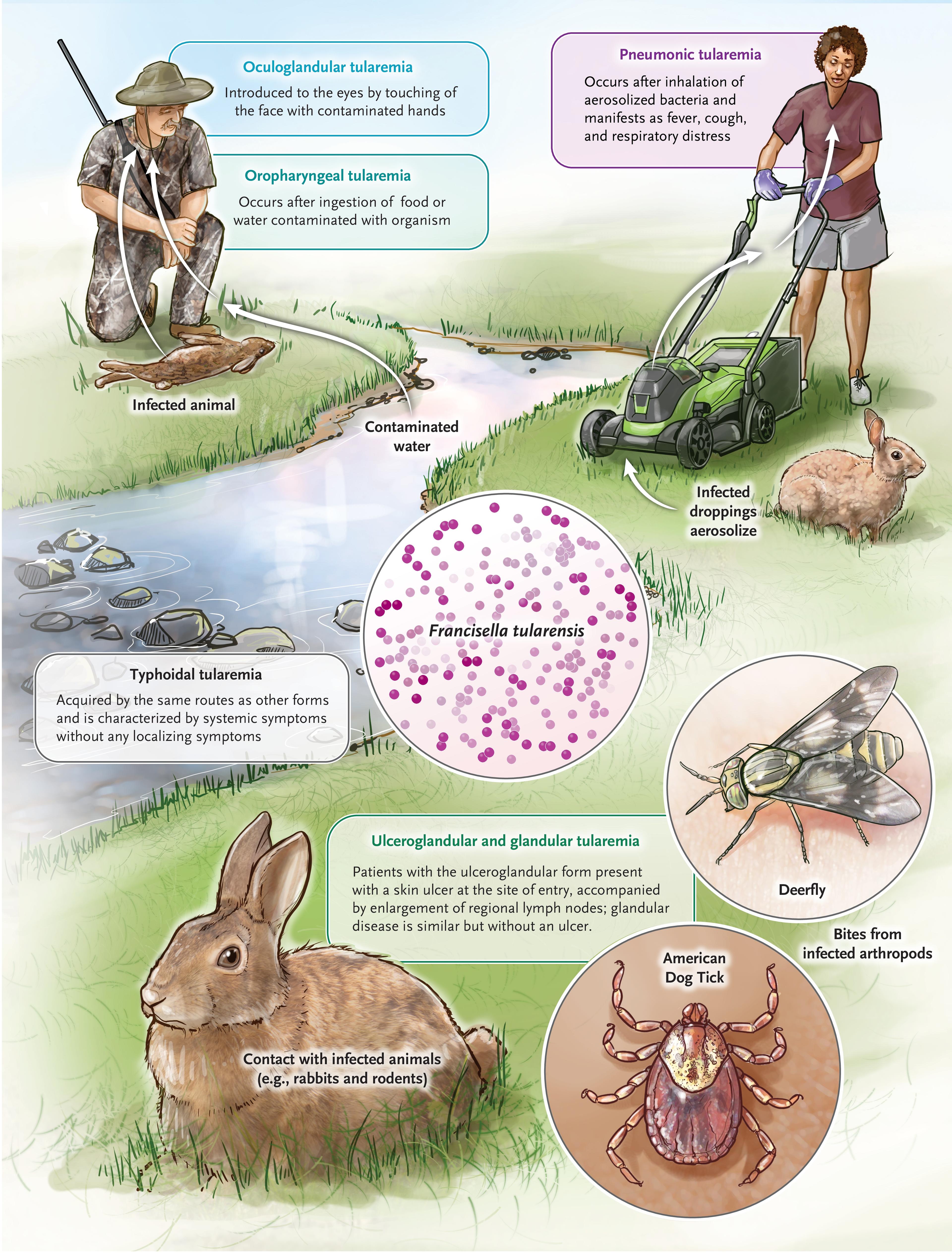
The following figure illustrates the various transmission routes and clinical manifestations of tularemia:
View full figure Figure 1. Tularemia — Modes of Acquisition and Manifestations. Going Down the Rabbit Hole. N Engl J Med. July 31, 2024.
History
Key HPI questions
- • Onset and duration of symptoms (typically 3-5 days incubation, range 1-14 days)[4]
- • Fever pattern and severity (38.0-41.5°C)[4]
- • Respiratory symptoms: cough (often with scant sputum), chest pain, dyspnea[1][5]
- • Constitutional symptoms: fatigue, headache, myalgias, malaise[1][4]
Symptom characterization
- • Fever is typically high-grade and acute in onset[4]
- • Cough is usually nonproductive or with minimal sputum[6]
- • Chest pain may be pleuritic[5]
Timing, triggers, severity, progression
- • Symptoms develop 1-14 days after exposure (average 3-5 days)[4]
- • Can progress rapidly to severe pneumonia and respiratory failure[7]
- • May present initially as systemic illness without prominent respiratory signs[7]
Associated symptoms
- • Headache, myalgias, malaise, chills[4]
- • Abdominal pain, nausea, vomiting (especially in typhoidal form)[7]
- • Pharyngitis may be present[4]
Important negatives
- • Absence of skin ulcers or lymphadenopathy (distinguishes from ulceroglandular form)[7]
- • No conjunctival involvement[7]
Alarm Features
Red flag symptoms/signs
- • High fever with rapid clinical deterioration[2]
- • Respiratory distress or failure[7]
- • Septic shock presentation[4]
- • Altered mental status[7]
Features suggesting life-threatening pathology
- • Pneumonic and typhoidal forms have highest mortality[2]
- • Rapid progression to severe pneumonia[7]
- • Signs of sepsis or multi-organ failure[7]
Indications for urgent escalation
- • Respiratory distress requiring oxygen support
- • Hemodynamic instability
- • Suspected bioterrorism exposure (requires immediate public health notification)[8]
Medications
Relevant medication contributors
- • Beta-lactam antibiotics are ineffective and should be avoided[9-10]
- • Anti-TNF agents increase risk of severe infection[6]
- • Immunosuppressive medications increase severity risk[6]
Common treatments
- • First-line for severe disease: Gentamicin 1.5 mg/kg IV q8h or streptomycin 15 mg/kg IM q12h[11]
- • First-line for mild-moderate disease: Ciprofloxacin 750 mg PO BID or levofloxacin 500 mg PO daily[8][11]
- • Alternative: Doxycycline 100 mg PO BID[11]
Contraindicated medications
- • Beta-lactam antibiotics (penicillins, cephalosporins)[9-10]
- • Most macrolides (except azithromycin in specific European strains)[10]
Medication interactions or cautions
- • Fluoroquinolones: avoid in pregnancy and young children due to musculoskeletal concerns[10]
- • Aminoglycosides: monitor renal function and hearing[11]
Diet
Dietary triggers or recommendations
- • No specific dietary restrictions during acute illness
- • Maintain adequate nutrition during prolonged illness
Hydration considerations
- • Ensure adequate hydration, especially with fever
- • Monitor fluid balance in severe cases
Review of Systems
Important ROS questions
- • Respiratory: cough, dyspnea, chest pain, hemoptysis
- • Constitutional: fever, chills, night sweats, weight loss
- • GI: abdominal pain, nausea, vomiting, diarrhea
- • Neurologic: headache, altered mental status
- • Skin: rash, ulcers, lymphadenopathy
High-yield associated systems
Collateral History and Family History
Important collateral information
- • Recent outdoor activities in endemic areas[1][5]
- • Animal exposure (rabbits, rodents, cats)[13]
- • Tick bites or arthropod exposure[5]
- • Travel to rural areas[1][5]
- • Occupational exposure (veterinarians, hunters, laboratory workers)
Relevant hereditary conditions
- • Immunodeficiency syndromes
- • Family history of unusual infections
Social context
- • Rural residence or activities[1][5]
- • Hunting, trapping, or animal handling[13]
- • Laboratory work with potential F. tularensis exposure
Risk Factors
Major epidemiologic risk factors
- • Rural residence or outdoor activities[1][5]
- • Contact with rabbits, rodents, or other small mammals[13]
- • Tick or deerfly bites[5]
- • Drinking untreated water[3]
- • Laboratory exposure[8]
Lifestyle contributors
- • Hunting, trapping, skinning animals[13]
- • Gardening, lawn mowing in endemic areas[3]
- • Camping in endemic areas
Comorbidities increasing risk
- • Immunosuppression (including anti-TNF therapy)[6]
- • Advanced age[12]
- • Chronic medical conditions[12]
Differential Diagnosis
Most important alternative diagnoses
- • Community-acquired pneumonia (bacterial, viral, atypical)
- • Tuberculosis[10]
- • Lung cancer or lymphoma[1]
- • Sarcoidosis[6]
- • Histoplasmosis or other endemic mycoses
Dangerous cannot-miss diagnoses
- • Pneumonic plague
- • Anthrax (inhalational)
- • Severe acute respiratory syndrome
- • Pneumonic tularemia in bioterrorism context[8]
Mimics and distinguishing features
- • vs. Tuberculosis: Tularemia has more acute onset, less cavitation[10]
- • vs. Lung cancer: Tularemia has fever, acute onset, exposure history[1]
- • vs. CAP: Tularemia often has mediastinal lymphadenopathy[1][12]
Past Medical History
Relevant prior conditions
- • Previous tularemia infection (provides some immunity)
- • Immunocompromising conditions
- • Chronic lung disease
Previous episodes
- • Prior tick-borne illnesses
- • Previous pneumonias
Surgical history
- • Thoracic procedures
- • Immunosuppressive procedures
Chronic illnesses impacting management
- • Renal disease (affects antibiotic dosing)[11]
- • Liver disease
- • Heart failure
Physical Exam
Key exam findings
- • Fever (often high-grade 38-41.5°C)[4]
- • Tachypnea, tachycardia
- • Pulmonary findings may be minimal early in disease[7]
Vital sign abnormalities
Focused exam maneuvers
- • Complete pulmonary examination
- • Lymph node examination (cervical, axillary, inguinal)
- • Skin examination for ulcers or rashes
- • Oropharyngeal examination
Expected vs concerning findings
- • Expected: Fever, mild respiratory findings initially[7]
- • Concerning: Respiratory distress, altered mental status, hypotension[7]
Lab Studies
Recommended labs
- • Complete blood count (usually normal or slightly elevated WBC)[4]
- • Comprehensive metabolic panel
- • Liver function tests (often elevated transaminases)[4]
- • Blood cultures (low sensitivity ~10%)[6]
- • Respiratory cultures if productive sputum
Expected abnormalities
- • Normal or slightly elevated WBC with normal differential[4]
- • Elevated hepatic transaminases[4]
- • Elevated inflammatory markers (ESR, CRP)
Labs used to rule out dangerous conditions
- • Blood cultures to rule out other bacterial pneumonia
- • Sputum cultures and stains
- • Procalcitonin may be elevated
Monitoring parameters
- • Renal function (if using aminoglycosides)[11]
- • Liver function
- • Complete blood count
Imaging
First-line imaging
Gold standard imaging
- • Chest CT: consistently shows mediastinal lymphadenopathy and pulmonary nodules[1]
- • May show subpleural micronodules or pleural effusion[1]
- • Subpleural round consolidations are characteristic[12]
Important imaging findings
- • Mediastinal lymphadenopathy (very common)[1][12]
- • Pulmonary nodules or consolidations[1]
- • Pleural effusions[1][12]
- • May mimic malignancy on PET scan[1]
When imaging is unnecessary
- • Chest imaging is essential for suspected pneumonic tularemia
Special Tests
Diagnostic scoring systems
- • No specific scoring systems available
Point-of-care tests
- • None available
Procedures or specialty tests
- • Bronchoscopy with EBUS-TBNA may be performed[5]
- • CT-guided biopsy (shows necrotizing granulomatous inflammation)[1][5]
ECG
ECG findings
- • Generally not specific for tularemia
- • May show sinus tachycardia
Indications for ECG
- • Severe illness with hemodynamic compromise
- • Elderly patients or those with cardiac risk factors
Assessment
Clinical summary
- • Pneumonic tularemia is a rare but serious form of tularemia with high mortality if untreated[2]
- • Often presents with nonspecific symptoms initially[1]
- • Imaging typically shows mediastinal lymphadenopathy and pulmonary nodules[1][12]
Severity stratification
- • Mild-moderate: Stable vital signs, minimal respiratory distress
- • Severe: Respiratory distress, hemodynamic instability, sepsis[2]
Typical vs atypical presentations
- • Typical: Acute febrile illness with respiratory symptoms and exposure history
- • Atypical: May present as systemic illness without prominent respiratory signs[7]
Complications to consider
Treatment Plan
Initial stabilization
- • Supportive care for respiratory distress
- • Fluid resuscitation if hypotensive
- • Oxygen support as needed
Medications and dosing
- • Severe disease: Gentamicin 1.5 mg/kg IV q8h or streptomycin 15 mg/kg IM q12h[11]
- • Mild-moderate disease: Ciprofloxacin 750 mg PO BID or levofloxacin 500 mg PO daily[8][11]
- • Alternative: Doxycycline 100 mg PO BID[11]
- • Duration: 10-14 days for severe cases, 14-21 days for mild-moderate[9][11]
Outpatient vs inpatient treatment
- • Inpatient: Severe disease, respiratory distress, hemodynamic instability
- • Outpatient: Mild disease with reliable follow-up
Follow-up management
- • Monitor for treatment response
- • Watch for complications or relapse[9]
Disposition
Admission criteria
- • Severe pneumonia or respiratory distress
- • Hemodynamic instability
- • Inability to tolerate oral medications
- • Concern for complications
Discharge criteria
- • Stable vital signs
- • Tolerating oral medications
- • Reliable follow-up available
- • No signs of complications
Observation indications
- • Borderline cases with mild respiratory symptoms
- • Elderly patients or those with comorbidities
Specialist consultation triggers
- • Infectious disease consultation for severe cases
- • Pulmonology if respiratory failure
- • ICU consultation for septic shock
Follow Up / Return Precautions
Follow-up timing
- • 48-72 hours for outpatients to assess response
- • Weekly follow-up until resolution
Symptoms requiring immediate reassessment
- • Worsening respiratory distress
- • High fever despite treatment
- • Signs of sepsis or shock
- • Inability to tolerate medications
Patient counseling points
- • Complete full antibiotic course[9]
- • Expect gradual improvement over days to weeks
- • Avoid beta-lactam antibiotics[9-10]
- • Report worsening symptoms immediately
Expected recovery course
- • Fever typically resolves within 24-115 hours depending on severity[12]
- • Complete recovery may take weeks
- • Relapse rates 5-15% depending on antibiotic choice[10]
References
1. Pulmonary Tularemia: A Diagnosis Not to Overlook. — Zaghdoudi A, Robin F, Moulinie J, et al. International Journal of Infectious Diseases : IJID : Official Publication of the International Society for Infectious Diseases. 2026.
2. Tularemia for Clinicians: An Up-to-Date Review on Epidemiology, Diagnosis, Prevention and Treatment. — Antonello RM, Giacomelli A, Riccardi N. European Journal of Internal Medicine. 2025.
3. Going Down the Rabbit Hole. — Burdick KJ, Ealick W, Vargas Acevedo H, Sectish TC, Sandora TJ. The New England Journal of Medicine. 2024.
4. Tick-Borne Diseases in the United States. — Spach DH, Liles WC, Campbell GL, et al. The New England Journal of Medicine. 1993.
5. Thoracic Manifestations of Tularaemia: A Case Series. — Vacca M, Wilhelms B, Zange S, et al. Infection. 2024.
6. Pulmonary tularaemia in a female adolescent with inflammatory bowel disease receiving infliximab: Do not miss the diagnosis. — Schwarzová V, Schwarz J, Mitrová K, et al. Pediatric Pulmonology. 2023.
7. Tularemia as a Biological Weapon: Medical and Public Health Management. — Dennis DT, Inglesby TV, Henderson DA, et al. The Journal of the American Medical Association. 2001.
8. Tularemia Antimicrobial Treatment and Prophylaxis: CDC Recommendations for Naturally Acquired Infections and Bioterrorism Response - United States, 2025. — Nelson CA, Meaney-Delman D, Fleck-Derderian S, Winberg J, Mead PS. MMWR. Recommendations and Reports : Morbidity and Mortality Weekly Report. Recommendations and Reports. 2025.
9. Tularemia Treatment: Experimental and Clinical Data. — Maurin M, Pondérand L, Hennebique A, et al. Frontiers in Microbiology. 2023.
10. Tularaemia: Clinical Aspects in Europe. — Maurin M, Gyuranecz M. The Lancet. Infectious Diseases. 2016.
11. Practice Guidelines for the Diagnosis and Management of Skin and Soft Tissue Infections: 2014 Update by the Infectious Diseases Society of America. — Stevens DL, Bisno AL, Chambers HF, et al. Clinical Infectious Diseases : An Official Publication of the Infectious Diseases Society of America. 2014.
12. Treatment Outcome of Severe Respiratory Type B Tularemia Using Fluoroquinolones. — Widerström M, Mörtberg S, Magnusson M, Fjällström P, Johansson AF. Clinical Infectious Diseases : An Official Publication of the Infectious Diseases Society of America. 2024.
13. Hunting for Tularaemia - A Review of Cases in North Carolina. — Rimawi RH, Shah KB, Chowdhary RA, Cook PP. Zoonoses and Public Health. 2015.
Figure
More from Deep Dive
Reviewed by Dr. Lucas Mastropaolo. SymptomDx is an educational tool for medical professionals — it does not replace clinical judgment. Verify all clinical data and drug dosages with authoritative sources.