Tularemia (Ulceroglandular)
Ulceroglandular tularemia is the most common clinical form of tularemia, caused by the gram-negative intracellular coccobacillus Francisella tularensis. It is characterized by a cutaneous ulcer at the inoculation site with painful regional lymphadenopathy, typically following a tick bite or direct contact with infected animals.[1-3] It is a CDC Category A bioterrorism agent due to its extremely low infectious dose (~10 organisms) and ease of aerosolization.[4-5]
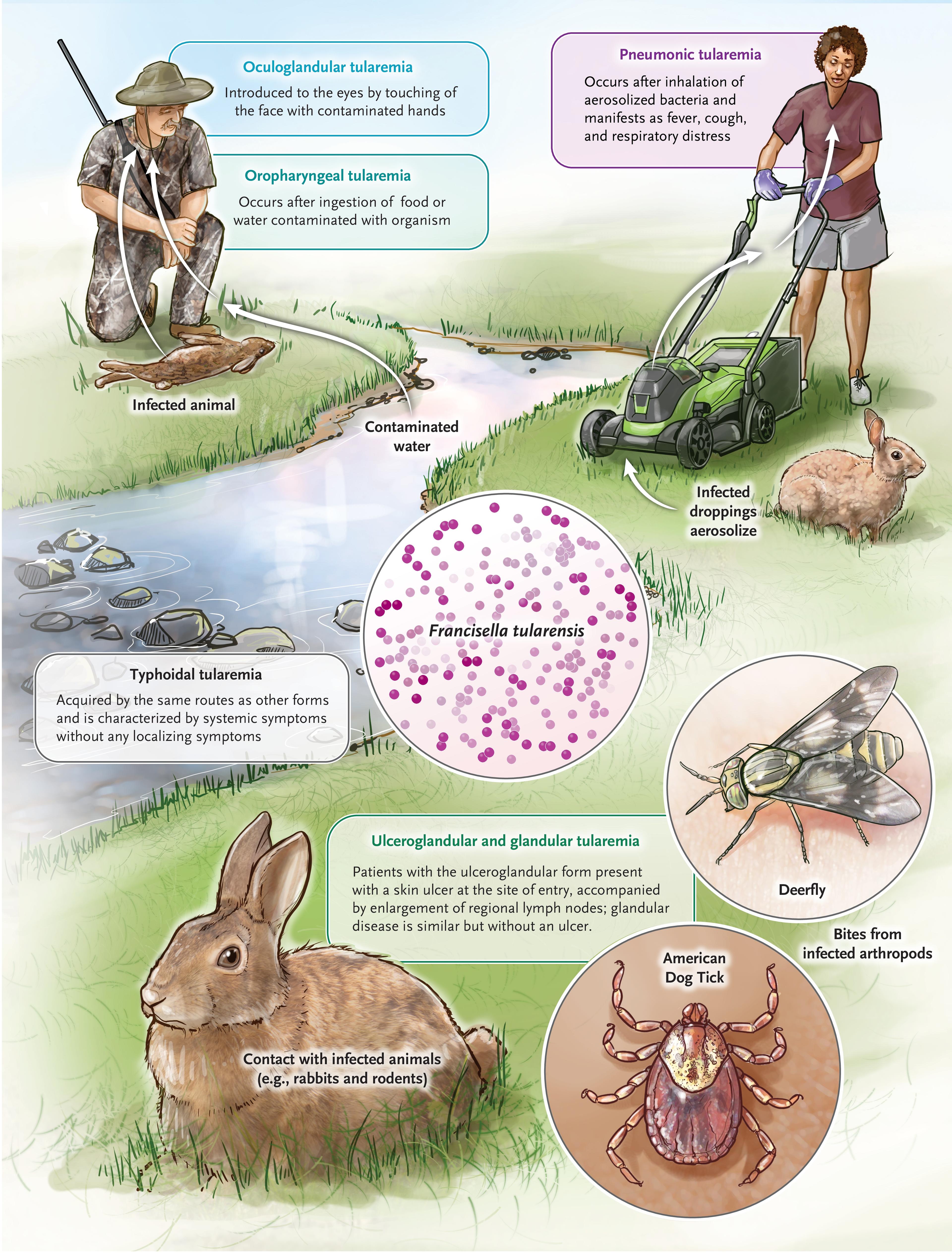
The following figure illustrates the various modes of acquisition and their corresponding clinical syndromes:
View full figure Figure 1. Tularemia — Modes of Acquisition and Manifestations. Going Down the Rabbit Hole. N Engl J Med. July 31, 2024.
History
- Exposure history is paramount: Ask about tick bites (most common US vector, ~69% of cases), handling rabbits/hares/rodents, skinning or butchering wild game, cat bites/scratches, deer fly bites, mowing over animal carcasses, and contaminated water exposure[2][5][7]
- Incubation period: Typically 3–5 days (range 1–21 days)[1][8-9]
- Symptom characterization: Abrupt onset of fever (38–40°C), chills, headache, malaise, myalgia, and anorexia, followed by development of a skin lesion at the inoculation site and painful swollen lymph nodes[1-2][5]
- Timing: Patients seek care after a median of 3 days of illness[7]
- Important negatives: No person-to-person transmission; no respiratory symptoms (distinguishes from pneumonic form); no pharyngitis (distinguishes from oropharyngeal form)[2][5]
Alarm Features
- High fever with systemic toxicity (rigors, prostration, confusion) — suggests progression to typhoidal or septic tularemia[5]
- Respiratory symptoms (cough, dyspnea, pleuritic pain) — any form can develop secondary pneumonia via hematogenous spread[5][9]
- Pulse-temperature dissociation — noted in up to 42% of patients; should raise suspicion[5][10]
- Suppurative lymphadenopathy with fluctuance — occurs in ~30% and may require surgical drainage[9][11]
- Immunocompromised patients — at risk for severe, atypical, and disseminated disease[2][12]
- Delayed treatment >2–3 weeks from onset — associated with higher treatment failure and relapse rates[11]
Medications
Effective treatments
Mild-moderate disease (outpatient)
- Ciprofloxacin 500–750 mg PO BID × 10–14 days[1][13-14]
- Levofloxacin 500 mg PO daily × 10–14 days[1]
- Doxycycline 100 mg PO BID × 14–21 days (higher relapse rate with shorter courses)[1][13]
Severe disease (inpatient)
- Gentamicin 5 mg/kg/day IV (or 1.5 mg/kg q8h) — first-line for severe tularemia[1][4]
- Streptomycin 15 mg/kg IM q12h (max 2 g/day) — historical gold standard[1][15]
- Step-down: Parenteral aminoglycoside until clinical improvement, then oral fluoroquinolone or doxycycline to complete 10–14 days[1]
Contraindicated/ineffective
- Beta-lactams — F. tularensis is intrinsically resistant; empiric use is a common cause of treatment failure[1][11]
- Most macrolides — generally ineffective[11]
- Anti-tuberculosis agents — ineffective[11]
Cautions
- Doxycycline and tetracyclines are bacteriostatic → higher relapse rates, especially with courses <7–10 days[1]
- Aminoglycosides require renal dose adjustment and monitoring[1]
- The 2025 CDC guidelines now designate fluoroquinolones and doxycycline as first-line for outbreaks of any size[13]
Diet
- No specific dietary triggers or restrictions
- Ensure adequate hydration, especially in febrile patients with systemic symptoms
- Avoid consumption of untreated water from natural sources in endemic areas (potential transmission route)[2][5]
- Ensure thorough cooking of wild game meat
Review of Systems
- Constitutional: Fever, chills, rigors, night sweats, weight loss, fatigue, anorexia[2][5]
- Skin: Ulcer or eschar at bite/contact site; erythema nodosum or erythema multiforme (rare)[8-9]
- Lymphatic: Painful regional lymphadenopathy (inguinal/femoral for lower extremity bites; axillary for upper extremity; cervical for head/neck)[3][10]
- Respiratory: Cough, dyspnea, pleuritic chest pain (screen for secondary pneumonia)[5]
- GI: Nausea, vomiting, diarrhea, abdominal pain[2][5]
- Musculoskeletal: Myalgia, arthralgia, low back pain[5][9]
- Neurologic: Headache; confusion/stupor in severe typhoidal forms[9]
- Ophthalmologic: Photophobia, conjunctivitis (if oculoglandular form suspected)[2]
Collateral History and Family History
- Occupational exposure: Hunting, trapping, butchering, farming, landscaping/mowing, veterinary work, laboratory work[5][16]
- Recreational exposure: Hiking, camping, outdoor activities in endemic areas during summer months[7][16]
- Animal contact: Recent contact with rabbits, hares, rodents, or domestic cats; dead animal sightings near home[2][5]
- Geographic context: Residence or travel to endemic areas (Arkansas, Missouri, Oklahoma, South Dakota, Montana; Scandinavia, former Soviet Union)[5][17]
- Household contacts: No person-to-person transmission, but shared environmental exposures may indicate cluster/outbreak[5]
- Family history is generally not relevant (no hereditary predisposition)
Risk Factors
- Tick exposure — most common US vector (~69% of cases); peak incidence in summer months[7][16]
- Direct animal contact — handling infected rabbits, hares, rodents, or their carcasses[2][5]
- Male sex — 65% of cases; reflects occupational/recreational exposure patterns[7][17]
- Age bimodal distribution — highest incidence in children aged 5–9 years and men >55 years[17]
- Rural residence in endemic states[5]
- Occupational risk: Hunters, trappers, farmers, landscapers, laboratory workers[5]
- Immunocompromised status — anti-TNF-α therapy, other immunosuppression → risk of severe/disseminated disease[12]
- Cat bites/scratches — increasingly recognized transmission route[1][18]
Differential Diagnosis
Cannot-miss diagnoses
- Plague (bubonic) — similar ulcer + lymphadenopathy; more rapid progression, higher mortality; exposure to rodent fleas
- Anthrax (cutaneous) — painless black eschar with surrounding edema; no significant lymphadenopathy initially
- Necrotizing soft tissue infection — rapidly progressive; systemic toxicity disproportionate to local findings
Most important alternatives
- Cat scratch disease (Bartonella henselae) — lymphadenopathy with cat exposure; typically less systemic toxicity; no ulcer at inoculation site[19]
- Sporotrichosis — nodular lymphangitis pattern; gardening/soil exposure; chronic course
- Staphylococcal/streptococcal lymphadenitis — responds to beta-lactams (tularemia does not)
- Tuberculosis — chronic lymphadenopathy with caseating granulomas; tularemia can mimic TB histologically[20]
- Lymphoma — painless lymphadenopathy; B symptoms; tularemia lymphadenopathy can mimic malignancy on PET/CT[20-21]
- Other tick-borne diseases — RMSF, ehrlichiosis, Lyme disease (different rash patterns, different lymph node involvement)[3]
- Mycobacterium marinum — if water exposure; chronic granulomatous skin lesion
- Key distinguishing feature: Failure to respond to beta-lactam antibiotics in a patient with ulcer + lymphadenopathy should raise strong suspicion for tularemia[11][22]
Past Medical History
- Immunosuppression — HIV, organ transplant, anti-TNF-α therapy, chemotherapy → increased risk of severe/disseminated disease[2][12]
- Prior tularemia — cellular immunity is long-lasting; reinfection tends to be localized[10]
- Chronic kidney disease — impacts aminoglycoside dosing[1]
- Prior tick-borne illness — suggests ongoing arthropod exposure risk
- Splenectomy — increased susceptibility to encapsulated and intracellular organisms
Physical Exam
Vital signs
- Fever 38–40°C (often high-grade)[5]
- Pulse-temperature dissociation (relative bradycardia) in up to 42%[5][10]
- Tachycardia if septic; hypotension in severe cases
Focused exam
- Skin: Tender papule → pustule → punched-out ulcer with raised borders and necrotic base (eschar) at inoculation site; typically on lower extremities (tick bite), upper extremities (animal handling), or trunk[1][3]
- Lymph nodes: Tender, enlarged regional lymphadenopathy — inguinal/femoral (lower extremity inoculation), axillary (upper extremity), cervical (head/neck); may be fluctuant if suppurated[1][3][9]
- Lungs: Usually clear in ulceroglandular form; crackles or decreased breath sounds if secondary pneumonia develops[5]
- Abdomen: Hepatosplenomegaly possible in systemic disease[10]
- Skin rashes: Erythema nodosum, erythema multiforme (uncommon complications)[8-9]
Lab Studies
Recommended
- Tularemia serology (microagglutination test) — preferred diagnostic method; seroconversion or 4-fold rise in paired sera is confirmatory; single titer ≥1:128 is presumptive[1][9]
- Antibodies typically detectable 1–2 weeks after symptom onset; peak at 3–4 weeks[9]
- PCR for F. tularensis — from ulcer swab, lymph node aspirate, or biopsy; rapid and highly sensitive/specific[9][12]
- Blood cultures — low yield (<10%), but should be obtained; must notify lab of tularemia suspicion (biosafety risk)[1][9][15]
- CBC — may show leukocytosis or normal WBC; nonspecific
- CMP — mild hepatitis (elevated transaminases) is common[10]
- CRP/ESR — typically elevated; nonspecific
- Key lab pearl: Routine cultures are often negative unless cysteine-supplemented media are used. Unsuspected growth of F. tularensis poses a serious laboratory-acquired infection risk — always alert the microbiology lab[1][15][19]
Imaging
- Ulceroglandular form: Imaging is generally not necessary for straightforward presentations
- Ultrasound of lymph nodes — useful to assess for suppuration/abscess formation requiring drainage[9]
- Chest X-ray — obtain if respiratory symptoms present; findings are nonspecific (infiltrates, hilar lymphadenopathy, pleural effusion)[15][23]
- CT chest — if pneumonic involvement suspected; may show mediastinal lymphadenopathy, pulmonary nodules, pleural effusion[21]
- PET/CT — can show intensely hypermetabolic lymph nodes mimicking lymphoma; avoid unnecessary biopsy if tularemia is in the differential[21]
Special Tests
- Tularemia microagglutination test — gold standard serologic method; paired sera 2–4 weeks apart[9]
- PCR (F. tularensis-specific) — from wound swab, lymph node aspirate; faster than serology[9][12]
- Immunofluorescence staining — can be performed on tissue specimens[15]
- Culture on cysteine heart agar with 9% chocolate blood or chocolate agar — growth in 24–48 hours at 37°C; requires BSL-3 precautions[9]
- Lymph node FNA or biopsy — may show necrotizing granulomatous inflammation; can mimic TB (caseating granulomas)[20]
- Point-of-care: No rapid bedside test currently available
ECG
- Not routinely indicated for ulceroglandular tularemia
- Cardiovascular complications are very rare but reported: myocarditis, pericarditis (usually with concomitant pneumonia), and extremely rare endocarditis[18][24-25]
- Obtain ECG if: chest pain, dyspnea out of proportion to exam, new arrhythmia, or signs of myocarditis (elevated troponin, new heart failure)
- If myocarditis suspected: look for diffuse ST changes, low voltage, new conduction abnormalities[18]
Assessment
- Clinical summary: Ulceroglandular tularemia presents as an acute febrile illness with a skin ulcer at the inoculation site and painful regional lymphadenopathy, typically 3–5 days after tick bite or animal contact. It is the most common form, accounting for ~37–47% of all tularemia cases in the US.[7][22]
Severity stratification
- Mild-moderate: Localized ulcer + lymphadenopathy, low-grade fever, non-toxic appearance → outpatient oral therapy
- Severe: High fever, systemic toxicity, suppurative nodes, immunocompromised host, concern for secondary pneumonia or sepsis → inpatient IV therapy
Typical vs. atypical
- Typical: Ulcer + regional adenopathy + fever after tick/animal exposure
- Atypical: Ulcer may be healed/inconspicuous at presentation ("glandular" form); granulomatous lymphadenitis mimicking TB or lymphoma[1][20]
Complications
- Lymph node suppuration (~30%)[9][11]
- Secondary pneumonia via hematogenous spread[5]
- Sepsis (rare in ulceroglandular form)
- Meningitis, brain abscess (very rare)[9]
- Myocarditis, pericarditis (very rare)[18][25]
- Erythema nodosum, erythema multiforme[8-9]
Treatment Plan
Initial stabilization
- IV access, fluid resuscitation, and antipyretics for febrile/toxic patients
- Obtain cultures and serology before starting antibiotics, but do not delay treatment while awaiting results
Mild-moderate ulceroglandular (outpatient)
- Ciprofloxacin 500 mg PO BID × 10–14 days, OR
- Doxycycline 100 mg PO BID × 14–21 days (longer course to reduce relapse)[1][13]
Severe disease (inpatient)
- Gentamicin 5 mg/kg/day IV divided q8h (adjust for renal function), OR
- Streptomycin 1 g IM q12h[1]
- Step down to oral fluoroquinolone or doxycycline once clinically improved; total course 10–14 days[1]
Suppurative lymph nodes
- Incision and drainage or surgical excision may be necessary, especially in patients with delayed treatment[9][11]
Special populations
- Children: Gentamicin 6 mg/kg/day IV divided q8h for severe disease; ciprofloxacin or doxycycline for mild disease[1]
- Pregnancy: Gentamicin preferred for severe disease; ciprofloxacin may be considered for mild disease (risk-benefit discussion)[13]
- Immunocompromised: Lower threshold for aminoglycoside therapy and longer treatment courses[13]
Disposition
Admission criteria
- Systemic toxicity, hemodynamic instability, or sepsis
- Pneumonic or typhoidal features
- Inability to tolerate oral medications
- Immunocompromised host with moderate-severe disease
- Need for IV aminoglycoside therapy
- Suppurative lymphadenopathy requiring surgical intervention
- Diagnostic uncertainty with concern for dangerous mimics (plague, anthrax)
Discharge criteria (outpatient management appropriate if)
- Non-toxic appearance, stable vitals
- Localized ulceroglandular disease without systemic complications
- Able to tolerate oral antibiotics
- Reliable follow-up available
- Immunocompetent
Observation
- Consider for borderline cases — moderate fever with early systemic symptoms, pending serology/culture results
Specialist consultation triggers
- Infectious disease — all confirmed/suspected cases (uncommon disease, complex treatment decisions)
- Surgery — suppurative lymph nodes requiring drainage
- Pulmonology — if pneumonic involvement suspected
- Public health notification — tularemia is a nationally notifiable disease; report to local/state health department[16-17]
Follow Up / Return Precautions
Follow-up timing
- Recheck in 48–72 hours after initiating antibiotics to assess clinical response
- Repeat serology at 2–4 weeks for paired sera confirmation[9]
- Follow-up at 2 weeks to assess ulcer healing and lymph node regression
Symptoms requiring immediate reassessment
- Worsening fever or new rigors despite 48–72 hours of appropriate antibiotics
- New respiratory symptoms (cough, dyspnea, chest pain) — concern for secondary pneumonia
- Increasing lymph node size, fluctuance, or new drainage — may need I&D
- Altered mental status, neck stiffness — concern for meningitis
- Rash progression (erythema nodosum, erythema multiforme)
Patient counseling
- No person-to-person transmission — standard precautions are sufficient[5][15]
- Ulcer healing may take weeks to months; lymphadenopathy can persist for months[9]
- Relapse is possible, especially with bacteriostatic agents (doxycycline) or short courses — complete the full antibiotic course[1][11]
- Tick prevention: DEET-based repellents, permethrin-treated clothing, daily tick checks, prompt tick removal[2]
- Avoid handling sick/dead wild animals without gloves[5]
Expected recovery
- With appropriate antibiotics, clinical improvement typically occurs within 48–72 hours[7]
- Overall mortality for ulceroglandular form is low (<2% with treatment)[8][14]
- Untreated fatality rate for all forms can reach up to 60%, though ulceroglandular carries the best prognosis among tularemia subtypes[4][10]
References
1. Practice Guidelines for the Diagnosis and Management of Skin and Soft Tissue Infections: 2014 Update by the Infectious Diseases Society of America. — Stevens DL, Bisno AL, Chambers HF, et al. Clinical Infectious Diseases : An Official Publication of the Infectious Diseases Society of America. 2014.
2. Tickborne Diseases of the United States: A Reference Manual for Healthcare Providers Sixth Edition. — Nancy Shadick MD MPH, Nancy Maher MPH, Dennis Hoak MD United States Centers for Disease Control and Prevention (2022). 2022.
3. Tick-Borne Diseases in the United States. — Spach DH, Liles WC, Campbell GL, et al. The New England Journal of Medicine. 1993.
4. Tularemia for Clinicians: An Up-to-Date Review on Epidemiology, Diagnosis, Prevention and Treatment. — Antonello RM, Giacomelli A, Riccardi N. European Journal of Internal Medicine. 2025.
5. Tularemia as a Biological Weapon: Medical and Public Health Management. — Dennis DT, Inglesby TV, Henderson DA, et al. The Journal of the American Medical Association. 2001.
6. Going Down the Rabbit Hole. — Burdick KJ, Ealick W, Vargas Acevedo H, Sectish TC, Sandora TJ. The New England Journal of Medicine. 2024.
7. Clinical Recognition and Management of Tularemia in Missouri: A Retrospective Records Review of 121 Cases. — Weber IB, Turabelidze G, Patrick S, et al. Clinical Infectious Diseases : An Official Publication of the Infectious Diseases Society of America. 2012.
8. Tularemia‐induced erythema multiforme minor in an 11‐year‐old girl. — Coates SJ, Briggs B, Cordoro KM. Pediatric Dermatology. 2018.
9. Tularaemia: Clinical Aspects in Europe. — Maurin M, Gyuranecz M. The Lancet. Infectious Diseases. 2016.
10. Tularemia: A 30-Year Experience With 88 Cases. — Evans ME, Gregory DW, Schaffner W, McGee ZA. Medicine. 1985.
11. Tularemia Treatment: Experimental and Clinical Data. — Maurin M, Pondérand L, Hennebique A, et al. Frontiers in Microbiology. 2023.
12. Pulmonary tularaemia in a female adolescent with inflammatory bowel disease receiving infliximab: Do not miss the diagnosis. — Schwarzová V, Schwarz J, Mitrová K, et al. Pediatric Pulmonology. 2023.
13. Tularemia Antimicrobial Treatment and Prophylaxis: CDC Recommendations for Naturally Acquired Infections and Bioterrorism Response - United States, 2025. — Nelson CA, Meaney-Delman D, Fleck-Derderian S, Winberg J, Mead PS. MMWR. Recommendations and Reports : Morbidity and Mortality Weekly Report. Recommendations and Reports. 2025.
14. Tularemia Clinical Manifestations, Antimicrobial Treatment, and Outcomes: An Analysis of US Surveillance Data, 2006-2021. — Wu HJ, Bostic TD, Horiuchi K, et al. Clinical Infectious Diseases : An Official Publication of the Infectious Diseases Society of America. 2024.
15. Clinical Management of Potential Bioterrorism-Related Conditions. — Adalja AA, Toner E, Inglesby TV. The New England Journal of Medicine. 2015.
16. Tularemia - Missouri, 2000-2007. — MMWR. Morbidity and Mortality Weekly Report. 2009.
17. Tularemia - United States, 2001-2010. — MMWR. Morbidity and Mortality Weekly Report. 2013.
18. Tularemia: An Experience of 13 Cases Including a Rare Myocarditis in a Referral Center in Eastern Switzerland (Central Europe) and a Review of the Literature. — Frischknecht M, Meier A, Mani B, et al. Infection. 2019.
19. Guide to Utilization of the Microbiology Laboratory for Diagnosis of Infectious Diseases: 2024 Update by the Infectious Diseases Society of America (IDSA) and the American Society for Microbiology (ASM). — Miller JM, Binnicker MJ, Campbell S, et al. Clinical Infectious Diseases : An Official Publication of the Infectious Diseases Society of America. 2024.
20. A Clinical Pitfall in Caseating Necrotizing Granulomatous Lymphadenitis: Tularemia. — Özan Köse S, Erdem H, Köse ÖC, Yılmaz Ertürk F. Diagnostic Microbiology and Infectious Disease. 2025.
21. Pulmonary Tularemia: A Diagnosis Not to Overlook. — Zaghdoudi A, Robin F, Moulinie J, et al. International Journal of Infectious Diseases : IJID : Official Publication of the International Society for Infectious Diseases. 2026.
22. Tularemia in Pediatric Patients: A Case Series and Review of the Literature. — Kossadoum RF, Baron A, Parizot M, et al. The Pediatric Infectious Disease Journal. 2025.
23. Tularaemia. — Tärnvik A, Berglund L. The European Respiratory Journal. 2003.
24. ACCF/AHA/CDC Conference Report on Emerging Infectious Diseases and Biological Terrorism Threats. Task Force III: Prevention and Control of Cardiovascular Complications of Emerging Infectious Diseases and Potential Biological Terrorism Agents and Diseases. — Cooper LT, Mensah GA, Baddour LM, et al. Journal of the American College of Cardiology. 2007.
25. ACCF/AHA/CDC Conference Report on Emerging Infectious Diseases and Biological Terrorism Threats. Task Force I: Direct Cardiovascular Implications of Emerging Infectious Diseases and Biological Terrorism Threats. — Baddour LM, Zheng ZJ, Labarthe DR, O'Connor S. Journal of the American College of Cardiology. 2007.
Figure
More from Deep Dive
Reviewed by Dr. Lucas Mastropaolo. SymptomDx is an educational tool for medical professionals — it does not replace clinical judgment. Verify all clinical data and drug dosages with authoritative sources.