Unstable Angina
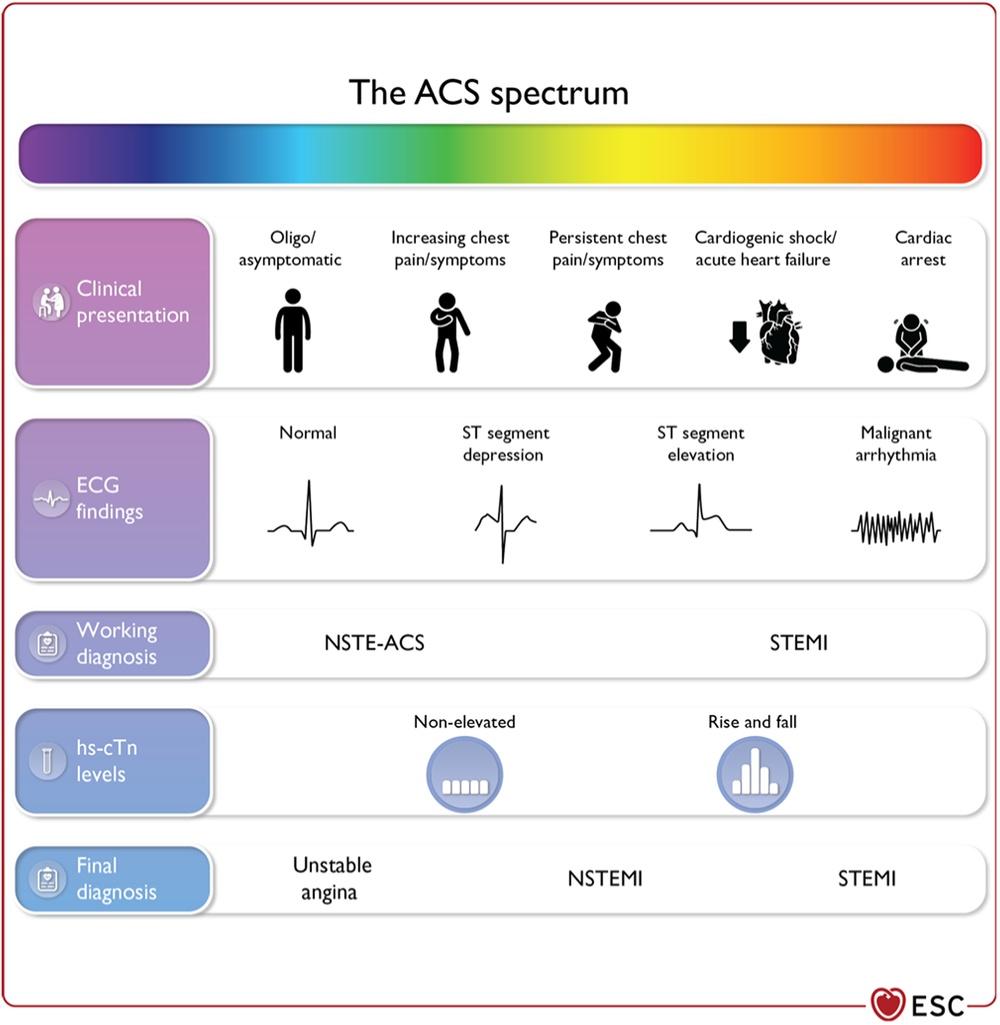
Unstable angina (UA) is defined by transient myocardial ischemia from atherosclerotic plaque disruption with partial coronary thrombosis, in the absence of significant myonecrosis (i.e., troponin-negative).[1-2] It exists on the acute coronary syndrome (ACS) continuum and can rapidly progress to NSTEMI or STEMI.[1] The following figure illustrates the ACS spectrum from unstable angina through STEMI:
View full figure Figure 1. The spectrum of clinical presentations, electrocardiographic findings, and high‐sensitivity cardiac troponin levels in patients with acute coronary syndrome. What US Cardiology Can Learn From the 2023 ESC Guidelines for the Management of Acute Coronary Syndromes. Clin Cardiol. July 31, 2024.
History
Three principal presentations
- Rest angina: chest pain at rest, usually >20 minutes
- New-onset angina: <2 months, at least CCS Class III severity
- Crescendo angina: previously stable angina increasing in frequency, duration, or lower threshold
- Character: retrosternal pressure, heaviness, tightness, squeezing; may radiate to arms, neck, jaw[5]
- Associated symptoms: diaphoresis, dyspnea (most common anginal equivalent), nausea, lightheadedness, presyncope[5-6]
- Pain that is pleuritic, positional, or reproducible with palpation is lower risk for ACS, but does not exclude it[7]
- Relief with nitroglycerin is not diagnostic and should not be used as a diagnostic criterion[6]
- Atypical presentations more common in women, elderly, diabetics, and patients with renal insufficiency — may present with isolated dyspnea, epigastric pain, or fatigue[5]
Alarm Features
- Prolonged rest pain >20 minutes or accelerating symptoms over 48 hours[8]
- Hemodynamic instability: hypotension, tachycardia, bradycardia[8-9]
- Signs of heart failure: pulmonary edema, new S3, rales[8]
- New or worsening mitral regurgitation murmur[8]
- Syncope or presyncope
- Dynamic ECG changes (ST depression, transient ST elevation)[1]
- Sustained ventricular tachycardia[8]
- Any of these features classify the patient as high risk for short-term death or nonfatal MI[8][10]
Medications
Acute Treatment
- Aspirin 162–325 mg loading, then 81 mg daily[11]
- P2Y₁₂ inhibitor: ticagrelor (180 mg load → 90 mg BID) or clopidogrel (300–600 mg load → 75 mg daily)[11-12]
- Anticoagulation: unfractionated heparin (60 U/kg bolus, 12 U/kg/hr), enoxaparin, fondaparinux, or bivalirudin[13-14]
- Nitroglycerin SL 0.4 mg q5min × 3 for ongoing ischemic pain; IV drip if refractory[10]
- Beta-blocker (metoprolol, atenolol) — reduces heart rate and myocardial oxygen demand[10][14]
- High-intensity statin (atorvastatin 80 mg or rosuvastatin 40 mg) — initiate early[11]
Contraindicated/Cautions
- Nitroglycerin contraindicated with hypotension (SBP <90), RV infarction, or PDE-5 inhibitor use within 24–48 hours
- Avoid beta-blockers in acute decompensated HF, cardiogenic shock, severe bradycardia, or active bronchospasm
- NSAIDs (except aspirin) should be discontinued — increase cardiovascular risk
- Fibrinolytics are contraindicated in NSTE-ACS[15]
Diet
- Mediterranean-style diet is recommended for secondary prevention: emphasizes vegetables, fruits, legumes, nuts, whole grains, lean protein, and healthy fats (olive oil, fish)[16]
- Limit saturated fat to <6% of total calories; avoid trans fats entirely[16]
- Sodium restriction <2,300 mg/day (optimally <1,500 mg/day)[16]
- Limit refined carbohydrates and sugar-sweetened beverages[16]
- Nonprescription supplements (omega-3, vitamins C/D/E, beta-carotene) are not recommended for CVD event reduction[16]
- Adequate hydration; avoid excessive caffeine and alcohol acutely
Review of Systems
- Cardiovascular: palpitations, syncope, orthopnea, PND, lower extremity edema
- Pulmonary: dyspnea (most common anginal equivalent), pleuritic pain (suggests alternative diagnosis)
- GI: nausea, vomiting, epigastric pain (may be anginal equivalent or suggest alternative diagnosis such as GERD, peptic ulcer)
- Neurologic: lightheadedness, presyncope, altered mental status (suggests hemodynamic compromise)
- Vascular: claudication, prior stroke/TIA (suggests diffuse atherosclerotic disease, higher CAD likelihood)[5]
- Psychiatric: anxiety, panic symptoms (common mimic)
Collateral History and Family History
- Family history of premature CAD: first-degree relative with CVD <55 years (male) or <65 years (female)[11]
- Prior cardiac testing results, prior catheterization/stenting/CABG
- Medication compliance (especially antiplatelet agents, statins)
- Substance use: cocaine and amphetamine use can cause coronary vasospasm and ACS
- Functional status and baseline exercise tolerance
- Social support and ability to follow up
Risk Factors
- Major: age ≥65, male sex, hypertension, diabetes mellitus, hyperlipidemia, current smoking, obesity (BMI >30), family history of premature CAD[11]
- Atherosclerotic disease: prior MI, PCI/CABG, CVA/TIA, peripheral arterial disease[5]
- Chronic kidney disease and renal insufficiency[5]
- Cocaine/stimulant use
- Sedentary lifestyle
- Metabolic syndrome
Differential Diagnosis
Cannot-miss life-threatening diagnoses
- NSTEMI/STEMI — distinguished by troponin elevation and/or ST elevation
- Aortic dissection — tearing pain radiating to back, pulse differential, widened mediastinum
- Pulmonary embolism — pleuritic pain, dyspnea, tachycardia, risk factors for VTE
- Tension pneumothorax — acute dyspnea, unilateral absent breath sounds
- Esophageal rupture (Boerhaave) — post-emesis, subcutaneous emphysema
Other cardiovascular
- Pericarditis/myocarditis — positional pain, friction rub, diffuse ST elevation
- Takotsubo cardiomyopathy — emotional/physical stress trigger, apical ballooning
- MINOCA — MI with nonobstructive coronary arteries[9]
Non-cardiac mimics
- GERD, esophageal spasm, peptic ulcer disease
- Costochondritis, musculoskeletal chest wall pain
- Biliary disease, pancreatitis
- Panic disorder, anxiety
Past Medical History
- Prior ACS events, PCI, CABG, or known CAD
- Prior stress test results (positive, negative, equivocal)
- Known coronary artery calcium score or prior CT imaging
- Heart failure, valvular disease, arrhythmias
- Diabetes, CKD, peripheral vascular disease
- Bleeding history (impacts anticoagulation/antiplatelet decisions)
- Prior GI bleeding (impacts DAPT risk-benefit)
Physical Exam
Vital signs
- Blood pressure in both arms (if dissection suspected)[15]
- Heart rate, respiratory rate, SpO₂, temperature
Cardiovascular
- New S3 or S4 gallop — suggests LV dysfunction[8-9]
- New or worsening systolic murmur — acute MR or VSD[9]
- JVD, peripheral edema — signs of heart failure
- Peripheral pulses and bruits — assess for PAD (higher CAD likelihood)[15]
Pulmonary
- Rales/crackles — pulmonary edema from ischemia-driven LV failure[8]
- Unequal breath sounds — consider pneumothorax
Other
- Diaphoresis, cool/clammy extremities — signs of cardiogenic shock[9]
- Chest wall tenderness — suggests musculoskeletal cause but does not exclude ACS
- Pericardial friction rub — suggests pericarditis[15]
Lab Studies
- Cardiac troponin (hs-cTnI or hs-cTnT): the key differentiator — normal in UA, elevated in NSTEMI[1][9][18]
- Serial measurement at presentation and 1–3 hours later (hs-cTn) or 3–6 hours (conventional)[2][5]
- Two normal hs-cTn values within 1–3 hours have NPV ~99% for MI[2]
- CBC: assess for anemia (precipitant of demand ischemia)
- BMP/CMP: renal function (impacts anticoagulation dosing), electrolytes
- Coagulation studies: PT/INR, aPTT (baseline before anticoagulation)
- Lipid panel: baseline for statin initiation
- BNP/NT-proBNP: may be considered for risk stratification[5]
- D-dimer: if PE is in the differential
- HbA1c: screen for undiagnosed diabetes
Imaging
- Chest X-ray: first-line; assess for pulmonary edema, widened mediastinum, pneumothorax, pneumonia[19]
- Echocardiography: assess LV function, wall motion abnormalities, valvular pathology; urgent if hemodynamic instability[1][5]
- CT coronary angiography (CCTA): can stratify risk in low-to-intermediate risk patients with nondiagnostic ECG and negative troponins; normal CCTA effectively rules out obstructive CAD[2]
- Invasive coronary angiography: gold standard; indicated for high-risk patients or those with positive noninvasive testing[6][9]
- Stress testing (exercise or pharmacologic with imaging): for low-to-intermediate risk patients before or within 72 hours of discharge[15][20]
Special Tests
- Low risk Patients with a HEART score of 0-2 are considered low risk for major adverse cardiac events (MACE) within 30 days, with an endpoint occurrence of 0.5%.[21] This score range suggests that these patients may be suitable for early discharge or outpatient management.[21]
Risk Stratification Scores
- HEART Score (above): scores 0–3 = low risk (MACE <2%), 4–6 = intermediate, 7–10 = high risk; validated for ED disposition decisions[19][22]
- TIMI Risk Score: 7 variables (age ≥65, ≥3 CAD risk factors, known CAD, ASA use, ≥2 anginal episodes in 24h, ST deviation, elevated biomarkers); score 0–7[8][22]
- GRACE Score: predicts in-hospital and 6-month mortality; score >140 = high risk warranting catheterization within 24 hours[9][22]
- EDACS: combined with serial troponin and nonischemic ECG, identifies low-risk patients (30-day MACE <1%)[19]
- Killip Classification: stratifies by degree of heart failure (Class I–IV); strongly predicts mortality[9]
Point-of-care
- Bedside echocardiography/POCUS for wall motion abnormalities and alternative diagnoses[1]
ECG
- ECG should be obtained within 10 minutes of arrival.[5][19] Key findings in UA:
- ST-segment depression ≥0.5 mm in ≥2 contiguous leads (horizontal or downsloping)[1]
- Transient ST-segment elevation — resolves with symptom relief; suggests severe ischemia[1][8]
- T-wave inversion >1 mm in ≥2 contiguous leads with prominent R wave[1]
- Wellens syndrome: biphasic or deeply inverted T waves in V2–V3 — indicates critical proximal LAD stenosis[19]
- De Winter's sign: upsloping ST depression with tall symmetric T waves in precordial leads — proximal LAD occlusion[19]
- Normal ECG does not exclude ACS — occurs in 1–6% of confirmed ACS[5]
- If initial ECG is nondiagnostic, repeat at 15–30 minute intervals during the first hour[5]
- Consider posterior leads (V7–V9) if isolated ST depression in V1–V3[5][19]
- New or presumed new LBBB requires clinical correlation; not a STEMI equivalent in isolation[1]
Assessment
Unstable angina represents transient myocardial ischemia without myonecrosis, defined by ischemic symptoms with normal serial troponins.[1] It is the least severe end of the ACS spectrum but carries significant risk of progression to MI.[9] With the advent of high-sensitivity troponin assays, many patients previously classified as UA are now reclassified as NSTEMI, making "true" UA increasingly uncommon.[9]
- Severity stratification is based on clinical features, ECG findings, troponin trends, and validated risk scores (HEART, TIMI, GRACE).[5][10] Patients can be classified as:
- High risk: ongoing pain, dynamic ECG changes, hemodynamic instability, high HEART/TIMI/GRACE scores → early invasive strategy[6][9]
- Intermediate risk: resolved symptoms, nondiagnostic ECG, negative troponins but concerning history → observation and further testing[19]
- Low risk: resolved symptoms, normal ECG, negative serial troponins, low HEART score (≤3) → candidate for early discharge[19]
- Complications to consider: progression to NSTEMI/STEMI, arrhythmias, acute heart failure, cardiogenic shock, mechanical complications (if MI develops).[1]
Treatment Plan
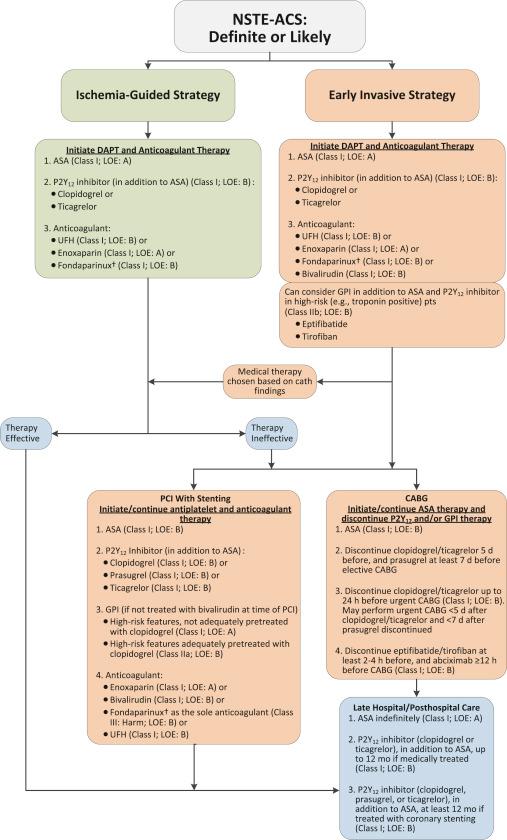
- The following algorithm from the 2014 AHA/ACC guidelines outlines the management approach for NSTE-ACS:
- View full figure Figure 3. Algorithm for Management of Patients With Definite or Likely NSTE-ACS* 2014 AHA/ACC Guideline for the Management of Patients With Non-St-Elevation Acute Coronary Syndromes: A Report of the American College of Cardiology/American Heart Association Task Force on Practice Guidelines. J Am Coll Cardiol. December 22, 2014.
Initial Stabilization
- Continuous cardiac monitoring, IV access, supplemental O₂ if SpO₂ <90%[11]
- Aspirin 162–325 mg chewed immediately[11]
- Sublingual nitroglycerin 0.4 mg q5min × 3 for ongoing pain; IV NTG if refractory[10]
Anti-ischemic Therapy
- Beta-blocker (oral metoprolol 25–50 mg or IV if hypertensive/tachycardic without contraindications)[10][14]
- Non-dihydropyridine CCB (diltiazem, verapamil) if beta-blocker contraindicated[14]
Antithrombotic Therapy
- Dual antiplatelet therapy: aspirin + P2Y₁₂ inhibitor[11][13]
- Parenteral anticoagulation: UFH, enoxaparin, fondaparinux, or bivalirudin[13]
- P2Y₁₂ inhibitor pretreatment is no longer routinely recommended before catheterization in planned early invasive strategy[9]
Invasive vs. Ischemia-Guided Strategy
- Early invasive (angiography within 24h): preferred for high-risk patients (GRACE >140, dynamic ECG changes, elevated troponin, hemodynamic instability)[5][9]
- Ischemia-guided (conservative): appropriate for low-risk patients who stabilize with medical therapy; noninvasive testing to guide need for catheterization[5]
Long-term Medications at Discharge
- Aspirin indefinitely + P2Y₁₂ inhibitor for ≥12 months (DAPT)[11]
- High-intensity statin[11]
- Beta-blocker[14]
- ACE inhibitor/ARB (especially if LVEF <40%, HTN, DM, or CKD)[14]
- SGLT2 inhibitor consideration post-MI[11]
- Cardiac rehabilitation referral[23]
Disposition
Admit (inpatient or CCU)
- Recurrent ischemic symptoms despite initial treatment
- Dynamic ECG changes or positive troponin (reclassified as NSTEMI)
- Hemodynamic instability, arrhythmias, or signs of heart failure
- High-risk features on clinical assessment or risk scores
- Need for early invasive strategy
Observation unit
- Intermediate-risk patients undergoing serial troponins and noninvasive testing before discharge
Discharge from ED
- Low-risk patients: pain-free, normal/unchanged ECG, negative serial troponins (at least 2 values over 1–3h with hs-cTn), low HEART score (≤3) or EDACS (<16)
- Prescribe aspirin, sublingual NTG, and consider beta-blocker pending outpatient stress testing[15]
- Arrange outpatient stress test or CCTA within 72 hours[15]
Cardiology consultation triggers
- Any troponin elevation, ischemic ECG changes, hemodynamic instability, high-risk scores, reduced LVEF, or need for catheterization
Follow Up / Return Precautions
Follow-up timing
- Low-risk patients discharged from ED: PCP or cardiology follow-up within 72 hours; stress testing within 72 hours if not done predischarge[15][20]
- Intermediate-risk patients: follow-up within 7 days, preferably with established cardiologist[19]
- Post-catheterization/revascularization: cardiology follow-up within 2–4 weeks; cardiac rehabilitation referral[19]
- Return precautions — instruct patients to call 911 or return immediately for:
- Recurrence of chest pain, pressure, or tightness — especially at rest or lasting >5 minutes
- New or worsening shortness of breath
- Lightheadedness, syncope, or near-syncope
- Palpitations or sensation of rapid/irregular heartbeat
- Nitroglycerin not relieving symptoms after 1 dose (call 911)
Patient counseling
- Take aspirin daily as prescribed; do not stop without physician guidance
- Keep sublingual NTG accessible; replace every 6 months
- Smoking cessation is the single most impactful lifestyle modification[23-24]
- Cardiac rehabilitation improves outcomes and reduces mortality[23]
- Expected recovery: with appropriate treatment and risk factor modification, prognosis is favorable; however, ongoing adherence to DAPT, statins, and lifestyle changes is essential for long-term event reduction[1]
References
1. 2025 ACC/AHA/ACEP/NAEMSP/SCAI Guideline for the Management of Patients With Acute Coronary Syndromes: A Report of the American College of Cardiology/American Heart Association Joint Committee on Clinical Practice Guidelines. — Rao SV, O'Donoghue ML, Ruel M, et al. Journal of the American College of Cardiology. 2025.
2. Diagnosis and Treatment of Acute Coronary Syndromes: A Review. — Bhatt DL, Lopes RD, Harrington RA. The Journal of the American Medical Association. 2022.
3. What US Cardiology Can Learn From the 2023 ESC Guidelines for the Management of Acute Coronary Syndromes. — Wenger NK. Clinical Cardiology. 2024.
4. ACC/AHA 2007 Guidelines for the Management of Patients With Unstable Angina/Non-St-Elevation Myocardial Infarction: A Report of the American College of Cardiology/American Heart Association Task Force on Practice Guidelines (Writing Committee to Revise the 2002 Guidelines for the Management of Patients With Unstable Angina/Non-St-Elevation Myocardial Infarction) Developed in Collaboration With the American College of Emergency Physicians, the Society for Cardiovascular Angiography and Interventions, and the Society of Thoracic Surgeons Endorsed by the American Association of Cardiovascular and Pulmonary Rehabilitation and the Society for Academic Emergency Medicine. — Anderson JL, Adams CD, Antman EM, et al. Journal of the American College of Cardiology. 2007.
5. 2014 AHA/ACC Guideline for the Management of Patients With Non-St-Elevation Acute Coronary Syndromes: A Report of the American College of Cardiology/American Heart Association Task Force on Practice Guidelines. — Amsterdam EA, Wenger NK, Brindis RG, et al. Journal of the American College of Cardiology. 2014.
6. 2021 AHA/ACC/ASE/CHEST/SAEM/SCCT/SCMR Guideline for the Evaluation and Diagnosis of Chest Pain: A Report of the American College of Cardiology/American Heart Association Joint Committee on Clinical Practice Guidelines. — Gulati M, Levy PD, Mukherjee D, et al. Journal of the American College of Cardiology. 2021.
7. Acute Chest Pain in Adults: Outpatient Evaluation. — McConaghy JR, Sharma M, Patel H. American Family Physician. 2020.
8. ACC/AATS/AHA/ASE/ASNC/SCAI/SCCT/STS 2016 Appropriate Use Criteria for Coronary Revascularization in Patients With Acute Coronary Syndromes: A Report of the American College of Cardiology Appropriate Use Criteria Task Force, American Association for Thoracic Surgery, American Heart Association, American Society of Echocardiography, American Society of Nuclear Cardiology, Society for Cardiovascular Angiography and Interventions, Society of Cardiovascular Computed Tomography, and the Society of Thoracic Surgeons. — Patel MR, Calhoon JH, Dehmer GJ, et al. Journal of the American College of Cardiology. 2017.
9. Acute Coronary Syndromes. — Bergmark BA, Mathenge N, Merlini PA, Lawrence-Wright MB, Giugliano RP. Lancet. 2022.
10. A 43-Year-Old Man With Angina, Elevated Troponin, and Lateral ST Depression: Management of Acute Coronary Syndromes. — Pinto DS. The Journal of the American Medical Association. 2010.
11. Acute Coronary Syndrome: Diagnosis and Initial Management. — Nohria R, Viera AJ. American Family Physician. 2024.
12. FDA Orange Book. — FDA Orange Book. 2026.
13. 2011 ACCF/AHA Focused Update of the Guidelines for the Management of Patients With Unstable Angina/Non-St-Elevation Myocardial Infarction (Updating the 2007 Guideline): A Report of the American College of Cardiology Foundation/American Heart Association Task Force on Practice Guidelines Developed in Collaboration With the American College of Emergency Physicians, Society for Cardiovascular Angiography and Interventions, and Society of Thoracic Surgeons. — Wright RS, Anderson JL, Adams CD, et al. Journal of the American College of Cardiology. 2011.
14. Routine Invasive Strategies Versus Selective Invasive Strategies for Unstable Angina and Non-St Elevation Myocardial Infarction in the Stent Era. — Fanning JP, Nyong J, Scott IA, Aroney CN, Walters DL. The Cochrane Database of Systematic Reviews. 2016.
15. 2011 ACCF/AHA Focused Update Incorporated Into the ACC/AHA 2007 Guidelines for the Management of Patients With Unstable Angina/Non-St-Elevation Myocardial Infarction: A Report of the American College of Cardiology Foundation/American Heart Association Task Force on Practice Guidelines Developed in Collaboration With the American Academy of Family Physicians, Society for Cardiovascular Angiography and Interventions, and the Society of Thoracic Surgeons. — Wright RS, Anderson JL, Adams CD, et al. Journal of the American College of Cardiology. 2011.
16. 2023 AHA/ACC/ACCP/ASPC/NLA/PCNA Guideline for the Management of Patients With Chronic Coronary Disease: A Report of the American Heart Association/American College of Cardiology Joint Committee on Clinical Practice Guidelines. — Virani SS, Newby LK, Arnold SV, et al. Journal of the American College of Cardiology. 2023.
17. Non-Invasive Imaging in Coronary Syndromes: Recommendations of the European Association of Cardiovascular Imaging and the American Society of Echocardiography, in Collaboration With the American Society of Nuclear Cardiology, Society of Cardiovascular Computed Tomography, and Society for Cardiovascular Magnetic Resonance. — Edvardsen T, Asch FM, Davidson B, et al. Journal of the American Society of Echocardiography : Official Publication of the American Society of Echocardiography. 2022.
18. Acute Myocardial Infarction. — Anderson JL, Morrow DA. The New England Journal of Medicine. 2017.
19. 2022 ACC Expert Consensus Decision Pathway on the Evaluation and Disposition of Acute Chest Pain In the Emergency Department: A Report of the American College of Cardiology Solution Set Oversight Committee. — Kontos MC, de Lemos JA, Deitelzweig SB, et al. Journal of the American College of Cardiology. 2022.
20. Early Noninvasive Cardiac Testing After Emergency Department Evaluation for Suspected Acute Coronary Syndrome. — Kawatkar AA, Sharp AL, Baecker AS, et al. JAMA Internal Medicine. 2020.
21. HEART-score Can Be Simplified Without Loss of Discriminatory Power in Patients With Chest Pain - Introducing the HET-score. — Löfmark H, Muhrbeck J, Eggers KM, et al. The American Journal of Emergency Medicine. 2023.
22. Does This Patient With Chest Pain Have Acute Coronary Syndrome?The Rational Clinical Examination Systematic Review. — Fanaroff AC, Rymer JA, Goldstein SA, Simel DL, Newby LK. The Journal of the American Medical Association. 2015.
23. Management of Chronic Coronary Disease: Guidelines From the American College of Cardiology and American Heart Association. — Buelt A, Selco M, Thompson B. American Family Physician. 2024.
24. State of the Art: Evaluation and Medical Management of Nonobstructive Coronary Artery Disease in Patients With Chest Pain: A Scientific Statement From the American Heart Association. — Slipczuk L, Blankstein R, Bucciarelli-Ducci C, et al. Circulation. 2025.
Figures
More from Deep Dive
Reviewed by Dr. Lucas Mastropaolo. SymptomDx is an educational tool for medical professionals — it does not replace clinical judgment. Verify all clinical data and drug dosages with authoritative sources.