Urethritis
Urethritis is inflammation of the urethra, classified as gonococcal (caused by Neisseria gonorrhoeae) or nongonococcal (most commonly Chlamydia trachomatis, Mycoplasma genitalium, or Trichomonas vaginalis).[1-2] It is one of the most common presentations of sexually transmitted infections in the ED and primary care setting. The following is a clinically focused summary organized for rapid decision-making.
History
- Discharge characterization: Color (clear/mucoid vs. mucopurulent vs. frankly purulent), volume, timing (morning "glue" vs. constant)
- Dysuria: Onset, severity, internal vs. meatal burning
- Urethral pruritus or irritation without discharge[1-2]
- Timing: Onset relative to last sexual contact; gonococcal urethritis typically presents 2–8 days after exposure, chlamydial urethritis 7–21 days[3]
- Sexual history: Number and gender of partners, new partners, condom use, oral/anal/vaginal contact, transactional sex[4]
- Prior STI history and treatment: Especially recent azithromycin use (raises concern for macrolide-resistant M. genitalium)[2][5]
- Important negatives: Hematuria, flank pain, fever, testicular pain/swelling, joint pain, skin lesions, eye symptoms
Alarm Features
- Testicular pain/swelling → epididymitis/orchitis[2][6]
- Fever + polyarthralgia + skin lesions (pustules/petechiae) → disseminated gonococcal infection (DGI)[2-3]
- Tenosynovitis (especially asymmetric, involving wrists/hands) → DGI[2]
- Abdominal pain in female partners → PID risk from untreated infection[7]
- Conjunctivitis → gonococcal autoinoculation or reactive arthritis (Reiter syndrome)[4]
- Urethral stricture symptoms (weak stream, straining) → rare complication of untreated gonococcal urethritis[3]
- Meningismus or new heart murmur → rare gonococcal endocarditis or meningitis[2]
Medications
Empiric treatment (etiology unknown)
- Ceftriaxone 500 mg IM × 1 (1,000 mg if >150 kg) PLUS doxycycline 100 mg PO BID × 7 days
Organism-specific regimens
- Export Etiology Recommended Regimen Alternative References N. gonorrhoeae Ceftriaxone 500 mg IM × 1 Cefixime 800 mg PO × 1[1-2]
- C. trachomatis Doxycycline 100 mg PO BID × 7 days Azithromycin 1 g PO × 1[2-3]
- M. genitalium Doxycycline × 7 days → moxifloxacin 400 mg daily × 7 days Resistance-guided azithromycin if macrolide-sensitive[4-5]
- T. vaginalis Metronidazole 2 g PO × 1 (men) Tinidazole 2 g PO × 1[2, 6]
Key medication pearls
- Azithromycin co-treatment for gonorrhea is no longer recommended per 2021 CDC guidelines[7-8]
- Doxycycline is now preferred over azithromycin for chlamydia due to higher microbiologic cure rates[7][10]
- Azithromycin 1 g remains the recommended chlamydia treatment in pregnancy[7]
- Contraindicated: Doxycycline in pregnancy; fluoroquinolones in pregnancy and pediatric patients
Diet
- No specific dietary triggers or restrictions
- Encourage adequate hydration to promote urinary flow and comfort
- Advise avoiding alcohol during metronidazole therapy (disulfiram-like reaction)
Review of Systems
- GU: Dysuria, discharge, frequency, urgency, hematuria, testicular pain/swelling, pain with ejaculation[4]
- MSK: Joint pain, swelling (DGI, reactive arthritis)[4]
- Derm: Rash, skin lesions (pustules, papules, ulcers)[2]
- Ophthalmologic: Eye redness, discharge (conjunctivitis)[4]
- GI/Anorectal: Rectal pain, discharge, bleeding, tenesmus (proctitis if receptive anal intercourse)[4]
- Constitutional: Fever, chills, malaise (suggests dissemination or ascending infection)
- Oropharyngeal: Sore throat, exudates (pharyngeal gonorrhea)[3]
Collateral History and Family History
- Partner notification is critical: Partners should be evaluated and treated; expedited partner therapy (EPT) is permitted in most states[9]
- Ask about partner symptoms (discharge, dysuria, abnormal bleeding)
- Social context: Incarceration, substance use, transactional sex — all increase STI risk[4]
- Family history is generally not contributory, except terminal complement deficiency (hereditary) increases risk of DGI[2]
Risk Factors
- Age <25 years[4]
- Multiple or new sexual partners[4]
- Inconsistent condom use[4]
- Men who have sex with men (MSM)[1]
- Prior STI history[4]
- Transactional sex[4]
- Substance use (particularly in MSM)[4]
- M. genitalium specifically more common in younger men, smokers, and those with multiple partners[1]
- T. vaginalis more common in heterosexual men, older age, incarcerated populations, and high-prevalence geographic areas[1-2]
Differential Diagnosis
- Urinary tract infection / cystitis — more common in women; culture-positive with uropathogens
- Prostatitis — suprapubic/perineal pain, prostatic tenderness on DRE, LUTS[11]
- Epididymitis — unilateral testicular pain/swelling, positive Prehn sign[6]
- Herpes simplex urethritis — meatitis, genital ulceration, severe dysuria; more common with HSV-1 via oral-genital contact[2]
- Reactive arthritis (Reiter syndrome) — triad of urethritis, conjunctivitis, arthritis[4]
- Urethral foreign body or trauma
- Chemical/irritant urethritis — soaps, spermicides
- Adenoviral urethritis — dysuria, meatitis, conjunctivitis; associated with oral-genital contact[2]
- Non-infectious/idiopathic NGU — accounts for up to ~50% of NGU cases with no identifiable pathogen[2]
Past Medical History
- Prior STI episodes and treatments received (especially azithromycin — raises macrolide resistance concern for M. genitalium)[5]
- HIV status — immunosuppression may alter presentation and increase susceptibility
- History of urethral stricture or instrumentation
- Complement deficiency (risk for DGI)[2]
- Use of eculizumab (inhibits terminal complement → increased DGI risk)[2]
Physical Exam
- Urethral meatus: Discharge (express if not spontaneously visible — "milking" the urethra), erythema, meatitis[1]
- Inguinal lymph nodes: Lymphadenopathy (consider LGV if tender, unilateral)[4]
- Testicular exam: Tenderness, swelling, epididymal induration (epididymitis)[6]
- Skin: Pustular or petechial acral lesions (DGI), genital ulcers (HSV, syphilis)[2]
- Joints: Tenosynovitis, effusion (DGI, reactive arthritis)[2]
- Oropharynx: Exudates, erythema (pharyngeal gonorrhea)[3]
- Conjunctivae: Injection, discharge[4]
- Rectal exam: If anorectal symptoms present — discharge, tenderness
- The CDC recommends examination of skin, pharynx, lymph nodes, anogenital area, and neurologic system when evaluating for STIs[1]
Lab Studies
- NAAT for N. gonorrhoeae and C. trachomatis on first-void urine (preferred specimen in males) — this is the gold standard diagnostic test[1-3]
- Urinalysis: First-void; ≥10 WBC/HPF or positive leukocyte esterase supports diagnosis[1]
- Gram stain of urethral discharge (if available): ≥2 WBC/oil immersion field confirms urethritis; gram-negative intracellular diplococci (GNID) = presumptive gonorrhea[2]
- HIV, syphilis (RPR/VDRL), hepatitis B screening — recommended for all patients with urethritis and STI risk factors[1]
- Hepatitis C screening in MSM and those on PrEP[7]
- **M. genitalium NAAT — reserve for persistent/recurrent NGU, not initial presentation[2]
- **T. vaginalis NAAT — consider in heterosexual men, recurrent urethritis, or high-prevalence areas[1-2]
- Urine culture — not routinely needed; reserve for suspected antimicrobial-resistant gonorrhea or atypical presentations[1]
Imaging
- Imaging is generally unnecessary for uncomplicated urethritis
- Scrotal ultrasound if epididymitis or testicular torsion is suspected
- Pelvic ultrasound in female patients with concern for PID/tubo-ovarian abscess
- Joint imaging if DGI with septic arthritis is suspected
Special Tests
- Point-of-care NAAT (binx health io CT/NG, Visby Medical Sexual Health Test) — provides same-day results, reduces loss to follow-up and overtreatment[4]
- Gram stain / methylene blue / gentian violet stain of urethral secretions — highly sensitive and specific POC test for confirming urethritis and identifying gonococcal infection[2]
- Macrolide resistance testing for M. genitalium — recommended when available to guide therapy; not yet widely available in the US[2][5]
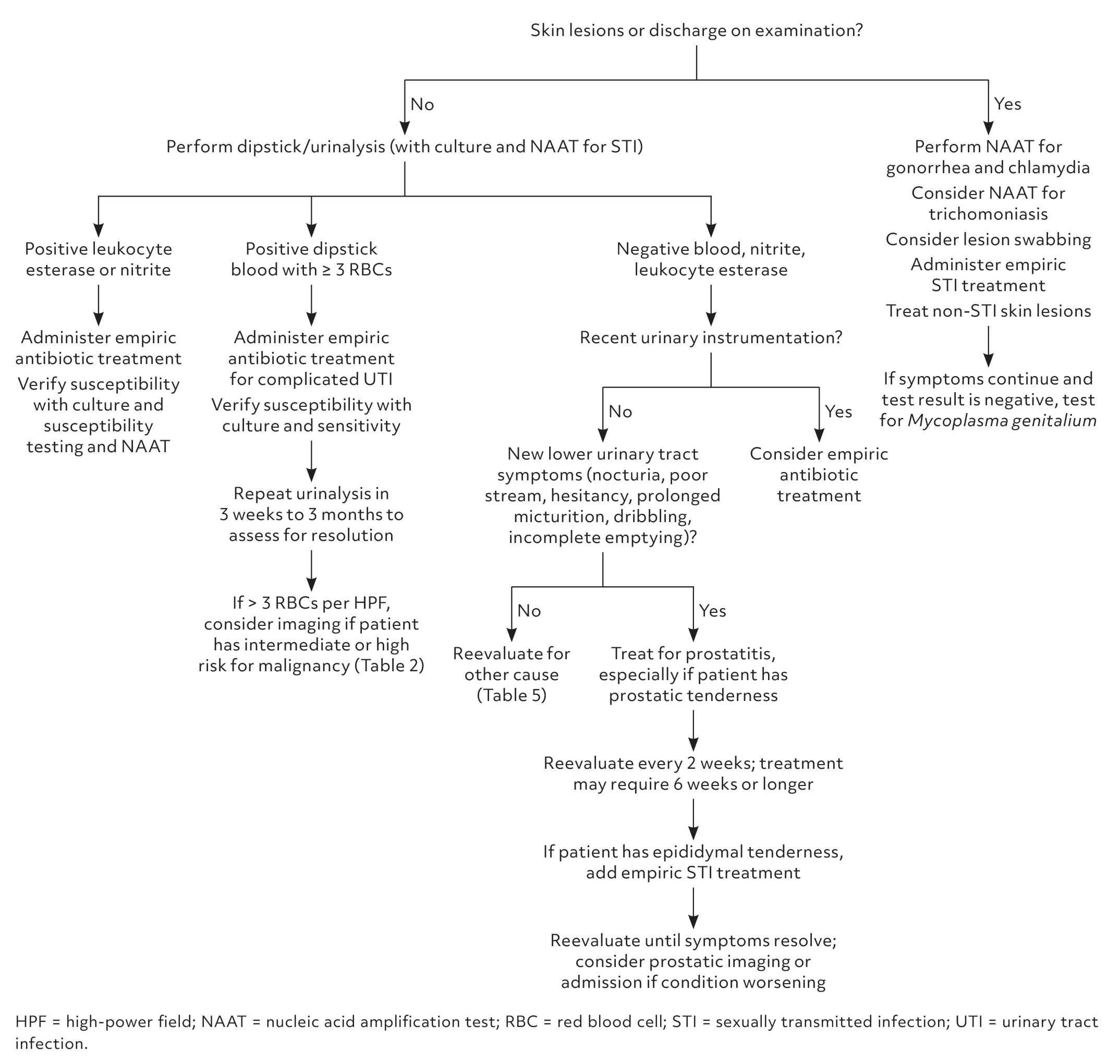
- The following figure illustrates a systematic approach to evaluating dysuria in male patients:
- View full figure Figure 2. Approach to a male with dysuria. Information from references 7, 13, 21, 41, 43, 45, 51–53. Dysuria: Evaluation and Differential Diagnosis in Adults. Am Fam Physician. December 31, 2024.
ECG
- Not routinely indicated for uncomplicated urethritis
- Obtain ECG if DGI with suspected endocarditis (new murmur, persistent bacteremia, embolic phenomena)[2]
Assessment
- Clinical summary: Urethritis is predominantly an STI-driven condition. N. gonorrhoeae and C. trachomatis account for the majority of cases, with M. genitalium increasingly recognized as a cause of persistent/recurrent NGU (15–25% of NGU cases).[2-3] Approximately 50% of NGU cases remain idiopathic even with comprehensive testing.[2]
Severity stratification
- Uncomplicated: Isolated urethral symptoms, no systemic signs → outpatient management
- Complicated: Epididymitis, prostatitis, DGI, reactive arthritis → escalation of care
Typical vs. atypical presentations
- Gonococcal: Profuse purulent discharge, acute onset 2–8 days post-exposure[3]
- Chlamydial/NGU: Scant mucoid discharge, milder dysuria, may be asymptomatic[1]
- A significant proportion of infections (55–87% of urogenital gonorrhea in men in population-based studies) may be asymptomatic[3]
Treatment Plan
Initial management
- Empiric treatment at time of diagnosis — do not wait for NAAT results if clinical suspicion is high:[1-2]
- Ceftriaxone 500 mg IM × 1 + doxycycline 100 mg PO BID × 7 days
- First dose should be directly observed in clinic when possible[2]
- If Gram stain shows no GNID (nongonococcal urethritis): doxycycline 100 mg PO BID × 7 days alone is appropriate[2]
- Persistent/recurrent NGU (symptoms persist after initial treatment):
- Ensure adherence and rule out reinfection (re-exposure)
- Test for M. genitalium (NAAT) and T. vaginalis[2]
- M. genitalium: Doxycycline 100 mg BID × 7 days → moxifloxacin 400 mg daily × 7 days (resistance-guided therapy preferred if available)[2-3]
- T. vaginalis: Metronidazole 2 g PO × 1[1]
- Persistent NGU after M. genitalium and T. vaginalis treatment → refer to ID or urology[2]
Partner management
- All sexual partners within the preceding 60 days should be referred for evaluation and treatment[4]
- Expedited partner therapy (EPT) is an option in most states[9]
Disposition
- Discharge (vast majority): Uncomplicated urethritis is managed entirely as an outpatient[1]
Observation/Admission criteria
- Suspected DGI (fever, polyarthralgia, skin lesions, tenosynovitis) → hospitalization and ID consultation recommended[2]
- Suspected gonococcal endocarditis or meningitis[2]
- Inability to tolerate oral medications or concern for nonadherence in complicated cases
Specialist consultation triggers
- Persistent/recurrent NGU after appropriate treatment for M. genitalium and T. vaginalis → ID or urology referral[2]
- Suspected antimicrobial-resistant gonorrhea
- DGI → ID consultation[2]
Follow Up / Return Precautions
- Abstain from sexual intercourse for 7 days after single-dose treatment, or until completion of a 7-day course AND symptom resolution AND partner treatment[1][4]
- Repeat testing (test of reinfection): 3 months after treatment, or at first visit within 12 months[1][4]
- Do NOT repeat NAAT <3 weeks after treatment — risk of false-positive results from residual nucleic acid[1]
- Test-of-cure is NOT needed for urogenital gonorrhea but IS recommended for pharyngeal gonorrhea (14 days post-treatment)[7]
- Report gonorrhea and chlamydia to the local health department (both are reportable conditions)[2]
- Return precautions — advise patients to return immediately for:
- Persistent or worsening discharge/dysuria after completing treatment
- Testicular pain or swelling
- Fever, joint pain, or rash
- Eye redness or discharge
- Expected course: Symptoms typically improve within 48–72 hours of appropriate antibiotic therapy. If no improvement, reassess for resistant organisms, alternative diagnoses, or nonadherence.[6]
References
1. Urethritis: Rapid Evidence Review. — Sell J, Nasir M, Courchesne C. American Family Physician. 2021.
2. Sexually Transmitted Infections Treatment Guidelines, 2021. — Workowski KA, Bachmann LH, Chan PA, et al. MMWR. Recommendations and Reports : Morbidity and Mortality Weekly Report. Recommendations and Reports. 2021.
3. Diagnosis and Treatment of Sexually Transmitted Infections: A Review. — Tuddenham S, Hamill MM, Ghanem KG. The Journal of the American Medical Association. 2022.
4. Chlamydial and Gonococcal Infections: Screening, Diagnosis, and Treatment. — Yonke N, Aragón M, Phillips JK. American Family Physician. 2022.
5. Emerging and Reemerging Sexually Transmitted Infections. — Williamson DA, Chen MY. The New England Journal of Medicine. 2020.
6. Guide to Utilization of the Microbiology Laboratory for Diagnosis of Infectious Diseases: 2024 Update by the Infectious Diseases Society of America (IDSA) and the American Society for Microbiology (ASM). — Miller JM, Binnicker MJ, Campbell S, et al. Clinical Infectious Diseases : An Official Publication of the Infectious Diseases Society of America. 2024.
7. Sexually Transmitted Infections: Updates From the 2021 CDC Guidelines. — Dalby J, Stoner BP. American Family Physician. 2022.
8. Management of Neisseria Gonorrhoeae in the United States: Summary of Evidence From the Development of the 2020 Gonorrhea Treatment Recommendations and the 2021 Centers for Disease Control and Prevention Sexually Transmitted Infection Treatment Guidelines. — Barbee LA, St Cyr SB. Clinical Infectious Diseases : An Official Publication of the Infectious Diseases Society of America. 2022.
9. Sexually Transmitted Infections: Updated Guideline From the CDC. — Klein DA, Valerio CR, Cofield ZN. American Family Physician. 2022.
10. Diagnosis and Management of Uncomplicated Chlamydia Trachomatis Infections in Adolescents and Adults: Summary of Evidence Reviewed for the 2021 Centers for Disease Control and Prevention Sexually Transmitted Infections Treatment Guidelines. — Geisler WM, Hocking JS, Darville T, Batteiger BE, Brunham RC. Clinical Infectious Diseases : An Official Publication of the Infectious Diseases Society of America. 2022.
11. Dysuria: Evaluation and Differential Diagnosis in Adults. — Hoffman A, Dolezal KA, Powell R. American Family Physician. 2025.
Figure
More from Deep Dive
Reviewed by Dr. Lucas Mastropaolo. SymptomDx is an educational tool for medical professionals — it does not replace clinical judgment. Verify all clinical data and drug dosages with authoritative sources.