Croup
Croup is a common acute viral upper airway illness of early childhood caused predominantly by parainfluenza virus, characterized by a barking (seal-like) cough, inspiratory stridor, hoarseness, and variable respiratory distress. [1-2] It affects approximately 3% of children aged 6 months to 3 years, accounts for ~1.4% of pediatric ED visits, and 85% of cases are mild. [2-4]
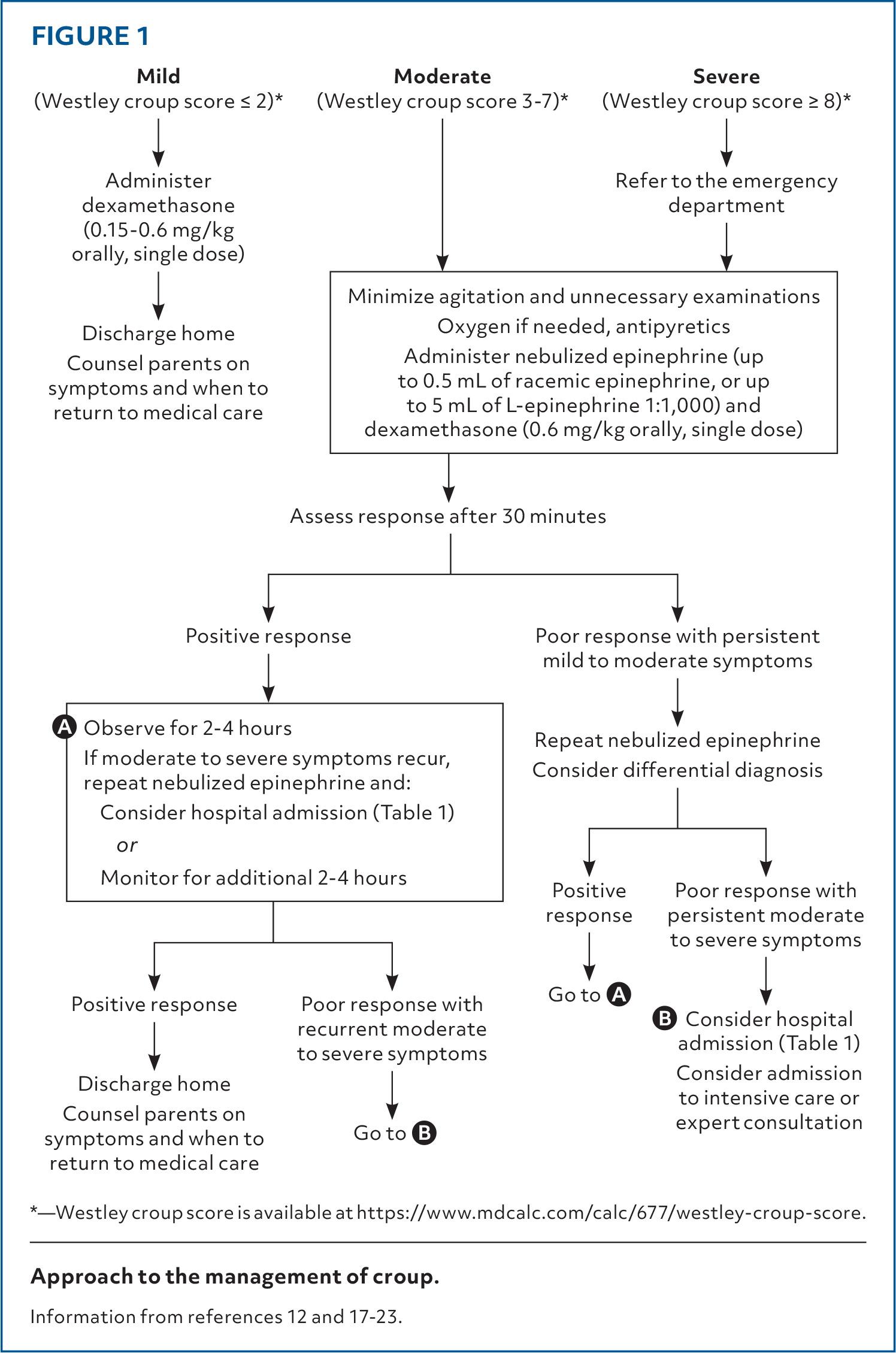
The following management algorithm from the AAFP outlines a severity-based approach:
History
- Barking/seal-like cough — the hallmark symptom; abrupt onset, classically worse at night [1][4]
- Preceding 1–3 day URI prodrome: rhinorrhea, nasal congestion, low-grade fever [5-6]
- Timing: symptoms peak on days 2–3, barking cough resolves within 48 hours in ~60% [5]
- Severity characterization: stridor at rest vs. only with agitation, degree of respiratory distress, ability to feed/drink
- Hoarseness or voice change
- Ask about fever (may reach 40°C, but high fever with toxic appearance suggests alternative diagnosis) [7]
- Important negatives: no drooling, no dysphagia, no sudden onset without prodrome, no foreign body ingestion history
Alarm Features
- Stridor at rest (moderate-severe croup)
- Marked chest wall retractions (suprasternal, intercostal, subcostal)
- Cyanosis or SpO₂ <92%
- Lethargy, altered consciousness, or agitation disproportionate to respiratory effort
- Toxic appearance — suggests bacterial tracheitis, epiglottitis, or abscess [2][7]
- Drooling, refusal to swallow, tripoding/sniffing position — classic for epiglottitis [7-8]
- No response to standard dexamethasone + nebulized epinephrine — consider bacterial tracheitis [7]
- Rapid progression or biphasic stridor
- Age <6 months or >6 years (atypical age → consider anatomic abnormality or alternative diagnosis) [2]
Medications
- First-line: Dexamethasone — single oral dose 0.6 mg/kg (max 12 mg), regardless of severity. Prednisolone is an acceptable alternative [2]
- Moderate-severe: Nebulized racemic epinephrine — 0.5 mL of 2.25% in 4.5 mL NS; or L-epinephrine 5 mL of 1:1000 [4][7]
- Antibiotics are not indicated for uncomplicated croup [5]
- Avoid sedatives (may worsen airway obstruction)
- Avoid cough suppressants — no role in croup management
- Humidified mist therapy has no proven benefit [2][6]
- Heliox: limited evidence, may be considered in severe cases as a bridge while awaiting steroid effect [5]
Diet
- Encourage clear fluids to maintain hydration
- Avoid forcing oral intake in a child with significant respiratory distress (aspiration risk)
- Cool fluids may provide mild symptomatic comfort
- No specific dietary triggers or restrictions
Review of Systems
- Respiratory: cough character (barking vs. productive), stridor (inspiratory vs. biphasic), work of breathing, apneic episodes
- ENT: voice changes, drooling, dysphagia, sore throat
- Constitutional: fever, irritability, lethargy, poor feeding
- GI: vomiting (from coughing paroxysms), ability to tolerate fluids
- Allergic/Atopic: history of eczema, asthma, allergic rhinitis (associated with recurrent croup) [2]
- GI/Reflux: GERD symptoms (associated with recurrent croup) [2]
Collateral History and Family History
- Sick contacts, daycare/school exposure
- Immunization status — particularly Hib vaccine (epiglottitis risk if under-immunized) [2][9]
- Prior episodes of croup (≥2 episodes → evaluate for anatomic abnormality or GERD) [2]
- Family history of asthma, atopy, or subglottic stenosis
- History of prior intubation or airway surgery (subglottic stenosis risk)
- Birth history: prematurity, neonatal intubation
Risk Factors
- Age 6 months to 3 years (peak incidence in second year of life) [5][10]
- Male sex (male:female ratio ~1.5–2:1), possibly related to impaired antiviral immunity [2][5]
- Fall/winter seasonality — peak October–November, coinciding with parainfluenza type 1 epidemics [2][10-11]
- Daycare attendance / viral exposure
- Atopy, asthma, or allergic conditions (risk factor for recurrent croup) [2][5]
- GERD [2]
- Underlying airway abnormality (subglottic stenosis, tracheomalacia) [2]
- Under-immunization (risk for diphtheria, measles-related croup in unvaccinated populations) [5]
Differential Diagnosis
- Bacterial tracheitis — toxic-appearing child, worsening despite standard croup therapy, thick tracheal secretions; most common pathogen is S. aureus [7]
- Epiglottitis — sudden high fever, drooling, dysphagia, tripoding, muffled voice, absence of barking cough; consider in under-immunized children [2][7-8]
- Foreign body aspiration — sudden onset without prodrome or fever, no barking cough, possible witnessed choking event [4][7]
- Retropharyngeal/peritonsillar abscess — dysphagia, drooling, neck stiffness, unilateral cervical adenopathy [7]
- Angioedema — rapid onset, possible urticaria, history of allergy or ACE inhibitor use [4][7]
- Spasmodic croup — recurrent episodes without viral prodrome, often atopic child, responds well to cool air [4]
- Laryngeal diphtheria — gradual onset, pharyngeal membrane, inadequate immunization [7]
- Subglottic stenosis or hemangioma — consider in recurrent or atypical presentations, especially age <6 months
Key differentiating feature: coughing predicts croup (sensitivity 1.00, specificity 0.98), while drooling predicts epiglottitis (sensitivity 0.79, specificity 0.94). [8]
Past Medical History
- Prior episodes of croup (recurrent croup = ≥2 episodes/year) [2]
- History of intubation or airway instrumentation
- Known subglottic stenosis or airway anomaly
- Prematurity
- Asthma or reactive airway disease
- GERD
- Immunodeficiency
- Congenital heart disease (may worsen with respiratory distress)
Physical Exam
- Vital signs: tachypnea, tachycardia (proportional to distress), fever (usually low-grade), SpO₂ (may be normal in mild-moderate cases)
- General: assess degree of distress, level of consciousness, position of comfort
- Airway: inspiratory stridor (at rest = moderate-severe; with agitation only = mild) [4][6]
- Chest wall: intercostal, subcostal, suprasternal retractions [5]
- Lungs: air entry (decreased in severe cases), absence of wheezing (wheezing/crackles suggest lower airway involvement → laryngotracheobronchitis) [4]
- Oropharynx: examine gently — no drooling, no pharyngeal membrane, no peritonsillar bulging
- Neck: no cervical lymphadenopathy or neck stiffness (if present → consider abscess)
- Skin: no urticaria or angioedema
- Concerning findings: cyanosis, lethargy, markedly diminished air entry, biphasic stridor
Pearl: Minimize agitation during examination — crying worsens dynamic airway obstruction. [5]
Lab Studies
- Labs are typically unnecessary for the diagnosis of croup [2-3]
- Viral cultures and rapid antigen testing have minimal impact on management and are not routinely recommended [3][7]
- If bacterial tracheitis or laryngotracheobronchopneumonia is suspected: CBC with differential (elevated or low WBC with bandemia), blood cultures [4]
- Procalcitonin and NLR may correlate with severity in research settings but are not standard clinical practice [12]
- Rapid influenza testing may be considered in appropriate season if influenza-specific treatment would be initiated [4]
Imaging
- Imaging is not routinely indicated for classic croup presentations [2][7]
- AP neck radiograph: classic "steeple sign" (subglottic narrowing) — supportive but not diagnostic; sensitivity is limited
- Lateral neck radiograph: useful if epiglottitis suspected (thickened epiglottis, "thumbprint sign") or retropharyngeal abscess (widened prevertebral soft tissue) [4][7]
- Bacterial tracheitis on imaging: ragged tracheal contour or intraluminal membrane [7]
- Important: radiographs can be normal even in epiglottitis or bacterial tracheitis [7]
- If imaging is obtained, the child must be closely monitored by skilled personnel with airway management equipment [7]
- CT neck with contrast: reserved for suspected deep space neck infections (retropharyngeal/peritonsillar abscess)
Special Tests
Westley Croup Score — the most widely used severity scoring system: [4-5]
- Mild: Westley score ≤2 (barking cough, no stridor at rest)
- Moderate: Westley score 3–5 (stridor at rest, mild retractions)
- Severe: Westley score ≥6 (stridor at rest, marked retractions, decreased air entry, distress) [5][13]
Patients with initial Westley score <2 can generally be safely treated at home; those with score ≥5 are more likely to require hospitalization. [13]
- Laryngoscopy/bronchoscopy: reserved for atypical presentations, recurrent croup in children <3 years, or suspected anatomic abnormality [2]
- Triple endoscopy (laryngoscopy, bronchoscopy, esophagoscopy): for recurrent croup with high suspicion for airway abnormality [2]
ECG
- ECG is not routinely indicated in croup
- Consider cardiac monitoring if multiple doses of nebulized epinephrine are administered — one case report of ventricular tachycardia and myocardial infarction in a child receiving 3 doses within 1 hour [6-7]
- Single-dose nebulized epinephrine has not been associated with clinically significant tachycardia or blood pressure changes [7]
- Monitor for tachycardia and pallor as mild side effects of epinephrine [7]
Assessment
Croup is a clinical diagnosis based on the triad of barking cough, inspiratory stridor, and hoarseness, typically preceded by a URI prodrome in a child aged 6 months to 3 years. [7] Approximately 85% of cases are mild, with <1% classified as severe. [4] The illness is self-limiting, with barking cough resolving within 48 hours in 60% of children. [5] Only 1–8% require hospitalization, and <3% of admitted patients require intubation. [14]
Atypical features that should raise concern: age outside the typical range, toxic appearance, failure to respond to standard therapy, drooling, absence of cough, or recurrent episodes. [2][4]
Treatment Plan
Mild croup (Westley ≤2)
- Dexamethasone 0.6 mg/kg PO × 1 dose (max 12 mg) [2][4]
- Supportive care: comfort measures, cool air exposure (<50°F/10°C for 30 min may reduce symptoms when combined with dexamethasone) [2]
- Reassess in 30 minutes [2]
Moderate croup (Westley 3–5)
- Dexamethasone 0.6 mg/kg PO × 1 dose [2]
- Nebulized racemic epinephrine 0.5 mL of 2.25% in 4.5 mL NS (or L-epinephrine 5 mL of 1:1000) [4][7]
- Observe 2–4 hours post-epinephrine for symptom recurrence [2][7]
- Reassess; if improved and stable → discharge with precautions
Severe croup (Westley ≥6)
- Nebulized epinephrine (may repeat as needed) + dexamethasone [4][15]
- Supplemental oxygen if SpO₂ <92%
- Minimize agitation — keep child in parent's lap
- Continuous cardiorespiratory monitoring and pulse oximetry [7]
- If no response: consider heliox as bridge therapy, prepare for advanced airway management [5]
- If bacterial superinfection suspected: IV antibiotics (vancomycin + cefotaxime) and consider intubation [4]
Key pharmacologic pearl: Corticosteroids take ~30 minutes to begin working; epinephrine works within 10–30 minutes but effect wears off by 2 hours. [5-6] Symptoms return to baseline (not worse) as epinephrine wears off. [7]
Disposition
Discharge criteria
- Mild croup after dexamethasone with no stridor at rest
- Moderate croup that has responded to epinephrine + dexamethasone and remained stable for 2–4 hours post-epinephrine [2][7]
- Reliable caregivers with access to follow-up and ability to return
Admission criteria
- Persistent or recurrent stridor at rest after treatment
- Requiring >2 doses of nebulized epinephrine
- Severe croup not responding to standard therapy
- Hypoxia, altered mental status, or signs of respiratory failure [2][15]
- Suspected bacterial tracheitis, epiglottitis, or deep space infection [2]
- Unreliable social situation or inability to return promptly
ICU admission: respiratory failure, need for intubation, or impending airway compromise
Specialist consultation triggers: ENT/anesthesia for impending airway loss, suspected epiglottitis or bacterial tracheitis, recurrent croup requiring endoscopic evaluation [2]
Follow Up / Return Precautions
- Follow-up: PCP within 24–48 hours if discharged from ED, sooner if symptoms persist
- Expected course: barking cough typically resolves within 2–3 days; total illness duration 3–7 days [5]
- Up to 5% of children discharged from the ED return, underscoring the importance of appropriate steroid treatment and clear return precautions [2]
Return immediately if
- Stridor at rest or worsening breathing difficulty
- Drooling, inability to swallow, or refusal to drink
- Cyanosis or color change
- Lethargy or decreased responsiveness
- High fever with toxic appearance
- No improvement or worsening despite dexamethasone
Parent counseling
- Symptoms are often worse at night
- Cool night air or cool mist may provide comfort (though evidence for humidified air is lacking) [2][6]
- Keep the child calm — crying and agitation worsen stridor
- Recurrent episodes (≥2/year) warrant further evaluation for underlying conditions [2]
References
1. Acute Upper Airway Obstruction. — Eskander A, de Almeida JR, Irish JC. The New England Journal of Medicine. 2019.
2. Croup: Rapid Evidence Review. — Cooke A, Conway S, Griffin L. American Family Physician. 2026.
3. Croup: Diagnosis and Management. — Smith DK, McDermott AJ, Sullivan JF. American Family Physician. 2018.
4. Croup. — Cherry JD. The New England Journal of Medicine. 2008.
5. Heliox for Croup in Children. — Moraa I, Sturman N, McGuire TM, van Driel ML. The Cochrane Database of Systematic Reviews. 2021.
6. Nebulized Epinephrine for Croup in Children. — Bjornson C, Russell K, Vandermeer B, Klassen TP, Johnson DW. The Cochrane Database of Systematic Reviews. 2013.
7. Croup. — Bjornson CL, Johnson DW. Lancet. 2008.
8. Symptoms and Signs Differentiating Croup and Epiglottitis. — Tibballs J, Watson T. Journal of Paediatrics and Child Health. 2011.
9. Antibiotic Use in Acute Upper Respiratory Tract Infections. — Sur DKC, Plesa ML. American Family Physician. 2022.
10. Croup: An 11-Year Study in a Pediatric Practice. — Denny FW, Murphy TF, Clyde WA, Collier AM, Henderson FW. Pediatrics. 1983.
11. Pediatric Hospitalizations for Croup (Laryngotracheobronchitis): Biennial Increases Associated With Human Parainfluenza Virus 1 Epidemics. — Marx A, Török TJ, Holman RC, Clarke MJ, Anderson LJ. The Journal of Infectious Diseases. 1997.
12. Predictors of Disease Severity and Outcomes in Pediatric Patients With Croup and COVID-19 in the Pediatric Emergency Department. — Lee EP, Mu CT, Yen CW, et al. The American Journal of Emergency Medicine. 2023.
13. Westley Score and Clinical Factors in Predicting the Outcome of Croup in the Pediatric Emergency Department. — Yang WC, Lee J, Chen CY, Chang YJ, Wu HP. Pediatric Pulmonology. 2017.
14. Croup: An Overview. — Zoorob R, Sidani M, Murray J. American Family Physician. 2011.
15. Preparation for Pediatric Emergencies in the Office: Technical Report. — Cantrell P, Hoffmann J, Yuknis M, et al. Pediatrics. 2026.
Figure
More from Deep Dive
Reviewed by Dr. Lucas Mastropaolo. SymptomDx is an educational tool for medical professionals — it does not replace clinical judgment. Verify all clinical data and drug dosages with authoritative sources.