Retropharyngeal Abscess
Retropharyngeal abscess (RPA) is a potentially life-threatening deep neck space infection occurring in the space between the posterior pharyngeal wall and the prevertebral fascia. It predominantly affects children under 5 years (median age ~3 years) due to the presence of retropharyngeal lymph nodes that atrophy after age 5. [1-3] In adults, RPA is rare and typically associated with immunocompromise, foreign body ingestion, or trauma. [4] The incidence has been increasing, with a rising prevalence of MRSA as a causative organism. [5]
History
- Chief complaints: Neck pain/stiffness (38%), fever (17–70%), sore throat/odynophagia (17%), neck mass/swelling (16%), refusal to eat/decreased oral intake [1][3]
- Symptom characterization: Difficulty swallowing, drooling, muffled/"hot potato" voice, neck held in extension or torticollis [1][6]
- Timing: Often preceded by an upper respiratory infection, pharyngitis, or otitis media days prior; may follow dental infection or foreign body ingestion in adults [4][7]
- Progression: Symptoms typically worsen over 2–5 days; failure to improve on oral antibiotics for pharyngitis should raise suspicion [8]
- Important negatives: Stridor and respiratory distress are uncommon at presentation (~5%), which can lead to delayed diagnosis [1][3]
Alarm Features
- Stridor, respiratory distress, or drooling — suggests airway compromise [1][7]
- Toxic appearance, high fever, rigors — concern for sepsis or mediastinal extension [2][9]
- Rapidly progressive neck swelling — risk of airway obstruction; retropharyngeal abscesses caused upper airway obstruction in 36% of adult cases in one series [10]
- Bilateral neck swelling or chest pain — suggests descending necrotizing mediastinitis (mortality ~40%) [10-11]
- Persistent/worsening symptoms despite antibiotics — concern for abscess formation requiring drainage [2]
- Trismus — suggests parapharyngeal extension [4]
- Unilateral neck tenderness along the SCM with persistent fever — consider Lemierre syndrome (IJV thrombophlebitis) [12]
Medications
- Empiric IV antibiotics should cover Group A Streptococcus, Staphylococcus aureus (including MRSA), and anaerobes: [5][7][13]
- First-line: Ampicillin-sulbactam (Unasyn) OR clindamycin monotherapy
- Preferred combination (especially if MRSA concern): Ceftriaxone + clindamycin — this was the most common effective regimen in a large pediatric series [5]
- Alternative: Penicillin G + metronidazole (for non-MRSA settings) [13-14]
- Severe/complicated: Piperacillin-tazobactam or meropenem for extensive disease [14]
- Adjunctive corticosteroids (e.g., dexamethasone) have been used to reduce inflammation and may shorten hospital stay, though evidence is limited [15]
- Avoid: Oral antibiotics alone are insufficient for confirmed abscess; IV therapy is standard [8][16]
- Duration: Typically 2–4 weeks total (IV transitioned to oral), with median total antibiotic duration ~19–21 days [16-17]
Diet
- NPO if airway compromise is suspected or surgical drainage is planned
- Soft/liquid diet as tolerated; many children present with decreased oral intake and odynophagia
- Assess and correct dehydration with IV fluids
- In adults, foreign body ingestion (fish bones, chicken bones) is a common precipitant — dietary counseling on careful eating may be relevant [4]
Review of Systems
- HEENT: Sore throat, dysphagia, odynophagia, voice change, otalgia, trismus, drooling
- Respiratory: Stridor, noisy breathing, snoring (new-onset sleep apnea has been reported), cough, dyspnea [18]
- Neck: Pain, stiffness, swelling, torticollis, limited range of motion
- Constitutional: Fever, malaise, irritability, poor feeding (infants)
- GI: Nausea, vomiting, decreased oral intake
- Pulmonary/systemic: Chest pain, pleurisy (if mediastinal extension or Lemierre syndrome with septic emboli) [12]
Collateral History and Family History
- Collateral: Recent URI, pharyngitis, otitis media, dental procedures, or foreign body ingestion; prior antibiotic use (a return ED visit within 1 week is associated with surgically significant abscess) [19]
- Immunocompromise: HIV status, diabetes, immunosuppressive medications — particularly relevant in adults [4][20]
- Family history: Generally not contributory, though recurrent deep neck infections should prompt evaluation for congenital anomalies (e.g., branchial cleft fistula) [21]
Risk Factors
- Age <5 years (retropharyngeal lymph nodes present) [1-2]
- Male sex (slight predominance) [3][16]
- Recent upper respiratory infection or pharyngitis [3]
- Immunocompromise (HIV, diabetes, chronic steroid use) — especially in adults [4][20]
- Foreign body ingestion or pharyngeal trauma — leading cause in adults [4]
- Dental/odontogenic infection [22]
- IVDU (in adults, associated with atypical organisms)
- Prior antibiotic use without improvement [19]
Differential Diagnosis
- Peritonsillar abscess — more common; unilateral tonsillar bulging, uvular deviation, trismus; typically older children/adults
- Parapharyngeal abscess — lateral neck swelling, medial displacement of tonsil; often requires transcervical drainage [20]
- Epiglottitis — similar presentation with fever, drooling, dysphagia, stridor; distinguished by direct visualization and lateral neck film [6]
- Calcific tendinitis of the longus colli — retropharyngeal fluid on imaging but afebrile, no leukocytosis; calcium deposits visible on CT [23]
- Cervical vertebral osteomyelitis/discitis — retropharyngeal fluid with vertebral body changes on imaging [4][23]
- Kawasaki disease / MIS-C — cervical lymphadenopathy with fever; should be considered in pediatric patients [24]
- Lemierre syndrome — pharyngitis progressing to IJV thrombophlebitis and septic emboli [12]
- Cervical lymphadenitis — reactive or suppurative; usually more superficial
- Retropharyngeal hematoma — post-traumatic or anticoagulated patients
- Malignancy (lymphoma, rhabdomyosarcoma) — in cases with atypical course [25]
Past Medical History
- Prior episodes of deep neck infection or peritonsillar abscess
- Recurrent pharyngitis or tonsillitis
- Diabetes mellitus (significant risk factor in adults; associated with worse outcomes) [4][26]
- HIV/immunodeficiency
- Recent dental work or oropharyngeal procedures
- History of congenital anomalies (branchial cleft fistula — associated with recurrence) [21]
Physical Exam
- Vitals: Fever (70%), tachycardia; monitor for signs of sepsis [3]
- General: Ill-appearing, irritable child; may hold neck in extension ("sniffing position") [6]
- Neck: Limited neck extension (45%), torticollis (36–54%), limited neck flexion (12.5%), cervical lymphadenopathy (77%), neck swelling/mass [1][3]
- Oropharynx: Posterior pharyngeal wall bulging (classic but not always visible); unilateral swelling suggests lateralized abscess [4]
- Drooling (8%), trismus [3-4]
- Stridor is rare (~5%) but indicates significant airway compromise [1][3]
- Palpation: Avoid aggressive palpation of the posterior pharynx — risk of abscess rupture and aspiration [7]
Lab Studies
- CBC with differential: Leukocytosis with left shift; WBC >15,000/μL is an independent predictor of PICU admission and need for surgery [9][19]
- CRP: Elevated; CRP >50 mg/L associated with PICU admission; CRP >10 associated with surgically significant abscess [9][19]
- Blood cultures: Should be obtained before antibiotics; positive in a minority but critical if bacteremia/sepsis suspected [27]
- BMP: Assess hydration status, glucose (rule out DM in adults)
- Wound/abscess culture: If surgical drainage performed — send for aerobic, anaerobic, and Gram stain in anaerobic transport [27]
- Procalcitonin: May help differentiate bacterial from viral etiology in ambiguous cases
Imaging
- Lateral soft tissue neck radiograph: Useful initial screening tool; sensitivity 84%, specificity 94% for retropharyngeal infection. Prevertebral soft tissue widening: >7 mm at C2 or >14 mm at C6 (children) / >22 mm at C6 (adults). Must be obtained in true lateral with neck in extension during inspiration to avoid false positives. Limited ability to distinguish abscess from cellulitis/edema [25][28]
- CT neck with IV contrast: Gold standard for confirming diagnosis, delineating extent, and guiding surgical decision-making. Key findings: rim-enhancing hypodense fluid collection, scalloped walls, gas within the collection (gas = abscess in all cases). PPV for abscess ~82–84%, but false positives occur. Cross-sectional area >2–3 cm² predicts need for surgery [1][25][29-32]
- MRI: Superior soft tissue contrast; better for detecting free fluid, intracranial complications, and skull base involvement; useful when CT is equivocal or to reduce radiation in children [24][33-34]
- Ultrasound: Limited role for deep neck space infections; may miss retropharyngeal collections; higher rate of repeat imaging [25]
Special Tests
- Flexible nasopharyngoscopy: Can visualize posterior pharyngeal bulging; performed by ENT
- Intraoperative findings: Definitive confirmation — presence of purulent material on incision and drainage
- D-zone test: For clindamycin-inducible resistance in MRSA isolates [35]
- TB testing: Consider in endemic areas or immunocompromised patients (PPD/IGRA) [4]
ECG
- Not routinely indicated unless:
- Sepsis with hemodynamic instability
- Concern for pericarditis from mediastinal extension [11]
- Pre-operative assessment
- Electrolyte abnormalities from dehydration/poor intake
Assessment
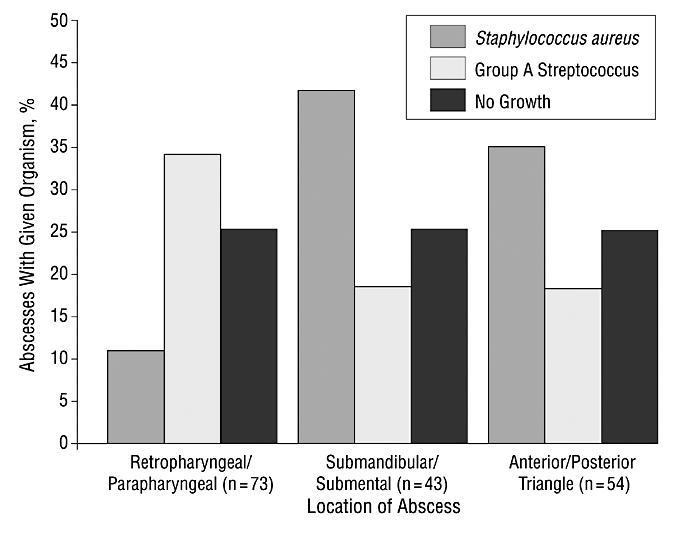
RPA is a polymicrobial infection in most cases. The predominant organisms are Group A Streptococcus, Staphylococcus aureus (including MRSA in up to 64% of S. aureus isolates), and anaerobes (Prevotella, Fusobacterium, Peptostreptococcus). [5][7] More than two-thirds of deep neck abscesses harbor beta-lactamase-producing organisms. [7]
The distribution of organisms cultured from retropharyngeal/parapharyngeal abscesses compared to other deep neck locations is shown in the following figure:
Severity stratification
- Mild/Cellulitis: Prevertebral soft tissue thickening without defined fluid collection on CT → trial of IV antibiotics
- Moderate (small abscess <2–3 cm): Rim-enhancing collection on CT → IV antibiotics with close monitoring; ~35–50% can be managed medically [1][31-32]
- Severe: Large abscess (≥3 cm), airway compromise, mediastinal extension, sepsis, or failure to improve in 24–48 hours → surgical drainage [2][16][32]
Complications (cannot-miss)
- Airway obstruction (36% of retropharyngeal abscesses in one adult series) [10]
- Descending necrotizing mediastinitis (mortality ~40%) [11]
- Aspiration from spontaneous rupture [7]
- Lemierre syndrome (IJV septic thrombophlebitis) [12][27]
- Carotid artery erosion/pseudoaneurysm
- Epidural abscess, meningitis [37]
- Sepsis (mortality 4.8% in adults) [20]
Treatment Plan
Initial stabilization
- Airway first — prepare for difficult airway; avoid blind nasotracheal intubation; have surgical airway equipment available; intubation ideally in the OR with ENT present [38]
- IV access, fluid resuscitation, NPO
Antibiotic therapy
- Empiric IV regimen: Ceftriaxone (50 mg/kg/day, max 2g) + Clindamycin (30–40 mg/kg/day IV divided q8h) [5][13]
- Alternative: Ampicillin-sulbactam (200–400 mg/kg/day of ampicillin component divided q6h) [13]
- Penicillin-allergic: Clindamycin monotherapy or vancomycin + metronidazole
- Severe/complicated: Piperacillin-tazobactam or meropenem [14]
- Narrow antibiotics based on culture and sensitivity data
Surgical drainage
- Indications: Large abscess (≥3 cm), airway compromise, failure to improve on IV antibiotics within 24–48 hours, mediastinal extension, immunocompromised host [2][16][32]
- Approach: Transoral incision and drainage (preferred for uncomplicated RPA) vs. transcervical (for extensive disease or parapharyngeal extension) [20]
- Transoral approach has lower recurrence (5.6% vs. 27%) and complication rates compared to transcervical in one series [20]
- ~35–58% of patients can be managed with antibiotics alone without surgery [1][31]
Disposition
Admit all confirmed or suspected RPA
- All patients require IV antibiotics and close airway monitoring [8]
- ICU admission criteria: Stridor, respiratory distress, airway compromise, sepsis, mediastinal extension, post-operative monitoring in young infants [2][9][39]
- Predictors of PICU admission: dysphagia, trismus, tonsillar hypertrophy, WBC ≥15,000, CRP ≥50 mg/L [9]
Discharge criteria
- Afebrile for 24–48 hours
- Tolerating oral intake and oral antibiotics
- Improving clinically with decreasing neck swelling/pain
- Reliable follow-up arranged
Consultation triggers
- ENT/Otolaryngology — consult early for all suspected RPA [8]
- Pediatric surgery or interventional radiology if CT-guided drainage considered
- Infectious disease — for complicated cases, MRSA, or atypical organisms
- Anesthesiology — for airway management planning
Follow Up / Return Precautions
- Follow-up: ENT follow-up within 1 week of discharge; primary care within 2–3 days
- Total antibiotic duration: Typically 2–4 weeks (IV + oral transition) [16-17]
- Return immediately for: Worsening neck swelling, difficulty breathing, stridor, inability to swallow, high fever, drooling, or worsening neck stiffness
- Expected course: Most patients improve within 48–72 hours of appropriate therapy; median hospital stay is 2.6 days (medical) to 3.5 days (surgical) [31]
- Recurrence: Uncommon (~5–9% for RPA); recurrent infections should prompt evaluation for congenital anomalies (branchial cleft fistula) or immunodeficiency [20-21]
- Patient counseling: Emphasize completion of full antibiotic course; educate on signs of airway compromise
References
1. Retropharyngeal Abscess in Children: Clinical Presentation, Utility of Imaging, and Current Management. — Craig FW, Schunk JE. Pediatrics. 2003.
2. Retropharyngeal Abscess Complicated by Mediastinitis in Infants. — Thomas A, Adam S, Goussard P, et al. Respiration; International Review of Thoracic Diseases. 2024.
3. Retropharyngeal and Parapharyngeal Abscess in Children--Epidemiology, Clinical Features and Treatment. — Grisaru-Soen G, Komisar O, Aizenstein O, et al. International Journal of Pediatric Otorhinolaryngology. 2010.
4. Retropharyngeal Abscess in Adults: Five Case Reports and Review of the Literature. — Harkani A, Hassani R, Ziad T, et al. TheScientificWorldJournal. 2011.
5. Retropharyngeal Abscess in Children: The Rising Incidence of Methicillin-Resistant Staphylococcus Aureus. — Abdel-Haq N, Quezada M, Asmar BI. The Pediatric Infectious Disease Journal. 2012.
6. Retropharyngeal Abscess: Epiglottitis of the New Millennium. — Lee SS, Schwartz RH, Bahadori RS. The Journal of Pediatrics. 2001.
7. Microbiology and Management of Peritonsillar, Retropharyngeal, and Parapharyngeal Abscesses. — Brook I. Journal of Oral and Maxillofacial Surgery : Official Journal of the American Association of Oral and Maxillofacial Surgeons. 2004.
8. A Pain in the Neck: Non-Traumatic Adult Retropharyngeal Abscess. — Schott CK, Counselman FL, Ashe AR. The Journal of Emergency Medicine. 2013.
9. Predictors of Pediatric Intensive Care Unit Admission in Pediatric Deep Neck Infections: A Retrospective Observational Study. — Kurt F, Yiğit H, Kaynak MO, et al. Medicine. 2025.
10. Deep neck infection: Analysis of 185 cases. — Huang TT, Liu TC, Chen PR, et al. Head & Neck. 2004.
11. Descending Necrotizing Mediastinitis Secondary to a Retropharyngeal Abscess. — Takao M, Ido M, Hamaguchi K, et al. The European Respiratory Journal. 1994.
12. High Risk and Low Prevalence Diseases: Lemierre's Syndrome. — Carius BM, Koyfman A, Long B. The American Journal of Emergency Medicine. 2022.
13. Contemporary Management of Deep Infections of the Neck. — Peterson LJ. Journal of Oral and Maxillofacial Surgery : Official Journal of the American Association of Oral and Maxillofacial Surgeons. 1993.
14. Clinical Evaluation of Antibiotic Regimens in Patients With Surgically Verified Parapharyngeal Abscess: A Prospective Observational Study. — Klug TE, Andersen C, Hahn P, et al. European Archives of Oto-Rhino-Laryngology : Official Journal of the European Federation of Oto-Rhino-Laryngological Societies : Affiliated With the German Society for Oto-Rhino-Laryngology - Head and Neck Surgery. 2022.
15. Role of Steroids in Conservative Treatment of Parapharyngeal and Retropharyngeal Abscess in Children. — Villanueva-Fernández E, Casanueva-Muruáis R, Vivanco-Allende A, Llorente JL, Coca-Pelaz A. European Archives of Oto-Rhino-Laryngology : Official Journal of the European Federation of Oto-Rhino-Laryngological Societies : Affiliated With the German Society for Oto-Rhino-Laryngology - Head and Neck Surgery. 2022.
16. Deep Neck Abscesses in Children: An Italian Retrospective Study. — Donà D, Gastaldi A, Campagna M, et al. Pediatric Emergency Care. 2021.
17. Retrospective Review of 33 Cases of Paediatric Retropharyngeal and Parapharyngeal Infections and a Proposed Algorithm for Managing Future Cases. — Fitzsimons M, Boyle S, Colreavy M, et al. The Journal of Laryngology and Otology. 2025.
18. Retropharyngeal Abscess Presenting With Sleep Apnea Syndrome. — Koçak HE, Kiral MN, Acipayam H, Elbistanli MS, Kayhan FT. The Journal of Craniofacial Surgery. 2017.
19. Features Associated With Surgically Significant Abscesses on Computed Tomography Evaluation of the Neck in Pediatric Patients. — Heilbronn C, Heyming TW, Knudsen-Robbins C, et al. International Journal of Pediatric Otorhinolaryngology. 2021.
20. Comparing Transoral and Transcervical Approaches for Retropharyngeal and Parapharyngeal Abscesses: Postoperative Outcomes and Complications. — Nguyen K, Eckard P, Benafield A, et al. American Journal of Otolaryngology. 2025.
21. Clinical and Microbiological Characteristics of Deep Neck Space Abscesses: A Retrospective Study. — Wu X, Wang J, Zhang J, Wei C. Acta Oto-Laryngologica. 2026.
22. Odontogenic Retropharyngeal Space Abscesses: Incidence and Distinctive Features From a Multi-Institutional Cohort of 145 Patients. — Iwata E, Kikuta S, Iwanaga J, et al. The Journal of Craniofacial Surgery. 2025.
23. Fluid Collection in the Retropharyngeal Space: A Wide Spectrum of Various Emergency Diseases. — Tomita H, Yamashiro T, Ikeda H, et al. European Journal of Radiology. 2016.
24. Emerging Findings for the Assessment and Treatment of Pediatric Deep Neck Abscesses. — Hankey PB, Tracy M, Arganbright JM. Current Opinion in Otolaryngology & Head and Neck Surgery. 2023.
25. Optimizing Advanced Imaging of the Pediatric Patient in the Emergency Department: Technical Report. — Marin JR, Lyons TW, Claudius I, et al. Pediatrics. 2024.
26. Bacteriology of Deep Neck Abscesses: A Retrospective Review of 96 Consecutive Cases. — Lee YQ, Kanagalingam J. Singapore Medical Journal. 2011.
27. Guide to Utilization of the Microbiology Laboratory for Diagnosis of Infectious Diseases: 2024 Update by the Infectious Diseases Society of America (IDSA) and the American Society for Microbiology (ASM). — Miller JM, Binnicker MJ, Campbell S, et al. Clinical Infectious Diseases : An Official Publication of the Infectious Diseases Society of America. 2024.
28. Utility of Soft Tissue Lateral Neck Radiographs in the Emergency Department: The 5-Year Experience of a Large Tertiary Care Pediatric Hospital. — Sao Pedro T, Scolnik D, Traubici J, Stephens D. Pediatric Emergency Care. 2020.
29. Prediction of Deep Neck Abscesses by Contrast-Enhanced Computerized Tomography in 76 Clinically Suspect Consecutive Patients. — Freling N, Roele E, Schaefer-Prokop C, Fokkens W. The Laryngoscope. 2009.
30. Diagnostic Accuracy of Contrast-Enhanced CT for Neck Abscesses: A Systematic Review and Meta-Analysis of Positive Predictive Value. — Hagelberg J, Pape B, Heikkinen J, et al. PloS One. 2022.
31. Prognostic Factors for Retropharyngeal Abscess in Children Receiving Surgery or Antibiotic Therapy. — Liu Y, Nicotera DJ, Islam AA, Dunsky K, Lieu JEC. The Laryngoscope. 2024.
32. Prognostic Factors in the Management of Paediatric Patients With Retropharyngeal and Parapharyngeal Infections. — Hu K, Sattar Othman M, Davidson J, et al. The Journal of Laryngology and Otology. 2026.
33. ESR Essentials: Acute Infections of the Head and Neck-Practice Recommendations by the European Society of Head and Neck Radiology. — Hirvonen J, Lingam RK, Connor S. European Radiology. 2025.
34. Advanced Imaging of Head and Neck Infections. — Baba A, Kurokawa R, Kurokawa M, et al. Journal of Neuroimaging : Official Journal of the American Society of Neuroimaging. 2023.
35. FDA Drug Label. — Updated date: 2026-04-28. Food and Drug Administration.
36. Age-, Site-, and Time-Specific Differences in Pediatric Deep Neck Abscesses. — Coticchia JM, Getnick GS, Yun RD, Arnold JE. Archives of Otolaryngology--Head & Neck Surgery. 2004.
37. Lemierre Syndrome: More Than "The Forgotten Disease". — Morelli N, Rota E, Sacchini D, et al. Neurology. 2013.
38. Difficult Intubation and Ventilation in an Infant With Retropharyngeal Abscess With Mediastinal Extension. — Bruno MA, Drabek T, Manole MD. Pediatric Emergency Care. 2019.
39. A Prospective Study of 113 Deep Neck Infections Managed Using a Clinical Practice Guideline. — Saluja S, Brietzke SE, Egan KK, et al. The Laryngoscope. 2013.
Figure
Reviewed by Dr. Lucas Mastropaolo. SymptomDx is an educational tool for medical professionals — it does not replace clinical judgment. Verify all clinical data and drug dosages with authoritative sources.