African Sleeping Sickness
Human African Trypanosomiasis (HAT) is a life-threatening neglected tropical disease caused by protozoan parasites Trypanosoma brucei gambiense (West/Central Africa, ~95% of cases, chronic) and T. b. rhodesiense (East/Southern Africa, ~5%, acute), transmitted by the tsetse fly (Glossina spp). Fatal if untreated. [1-2]
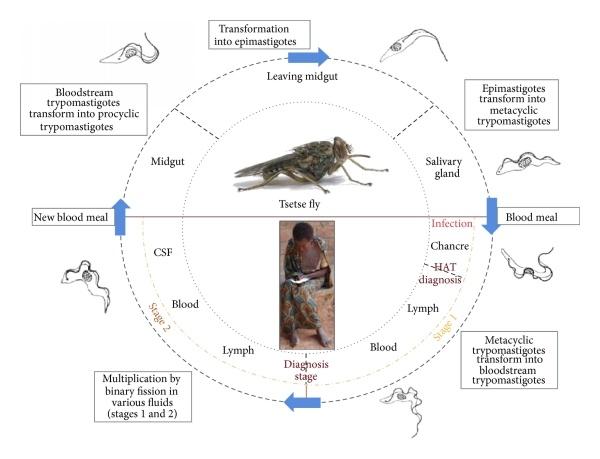
The following figure illustrates the life cycle of the parasite through the tsetse fly vector and human host, highlighting the diagnostic implications at each stage:
History
- Travel history is paramount: recent or remote travel to sub-Saharan Africa, specifically rural/forested areas with tsetse fly exposure [2][4]
- Activities increasing exposure: farming, water collection, hunting, fishing, wood gathering [5]
- Symptom timeline: gambiense incubation can be months with a mean disease duration ~3 years; rhodesiense incubation is days to 3 weeks with rapid progression [1]
- Ask about: intermittent fevers, persistent headache, pruritus, arthralgias, weight loss, fatigue, malaise, sleep disturbances (daytime somnolence, nocturnal insomnia) [1][6]
- Painful skin lesion at bite site (trypanosomal chancre) — more common in rhodesiense (5–26% in endemic populations, up to 88% in travelers) [1]
- Important negatives: no response to antimalarials (recurrent fever despite treatment is a key clue), no typical malaria periodicity [7]
Alarm Features
- Neurological signs indicating severe second-stage disease: mental confusion, atypical behavior, logorrhoea, anxiety, ataxia, tremor, motor weakness, speech impairment, irregular gait, abnormal movements, seizures [1][8]
- Rhodesiense-specific red flags: hemodynamic instability, signs of myocarditis/pericarditis, congestive heart failure, multiorgan failure — patients can die of cardiac failure before neurological manifestation [1][9]
- Progressive somnolence, coma, incontinence, cachexia [1]
- Rapid clinical deterioration (rhodesiense can be fatal within days to weeks) [1]
Medications
Six drugs are currently available (all donated by manufacturers and distributed free via WHO): [1]
- Fexinidazole (oral, 10-day course): Now first-line for both gambiense and rhodesiense HAT in patients ≥6 years and ≥20 kg. Must be taken with a substantial meal for adequate absorption. Loading dose × 4 days, then maintenance × 6 days [1-2][8]
- QT prolongation[1-2]
- Pentamidine (IM, 7 days): First-line for first-stage gambiense HAT in children <6 years or <20 kg; bridge therapy for rhodesiense when fexinidazole unavailable. Caution: severe hypotension, hypoglycemia [1][8]
- NECT (nifurtimox PO + eflornithine IV): For severe second-stage gambiense HAT (CSF WBC ≥100/μL). Eflornithine requires IV infusion × 7 days [1][8]
- Suramin (IV, weekly × 5 weeks): First-stage rhodesiense in children <6 years/<20 kg. Test dose required (anaphylaxis risk). Nephrotoxic [1]
- Melarsoprol (IV): Reserved for second-stage rhodesiense in children <6 years/<20 kg or when fexinidazole cannot be given. Encephalopathic syndrome in ~7%, treatment-related death in 3–8% [1-2]
- Contraindicated medications: Melarsoprol is no longer recommended for gambiense HAT due to unacceptable toxicity [10]
Diet
- Fexinidazole must be taken with food — bioavailability is substantially compromised in the fasting state, which can lead to treatment failure [1][8]
- Nutritional support is critical in advanced disease with cachexia
- Adequate hydration, especially with vomiting from fexinidazole (reported in ~38% of patients) [2]
Review of Systems
- Constitutional: Intermittent fever, weight loss, fatigue, malaise, night sweats [1][6]
- Neurological: Sleep-wake cycle disruption, daytime somnolence, headache, tremor, gait disturbance, confusion, behavioral changes, seizures [1][6]
- Dermatologic: Chancre at bite site, circinate/serpentine rash, generalized pruritus, facial edema [1]
- Cardiovascular: Chest pain, dyspnea, palpitations (myocarditis/pericarditis) [1][6]
- Lymphatic: Painless lymphadenopathy, especially posterior cervical [1]
- GI: Hepatosplenomegaly, diarrhea (especially in travelers) [6]
- Endocrine: Amenorrhea, impotence, alopecia [1][6]
- Psychiatric: Hallucinations, anxiety, irritability, excessive sexual impulses, behavioral disturbances [6]
Collateral History and Family History
- Detailed travel itinerary to sub-Saharan Africa — specific countries, rural vs. urban, duration, activities [2][6]
- Occupation and outdoor exposure in endemic areas
- Prior tsetse fly bites or known exposure
- Family members or travel companions with similar symptoms
- No hereditary predisposition; HAT is entirely vector-borne
- In non-endemic settings, travelers and expatriates present atypically with acute febrile illness regardless of subspecies [6]
Risk Factors
- Travel to or residence in tsetse fly–endemic areas of sub-Saharan Africa [2]
- Rural exposure: farming, fishing, hunting, water collection in forested/riverine areas [5]
- Gambiense: West/Central Africa (DRC accounts for >80% of cases) [4]
- Rhodesiense: East/Southern Africa (Uganda, Malawi, Tanzania, Zambia) [2]
- Safari travelers, aid workers, researchers in endemic zones
- No vaccine or chemoprophylaxis available
- Lack of personal protective measures against tsetse flies
Differential Diagnosis
- Malaria — most common misdiagnosis; intermittent fever, similar geography. Key distinguisher: HAT fever does not respond to antimalarials [1][7]
- HIV infection — lymphadenopathy, weight loss, neuropsychiatric symptoms [6]
- Tuberculosis — chronic fever, weight loss, lymphadenopathy [6]
- Typhoid fever — prolonged fever, hepatosplenomegaly [6]
- Viral encephalitis — CNS involvement, altered mental status [6]
- Brucellosis — undulant fever, arthralgias [6]
- Leishmaniasis — hepatosplenomegaly, fever, pancytopenia [6]
- Toxoplasmosis — CNS involvement in immunocompromised [6]
- Lymphoma — generalized lymphadenopathy, constitutional symptoms
- Chancre may mimic arachnid/insect bites or eschar (e.g., rickettsial disease) [1]
Past Medical History
- Previous episodes of HAT (relapses can occur)
- Prior treatment with HAT drugs (risk of drug resistance, cross-resistance between nifurtimox and fexinidazole) [1][8]
- HIV status (co-infection complicates management)
- Cardiac history (relevant given myocarditis risk and QT-prolonging drugs)
- Renal function (suramin is nephrotoxic) [1]
- Hepatic function (drug metabolism considerations)
- Psychiatric history (fexinidazole neuropsychiatric adverse effects) [1]
Physical Exam
- Vital signs: Intermittent fever (irregular pattern), tachycardia, hypotension (cardiac involvement in rhodesiense) [1]
- Winterbottom's sign: Painless, soft, enlarged posterior cervical lymph nodes — classic for gambiense HAT [1][9]
- Trypanosomal chancre: Painful erythematous lesion 2–5 cm at bite site, no necrosis, larger than typical eschar [1]
- Trypanosomal rash: Circular or serpentine outline, transient, migratory [1]
- Hepatosplenomegaly [1]
- Facial/peripheral edema [1]
- Neurological exam: Assess for tremor, ataxia, motor weakness, abnormal gait, speech impairment, abnormal movements, altered mental status, seizures [1][8]
- Kerandel's sign: Delayed hyperaesthesia at bone crests or soft tissues [1]
- Cardiac exam: Signs of pericardial effusion, heart failure (especially rhodesiense) [1][9]
Lab Studies
- Giemsa-stained thick and thin blood films — gold standard for rhodesiense (high parasitemia); may require repeated exams and concentration techniques for gambiense [1][11]
- Buffy coat preparation — concentrates trypanosomes; ~50% sensitivity for gambiense [1]
- Mini anion exchange centrifugation technique (mAECT) — ~80% sensitivity for gambiense [1]
- Lymph node aspirate microscopy — when palpable cervical nodes present [1]
- Serological screening (gambiense only): CATT or lateral flow RDTs (HAT Sero K-SeT: 100% sensitivity, ~94% specificity) [1][7]
- CSF analysis for staging: WBC count and trypanosome detection
- CBC: Anemia, thrombocytopenia, leukocytosis
- CMP: Renal function (baseline before suramin), hepatic function
- ECG monitoring during fexinidazole treatment (QT prolongation) [1-2]
- PCR available through CDC/reference labs (sensitivity ~99%, specificity ~98%) but not widely available in field settings [6]
Imaging
- No specific imaging is diagnostic for HAT
- Echocardiography: Indicated in rhodesiense HAT to evaluate for myocarditis, pericardial effusion, cardiac dysfunction [1][9]
- Brain MRI: May show white matter changes or meningoencephalitic features in second-stage disease, but not routinely required for diagnosis or staging
- Chest X-ray: If pulmonary edema or pericardial effusion suspected
- Imaging is generally unnecessary for diagnosis — staging relies on CSF examination [1]
Special Tests
- Lumbar puncture with CSF examination: The critical staging test. Required for children <6 years/<20 kg, and when clinical signs suggest severe second-stage disease. Can be avoided in adults/older children without neurological signs when fexinidazole is planned [1][8]
- CATT (Card Agglutination Test for Trypanosomiasis): Serological screening for gambiense; titer ≥1:16 considered positive [1][6]
- Lateral flow RDTs: Individual screening for gambiense in field settings [1]
- Trypanolysis test: Specific for T. b. gambiense contact; reference lab only [1]
- Indirect ELISA–T. b. gambiense: ~99% specificity, available for high-throughput screening [1]
- Chancre aspirate: Can detect trypanosomes within days of rhodesiense infection [1]
ECG
- Baseline ECG recommended before fexinidazole initiation — QT prolongation is a recognized adverse effect [1-2]
- Monitor for QTc prolongation during treatment course
- In rhodesiense HAT: ECG may show signs of myocarditis (ST-T wave changes, arrhythmias, conduction abnormalities) or pericarditis [1][6]
- Avoid concurrent QT-prolonging medications during fexinidazole therapy
Assessment
- HAT is a two-stage disease: haemolymphatic (stage 1) → meningoencephalitic (stage 2) [1]
- Gambiense HAT: Chronic, insidious course over months to years; often misdiagnosed as malaria. Winterbottom's sign is classic. Spontaneous cure or chronic carriage has been rarely observed [1]
- Rhodesiense HAT: Acute, rapidly progressive over days to weeks; can present as severe sepsis with cardiac involvement and multiorgan failure before neurological signs appear [1]
- Travelers present atypically: acute febrile illness regardless of subspecies, chancre more common (88%), diarrhea and jaundice may lead to erroneous GI diagnosis, sleep disturbances and lymphadenopathy less common [6]
- Complications: reactive encephalopathy (especially with melarsoprol), irreversible neurocognitive impairment, cardiac failure, superimposed bacterial infections, cachexia, death [1-2]
Treatment Plan
Initial stabilization (especially rhodesiense)
- IV access, hemodynamic monitoring, treat concurrent malaria if present
- Rhodesiense HAT must be treated without delay — can progress to multiorgan failure rapidly [1]
Definitive treatment by subspecies and stage: [1-2]
Key treatment pearls
- Fexinidazole: must be taken with food; directly observed therapy for all 10 days [1][8]
- Monitor for neuropsychiatric adverse effects and QT prolongation during fexinidazole [1-2]
- Suramin: test dose required before full treatment (anaphylaxis risk); monitor renal function [1]
- In non-endemic countries, contact the CDC for drug access and specialist consultation — WHO maintains strategic emergency drug depots [2][11]
- Acoziborole (single oral dose) is a promising pipeline drug for gambiense HAT, with phase 2/3 data showing efficacy in both stages [12]
Disposition
- All confirmed HAT cases require admission for treatment initiation, monitoring, and staging [1-2]
- Fexinidazole requires 10 days of directly observed therapy with food, ideally in a health facility [8]
- NECT requires hospitalization for IV eflornithine infusions [8]
- Rhodesiense HAT: ICU-level care may be needed for hemodynamic instability, cardiac involvement, or multiorgan failure [1]
- Infectious disease consultation is essential, especially in non-endemic settings
- Contact CDC Parasitic Diseases Hotline (in the US) for drug access and management guidance [11]
Follow Up / Return Precautions
Post-treatment follow-up: [1-2][8]
- Gambiense HAT (fexinidazole): Clinical assessment at 6, 12, 18, and 24 months post-treatment, or at any time if symptoms recur
- Rhodesiense HAT (fexinidazole): Clinical evaluation at end of treatment, 1, 3, 6, and 12 months post-treatment
- Pentamidine/NECT: Systematic follow-up currently not routinely recommended but clinical vigilance maintained [8]
Return precautions — seek immediate care for
- Recurrence of fever, headache, or sleep disturbances
- Any new neurological or psychiatric symptoms (confusion, tremor, gait changes, seizures)
- Signs of cardiac decompensation
Key counseling points
- Relapses with fexinidazole can occur up to 12–24 months after treatment [8]
- Drug resistance is a theoretical concern (cross-resistance between nifurtimox and fexinidazole) [1][8]
- Treatment success defined as: alive, no trypanosomes in any body fluid, CSF WBC normalizing by 6 months [2]
- No vaccine or chemoprophylaxis exists — prevention relies on tsetse fly avoidance (long sleeves, neutral-colored clothing, insect repellent, avoiding bushland during peak biting hours) [2]
References
1. Human African Trypanosomiasis. — Lejon V, Lindner AK, Franco JR. Lancet. 2025.
2. New WHO Guidelines for Treating Rhodesiense Human African Trypanosomiasis: Expanded Indications for Fexinidazole and Pentamidine. — Lindner AK, Lejon V, Barrett MP, et al. The Lancet. Infectious Diseases. 2025.
3. Overview of the Diagnostic Methods Used in the Field for Human African Trypanosomiasis: What Could Change in the Next Years?. — Bonnet J, Boudot C, Courtioux B. BioMed Research International. 2015.
4. Oral Fexinidazole for Late-Stage African Trypanosoma Brucei Gambiense Trypanosomiasis: A Pivotal Multicentre, Randomised, Non-Inferiority Trial. — Mesu VKBK, Kalonji WM, Bardonneau C, et al. Lancet. 2018.
5. Chemotherapy for Second-Stage Human African Trypanosomiasis: Drugs in Use. — Lutje V, Probyn K, Seixas J, Bergman H, Villanueva G. The Cochrane Database of Systematic Reviews. 2021.
6. Clinical Features, Diagnosis, and Treatment of Human African Trypanosomiasis (Sleeping Sickness). — Kennedy PG. The Lancet. Neurology. 2013.
7. Passive Surveillance of Human African Trypanosomiasis in the Democratic Republic of the Congo: Clinical Presentation and Prospective Evaluation of Rapid Diagnostic and Reference Laboratory Test Accuracy. — Makabuza J, Lukusa IN, Lumbala C, et al. PLoS Neglected Tropical Diseases. 2025.
8. New WHO Guidelines for Treatment of Gambiense Human African Trypanosomiasis Including Fexinidazole: Substantial Changes for Clinical Practice. — Lindner AK, Lejon V, Chappuis F, et al. The Lancet. Infectious Diseases. 2020.
9. The Trypanosomiases. — Barrett MP, Burchmore RJ, Stich A, et al. Lancet. 2003.
10. Recent Progress in Diagnosis and Treatment of Human African Trypanosomiasis Has Made the Elimination of This Disease a Realistic Target by 2030. — Álvarez-Rodríguez A, Jin BK, Radwanska M, Magez S. Frontiers in Medicine. 2022.
11. Guide to Utilization of the Microbiology Laboratory for Diagnosis of Infectious Diseases: 2024 Update by the Infectious Diseases Society of America (IDSA) and the American Society for Microbiology (ASM). — Miller JM, Binnicker MJ, Campbell S, et al. Clinical Infectious Diseases : An Official Publication of the Infectious Diseases Society of America. 2024.
12. Efficacy and Safety of Acoziborole in Patients With Human African Trypanosomiasis Caused by Trypanosoma Brucei Gambiense: A Multicentre, Open-Label, Single-Arm, Phase 2/3 Trial. — Betu Kumeso VK, Kalonji WM, Rembry S, et al. The Lancet. Infectious Diseases. 2023.
Figure
More from Deep Dive
Reviewed by Dr. Lucas Mastropaolo. SymptomDx is an educational tool for medical professionals — it does not replace clinical judgment. Verify all clinical data and drug dosages with authoritative sources.