Anthrax
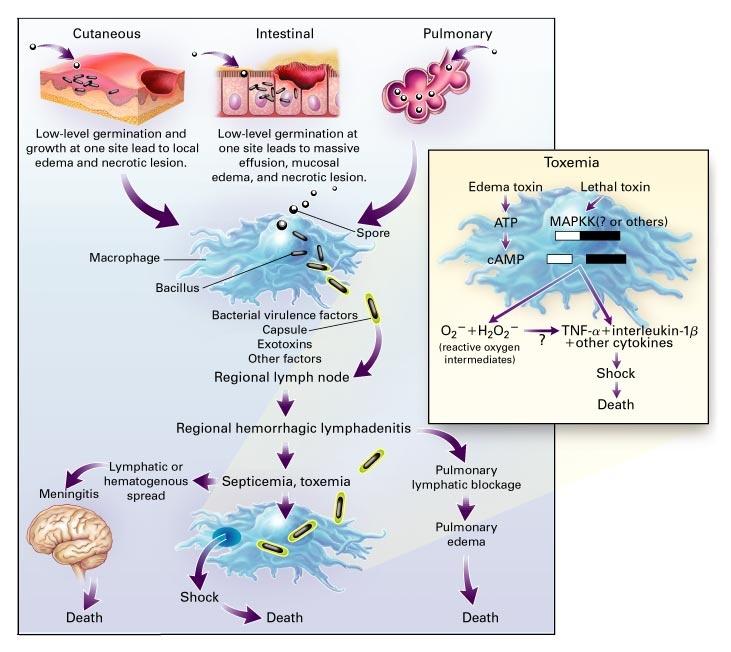
Anthrax is a toxin-mediated zoonotic disease caused by the spore-forming, gram-positive rod Bacillus anthracis, classified as a CDC Category A bioterrorism agent. [1] Four clinical forms exist: cutaneous (>95% of natural cases), inhalational, ingestion, and injection (associated with contaminated heroin). [1-2] Anthrax meningitis can complicate any form. [3]
The following figure illustrates the pathophysiology of anthrax from spore entry through systemic toxemia:
History
- Exposure history is paramount: contact with herbivore animals (sheep, goats, cattle), animal hides/wool/meat, travel to endemic regions (sub-Saharan Africa, central/southwestern Asia, southern/eastern Europe), injection drug use (heroin), or suspicious mail/powder [1-2]
- Incubation periods: cutaneous ~1–7 days; inhalational median 7 days (IQR 4–9), can extend up to 6 weeks (Sverdlovsk) or 9 weeks (primate models); ingestion 1–7 days; injection ~1 day [5-6]
- Cutaneous: painless pruritic papule → vesicle → painless black eschar with surrounding edema disproportionate to lesion size; ~1/3 develop fever [3][7]
- Inhalational: biphasic course — initial nonspecific "flu-like" prodrome (fever, malaise, myalgia, nonproductive cough, absence of rhinorrhea) lasting hours to days, sometimes with brief improvement, followed by fulminant respiratory failure, shock, and hemodynamic collapse [3][6]
- Ingestion: nausea, vomiting, bloody diarrhea, abdominal pain, ascites (>50% of cases) [3][5]
- Injection: severe soft tissue infection at injection site with marked edema [2][8]
Alarm Features
- Widened mediastinum on CXR in a febrile patient — essentially pathognomonic of advanced inhalational anthrax [4][9]
- Rapid progression from flu-like illness to shock and respiratory failure within hours [6][10]
- Hemorrhagic meningitis (altered mental status, seizures, nuchal rigidity) — occurs in up to 50% of systemic cases; nearly uniformly fatal [3][6]
- Cutaneous lesion with systemic signs: fever, hypotension, extensive edema, lymphadenopathy, bacteremia, coagulopathy, or neurologic signs [1]
- Clustering of patients with similar respiratory symptoms suggesting intentional release [2][11]
- Pleural/pericardial effusions, especially hemorrhagic [1][6]
Medications
Postexposure Prophylaxis (PEP): [1][12]
Treatment — Cutaneous (uncomplicated): Oral ciprofloxacin or doxycycline for 7–10 days (extend to 60 days if aerosol exposure suspected) [6]
Treatment — Systemic (with or without meningitis): [1]
- Empiric triple therapy: two bactericidal drugs from different classes + a protein synthesis inhibitor (PSI) or RNA synthesis inhibitor
- Preferred: IV ciprofloxacin + meropenem (CNS-penetrating bactericidal) + linezolid (PSI) [6][13]
- If meningitis ruled out by LP: fluoroquinolone + linezolid or clindamycin (two-drug regimen) [6]
- Duration: ≥2 weeks IV, then transition to oral; total 60 days if aerosol exposure [1]
- Adjunctive antitoxin (raxibacumab, obiltoxaximab) recommended for systemic disease [1]
Contraindicated/Cautions
- Extended-spectrum cephalosporins — B. anthracis is naturally resistant [9]
- Penicillins should only be used if susceptibility is confirmed (<10% natural resistance) [1]
- Steroids did not improve survival and may worsen outcomes in shock [1][14]
Diet
- No specific dietary triggers or recommendations
- Ingestion anthrax results from consumption of contaminated/undercooked meat from infected herbivores — thorough cooking of meat in endemic areas is critical [1]
- Aggressive IV fluid resuscitation in systemic disease per sepsis protocols [6]
Review of Systems
- Constitutional: fever, chills, malaise, diaphoresis, myalgias
- Respiratory: cough (nonproductive), dyspnea, chest tightness — notably rhinorrhea is absent in inhalational anthrax (distinguishing from influenza) [6]
- GI: nausea, vomiting, abdominal pain, bloody diarrhea (ingestion form)
- Neurologic: headache, confusion, altered mental status, seizures, meningismus (meningitis complication) [3]
- Dermatologic: painless skin lesion, vesicles, eschar, disproportionate edema [7]
- Cardiovascular: chest pain, hypotension, tachycardia
Collateral History and Family History
- Occupational exposure: agricultural workers, veterinarians, wool/hide processors, laboratory workers [1]
- Travel history: endemic regions (sub-Saharan Africa, central Asia, southern Europe) [1]
- Injection drug use: heroin contaminated with B. anthracis spores (injection anthrax) [2][8]
- Bioterrorism context: suspicious packages, powder exposure, clustering of cases [11]
- No hereditary predisposition; family history is not relevant unless shared exposure
- Comorbidities associated with worse outcomes in cutaneous anthrax: diabetes, obesity, hypertension, COPD [1]
Risk Factors
- Contact with infected animals or contaminated animal products (hides, wool, meat, bone meal) [1]
- Occupational exposure (farmers, veterinarians, textile workers, laboratory personnel)
- Travel to or residence in endemic agricultural regions [1]
- Injection drug use (heroin) [2]
- Bioterrorism exposure (aerosolized spores) [1]
- Immunocompromised status (may require extended PEP) [1]
Differential Diagnosis
Past Medical History
- Prior anthrax vaccination status (AVA series)
- Previous anthrax episodes (rare; natural immunity may develop)
- Chronic conditions worsening prognosis: diabetes, obesity, hypertension, COPD — all significantly associated with severe cutaneous anthrax (p<0.01) [1]
- Immunocompromised states (may require extended antimicrobial prophylaxis post-treatment) [1]
Physical Exam
- Vitals: fever (may be absent early), tachycardia, hypotension (late/systemic), tachypnea, hypoxia
- Cutaneous: painless pruritic papule → vesicle → painless black eschar with surrounding non-pitting edema disproportionate to lesion size; regional lymphadenopathy [3][7]
- Respiratory: decreased breath sounds (pleural effusions in 76% of inhalational cases), signs of respiratory distress [1]
- Neurologic: meningismus (nuchal rigidity, Kernig/Brudzinski signs), altered mental status, focal deficits, seizures [3]
- Abdominal: tenderness, distension, ascites (ingestion form) [3]
- Injection site: severe soft tissue edema, induration, compartment syndrome [8]
Lab Studies
- Blood cultures (most useful test) — obtain before antibiotics; growth in 6–24 hours; even 1–2 doses of antibiotics can sterilize cultures [6][10]
- Gram stain of blood, vesicular fluid, CSF, or tissue: large, encapsulated, gram-positive, "boxcar-shaped" rods [15-16]
- CBC: hemoconcentration, dramatic neutrophilic leukocytosis with bandemia (especially inhalational) [6][16]
- CMP/LFTs: elevated transaminases [6]
- Coagulation studies: coagulopathy in ~1/3 of systemic cases [1]
- Lumbar puncture: required to rule out meningitis — hemorrhagic CSF with PMN pleocytosis and gram-positive rods [16]
- Confirmatory testing: PCR (pagA, lef, capB targets), immunohistochemistry, gamma phage lysis — performed at LRN reference laboratories [15][17]
- Serology (anti-PA ELISA) — only useful retrospectively [15]
Imaging
- CXR (first-line): widened mediastinum (pathognomonic in context), bilateral pleural effusions, perihilar infiltrates; notably does NOT show classic lobar pneumonia [9-10]
- CT chest (gold standard): hyperdense (hemorrhagic) mediastinal lymphadenopathy on non-contrast CT, bilateral pleural effusions, mediastinal fat edema, pericardial effusion [6][10]
- Echocardiogram: pericardial effusion [6]
- CT/MRI brain: hemorrhagic meningitis — subarachnoid, subdural, or intraparenchymal hemorrhages [16]
- Abdominal CT: ascites, bowel wall thickening, mesenteric lymphadenopathy (ingestion form)
Special Tests
- CDC Anthrax Triage Checklist: clinical decision tool distinguishing anthrax from non-anthrax illness with 95% sensitivity; correctly classified 95% of anthrax cases and 76% of controls [18]
- Point-of-care Gram stain of peripheral blood — bacilli may be visible on unspun blood smear in advanced bacteremia [9]
- Pleural fluid analysis: drainage recommended for all inhalational cases; spectrographic analysis may detect anthrax lethal factor at levels exceeding serum [1][13]
- CSF analysis: hemorrhagic fluid with PMN pleocytosis; Gram stain and culture [16]
- Nasal swab culture: epidemiologic/investigative tool only — does NOT predict clinical illness risk [15]
ECG
- Arrhythmias observed in ~7% of adults with inhalation anthrax [1]
- ECG indicated in all systemic anthrax to evaluate for arrhythmia, pericardial effusion (low voltage, electrical alternans), and hemodynamic compromise
- No pathognomonic ECG pattern; findings are nonspecific and related to sepsis/shock physiology
Assessment
Severity Stratification: [1]
- Anthrax is fundamentally a toxin-mediated disease — even after bacterial sterilization, toxin effects continue [1][4]
- Predictors of fatal outcome in cutaneous anthrax: constitutional symptoms, thoracic edema, hypotension, neurologic signs, coagulopathy, bacteremia [1]
- Inhalational anthrax has a characteristic biphasic course — brief improvement before fulminant collapse [6]
Treatment Plan
Initial Stabilization (Systemic Anthrax)
- ICU admission with hemodynamic monitoring, mechanical ventilation as needed, vasopressors, DVT prophylaxis, GI bleeding prophylaxis per sepsis protocols [6]
- Early, aggressive drainage of pleural effusions — recommended for all inhalational cases; pleural fluid contains high concentrations of lethal factor [1][13]
Antimicrobial Therapy
- Systemic/meningitis: IV triple therapy — ciprofloxacin + meropenem + linezolid (or clindamycin); duration ≥2 weeks, then oral step-down [1][6]
- Cutaneous (uncomplicated): oral ciprofloxacin 500 mg q12h or doxycycline 100 mg q12h for 7–10 days [6]
- If bioterrorism-related: extend all courses to 60 days total [1][6]
Adjunctive Therapies
- Antitoxin (raxibacumab or obiltoxaximab) as adjunct for systemic disease [1]
- Mannitol improved survival in meningitis patients [14]
- Steroids are not recommended — no survival benefit and potential harm [1][14]
Postexposure Prophylaxis
Disposition
- Admit to ICU: all systemic anthrax (inhalational, ingestion, injection, cutaneous with systemic signs, meningitis) [6]
- Admit to floor: cutaneous anthrax with extensive edema, head/neck involvement, or concerning features [1]
- Outpatient management: uncomplicated localized cutaneous anthrax without systemic signs, with close follow-up
- Immediate public health notification: contact local/state health department and CDC for any suspected case — anthrax is a nationally notifiable disease [15]
- Specialist consultation: infectious disease (all cases), critical care (systemic), neurosurgery (meningitis with mass effect), surgery (injection anthrax — prompt surgical debridement may be critical) [8]
Follow Up / Return Precautions
- PEP follow-up: monitor for medication adherence and adverse effects throughout 60-day course; GI intolerance is common and a major cause of non-compliance [10]
- Post-PEP counseling: after completing prophylaxis, patients must immediately report any flu-like symptoms or febrile illness — spores may remain latent and germinate after antibiotic discontinuation [10]
- Cutaneous anthrax: follow-up in 48–72 hours to assess lesion progression; eschar typically resolves over 1–3 weeks even with treatment [7]
- Post-hospitalization: infectious disease follow-up within 1 week; monitor for late complications including persistent effusions and neurologic sequelae
- Return precautions: fever, dyspnea, chest pain, worsening skin lesion, confusion, headache with neck stiffness, or any new systemic symptoms
References
1. CDC Guidelines for the Prevention and Treatment of Anthrax, 2023. — William A. Bower MD, Yon Yu PharmD, Marissa K. Person MSPH, et al United States Centers for Disease Control and Prevention. 2025.
2. Anthrax Infection. — Sweeney DA, Hicks CW, Cui X, Li Y, Eichacker PQ. American Journal of Respiratory and Critical Care Medicine. 2011.
3. Clinical Framework and Medical Countermeasure Use During an Anthrax Mass-Casualty Incident. — Bower WA, Hendricks K, Pillai S, Guarnizo J, Meaney-Delman D. MMWR. Recommendations and Reports : Morbidity and Mortality Weekly Report. Recommendations and Reports. 2015.
4. Anthrax. — Dixon TC, Meselson M, Guillemin J, Hanna PC. The New England Journal of Medicine. 1999.
5. Clinical Features of Patients Hospitalized for All Routes of Anthrax, 1880-2018: A Systematic Review. — Hendricks K, Person MK, Bradley JS, et al. Clinical Infectious Diseases : An Official Publication of the Infectious Diseases Society of America. 2022.
6. Clinical Management of Potential Bioterrorism-Related Conditions. — Adalja AA, Toner E, Inglesby TV. The New England Journal of Medicine. 2015.
7. CDC Issues Guidelines on Illnesses Associated With Intentional Release of Biologic Agents. — Ressel G. American Family Physician. 2001.
8. An Overview of Anthrax Infection Including the Recently Identified Form of Disease in Injection Drug Users. — Hicks CW, Sweeney DA, Cui X, Li Y, Eichacker PQ. Intensive Care Medicine. 2012.
9. Anthrax as a Biological Weapon: Medical and Public Health Management. — Inglesby TV, Henderson DA, Bartlett JG, et al. The Journal of the American Medical Association. 1999.
10. Anthrax as a Biological Weapon, 2002: Updated Recommendations for Management. — Inglesby TV, O'Toole T, Henderson DA, et al. The Journal of the American Medical Association. 2002.
11. Bioterrorism. — Rathjen NA, Shahbodaghi SD. American Family Physician. 2021.
12. Use of Anthrax Vaccine in the United States: Recommendations of the Advisory Committee on Immunization Practices, 2019. — Bower WA, Schiffer J, Atmar RL, et al. MMWR. Recommendations and Reports : Morbidity and Mortality Weekly Report. Recommendations and Reports. 2019.
13. Conference Report on Public Health and Clinical Guidelines for Anthrax. — Stern EJ, Uhde KB, Shadomy SV, Messonnier N. Emerging Infectious Diseases. 2008.
14. Systematic Review of Hospital Treatment Outcomes for Naturally Acquired and Bioterrorism-Related Anthrax, 1880-2018. — Person MK, Cook R, Bradley JS, et al. Clinical Infectious Diseases : An Official Publication of the Infectious Diseases Society of America. 2022.
15. Recognition and Management of Anthrax — An Update. — Swartz MN. The New England Journal of Medicine. 2001.
16. Management of Anthrax Meningitis. — Sejvar JJ, Tenover FC, Stephens DS. The Lancet. Infectious Diseases. 2005.
17. Comparing Microbiological and Molecular Diagnostic Tools for the Surveillance of Anthrax. — Ochai SO, Hassim A, Dekker EH, et al. PLoS Neglected Tropical Diseases. 2024.
18. Development and Performance of a Checklist for Initial Triage After an Anthrax Mass Exposure Event. — Hupert N, Person M, Hanfling D, et al. Annals of Internal Medicine. 2019.
Figure
More from Deep Dive
Reviewed by Dr. Lucas Mastropaolo. SymptomDx is an educational tool for medical professionals — it does not replace clinical judgment. Verify all clinical data and drug dosages with authoritative sources.