Bacterial Meningitis
Bacterial meningitis is a life-threatening medical emergency with mortality rates of 6–54% depending on pathogen and setting, and up to 25% of survivors develop neurological sequelae. [1-2] The most common causative organisms in adults are Streptococcus pneumoniae (~72%) and Neisseria meningitidis (~11%); in neonates, E. coli and Group B Streptococcus predominate. [1][3]
History
- Cardinal symptoms: Headache (84%), fever (74%), neck stiffness (74%), altered mental status (median GCS 11), nausea (62%) [1]
- Onset is typically acute — ~50% present within 24 hours of symptom onset [1]
- Ask about symptom progression: rapid deterioration over hours suggests bacterial etiology over viral
- Associated symptoms: Photophobia, vomiting, seizures, rash (especially petechial/purpuric in meningococcal disease)
- Important negatives: No recent head trauma, no neurosurgical procedures, no VP shunt (which would suggest healthcare-associated meningitis)
- Exposure history: Sick contacts, dormitory/barracks living, recent travel, daycare exposure
- Vaccination status: Pneumococcal, meningococcal, Hib vaccines [3]
- Recent infections: Otitis, sinusitis, pneumonia — extrameningeal foci present in ~43% of cases [2]
Alarm Features
- Petechial or purpuric rash — present in ~50% of meningococcal meningitis; high specificity (83–92%) for meningococcal disease [1-2]
- Rapidly declining GCS or coma (13% present comatose) [1]
- New-onset seizures (focal or generalized)
- Focal neurological deficits: Aphasia, hemiparesis (22%), cranial nerve palsies (9%) [1]
- Signs of septic shock: Hypotension, tachycardia, DIC
- Bulging fontanelle in infants
- Papilledema — suggests elevated ICP; obtain imaging before LP
- Delay in antibiotics >6 hours increases mortality from 6% to 45% [1]
Medications
Empiric Treatment (start within 1 hour of presentation): [1][3]
Add vancomycin if local ceftriaxone-resistant pneumococcus prevalence >1% [1]
Key adult dosing (normal renal/hepatic function): Ceftriaxone 4 g/day, vancomycin 30–60 mg/kg/day (target trough 15–20 mg/mL), ampicillin 12 g/day [2]
Adjunctive dexamethasone: 10 mg IV q6h × 4 days in adults; give with or before the first dose of antibiotics. [1] Reduces mortality in pneumococcal meningitis from 52% to 26%. [1] Discontinue immediately if Listeria is identified — associated with increased mortality (OR 4.58). [1] Not recommended in neonates. [2]
Contraindicated/cautions
- Oral step-down antibiotics are not recommended [3]
- Avoid moderate hypothermia and glycerol — associated with worse outcomes [2]
Diet
- NPO initially if altered mental status or risk of aspiration
- Ensure adequate IV hydration; avoid overhydration which may worsen cerebral edema
- No specific dietary triggers or long-term dietary management
Review of Systems
- Neurologic: Headache severity/quality, photophobia, phonophobia, vision changes, weakness, numbness, seizure activity
- Constitutional: Fever, chills, rigors, malaise, myalgias
- ENT: Ear pain, sinus pressure/drainage, hearing changes (baseline and new)
- Respiratory: Cough, dyspnea (concurrent pneumonia in ~9%) [1]
- Skin: Rash — specifically petechial, purpuric, or non-blanching
- GI: Nausea, vomiting, diarrhea
- Musculoskeletal: Leg pain (especially in children with meningococcal disease) [4]
Collateral History and Family History
- Collateral: Witnesses to onset, timeline of symptom progression, baseline mental status, recent antibiotic use (partially treated meningitis alters CSF findings)
- Exposures: Household contacts with meningococcal disease, dormitory/military barracks, daycare attendance
- Family history: Complement deficiency (increases susceptibility to meningococcal disease), asplenia, immunodeficiency syndromes
- Social context: Living situation (crowded housing), occupation (laboratory workers handling N. meningitidis), recent travel to meningitis belt (sub-Saharan Africa)
Risk Factors
- Age extremes: Neonates and adults >50 years [1]
- Immunocompromise: Present in ~33% of adults with bacterial meningitis — HIV/AIDS, organ transplant, asplenia, complement deficiency, chronic corticosteroid use [2]
- Anatomic: CSF leak, cochlear implants, basilar skull fracture, recent neurosurgery
- Contiguous infection: Otitis media, sinusitis, mastoiditis (especially pneumococcal) [2]
- Unvaccinated status against pneumococcus, meningococcus, or Hib [3]
- Crowded living: Dormitories, military barracks, prisons
Differential Diagnosis
- Viral meningitis (most common cause of meningitis overall; ~72% of cases) — typically milder, CSF lymphocytic predominance, normal glucose [1]
- Subarachnoid hemorrhage — thunderclap headache, acute onset; CT head ± LP
- Herpes simplex encephalitis — altered mental status, seizures, temporal lobe involvement; requires acyclovir
- Tuberculous meningitis — subacute onset (>5 days), lymphocytic CSF, very low glucose; consider in immunocompromised [5]
- Fungal meningitis (Cryptococcus) — indolent course, especially in HIV with CD4 <100
- Brain abscess/subdural empyema — focal deficits, imaging abnormalities
- Drug-induced aseptic meningitis — NSAIDs, trimethoprim, IVIG [6]
- Carcinomatous/lymphomatous meningitis — history of malignancy, cytology positive
- Autoimmune meningitis — SLE, sarcoidosis, Behçet disease [5]
Past Medical History
- Prior episodes of meningitis (recurrent meningitis suggests anatomic defect or complement deficiency)
- History of splenectomy or functional asplenia
- HIV status and CD4 count
- History of head trauma or neurosurgery
- Cochlear implants (increased pneumococcal meningitis risk)
- Chronic conditions: Diabetes, alcoholism, cirrhosis, chronic kidney disease
- Vaccination history
Physical Exam
- Vitals: Fever (74%), tachycardia, hypotension (suggests septic shock — poor prognostic sign)
- Mental status: GCS assessment — median GCS is 11 at presentation; 13% present comatose [1]
- Neck stiffness/nuchal rigidity: Present in 74–86% [1][3]
- Kernig and Brudzinski signs: High specificity (up to 95%) but very poor sensitivity (5–30%) — cannot be used to rule out meningitis [2-3]
- Jolt accentuation test: Sensitivity 52–65% [3]
- Skin: Petechial/purpuric rash — especially in meningococcal disease (63–80%) [2]
- Cranial nerves: Palsies in ~9% [1]
- Fundoscopy: Papilledema (suggests elevated ICP — image before LP)
- Fontanelle in infants: Bulging suggests elevated ICP
- Ears/sinuses: Evaluate for otitis, mastoiditis, sinusitis as source
Lab Studies
Blood
- CBC with differential (leukocytosis; serum WBC >10 × 10⁹/L is a risk factor for bacterial etiology) [1]
- Blood cultures (positive in up to 75%) — obtain before antibiotics [2]
- CRP, procalcitonin (may help differentiate bacterial from viral) [6]
- BMP (glucose for CSF:serum ratio), coagulation studies
- Lactate (if concern for sepsis)
- CSF lactate >35.1 mg/dL (3.9 mmol/L): 93–95% sensitive, 94–99% specific for bacterial meningitis if obtained before antibiotics [7]
- Multiplex PCR panel: >95% sensitivity and specificity; especially valuable if antibiotics given before LP [7]
Imaging
- CT head before LP is indicated only if: New-onset seizures, focal neurological deficits, papilledema, immunocompromised state, or moderate-to-severe impairment of consciousness [2]
- Do NOT delay antibiotics for imaging — start empiric treatment and dexamethasone before CT [1-2]
- Absence of the above features has a 97% negative predictive value for intracranial abnormality [2]
- Overuse of pre-LP imaging is common (67% of patients without indication still undergo CT) and delays treatment [1]
- MRI: Superior for detecting complications (empyema, abscess, infarction, ventriculitis) — obtain if clinical deterioration or failure to improve within 48 hours [2]
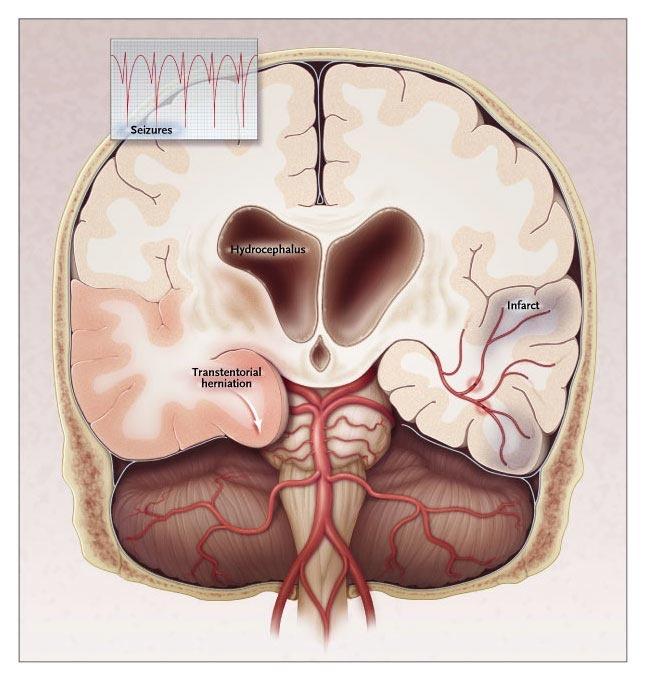
The following figure illustrates the major intracranial complications of bacterial meningitis, including hydrocephalus, cerebral infarction, transtentorial herniation, and seizure activity:
Special Tests
- Bacterial Meningitis Score (pediatric, age 2 months–18 years): Positive Gram stain (2 pts), CSF protein >80 mg/dL (1 pt), blood ANC >10,000 (1 pt), seizures (1 pt), CSF neutrophils >1,000 (1 pt). Score ≥2 suggests bacterial meningitis (sensitivity 99.3%, NPV 99.7%) [1]
- Adult risk score (Gram stain–negative): Immunosuppression, age >60, abnormal neuro exam, CSF glucose <45 mg/dL, CSF protein >100 mg/dL, serum WBC >12,000. Zero risk factors = essentially zero risk of bacterial meningitis [1]
- Latex agglutination for bacterial antigens — variable sensitivity, may be useful in partially treated cases [7]
- 16S rRNA PCR — useful when cultures are negative due to prior antibiotics [6]
ECG
- Not a primary diagnostic tool for meningitis
- Obtain if hemodynamic instability or septic shock to evaluate for myocarditis, arrhythmias, or QTc prolongation (relevant if using fluoroquinolones for prophylaxis)
- Meningococcal sepsis can cause myocardial dysfunction
Assessment
- Bacterial meningitis is a neurological emergency requiring immediate empiric treatment
- The classic triad (fever, neck stiffness, altered mental status) is present in only 40–50% of patients, but 95% have at least 2 of 4 cardinal symptoms (headache, fever, neck stiffness, altered mental status) [6][11]
- Atypical presentations are common in neonates (nonspecific: poor feeding, irritability), elderly (may lack meningeal signs), and immunocompromised patients [1-2]
- Severity stratification: Low GCS, seizures, focal deficits, septic shock, CSF WBC <1,000, and positive blood cultures predict worse outcomes [1][6]
- Complications: Hearing loss, hydrocephalus, cerebral infarction (up to 30% in pneumococcal), cerebral venous thrombosis, subdural empyema, brain abscess, DIC [2][12]
Treatment Plan
Immediate stabilization
- ABCs — intubate if GCS ≤8 or airway compromise
- IV access, fluid resuscitation if septic shock
- Dexamethasone 10 mg IV (adults) — give with or just before first antibiotic dose [1]
- Empiric antibiotics within 1 hour — do not delay for imaging or LP [1][3]
Empiric antibiotics (adults 18–49 years): Ceftriaxone 2 g IV q12h + vancomycin 15–20 mg/kg IV q8–12h [2-3]
- Add ampicillin 2 g IV q4h if age ≥50, pregnant, or immunocompromised (Listeria coverage) [1]
- Continue dexamethasone 10 mg IV q6h × 4 days; discontinue if Listeria confirmed [1-2]
Pathogen-directed therapy once culture and sensitivities available: [3]
- Penicillin-susceptible pneumococcus: Penicillin G or ampicillin (10–14 days)
- Meningococcus: Penicillin G or ceftriaxone (7 days)
- Listeria: Ampicillin ± gentamicin (≥21 days)
- MRSA: Vancomycin (≥14 days)
ICP management: Elevate head of bed 30°, avoid hyperthermia, consider osmotic therapy if signs of herniation; neurosurgical consultation for hydrocephalus or empyema [2]
Disposition
- All confirmed or suspected bacterial meningitis requires hospital admission — typically to the ICU given high mortality and risk of rapid deterioration [11]
- ICU criteria: GCS ≤12, hemodynamic instability, seizures, respiratory compromise, DIC
- Step-down when: Clinically improving, hemodynamically stable, no seizures, organism identified and susceptibilities known
- Neurosurgery consultation: Hydrocephalus, subdural empyema, brain abscess, need for ICP monitoring [2]
- Infectious disease consultation: Recommended for all cases to guide antibiotic optimization and duration
- Public health notification: Meningococcal disease is reportable — notify local health department immediately for contact tracing and chemoprophylaxis [13]
Follow Up / Return Precautions
Chemoprophylaxis for close contacts: [3][14]
- Meningococcal: Ciprofloxacin 500 mg PO × 1 dose (adults), rifampin 600 mg PO q12h × 2 days, or ceftriaxone 250 mg IM × 1 dose. Initiate within 24 hours of index case identification
- H. influenzae type B: Rifampin 20 mg/kg/day (max 600 mg) × 4 days for household contacts with unvaccinated children <4 years [3]
- Close contacts = household members, roommates, daycare contacts, anyone exposed to oral secretions [15]
Post-discharge follow-up
- Audiology evaluation — hearing loss is the most common sequela; prompt assessment with consideration for cochlear implants [6][16]
- Neurocognitive assessment — cognitive impairment, memory deficits, and sleep disorders are common long-term sequelae [2][17]
- Pneumococcal vaccination if not previously vaccinated — to prevent recurrence [16]
- Evaluate for anatomic predisposition (CSF leak, skull base defect) in recurrent cases
Return precautions: Instruct patients/families to return immediately for recurrent fever, worsening headache, new neurological symptoms (weakness, vision changes, seizures), altered mental status, or new rash.
Expected recovery: Clinical improvement typically begins within 48–72 hours of appropriate therapy. Failure to improve should prompt repeat imaging and consideration of complications. [2]
References
1. Progress and Challenges in Bacterial Meningitis: A Review. — Hasbun R. The Journal of the American Medical Association. 2022.
2. Community-Acquired Bacterial Meningitis. — van de Beek D, Brouwer MC, Koedel U, Wall EC. Lancet. 2021.
3. Aseptic and Bacterial Meningitis: Diagnosis, Treatment, and Prevention. — Krebs L, Durden B, Saguil A. American Family Physician. 2026.
4. Pre-Hospital Symptoms Associated With Acute Bacterial Meningitis Differs Between Children and Adults. — Hovmand N, Christensen HC, Lundbo LF, et al. Scientific Reports. 2023.
5. Dilemmas in the Diagnosis of Acute Community-Acquired Bacterial Meningitis. — Brouwer MC, Thwaites GE, Tunkel AR, van de Beek D. Lancet. 2012.
6. Acute Bacterial Meningitis in Adults. — McGill F, Heyderman RS, Panagiotou S, Tunkel AR, Solomon T. Lancet. 2016.
7. Cerebrospinal Fluid Analysis. — Shahan B, Choi EY, Nieves G. American Family Physician. 2021.
8. Practice Guidelines for the Management of Bacterial Meningitis. — Tunkel AR, Hartman BJ, Kaplan SL, et al. Clinical Infectious Diseases : An Official Publication of the Infectious Diseases Society of America. 2004.
9. Emergency Diagnosis and Treatment of Adult Meningitis. — Fitch MT, van de Beek D. The Lancet. Infectious Diseases. 2007.
10. Community-Acquired Bacterial Meningitis in Adults. — van de Beek D, de Gans J, Tunkel AR, Wijdicks EF. The New England Journal of Medicine. 2006.
11. High Risk and Low Prevalence Diseases: Adult Bacterial Meningitis. — Pajor MJ, Long B, Koyfman A, Liang SY. The American Journal of Emergency Medicine. 2023.
12. Pneumococcal Meningitis in Adults: Spectrum of Complications and Prognostic Factors in a Series of 87 Cases. — Kastenbauer S, Pfister HW. Brain : A Journal of Neurology. 2003.
13. Meningococcal Vaccination: Recommendations of the Advisory Committee on Immunization Practices, United States, 2020. — Mbaeyi SA, Bozio CH, Duffy J, et al. MMWR. Recommendations and Reports : Morbidity and Mortality Weekly Report. Recommendations and Reports. 2020.
14. Meningococcal Disease. — Lucy A. McNamara and Amy B. Rubis CDC Yellow Book. 2025.
15. Prevention of Meningococcal Disease. — Gardner P. The New England Journal of Medicine. 2006.
16. Update on Community-Acquired Bacterial Meningitis: Guidance and Challenges. — van Ettekoven CN, van de Beek D, Brouwer MC. Clinical Microbiology and Infection : The Official Publication of the European Society of Clinical Microbiology and Infectious Diseases. 2017.
17. Neurological Sequelae of Bacterial Meningitis. — Lucas MJ, Brouwer MC, van de Beek D. The Journal of Infection. 2016.
Figure
More from Deep Dive
Reviewed by Dr. Lucas Mastropaolo. SymptomDx is an educational tool for medical professionals — it does not replace clinical judgment. Verify all clinical data and drug dosages with authoritative sources.