Bipolar Disorder (Depressive Episode)
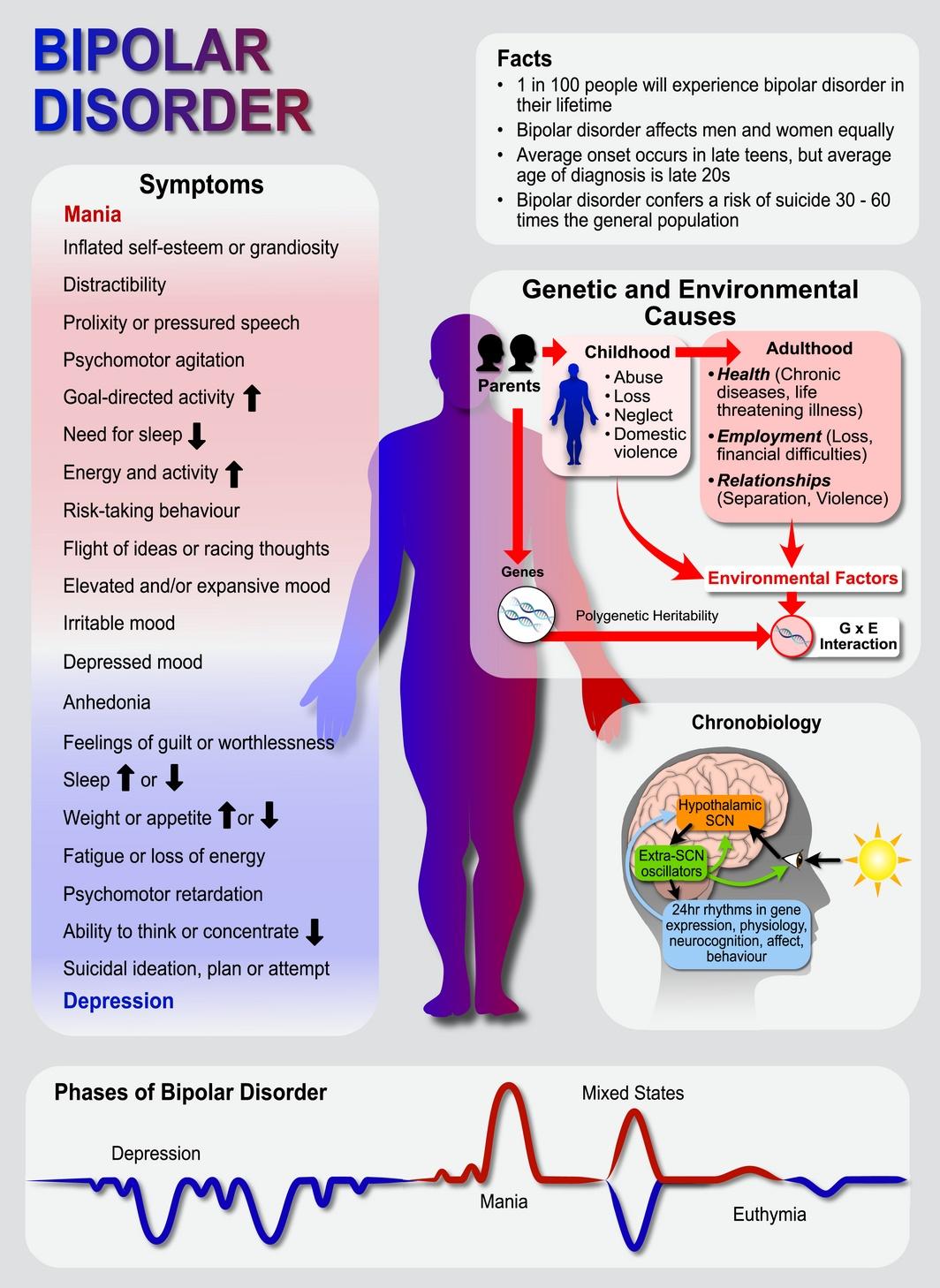
The following figure provides a comprehensive overview of bipolar disorder, including the spectrum of manic and depressive symptoms, epidemiologic facts, and the cyclical nature of mood episodes.
History
- Onset and course: Age at first depressive episode, total number of prior depressive and manic/hypomanic episodes, duration of current episode, and time since last euthymic period [2-3]
- Symptom characterization: Persistent sad or irritable mood, anhedonia, changes in appetite/weight, insomnia or hypersomnia, psychomotor agitation or retardation, fatigue, worthlessness/guilt, poor concentration, recurrent thoughts of death or suicide [2]
- Atypical features suggestive of bipolarity: Hypersomnia, hyperphagia, psychomotor retardation, psychotic features, abrupt onset/offset of symptoms, mixed features (co-occurring manic symptoms) [2-3]
- Prior manic/hypomanic symptoms: Ask about prior periods of elevated energy, decreased need for sleep, increased goal-directed activity, grandiosity, impulsivity, increased sexuality — the defining diagnostic feature [2]
- Treatment history: Prior antidepressant response (or lack thereof), antidepressant-induced mania/hypomania, current medications, adherence [3]
- Substance use: Alcohol, cannabis (worsens mood cycling), stimulants, opioids — obtain a thorough substance use history [4]
- Suicidality: Active vs. passive ideation, plan, intent, prior attempts, access to lethal means [4-5]
Alarm Features
- Active suicidal ideation with plan or intent — highest cause-specific elevated risk of premature mortality in bipolar disorder is death by suicide [5-6]
- Mixed features (co-occurring depressive and manic symptoms) — associated with markedly increased suicide risk [2][7]
- Psychotic symptoms (delusions, hallucinations, command auditory hallucinations)
- Catatonia (immobility, mutism, posturing, waxy flexibility)
- Severe functional decline: Inability to eat, drink, or perform self-care
- Rapid cycling (≥4 episodes/year) — indicates treatment complexity and higher relapse risk [4]
- Antidepressant-induced mood destabilization: New agitation, irritability, or mixed symptoms after starting an antidepressant [2-3]
Medications
FDA-approved for acute bipolar depression: [2][6]
Other key agents
- Lithium: Anti-suicidal properties; optimize to 0.6–0.8 mEq/L for depression; requires renal/thyroid monitoring [6]
- Lamotrigine: Effective for depressive relapse prevention; requires slow titration over 6 weeks to mitigate rash risk (5–10%); monotherapy may not be effective for acute bipolar depression per VA/DoD [2][8]
- Valproate: Second-line; monitor LFTs, CBC, levels
Contraindicated/caution
- Antidepressant monotherapy (especially in BD I) — risk of treatment-emergent mania (up to 12% in RCTs, 30% in retrospective studies); avoid in rapid cycling, mixed features, or prior antidepressant-induced destabilization [2-3]
- Tricyclics and SNRIs carry higher switch risk than SSRIs/bupropion [3]
- If antidepressants are used, they should be combined with a mood stabilizer or atypical antipsychotic [3][6]
Diet
- Alcohol avoidance: Worsens mood instability, interacts with mood stabilizers, and increases suicide risk
- Cannabis avoidance: Worsens mood swings in bipolar disorder [4]
- Caffeine moderation: Can disrupt sleep and exacerbate anxiety/agitation
- Lurasidone must be taken with food (≥350 kcal) for adequate absorption
- Metabolic monitoring: Many atypical antipsychotics cause weight gain and metabolic syndrome — dietary counseling and weight management are integral to long-term care [10-11]
- Lithium: Maintain consistent sodium and fluid intake; dehydration increases lithium toxicity risk
Review of Systems
- Psychiatric: Mood, anhedonia, sleep pattern (hypersomnia vs. insomnia), appetite changes, energy, concentration, guilt, suicidal ideation, psychotic symptoms, anxiety, irritability, impulsivity
- Neurologic: Psychomotor retardation or agitation, tremor (lithium), headache
- Endocrine: Weight changes, menstrual irregularities (valproate, antipsychotics), cold intolerance (hypothyroidism from lithium)
- GI: Nausea, diarrhea (lithium), constipation (quetiapine)
- Cardiovascular: Palpitations, syncope (QTc-prolonging medications)
- Substance use: Screen for alcohol, cannabis, stimulants, opioids [4][12]
Collateral History and Family History
- Collateral from family/significant others is essential — hypomanic and manic symptoms are often more obvious to others than to the patient [2]
- Family history of bipolar disorder is one of the strongest predictors; first-degree relative with BD significantly increases diagnostic probability [2-3]
- Family history of suicide increases risk [5]
- Childhood maltreatment is a recognized risk factor for bipolar disorder [2]
- Social context: Living situation, employment, relationship stability, social support, access to lethal means [4]
Risk Factors
- Family history of bipolar disorder or extensive psychopathology [3]
- Early age of onset (<25 years) [3][13]
- Multiple prior depressive episodes (≥3) [3]
- Atypical depression (hyperphagia, hypersomnia) [3]
- Treatment-resistant depression or antidepressant non-response [2-3]
- Comorbid substance use disorders (~56%), anxiety disorders (~71%), personality disorders (~36%), ADHD (~10–20%) [2]
- Childhood trauma/maltreatment [2]
- Suicide risk factors: Male sex, living alone, divorced, younger age (<35) or elderly (>75), prior suicide attempt, predominant depressive polarity, mixed episodes [5]
Differential Diagnosis
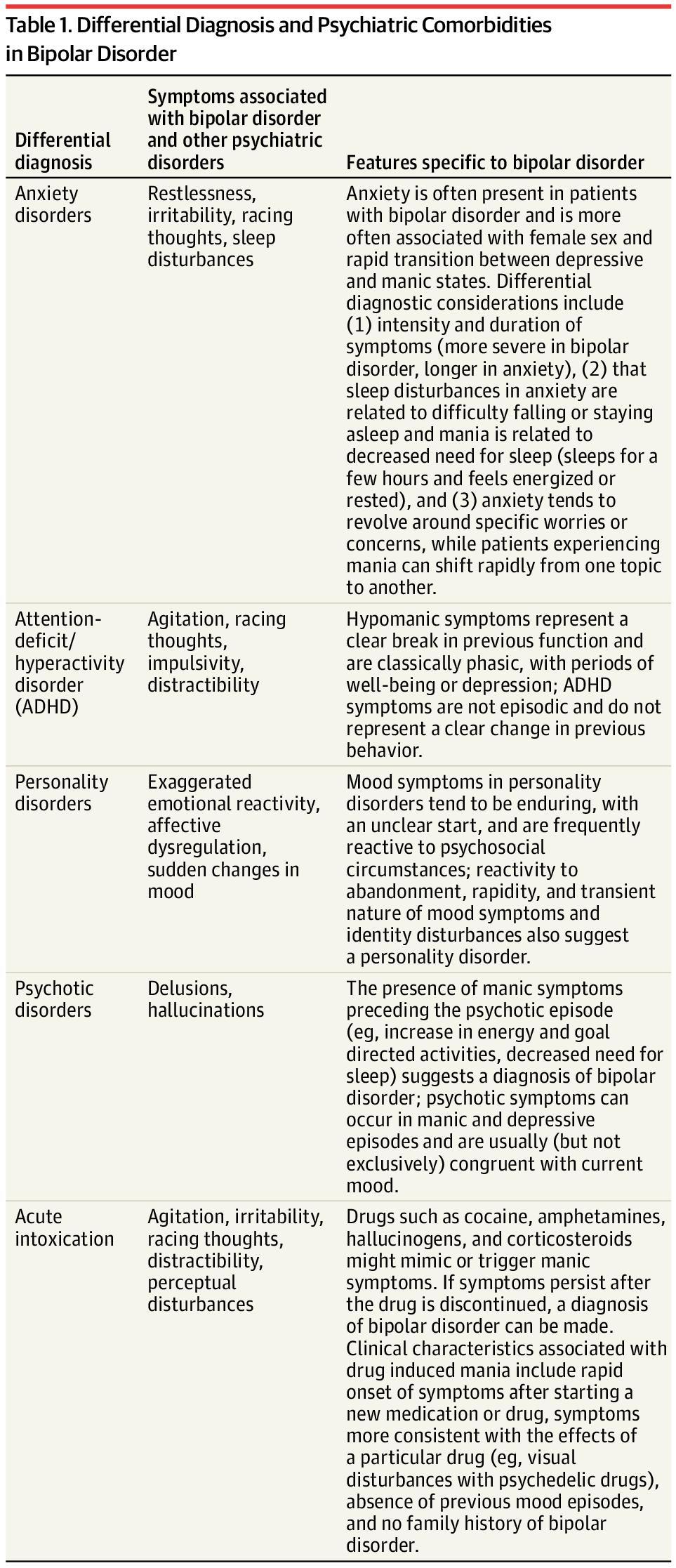
The following table from a JAMA review summarizes the key differential diagnoses and distinguishing features:
- Major depressive disorder (MDD): Most common misdiagnosis; at least 7% of patients treated for MDD in primary care may have unrecognized bipolar disorder; the diagnostic distinction requires eliciting a history of mania/hypomania [3][14]
- Borderline personality disorder: Affective dysregulation is enduring and reactive to psychosocial triggers, not episodic [2]
- ADHD: Symptoms are chronic and non-episodic, unlike the clear breaks in function seen with hypomania [2]
- Substance-induced mood disorder: Cocaine, amphetamines, corticosteroids can mimic mania; symptoms should resolve after drug discontinuation [2]
- Schizoaffective disorder / schizophrenia: Psychotic symptoms occur outside of mood episodes in schizophrenia [13]
- Anxiety disorders: Anxious ruminations may mimic racing thoughts; assess episodicity [13]
- Medical causes: Hypothyroidism, Cushing disease, multiple sclerosis, delirium [13][15]
Past Medical History
- Prior manic, hypomanic, depressive, and mixed episodes — number, severity, hospitalizations
- Prior suicide attempts (strongest predictor of future attempts) [5]
- Medication trials and responses (including adverse effects and switches)
- Comorbid medical conditions: Cardiovascular disease (2× risk), diabetes, obesity, thyroid disease, migraine [2][16]
- Comorbid psychiatric conditions: Anxiety, PTSD, substance use, eating disorders, ADHD [2]
- Surgical history (relevant for ECT candidacy)
- Reproductive history in women: Pregnancy status, contraception (teratogenicity of valproate, lithium, carbamazepine) [4]
Physical Exam
- Vital signs: Blood pressure, heart rate, temperature, weight/BMI (baseline for metabolic monitoring)
- General appearance: Psychomotor retardation (slowed speech, movement, latency) or agitation; poor hygiene/self-care suggesting severity
- Mental status exam: Mood, affect (flat, constricted, tearful), thought content (suicidal/homicidal ideation, delusions), thought process, cognition, insight, judgment
- Neurologic: Tremor (lithium), extrapyramidal symptoms (antipsychotics), akathisia, tardive dyskinesia [11]
- Thyroid: Goiter (lithium-induced hypothyroidism)
- Skin: Rash (lamotrigine — Stevens-Johnson syndrome risk)
- Abdominal: Hepatomegaly (valproate)
Lab Studies
Per the VA/DoD guidelines and AAFP recommendations: [4][16]
- Baseline labs:
- TSH (rule out thyroid disease; baseline before lithium)
- CBC
- CMP (renal function for lithium; hepatic function for valproate)
- Fasting glucose and lipid panel (metabolic baseline before antipsychotics)
- Urine drug screen
- Pregnancy test (if applicable)
- Prolactin (if starting antipsychotics, especially risperidone)
- Medication-specific monitoring:
- Lithium level (target 0.6–0.8 mEq/L for depression), renal function, thyroid function q6–12 months
- Valproate level, LFTs, CBC, ammonia if mental status changes
- Lamotrigine: No routine labs, but monitor for rash
- Antipsychotics: Fasting glucose, HbA1c, lipids at baseline, 3 months, then annually; weight/BMI monthly for first 3 months [11]
- Rule out medical mimics: Vitamin B12, folate, RPR, HIV as clinically indicated [15]
Imaging
- Routine neuroimaging is not indicated for typical bipolar depression presentations [4]
- Reserve MRI brain or CT for: new-onset psychosis, focal neurologic findings, atypical presentations, or suspicion of organic etiology (e.g., CNS lesion, demyelinating disease) [4][16]
- EEG: Consider if seizure disorder is suspected [4]
Special Tests
- Screening tools:
- Mood Disorder Questionnaire (MDQ): 13 yes/no items; ≥7 concurrent symptoms with moderate disability = positive screen; sensitivity ~73–80%, specificity ~70–90%; useful for excluding bipolar disorder but not sufficient to confirm diagnosis [3][12][16]
- Hypomania Checklist 32 (HCL-32): Sensitivity ~82%, specificity ~57% [3]
- PHQ-9: Useful for tracking depressive symptom severity; item 9 screens for suicidal ideation [4][14]
- Columbia-Suicide Severity Rating Scale (C-SSRS): Structured suicide risk assessment [4][7]
- Point-of-care: Urine drug screen, fingerstick glucose, pregnancy test
ECG
- Indications: Baseline ECG recommended for patients >40 years, those with cardiac risk factors, or before starting QTc-prolonging medications (olanzapine, quetiapine, ziprasidone, lumateperone) [16-17]
- QTc monitoring: A risk score–based approach can guide whether baseline ECG is needed; patients with ≥2 risk factors for QTc prolongation should have ECG before starting a potentially QTc-prolonging agent [17]
- Dangerous patterns: QTc >500 ms warrants medication change or dose reduction; monitor for torsades de pointes risk [17]
- Lithium: Can cause sinus node dysfunction, T-wave flattening/inversion; ECG at baseline is reasonable
Assessment
- Bipolar depression is the predominant mood state — patients spend significantly more time depressed than manic/hypomanic, and depression is typically the index presentation [2-3]
- Severity stratification: Mild (functional, no SI) → Moderate (impaired function, passive SI) → Severe (unable to function, active SI, psychotic features, catatonia, inability to eat/drink)
- Mixed features (co-occurring hypomanic symptoms during depression) significantly increase suicide risk and treatment complexity [2]
- Comorbidity is the rule: ~65% have ≥1 comorbid psychiatric disorder [2]
- Complications: Suicide (20–30× general population risk), substance abuse, cardiovascular disease, metabolic syndrome, functional impairment, cognitive decline [2][5]
Treatment Plan
Initial stabilization (ED/acute setting)
- Immediate safety assessment and suicide risk stratification [4]
- Lethal means counseling and restriction
- If severe SI, catatonia, or inability to maintain oral intake → consider ECT (response rate ~77% in bipolar depression) [2][4]
- First-line monotherapy: Quetiapine (per VA/DoD guidelines)
- Second-line options: Lurasidone, cariprazine, lumateperone (favorable metabolic profiles); olanzapine/fluoxetine (highest efficacy but significant metabolic burden)
- If already on lithium: Optimize to 0.6–0.8 mEq/L and add lamotrigine or quetiapine, or add lurasidone/lumateperone [4]
- If already on valproate/carbamazepine/lamotrigine: Add quetiapine, lurasidone, or cariprazine [4]
- Treatment-resistant: Consider ECT; ketamine if ECT is unacceptable, unsuccessful, or unavailable [2][4]
- Avoid antidepressant monotherapy in BD I [2-3]
Psychotherapy (adjunctive): [18]
- Psychoeducation, CBT, interpersonal and social rhythm therapy (IPSRT), family-focused therapy
- Emphasis on sleep hygiene, circadian rhythm stabilization, and medication adherence
Disposition
Admission criteria
- Active suicidal ideation with plan or intent
- Psychotic features
- Catatonia or inability to maintain oral intake
- Severe functional impairment with inability to care for self
- Need for ECT or acute medication titration requiring monitoring
- Involuntary admission when impaired judgment affects capacity to consent [2]
Observation indications
- Passive suicidal ideation without plan, with adequate safety plan and supports
- Medication initiation requiring short-term monitoring
Discharge criteria
- No active suicidal ideation with plan/intent
- Safety plan in place with identified supports
- Outpatient psychiatric follow-up arranged
- Medication plan established with clear instructions
- Lethal means restriction addressed
Specialist consultation triggers: [4]
- All suspected new diagnoses of bipolar disorder → psychiatry referral
- Mania, psychosis, or safety concerns → immediate ED evaluation
- Treatment-resistant depression → specialty mental health
- Pregnancy in a patient with bipolar disorder → high-risk OB and psychiatry co-management
Follow Up / Return Precautions
Follow-up timing
- Psychiatry follow-up within 1–2 weeks of ED discharge or medication initiation
- PCP follow-up for metabolic monitoring within 4–6 weeks of starting antipsychotics
- Lithium level check within 5–7 days of dose change, then q3–6 months when stable
- Most patients require lifelong treatment to reduce relapse rates [2]
Return precautions — instruct patient and family to return immediately for:
- Worsening suicidal thoughts, new plan or intent to harm self
- New psychotic symptoms (hearing voices, paranoia, delusions)
- Signs of mania/hypomania (decreased need for sleep, racing thoughts, impulsive behavior, grandiosity)
- Inability to eat, drink, or care for self
- Signs of medication toxicity: lithium (tremor, vomiting, confusion, ataxia), lamotrigine (any new rash), antipsychotics (muscle rigidity, fever → NMS)
Patient counseling
- Bipolar disorder is a chronic, relapsing illness — medication adherence is critical even when feeling well [2]
- Avoid alcohol, cannabis, and recreational drugs [4]
- Maintain regular sleep-wake schedule and daily routines (circadian rhythm stabilization) [18]
- Engage family/support system in monitoring for mood changes
- 988 Suicide & Crisis Lifeline (call or text 988) for crisis support
References
1. The 2020 Royal Australian and New Zealand College of psychiatrists clinical practice guidelines for mood disorders: Bipolar disorder summary. — Malhi GS, Bell E, Boyce P, et al. Bipolar Disorders. 2020.
2. Diagnosis and Treatment of Bipolar Disorder: A Review. — Nierenberg AA, Agustini B, Köhler-Forsberg O, et al. The Journal of the American Medical Association. 2023.
3. Bipolar Disorders. — McIntyre RS, Berk M, Brietzke E, et al. Lancet. 2020.
4. Management of Bipolar Disorder (BD) (2023). — Thad Abrams MD MS, Jennifer Bell MD, Paulette Cazares MD MPH, et al Department of Veterans Affairs. 2023.
5. Bipolar Disorder and Suicide: A Review. — Miller JN, Black DW. Current Psychiatry Reports. 2020.
6. Bipolar Disorder. — Singh B, Swartz HA, Cuellar-Barboza AB, et al. Lancet. 2025.
7. Suicide and Suicidal Behaviour. — Turecki G, Brent DA. Lancet. 2016.
8. Management of Bipolar Disorder: Guidelines From the VA/DoD. — Arnold MJ. American Family Physician. 2024.
9. FDA Orange Book. — FDA Orange Book. 2026.
10. Efficacy and Safety Profiles of Mood Stabilizers and Antipsychotics for Bipolar Depression: A Systematic Review. — Cai L, Chen G, Yang H, Bai Y. International Clinical Psychopharmacology. 2023.
11. Collaborative Care in the Identification and Management of Psychosis in Adolescents and Young Adults. — Hua LL. Pediatrics. 2021.
12. Bipolar Disorder — A Focus on Depression. — Frye MA. The New England Journal of Medicine. 2011.
13. Diagnostic and Statistical Manual of Mental Disorders. — Dilip V. Jeste, Jeffrey A. Lieberman, David Fassler, et al American Psychiatric Association (2022). 2022.
14. Management of Depression in Adults: A Review. — Simon GE, Moise N, Mohr DC. The Journal of the American Medical Association. 2024.
15. Depression in the Primary Care Setting. — Park LT, Zarate CA. The New England Journal of Medicine. 2019.
16. Bipolar Disorders: Evaluation and Treatment. — Marzani G, Price Neff A. American Family Physician. 2021.
17. QTc Monitoring in Adults With Medical and Psychiatric Comorbidities: Expert Consensus From the Association of Medicine and Psychiatry. — Xiong GL, Pinkhasov A, Mangal JP, et al. Journal of Psychosomatic Research. 2020.
18. Bipolar Disorder. — Carvalho AF, Firth J, Vieta E. The New England Journal of Medicine. 2020.
Figures
More from Deep Dive
Reviewed by Dr. Lucas Mastropaolo. SymptomDx is an educational tool for medical professionals — it does not replace clinical judgment. Verify all clinical data and drug dosages with authoritative sources.