Chikungunya Fever
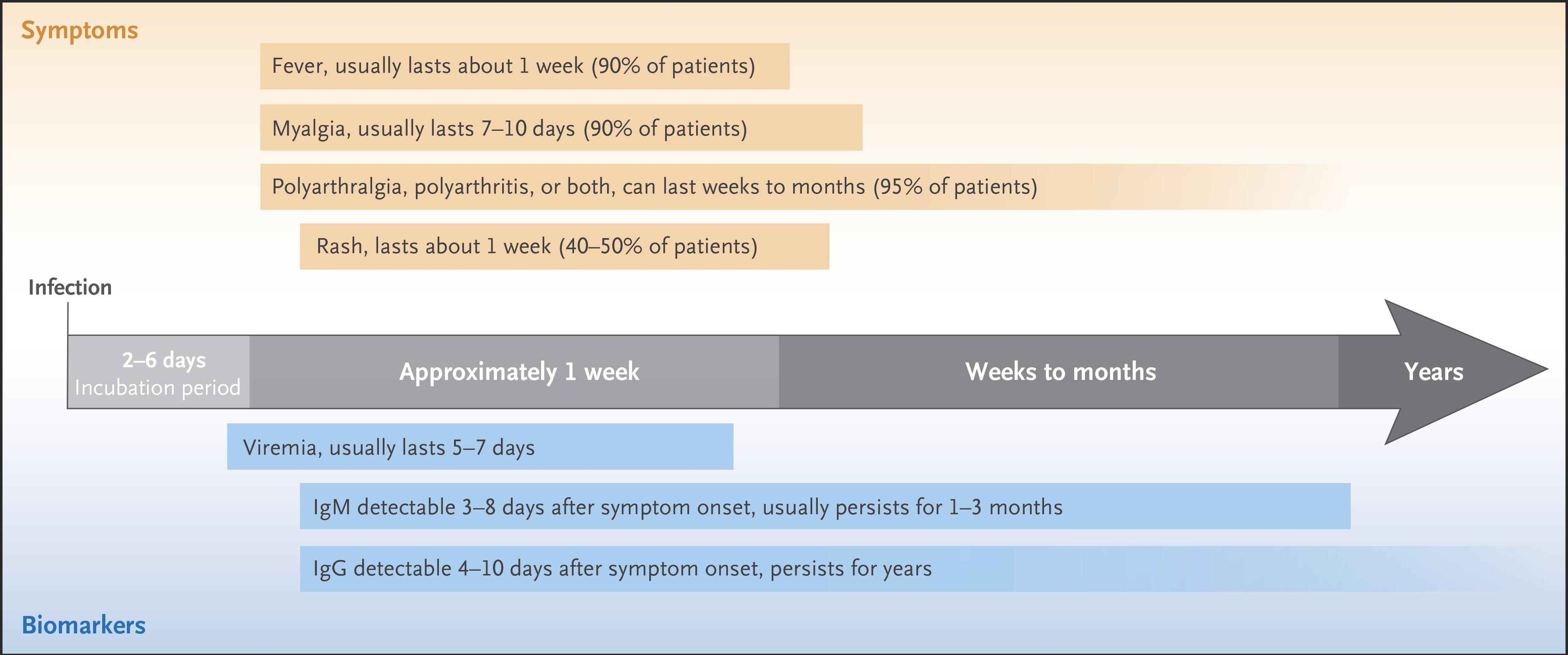
Chikungunya fever is an acute arboviral illness transmitted by Aedes mosquitoes, characterized by sudden-onset high fever (>39°C) and debilitating symmetric polyarthralgia, with no specific antiviral treatment available. [1-3] The following figure illustrates the clinical timeline of infection, symptoms, and biomarkers:
History
- Onset and timing: Abrupt onset of high fever after an incubation period of 3–7 days (range 1–12 days); fever typically lasts ≤1 week and can be biphasic [2-3]
- Travel history: Essential — ask about travel to endemic areas (Southeast Asia, Indian subcontinent, sub-Saharan Africa, Caribbean, Latin America, Pacific Islands) within the prior 2 weeks [2]
- Arthralgia characterization: Severe, symmetric, bilateral polyarthralgia involving both large and small joints (hands, feet, wrists, ankles); pain so intense patients may be unable to move from the position they were in at onset [3]
- Associated symptoms: Maculopapular rash (trunk, extremities, palms/soles), myalgia, headache, conjunctivitis, nausea/vomiting, fatigue, anorexia [2-3]
- Important negatives: Absence of significant hemorrhagic manifestations, absence of thrombocytopenia, and absence of respiratory/GI symptoms help distinguish from dengue [4]
Alarm Features
- Hemodynamic instability — hypotension, tachycardia, signs of shock [5]
- Neurological involvement — altered mental status, seizures, focal deficits (meningoencephalitis, Guillain-Barré syndrome, myelitis, cranial nerve palsies) [1-2]
- Cardiovascular decompensation — myocarditis, arrhythmias [1][5]
- Hemorrhagic signs — though rare in chikungunya, must exclude dengue coinfection [5]
- Respiratory failure, acute hepatitis, or acute renal failure [5]
- Severe bullous skin lesions (especially in children) [2]
- Neonates exposed intrapartum — risk of hemorrhagic symptoms, myocardial disease, neurologic disease [2]
- High-risk groups: Neonates, adults >65 years, patients with comorbidities (diabetes, heart disease, hypertension) — mortality risk increases 79-fold in those ≥60 years compared to 20–29-year-olds [2][6]
Medications
- First-line analgesia/antipyretic: Acetaminophen (paracetamol) — preferred until dengue is ruled out to avoid hemorrhagic risk; max 4 g/24 h, avoid in liver disease [2][5]
- NSAIDs: Can be used once dengue is excluded; effective for fever and joint pain. However, guidelines are contradictory — some advise caution due to risk of acute kidney injury and potential association with severe disease [5]
- Avoid aspirin/salicylates in the acute phase due to hemorrhage risk [5]
- Escalation for refractory pain: Tramadol, codeine, or opiates alone or in combination with paracetamol [5]
- Antihistamines: For pruritic rash (recommended by 39% of global guidelines) [5]
- Corticosteroids: Controversial in acute phase — some evidence of pain reduction when added to NSAIDs, but risk of rebound symptoms and immunosuppression; more accepted in subacute/chronic arthralgia [2][5]
- Chronic arthralgia: NSAIDs, corticosteroids, hydroxychloroquine, methotrexate, and physical therapy for persistent symptoms [2-3][7]
- No approved antivirals — ribavirin, favipiravir, and interferon-α have in vitro activity but no clinical evidence of efficacy [3][8-9]
Diet
- Hydration is critical — oral rehydration for mild cases; IV fluids for those unable to tolerate PO or with hemodynamic compromise [2][5]
- Rest — recommended during the acute febrile phase [2][5]
- Cold compresses to affected joints may provide symptomatic relief [5]
- No specific dietary triggers or restrictions; standard supportive nutrition during acute illness
Review of Systems
- MSK: Joint pain/swelling (symmetric, bilateral), joint stiffness, periarticular edema, back pain
- Dermatologic: Maculopapular rash, pruritus, bullous lesions (children)
- Ophthalmologic: Conjunctivitis, eye pain (uveitis, retinitis in severe cases)
- Neurologic: Headache, altered sensorium, weakness, paresthesias
- Cardiovascular: Chest pain, palpitations, dyspnea
- GI: Nausea, vomiting, abdominal pain (less common than in dengue)
- Renal: Decreased urine output
- Constitutional: Intense fatigue, asthenia, anorexia
Collateral History and Family History
- Household contacts with similar symptoms (cluster outbreaks suggest local transmission)
- Co-travelers with febrile illness
- Mosquito exposure history — outdoor activities, lack of repellent/bed nets, standing water near residence
- Prior arboviral infections — previous dengue or Zika (affects serologic interpretation due to cross-reactivity)
- Pregnancy status — intrapartum transmission risk to neonate [2]
- Family history is generally not contributory, though comorbidities (diabetes, hypertension, cardiac disease) in the patient increase risk of severe disease [2][6]
Risk Factors
- Travel to or residence in endemic areas (tropical/subtropical regions with Aedes mosquito populations) [1][5]
- Age extremes: Neonates and adults >65 years at highest risk for severe/atypical disease and death [2][6]
- Comorbidities: Diabetes, hypertension, cardiovascular disease, chronic kidney disease [2][6]
- Lack of prior immunity — naïve populations experience high attack rates; >85% of infected individuals are symptomatic [3]
- Rainy season/post-monsoon — peak mosquito breeding periods
- Urban settings with poor vector control [5]
Differential Diagnosis
The CDC recommends considering the following in the differential: [2]
- Dengue fever — more headache, retro-orbital pain, thrombocytopenia, leukopenia, hemorrhagic manifestations; less prominent arthralgia [4][10-11]
- Zika virus — lower-grade or absent fever, prominent pruritic rash, conjunctivitis; less arthralgia [11]
- Malaria — cyclical fevers, rigors, hepatosplenomegaly; thick/thin smear diagnostic
- Leptospirosis — conjunctival suffusion, jaundice, renal failure, exposure history
- Other alphaviruses — Mayaro, O'nyong-nyong, Ross River, Sindbis (similar arthritogenic presentation) [2][12]
- Measles/Rubella — rash characteristics, vaccination history, Koplik spots
- Parvovirus B19 — symmetric polyarthralgia, "slapped cheek" rash
- Reactive/postinfectious arthritis — temporal relationship to preceding infection
- Acute rheumatoid arthritis — chronic chikungunya can mimic RA [3]
- Group A Streptococcus, typhus, enteroviral disease [2]
Key distinguishing features of chikungunya: Debilitating polyarthralgia (PPV >80% for CHIKV viremia in endemic areas), absence of thrombocytopenia, joint swelling/edema, and rash — in contrast to dengue which features thrombocytopenia, leukopenia, and warning signs of plasma leak [3-4]
Past Medical History
- Chronic conditions — diabetes, hypertension, heart disease, CKD increase risk of severe/atypical disease and death [2][6]
- Prior arboviral infections — affects serologic interpretation; prior CHIKV infection likely confers lifelong immunity
- Immunosuppression — may alter disease course
- Liver disease — relevant for acetaminophen dosing [5]
- Renal disease — caution with NSAIDs [5]
- Pregnancy — risk of intrapartum transmission; spontaneous abortion reported after first-trimester infection [2]
Physical Exam
- Vitals: High fever (typically >39°C/102°F), tachycardia; hypotension is a red flag [2-3]
- MSK: Symmetric polyarthritis/polyarthralgia, periarticular edema (especially interphalangeal joints, wrists, ankles), tenderness along ligament insertions [3]
- Skin: Maculopapular rash on trunk and extremities (may involve palms, soles, face); can be bullous in children; pruritic [2-3]
- Eyes: Bilateral non-purulent conjunctivitis [1]
- Lymph nodes: Mild lymphadenopathy may be present
- Neuro: Assess for meningismus, focal deficits, altered consciousness (suggests atypical/severe disease)
- Cardiovascular: Assess for signs of myocarditis (new murmur, gallop, JVD)
- Tourniquet test: May help differentiate from dengue (more often positive in dengue)
Lab Studies
- CBC: Lymphopenia is common; thrombocytopenia is typically mild or absent (in contrast to dengue where it is prominent) [2][4][13]
- CMP: Elevated creatinine and liver function tests (AST/ALT) may be seen [2]
- CRP/ESR: Elevated in acute phase
- Confirmatory testing:
- RT-PCR (viral nucleic acid detection) — most useful in the first week of illness during viremia [2][7]
- IgM serology — develops toward end of first week; can persist months to years; may cross-react with other alphaviruses [2]
- IgG serology — appears 4–10 days after onset; persists for years [3]
- Plaque reduction neutralization test (PRNT) — confirmatory, discriminates cross-reacting antibodies [2]
- Rule-out labs: Dengue NS1 antigen, dengue IgM/IgG, malaria smear, blood cultures if bacterial infection suspected
Imaging
- Not routinely indicated in uncomplicated chikungunya
- Joint imaging (X-ray, ultrasound): Consider if chronic arthritis develops — may show periarticular soft tissue swelling; erosive changes can occur in chronic disease mimicking RA [3]
- Chest X-ray: If respiratory symptoms or suspected myocarditis/pulmonary edema
- CT/MRI brain: If neurological involvement suspected (encephalitis, myelitis)
- Echocardiography: If myocarditis suspected
Special Tests
- Clinical prediction rule for chikungunya (validated in dengue-endemic areas): Fever (1 pt) + exanthema (1 pt) + myalgia (2 pts) + arthralgia/arthritis (2 pts) + joint edema (2 pts); score ≥4 has 74% sensitivity and 52% specificity [14]
- Point-of-care rapid diagnostic tests: Chikungunya IgM rapid tests available in some settings
- Viral culture: Gold standard but impractical for clinical use; reserved for reference laboratories [7]
- Tourniquet test: Helps differentiate from dengue (more often positive in dengue)
ECG
- Indicated if: Chest pain, dyspnea, palpitations, or clinical suspicion of myocarditis
- Findings in myocarditis: ST-segment changes, T-wave inversions, conduction abnormalities, arrhythmias
- Routine ECG not required in uncomplicated cases
- Consider troponin and echocardiography if ECG abnormalities detected
Assessment
Typical presentation: Abrupt-onset high fever with severe symmetric polyarthralgia, maculopapular rash, myalgia, and conjunctivitis in a patient with recent travel to an endemic area. Acute symptoms resolve in 7–10 days. [2]
Severity stratification
- Non-severe (majority): Self-limited febrile illness with polyarthralgia; manageable as outpatient
- Severe/atypical (rare): Organ involvement — myocarditis, encephalitis, hepatitis, renal failure, hemorrhage; requires hospitalization [5]
Chronic phase: 30–50% of patients develop persistent or relapsing polyarthralgia lasting months to years, which can mimic rheumatoid arthritis and cause significant disability [3][5]
Complications: Myocarditis, meningoencephalitis, Guillain-Barré syndrome, myelitis, uveitis/retinitis, acute hepatitis, renal failure, severe bullous lesions, neonatal disease from intrapartum transmission [1-2]
Treatment Plan
Initial stabilization (ED)
- ABCs; IV access if hemodynamically unstable or unable to tolerate PO
- IV fluid resuscitation for dehydration or shock [5]
Acute management
- Acetaminophen 500–1000 mg PO q6h (max 4 g/day) as first-line for fever and pain — preferred until dengue excluded [2][5]
- NSAIDs (ibuprofen, naproxen) once dengue ruled out — effective for arthralgia and inflammation [2][5]
- Tramadol or codeine for pain refractory to acetaminophen/NSAIDs [5]
- Antihistamines (cetirizine, diphenhydramine) for pruritic rash [5]
- Oral rehydration — encourage adequate fluid intake [2]
- Rest and cold compresses to affected joints [5]
Subacute/chronic arthralgia (>2 weeks)
- NSAIDs as mainstay
- Short-course corticosteroids (e.g., prednisone) with caution — risk of rebound [2][5]
- Physical therapy for persistent joint symptoms [2]
- Hydroxychloroquine or methotrexate for chronic inflammatory arthritis refractory to NSAIDs — used off-label with variable success [3][7]
Severe/atypical disease
- ICU admission for organ failure, hemodynamic instability
- IV fluids, vasopressors as needed
- Blood products for hemorrhage [5]
- Organ-specific supportive care (ventilatory support, renal replacement therapy)
Disposition
Discharge criteria (majority of cases)
- Hemodynamically stable, tolerating PO fluids
- Pain controlled with oral analgesics
- No signs of severe/atypical disease
- Reliable follow-up and return precautions understood
Admission criteria: [5]
- Hemodynamic instability or signs of shock
- Atypical manifestations (neurologic, cardiac, hepatic, renal involvement)
- Severe pain unresponsive to oral analgesia
- Signs of hemorrhage
- Decompensation of underlying comorbidities
- Neonates with perinatal exposure
- Inability to tolerate oral intake / severe dehydration
Specialist consultation triggers
- Rheumatology — chronic/refractory arthralgia
- Infectious disease — diagnostic uncertainty, severe/atypical disease
- Neurology — encephalitis, GBS, myelitis
- Cardiology — suspected myocarditis
- Ophthalmology — uveitis, retinitis
Follow Up / Return Precautions
Follow-up timing
- Primary care follow-up within 1–2 weeks for symptom reassessment
- Earlier if symptoms worsen or new symptoms develop
- Rheumatology referral if joint symptoms persist beyond 4–6 weeks
Return precautions — instruct patients to return immediately for:
- Worsening fever or new fever after initial resolution
- Bleeding (gums, nose, GI, vaginal)
- Severe abdominal pain, persistent vomiting
- Altered mental status, seizures, weakness
- Chest pain, shortness of breath
- Decreased urine output
- Inability to tolerate fluids
Patient counseling
- Acute symptoms typically resolve in 7–10 days [2]
- Joint pain may persist for weeks to months in up to 30–50% of patients — this is expected and does not indicate a new infection [5]
- Mosquito bite prevention during the first week of illness to prevent onward transmission (bed nets, repellent, long sleeves) [2]
- Report to local health department — chikungunya is a nationally notifiable disease [2]
References
1. Chikungunya: Epidemiology, Pathogenesis, Clinical Features, Management, and Prevention. — Vairo F, Haider N, Kock R, et al. Infectious Disease Clinics of North America. 2019.
2. Chikungunya. — J. Erin Staples, Susan L. Hills, and Ann M. Powers CDC Yellow Book. 2026.
3. Chikungunya Virus and the Global Spread of a Mosquito-Borne Disease. — Weaver SC, Lecuit M. The New England Journal of Medicine. 2015.
4. Distinguishing Patients With Laboratory-Confirmed Chikungunya From Dengue and Other Acute Febrile Illnesses, Puerto Rico, 2012-2015. — Alvarado LI, Lorenzi OD, Torres-Velásquez BC, et al. PLoS Neglected Tropical Diseases. 2019.
5. An Evaluation of Global Chikungunya Clinical Management Guidelines: A Systematic Review. — Webb E, Michelen M, Rigby I, et al. EClinicalMedicine. 2022.
6. Chikungunya Virus Virus-Like Particle Vaccine Safety and Immunogenicity in Adults Older Than 65 Years: A Phase 3, Randomised, Double-Blind, Placebo-Controlled Trial. — Tindale LC, Richardson JS, Anderson DM, et al. Lancet. 2025.
7. Chikungunya Infection: A Global Public Health Menace. — Mathew AJ, Ganapati A, Kabeerdoss J, et al. Current Allergy and Asthma Reports. 2017.
8. Chikungunya: A Re-Emerging Virus. — Burt FJ, Rolph MS, Rulli NE, Mahalingam S, Heise MT. Lancet. 2012.
9. Chikungunya Virus: An Update on the Biology and Pathogenesis of This Emerging Pathogen. — Burt FJ, Chen W, Miner JJ, et al. The Lancet. Infectious Diseases. 2017.
10. Symptom Overlap in Chikungunya and Dengue: A Diagnostic Challenge During Outbreaks. — Brancini ML, Sene FCT, Pereira Dos Santos TF, et al. Acta Tropica. 2026.
11. Comparison of Dengue, Chikungunya, and Zika Among Children in Nicaragua Across 18 Years: A Single-Centre, Prospective Cohort Study. — Carrillo FAB, Ojeda S, Sanchez N, et al. The Lancet. Child & Adolescent Health. 2025.
12. Arthritogenic Alphaviruses: Epidemiological and Clinical Perspective on Emerging Arboviruses. — Zaid A, Burt FJ, Liu X, et al. The Lancet. Infectious Diseases. 2021.
13. Comparison of Clinical Presentation and Out-Comes of Chikungunya and Dengue Virus Infections in Patients With Acute Undifferentiated Febrile Illness From the Sindh Region of Pakistan. — Shahid U, Farooqi JQ, Barr KL, et al. PLoS Neglected Tropical Diseases. 2020.
14. Development and Validation of a Clinical Rule for the Diagnosis of Chikungunya Fever in a Dengue-Endemic Area. — Batista RP, Hökerberg YHM, de Oliveira RVC, Lambert Passos SR. PloS One. 2023.
Figure
More from Deep Dive
Reviewed by Dr. Lucas Mastropaolo. SymptomDx is an educational tool for medical professionals — it does not replace clinical judgment. Verify all clinical data and drug dosages with authoritative sources.