Cystitis
History
- Key HPI questions: Onset, duration, and severity of dysuria, urinary frequency, urgency, suprapubic pain, and hematuria [1-2]
- Symptom characterization: Burning/pain with urination (internal vs. external), sense of incomplete emptying, nocturia, gross hematuria, urine cloudiness or odor
- Timing/triggers: Relationship to sexual intercourse, new sexual partner, spermicide/diaphragm use, recent antibiotic use, recent catheterization or instrumentation [3]
- Associated symptoms: Vaginal discharge or irritation (suggests vaginitis/STI rather than cystitis), back/flank pain, fever, nausea/vomiting (suggests pyelonephritis) [1]
- Important negatives: Absence of vaginal discharge raises probability of cystitis to >90% in women with dysuria and frequency. Absence of fever, chills, and flank pain helps exclude upper tract involvement [1][4]
Alarm Features
- Fever (>38°C), chills, rigors, or hemodynamic instability → suspect pyelonephritis or urosepsis [1][4]
- Flank pain or costovertebral angle (CVA) tenderness → upper tract infection [4-5]
- Nausea/vomiting with urinary symptoms → pyelonephritis [1]
- Urinary retention or inability to void → urinary obstruction requiring same-day in-person evaluation [6]
- Pregnancy → all UTIs require culture-confirmed diagnosis and treatment; risk of ascending infection and preterm labor [5]
- Immunocompromised patients, recent urologic procedures, or indwelling catheters → complicated UTI pathway [4]
Medications
First-line empiric treatment (per IDSA/ACP guidelines): [7-8]
- Nitrofurantoin 100 mg BID × 5 days (most effective in recent head-to-head data) [9]
- TMP-SMX 160/800 mg BID × 3 days (if local resistance <20%) [8]
- Fosfomycin 3 g single dose (inferior efficacy vs. nitrofurantoin per SCOUT trial) [9]
- Pivmecillinam 400 mg TID × 3 days (FDA-approved in the US for uncomplicated UTI in women) [9-10]
Contraindicated/avoid
- Fluoroquinolones: Not recommended empirically for uncomplicated cystitis due to adverse effect profile (tendinopathy, QTc prolongation, aortic dissection risk, C. difficile); reserve for resistant organisms [11-12]
- Nitrofurantoin: Avoid if CrCl <30 mL/min; not effective for upper tract infections (poor renal parenchymal penetration)
- TMP-SMX: Avoid if local E. coli resistance >20% [8]
Medication cautions
- Nitrofurantoin: Pulmonary toxicity with prolonged use; avoid in G6PD deficiency
- Fosfomycin: Not recommended for non-E. coli ESBL infections (e.g., K. pneumoniae carries fosA gene) [12]
Diet
- Increased fluid intake: ≥1.5 L/day recommended for symptom relief and prevention of recurrence [2]
- Cranberry products: Evidence supports a role in prevention of recurrent UTI, not treatment of acute episodes [2]
- Avoid bladder irritants during acute episode: caffeine, alcohol, spicy foods, artificial sweeteners
- Long-term: Adequate hydration is the most evidence-supported dietary intervention for recurrence prevention
Review of Systems
- GU: Dysuria, frequency, urgency, hematuria, suprapubic pain, nocturia, vaginal discharge/irritation, urethral discharge (men)
- Constitutional: Fever, chills, rigors, malaise, fatigue
- GI: Nausea, vomiting, diarrhea (may suggest alternative diagnosis or systemic illness) [6]
- MSK/Back: Flank pain, CVA tenderness (pyelonephritis)
- GYN: Vaginal discharge, dyspareunia, vulvar lesions (vaginitis, STI)
- Neuro (elderly): New confusion or altered mental status may be the only presenting symptom in frail elderly patients
Collateral History and Family History
- Prior UTI history: Number of episodes, prior organisms and sensitivities, prior treatment failures
- Sexual history: New partners, contraceptive method (spermicide/diaphragm increase risk), STI risk factors [1]
- Menopausal status: Genitourinary syndrome of menopause (GSM) can mimic and predispose to UTI [6]
- Family history: Recurrent UTI in first-degree relatives may indicate genetic susceptibility
- Social context: Access to timely urine testing, barriers to follow-up (relevant for triage decisions) [6]
Risk Factors
- Female sex: 50× more common than in males; 40–50% of women experience ≥1 UTI in their lifetime [3]
- Sexual intercourse (strongest modifiable risk factor in premenopausal women) [1]
- Spermicide/diaphragm use [1]
- Prior UTI history [2]
- Postmenopausal status: Vaginal atrophy, loss of lactobacilli [6]
- Diabetes mellitus [13]
- Urinary catheterization or recent instrumentation [4]
- Urologic abnormalities: Obstruction, neurogenic bladder, vesicoureteral reflux
- Antibiotic use: Recent antibiotics increase risk of resistant organisms [6]
- Immunosuppression [14]
Differential Diagnosis
The following table from the AAFP summarizes key differentiating features: [2]
Past Medical History
- Prior UTIs: Frequency, organisms, resistance patterns, treatment responses
- Recurrent UTI (≥2 in 6 months or ≥3 in 12 months): Warrants in-person evaluation and culture-guided therapy [2][6]
- Urologic surgery or instrumentation
- Diabetes, immunosuppression, pregnancy
- Neurogenic bladder, urinary retention, structural abnormalities
- Kidney stones
- Allergies: Sulfa allergy (precludes TMP-SMX), nitrofurantoin hypersensitivity
Physical Exam
- Vital signs: Temperature (fever >38°C → pyelonephritis), heart rate, blood pressure (tachycardia/hypotension → sepsis)
- Abdominal exam: Suprapubic tenderness (supports cystitis); distended bladder (retention)
- CVA tenderness: The only physical exam finding that increases the probability of UTI — specifically indicates pyelonephritis [1]
- Pelvic exam (if vaginal symptoms present): Evaluate for discharge, cervicitis, vulvar lesions, vaginal atrophy [15]
- DRE (men): Prostatic tenderness/edema suggests prostatitis [17]
- Genital exam (men): Testicular tenderness/swelling (epididymo-orchitis)
Lab Studies
- Urinalysis (dipstick):
- Urine culture: Not required for uncomplicated cystitis in women with classic symptoms. Indicated for: recurrent UTI, treatment failure, resistant organisms, atypical presentation, all men, pregnant patients, elderly [1-2][6]
- CBC, BMP, blood cultures: Only if systemic illness suspected (fever, sepsis, pyelonephritis) [5]
- STI testing: Gonorrhea/chlamydia NAAT if risk factors present [17]
Imaging
- Not indicated for uncomplicated cystitis [2]
- Renal ultrasound: Consider if urinary obstruction, abscess, or structural abnormality suspected
- CT abdomen/pelvis: If nephrolithiasis, renal abscess, or emphysematous pyelonephritis suspected
- Important: Imaging should be reserved for complicated presentations, recurrent infections without clear cause, or failure to respond to appropriate therapy
Special Tests
- Urine dipstick: Point-of-care test; most useful when clinical picture is ambiguous. Adds little when history is strongly suggestive of UTI [1]
- Post-void residual (bladder scan): If urinary retention suspected [17]
- Cystoscopy: Not indicated acutely; consider for recurrent UTI, persistent hematuria after infection resolves, or suspected structural pathology
- Methenamine hippurate: Effective for recurrent UTI prevention (not a diagnostic test, but a notable preventive intervention) [2]
ECG
- Not routinely indicated for cystitis
- Consider if prescribing fluoroquinolones (risk of QTc prolongation) in patients with cardiac risk factors [12]
- Obtain ECG if sepsis or hemodynamic instability is present
Assessment
Clinical summary: Acute cystitis is a clinical diagnosis in women with classic symptoms (dysuria, frequency, urgency) without vaginal discharge. The probability exceeds 90% when dysuria and frequency are present without vaginal symptoms. [1] Most cases (80%) are caused by E. coli. [3]
Severity stratification
- Uncomplicated: Symptoms confined to the bladder, no systemic signs, in a non-pregnant, non-catheterized adult without urologic abnormalities [4]
- Complicated: Fever, flank pain, CVA tenderness, systemic illness, or presence of complicating factors (catheter, obstruction, pregnancy, immunosuppression) [4]
Atypical presentations: Elderly patients may present with confusion or functional decline without classic urinary symptoms. Men with cystitis symptoms should be evaluated for prostatitis and urethritis. [2][17]
Complications: Pyelonephritis (1–2% of untreated cases), urosepsis, renal abscess (rare)
Treatment Plan
Initial management — uncomplicated cystitis in women: [7-9]
Men: 7-day course of TMP-SMX or nitrofurantoin; always obtain urine culture [2]
Symptomatic relief: NSAIDs (ibuprofen) for pain; phenazopyridine 200 mg TID × 2 days for dysuria (warn about orange urine discoloration)
Delayed antibiotic strategy: In select low-risk women who prefer to avoid antibiotics, a backup prescription to fill if symptoms do not improve in 48–72 hours is a reasonable option [2]
Recurrence prevention: Adequate hydration (≥1.5 L/day), cranberry products, methenamine hippurate, topical vaginal estrogen in postmenopausal women [2][6]
Disposition
- Discharge (vast majority): Uncomplicated cystitis is managed entirely as an outpatient [2][13]
- Same-day in-person evaluation: Symptoms of pyelonephritis, complicated cystitis, or urinary obstruction [6]
- Admission criteria: Sepsis, hemodynamic instability, intractable vomiting (unable to tolerate oral antibiotics), severe pyelonephritis, immunocompromised with systemic illness, pregnant with pyelonephritis [5]
- Observation: Consider for borderline cases (e.g., early pyelonephritis responding to IV fluids and parenteral antibiotics)
- Specialist consultation: Urology referral for recurrent UTI (≥3/year), structural abnormalities, persistent hematuria after infection resolution, suspected obstruction [6]
Follow Up / Return Precautions
- Follow-up timing: Routine follow-up not needed if symptoms resolve. If symptoms persist beyond 48–72 hours of appropriate antibiotics, reassess and obtain urine culture [2]
- Return immediately for: Fever >38°C, rigors, flank pain, vomiting, inability to tolerate oral medications, worsening symptoms, signs of urinary retention
- Patient counseling:
- Complete the full antibiotic course
- Increase fluid intake
- Symptoms typically improve within 24–48 hours of starting antibiotics
- Phenazopyridine is for symptom relief only, not treatment
- Expected recovery: Most uncomplicated cases resolve within 3–5 days of treatment [2][9]
- Recurrent UTI: If ≥2 episodes in 6 months or ≥3 in 12 months, warrants at least one in-person evaluation with physical exam to assess for treatable underlying conditions (e.g., genitourinary syndrome of menopause) [6]
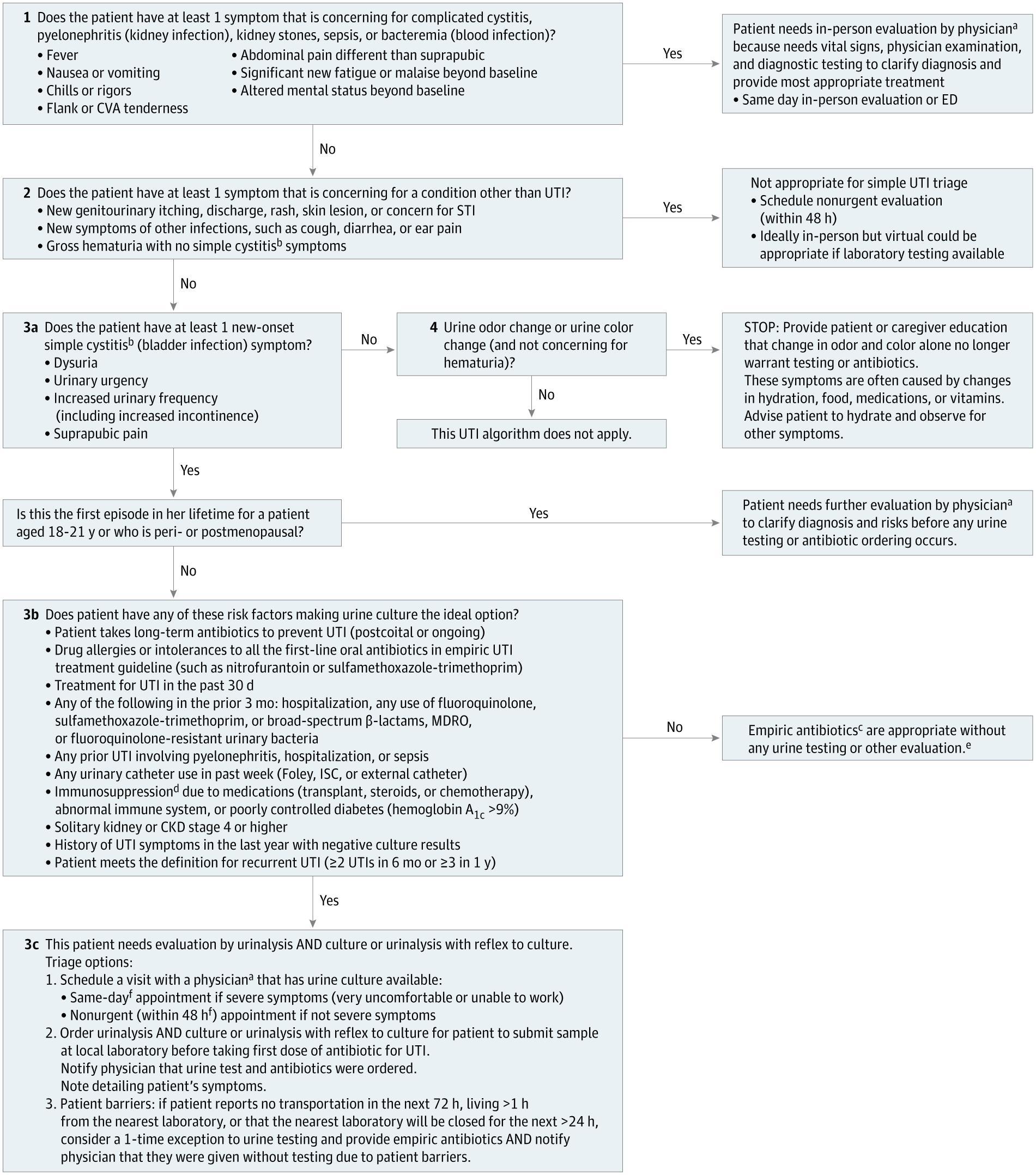
The following algorithm from the Ann Arbor Guide illustrates the triage approach for nonpregnant women with suspected UTI, including when empiric antibiotics, urine testing, and in-person evaluation are appropriate:
References
1. Uncomplicated Urinary Tract Infection. — Hooton TM. The New England Journal of Medicine. 2012.
2. Acute Uncomplicated UTIs in Adults: Rapid Evidence Review. — Kurotschka PK, Gágyor I, Ebell MH. American Family Physician. 2024.
3. Reappraisal of the Treatment Duration of Antibiotic Regimens for Acute Uncomplicated Cystitis in Adult Women: A Systematic Review and Network Meta-Analysis of 61 Randomised Clinical Trials. — Kim DK, Kim JH, Lee JY, et al. The Lancet. Infectious Diseases. 2020.
4. Clinical Practice Guideline by Infectious Diseases Society of America (IDSA): 2025 Guideline on Management and Treatment of Complicated Urinary Tract Infections: Introduction and Methods. — Barbara W. Trautner, Nicolás W. Cortés-Penfield, Kalpana Gupta, et al Infectious Diseases Society of America. 2025.
5. Urinary Tract Infections in Pregnant Individuals. — Committee on Clinical Consensus—Obstetrics Obstetrics and Gynecology. 2023.
6. Ann Arbor Guide to Triaging Adults With Suspected Urinary Tract Infection for In-Person and Telehealth Settings. — Meddings J, Chrouser K, Fowler KE, et al. JAMA Network Open. 2026.
7. Appropriate Use of Short-Course Antibiotics in Common Infections: Best Practice Advice From the American College of Physicians. — Lee RA, Centor RM, Humphrey LL, et al. Annals of Internal Medicine. 2021.
8. International Clinical Practice Guidelines for the Treatment of Acute Uncomplicated Cystitis and Pyelonephritis in Women: A 2010 Update by the Infectious Diseases Society of America and the European Society for Microbiology and Infectious Diseases. — Gupta K, Hooton TM, Naber KG, et al. Clinical Infectious Diseases : An Official Publication of the Infectious Diseases Society of America. 2011.
9. Clinical and Bacteriological Effectiveness of Three Different Short-Course Antibiotic Regimens and Single-Dose Fosfomycin for Uncomplicated Lower Urinary Tract Infections in Women (SCOUT): A Pragmatic, Multicentre, Open-Label, Randomised Clinical Trial. — Llor C, Monfà R, Garcia-Sangenís A, et al. Lancet. 2026.
10. FDA Orange Book. — FDA Orange Book. 2026.
11. Antibiotic Courses for Common Infections: Recommendations From the ACP. — Dakkak M, Sabharwal M. American Family Physician. 2022.
12. Infectious Diseases Society of America 2023 Guidance on the Treatment of Antimicrobial Resistant Gram-Negative Infections. — Tamma PD, Aitken SL, Bonomo RA, et al. Clinical Infectious Diseases : An Official Publication of the Infectious Diseases Society of America. 2023.
13. Diagnosis and Management of Urinary Tract Infections in the Outpatient Setting: A Review. — Grigoryan L, Trautner BW, Gupta K. The Journal of the American Medical Association. 2014.
14. Non-Steroidal Anti-Inflammatory Drugs for Treating Symptomatic Uncomplicated Urinary Tract Infections in Non-Pregnant Adult Women. — Sachdeva A, Rai BP, Veeratterapillay R, Harding C, Nambiar A. The Cochrane Database of Systematic Reviews. 2024.
15. Dysuria: Evaluation and Differential Diagnosis in Adults. — Michels TC, Sands JE. American Family Physician. 2015.
16. Symptoms of Interstitial Cystitis, Painful Bladder Syndrome and Similar Diseases in Women: A Systematic Review. — Bogart LM, Berry SH, Clemens JQ. The Journal of Urology. 2007.
17. Prostatitis. — Borgert BJ, Wallen EM, Pham MN. The Journal of the American Medical Association. 2025.
Figure
More from Deep Dive
Reviewed by Dr. Lucas Mastropaolo. SymptomDx is an educational tool for medical professionals — it does not replace clinical judgment. Verify all clinical data and drug dosages with authoritative sources.