Ectopic Pregnancy (Unruptured)
Ectopic pregnancy is the implantation of a fertilized ovum outside the uterine cavity, occurring in 1–2% of pregnancies and accounting for 2.7% of pregnancy-related deaths and 6% of maternal deaths in early pregnancy. [1-2] Over 90% are tubal in location. [3] Approximately 40% are misdiagnosed at the initial visit, making a high index of suspicion essential. [4]
History
- Classic triad: Amenorrhea, vaginal bleeding, and lower abdominal/pelvic pain — though fewer than half present with all three [2]
- Pain characterization: Unilateral or bilateral, crampy, dull, or sharp; ranges from mild to debilitating; may be localized to the iliac fossa or diffuse [2]
- Vaginal bleeding: Typically intermittent, light, bright or dark red, rarely exceeds normal menstrual flow [5]
- Timing: Symptoms typically present at 5–8 weeks gestational age; ask about LMP, cycle regularity, and possibility of pregnancy
- Important negatives: Passage of tissue (does not distinguish miscarriage from ectopic — may represent decidual cast); shoulder pain (late sign suggesting hemoperitoneum) [2]
- Ask about contraceptive use, IUD in situ, fertility treatments, and desire for pregnancy
Alarm Features
- Hemodynamic instability: Hypotension, tachycardia, diaphoresis, syncope → suspect rupture [2][5]
- Peritoneal signs: Rebound tenderness, guarding, rigid abdomen
- Shoulder tip pain: Diaphragmatic irritation from hemoperitoneum — a late and ominous sign [2]
- Severe, sudden-onset, generalized abdominal pain (may paradoxically improve briefly after rupture) [2]
- β-hCG >3,500 mIU/mL with no intrauterine pregnancy on TVUS and no history of recent miscarriage → highly suspicious for ectopic [6]
- Free fluid in the pelvis on ultrasound without an IUP → suspect ruptured ectopic with hemoperitoneum [6-7]
Medications
- Methotrexate (MTX): Standard medical management for unruptured ectopic; 50 mg/m² IM (single-dose protocol most common) [6][8]
- Contraindications to MTX (absolute): Hemodynamic instability, hepatic/renal dysfunction, immunodeficiency, active pulmonary disease, breastfeeding, peptic ulcer disease, blood dyscrasias [9]
- Must discontinue: Folic acid supplements and prenatal vitamins (reduce MTX efficacy) [9]
- Avoid during MTX treatment: NSAIDs (increase MTX toxicity via reduced renal clearance), alcohol, folic acid–containing foods in excess
- Rh immunoglobulin: Administer to Rh-negative patients
Diet
- Avoid folic acid–fortified foods and supplements during MTX treatment, as they antagonize the drug's mechanism [8-9]
- Avoid alcohol during and after MTX treatment (hepatotoxicity risk)
- Maintain adequate hydration
- No specific long-term dietary modifications required after resolution
Review of Systems
- GI: Nausea, vomiting, diarrhea (may indicate hemoperitoneum or MTX side effects)
- GU: Vaginal bleeding pattern, dysuria (rule out UTI as alternative cause of pelvic pain)
- Cardiovascular: Lightheadedness, syncope, palpitations (signs of hemorrhage)
- Respiratory: Dyspnea (rare — consider pneumonitis with MTX; also seen with massive hemorrhage)
- Musculoskeletal: Shoulder pain (referred pain from diaphragmatic irritation)
- Psychiatric: Anxiety, distress related to pregnancy loss
Collateral History and Family History
- Prior pregnancy outcomes, prior ectopic pregnancies (recurrence risk is significant) [1][9]
- History of pelvic inflammatory disease (PID), STIs (especially chlamydia) [1]
- Partner history of STIs
- Social support and ability to follow up reliably (critical for MTX management) [6]
- Family history of coagulopathy or thrombophilia (may affect bleeding risk)
Risk Factors
- Prior ectopic pregnancy (strongest individual risk factor; recurrence ~10–15%) [1][9]
- History of PID or STIs (especially chlamydia/gonorrhea) [1]
- Prior tubal surgery (tubal ligation, salpingostomy, tubal reanastomosis) [1]
- Current IUD use (does not increase absolute risk, but if pregnancy occurs with IUD, higher proportion are ectopic)
- Cigarette smoking [1]
- Infertility and assisted reproductive technology (especially IVF) [1]
- Age >35 years [10]
- DES exposure in utero
- A significant proportion of patients will have no identifiable risk factor [10]
Differential Diagnosis
- Threatened/incomplete miscarriage — most common mimic; vaginal bleeding and pain more likely to indicate miscarriage than ectopic [2]
- Normal early intrauterine pregnancy with physiologic bleeding
- Ruptured or hemorrhagic ovarian/corpus luteum cyst
- Ovarian torsion
- Appendicitis — most common abdominal surgical emergency; right-sided pain overlap [4]
- Pelvic inflammatory disease
- Urinary calculus/pyelonephritis
- Heterotopic pregnancy (rare, ~1/30,000 spontaneous; higher with ART ~1/100) [2]
- Gestational trophoblastic disease
Past Medical History
- Prior ectopic pregnancies and treatment method (medical vs. surgical)
- Prior pelvic/abdominal surgeries (adhesion risk)
- History of PID, endometriosis, or tubal pathology
- Hepatic or renal disease (contraindication to MTX) [9]
- Immunodeficiency or blood dyscrasias (contraindication to MTX)
- Pulmonary disease (risk of MTX-related pneumonitis) [9]
Physical Exam
- Vitals: Tachycardia and hypotension suggest rupture/hemorrhage [2][5]
- Abdominal exam: Tenderness (often unilateral lower quadrant), guarding, rebound (peritoneal signs suggest rupture)
- Pelvic exam:
- Cervical motion tenderness (CMT) — suggestive but nonspecific
- Adnexal tenderness or palpable adnexal mass (small, round, tender, mobile swelling lateral to uterus) [2]
- Cervical os: Closed os (open os with tissue suggests miscarriage)
- Vaginal bleeding: Assess volume and character
- Expected in unruptured: Mild-to-moderate unilateral tenderness, minimal bleeding, stable vitals
Lab Studies
- Quantitative serum β-hCG: Essential first step; serial levels q48h if pregnancy of unknown location [6][8]
- CBC: Baseline hemoglobin; low Hgb may suggest occult hemorrhage [11]
- Blood type and Rh: For Rh immunoglobulin administration
- BMP/Cr, LFTs: Required before MTX administration [9]
- Progesterone: Low levels (<5 ng/mL) suggest nonviable pregnancy but do not localize it
- Urinalysis: Rule out UTI as alternative diagnosis
Imaging
- First-line: Transvaginal ultrasound (TVUS) — single best diagnostic modality [2][12]
- Definitive finding: Extrauterine gestational sac with yolk sac or embryo [6]
- Suggestive findings: Inhomogeneous adnexal mass, "tubal ring" sign, extrauterine saclike structure [6][12]
- Free pelvic fluid without IUP → suspect rupture [6-7]
- TVUS sensitivity 99%, specificity 84% when β-hCG >1,500 IU/L [12]
- Adnexal mass + no IUP → LR+ of 111 for ectopic pregnancy [2]
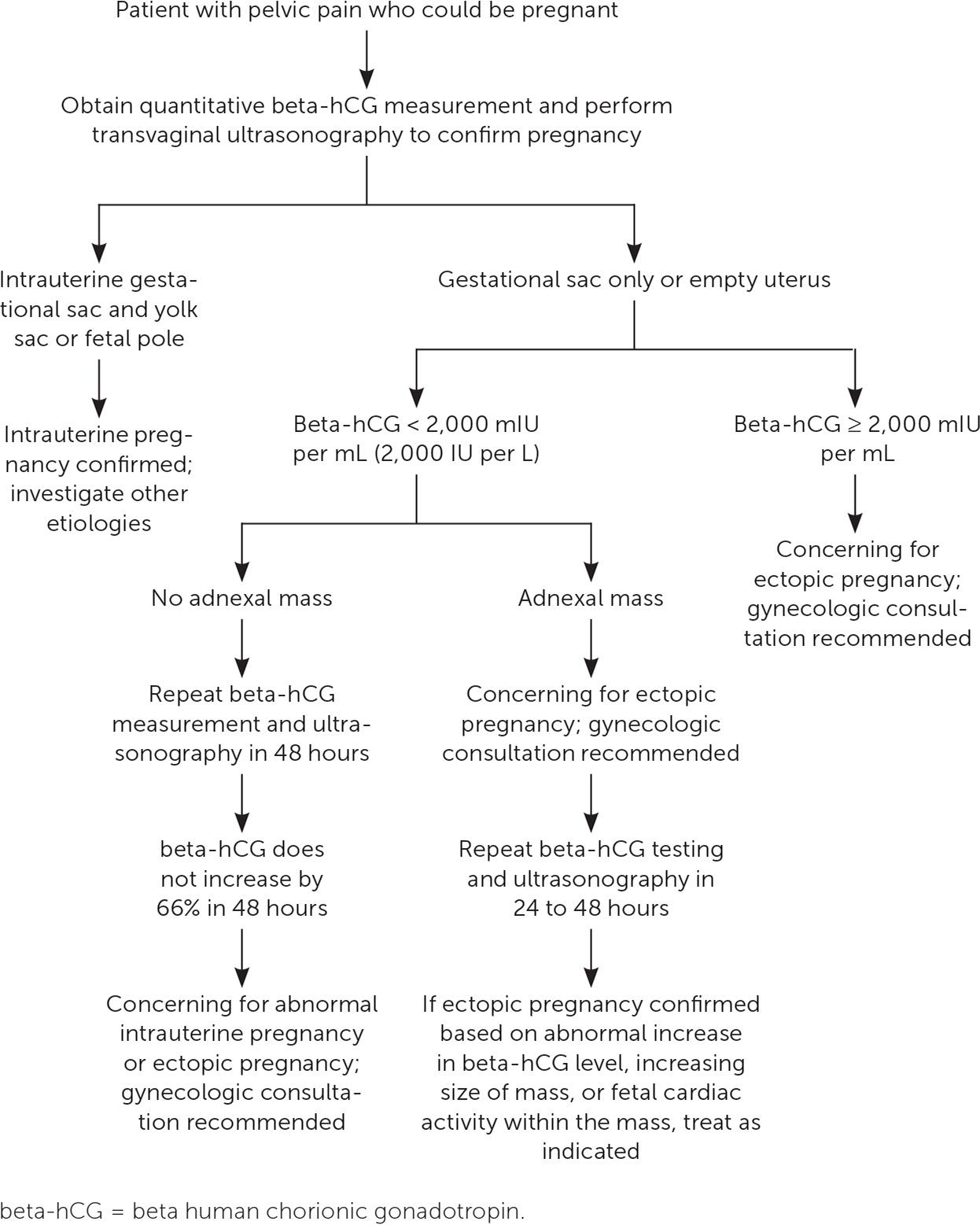
- Discriminatory zone: IUP should be visible on TVUS when β-hCG >3,000–3,500 mIU/mL (use conservative threshold to avoid interrupting viable IUP) [8][12]
- When imaging is nondiagnostic: Classify as "pregnancy of unknown location" (PUL) and follow with serial β-hCG and repeat TVUS [6]
- Transabdominal US: Supplement to assess for upper abdominal free fluid if rupture suspected [7]
- CT/MRI: Not routinely indicated; MRI may be useful for non-tubal ectopic locations
The following figure illustrates the diagnostic algorithm for evaluating pelvic pain in a patient who could be pregnant:
Special Tests
- Serial β-hCG monitoring: The cornerstone of diagnosis when TVUS is nondiagnostic; q48h until diagnosis confirmed [8]
- Uterine aspiration/curettage: Can differentiate failed IUP from ectopic — absence of chorionic villi suggests ectopic [9]
- Point-of-care ultrasound (POCUS): ED bedside TVUS can identify IUP or free fluid rapidly; absence of IUP with positive pregnancy test should prompt formal imaging and OB/GYN consultation [10]
- Culdocentesis: Largely replaced by ultrasound; historically used to detect hemoperitoneum
ECG
- Not routinely indicated for uncomplicated unruptured ectopic pregnancy
- Obtain ECG if: Hemodynamically unstable, syncope, or pre-operative evaluation
- Sinus tachycardia may be seen with hemorrhage/hypovolemia
Assessment
Prevalence: 1–2% of all pregnancies; >90% are tubal (ampullary most common) [1][3]
Severity stratification
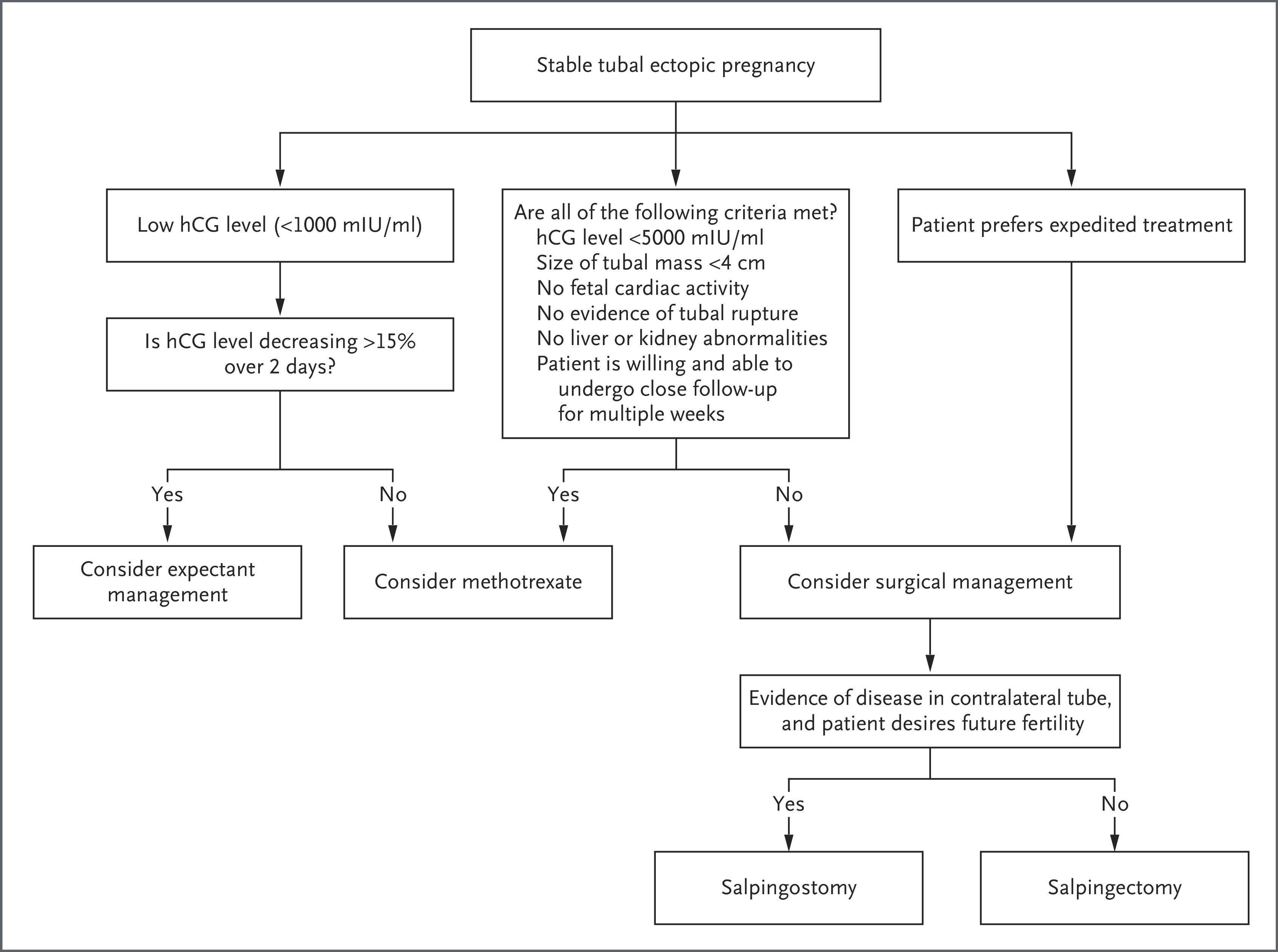
- Stable, unruptured: Hemodynamically stable, no peritoneal signs, β-hCG <5,000, mass <4 cm, no fetal cardiac activity → candidate for medical or surgical management [6]
- Unstable/ruptured: Hemodynamic instability, peritoneal signs, significant free fluid → emergent surgical management [5]
Typical presentation: Reproductive-age patient with amenorrhea (5–8 weeks), vaginal spotting, and unilateral pelvic pain. Many present atypically or are initially classified as PUL. [2]
Complications: Tubal rupture, hemorrhagic shock, infertility, recurrent ectopic pregnancy, psychological distress [13]
Treatment Plan
The following figure from the 2025 NEJM review outlines the treatment algorithm for stable tubal ectopic pregnancy:
Medical Management — Methotrexate [6][8]
- Eligibility criteria: Hemodynamically stable, unruptured, β-hCG <5,000 mIU/mL, mass <4 cm, no fetal cardiac activity, normal hepatic/renal function, reliable follow-up
- Single-dose protocol: MTX 50 mg/m² IM on day 1; check β-hCG on days 4 and 7
- If ≥15% decline day 4→7: Weekly β-hCG until nonpregnant level
- If <15% decline: Repeat MTX dose; if no decline after 2 doses → surgery
- Two-dose protocol: MTX 50 mg/m² IM on days 1 and 4; may be preferred when β-hCG >3,000 mIU/mL (higher success rate in this subgroup) [6][8]
- Success rate: ~70–89% depending on protocol and initial β-hCG [6]
- Median time to resolution: 22–28 days [6][14]
- Failure rate: 10–15%, requiring surgery [6]
- Laparoscopic salpingectomy: Definitive treatment; preferred in most cases
- Salpingostomy: Consider if contralateral tube is damaged and future fertility desired
- Indications for surgery: Patient preference, MTX contraindications, β-hCG >5,000, fetal cardiac activity, mass >4 cm, hemodynamic instability, MTX failure
- May be considered in highly selected patients: Hemodynamically stable, low and declining β-hCG (<1,000–2,000 mIU/mL), asymptomatic or minimal symptoms
- Success rate ~69% (vs. 79% with MTX); surgical intervention needed in ~19% [6]
- Requires close monitoring; abandon if symptoms develop or β-hCG fails to decline
Disposition
- Discharge with outpatient follow-up: Hemodynamically stable, confirmed or suspected unruptured ectopic, reliable patient with access to follow-up, treated with MTX or expectant management [6][10]
- Admission/observation: Hemodynamic instability, significant pain, concern for impending rupture, inability to follow up, need for surgical management
- Emergent OB/GYN consultation: Hemodynamic instability, peritoneal signs, suspected rupture → immediate surgical intervention [8]
- Specialist consultation triggers: All confirmed ectopic pregnancies warrant OB/GYN involvement; PUL patients need close OB/GYN or early pregnancy unit follow-up
Follow Up / Return Precautions
Post-MTX follow-up: [8]
- β-hCG on days 4 and 7 post-treatment, then weekly until undetectable (<5 mIU/mL)
- Resolution typically takes 2–4 weeks but can take up to 8 weeks [8]
- Avoid folic acid, NSAIDs, alcohol, and sexual intercourse during treatment
- Avoid new pregnancy until β-hCG fully resolved (wait at least one full menstrual cycle after resolution; some recommend 3 months)
- "Separation pain" (days 3–7 post-MTX) is common and usually self-limited; does not necessarily indicate rupture [9]
Return precautions — instruct patient to seek immediate care for:
- Severe or worsening abdominal pain
- Heavy vaginal bleeding (soaking >1 pad/hour)
- Lightheadedness, dizziness, syncope
- Shoulder pain
- Fever
Expected recovery: Most patients treated with MTX have complete resolution within 4 weeks. Subsequent fertility is not adversely affected by MTX treatment. [8] Recurrence risk of ectopic pregnancy is approximately 10–15% in future pregnancies. [1]
References
1. Ectopic Pregnancy: Diagnosis and Management. — Hendriks E, Rosenberg R, Prine L. American Family Physician. 2020.
2. Does This Woman Have an Ectopic Pregnancy?The Rational Clinical Examination Systematic Review. — Crochet JR, Bastian LA, Chireau MV. The Journal of the American Medical Association. 2013.
3. Combination of Gefitinib and Methotrexate to Treat Tubal Ectopic Pregnancy (GEM3): A Multicentre, Randomised, Double-Blind, Placebo-Controlled Trial. — Horne AW, Tong S, Moakes CA, et al. Lancet. 2023.
4. Evaluation of Acute Pelvic Pain in Women. — Frasca DJ, Jarrio CE, Perdue J. American Family Physician. 2023.
5. Ectopic Pregnancy. — Barnhart KT. The New England Journal of Medicine. 2009.
6. Tubal Ectopic Pregnancy. — Schreiber CA, Sonalkar S. The New England Journal of Medicine. 2025.
7. ACR Appropriateness Criteria® First Trimester Vaginal Bleeding: 2025 Update. — Expert Panel on GYN and OB Imaging, Laifer-Narin SL, Fruauff A, et al. Journal of the American College of Radiology : JACR. 2025.
8. ACOG Practice Bulletin No. 193: Tubal Ectopic Pregnancy. — Committee on Practice Bulletins—GynecologyThis Practice Bulletin was developed by the Committee on Practice Bulletins—Gynecology in collaboration with Kurt T Obstetrics and Gynecology. 2018.
9. Medical Treatment of Ectopic Pregnancy: A Committee Opinion. — Fertility and Sterility. 2013.
10. Updates in Emergency Medicine: Ectopic Pregnancy. — Jeffers K, Koyfman A, Long B. The American Journal of Emergency Medicine. 2024.
11. Risk Factors and Clinical Characteristics Associated With a Ruptured Ectopic Pregnancy: A 19-Year Retrospective Observational Study. — Li PC, Lin WY, Ding DC. Medicine. 2022.
12. ACR Appropriateness Criteria® Acute Pelvic Pain in the Reproductive Age Group: 2023 Update. — Brook OR, Dadour JR, Robbins JB, et al. Journal of the American College of Radiology : JACR. 2024.
13. Ectopic Pregnancy. — Chong KY, de Waard L, Oza M, et al. Nature Reviews. Disease Primers. 2024.
14. Time to Resolution of Tubal Ectopic Pregnancy Following Methotrexate Treatment: A Retrospective Cohort Study. — Davenport MJ, Lindquist A, Brownfoot F, et al. PloS One. 2022.
15. The Diagnosis and Management of Extrauterine and Uterine Ectopic Pregnancy. — Farren J, Al Wattar BH, Jurkovic D. Human Reproduction Update. 2025.
16. Methotrexate vs Expectant Management for Treatment of Tubal Ectopic Pregnancy: An Individual Participant Data Meta-Analysis. — Solangon SA, Van Wely M, Van Mello N, et al. Acta Obstetricia Et Gynecologica Scandinavica. 2023.
Figures
More from Deep Dive
Reviewed by Dr. Lucas Mastropaolo. SymptomDx is an educational tool for medical professionals — it does not replace clinical judgment. Verify all clinical data and drug dosages with authoritative sources.