Epididymitis
Acute epididymitis is a clinical syndrome of pain, swelling, and inflammation of the epididymis lasting <6 weeks, most commonly caused by sexually transmitted organisms (Chlamydia trachomatis, Neisseria gonorrhoeae) in men aged 14–35, and by enteric organisms (E. coli) in men >35 years. [1-2] The following is a comprehensive clinical summary organized for emergency medicine and primary care workflows.
History
- Onset and progression: Gradual onset of unilateral posterior scrotal pain over hours to days (sudden onset raises concern for torsion) [1-2]
- Urinary symptoms: Dysuria, urinary frequency, urgency, urethral discharge [2-3]
- Sexual history: Number of partners, condom use, insertive anal intercourse, recent new partner, history of STIs [1]
- Urologic history: Recent instrumentation, catheterization, prostate biopsy, vasectomy [1]
- Associated symptoms: Fever, scrotal swelling, penile discharge, lower abdominal pain
- Important negatives: Absence of nausea/vomiting (more common in torsion), no sudden onset, no trauma [3]
Alarm Features
- Sudden onset of severe scrotal pain → testicular torsion until proven otherwise [1][3]
- Absent cremasteric reflex — OR 47.6 for torsion in one study; 100% of torsion patients had absent cremasteric reflex vs. only 14% of epididymitis patients [4]
- High-riding testis in transverse lie [3]
- Nausea/vomiting with acute scrotal pain [3]
- Scrotal erythema with crepitus or rapid spread → Fournier's gangrene [1]
- Fever with severe pain unresponsive to treatment → abscess, infarction, or necrotizing fasciitis [1]
- Symptoms not improving within 48–72 hours of antibiotics → reevaluate for abscess, tumor, TB, or fungal infection [1][5]
Medications
Empiric antibiotic regimens (CDC 2021 STI Guidelines) — start presumptively before lab results: [1][3]
- For patients ≥150 kg: use ceftriaxone 1 g IM [1][3]
- The 2024 European guideline increased the ceftriaxone dose to 1 g IM for STI-related cases and no longer recommends azithromycin dual therapy (unless cefixime is used instead of ceftriaxone) [6]
- Adjunctive care: NSAIDs, bed rest, scrotal elevation until fever and inflammation subside [1][3]
- Medication contributors: Amiodarone is a recognized non-infectious cause of epididymitis [3]
- Contraindication: Avoid fluoroquinolone monotherapy if gonorrhea has not been ruled out [1]
Diet
- No specific dietary triggers or restrictions
- Adequate hydration is recommended, particularly if concurrent UTI is present
- Avoid alcohol during antibiotic therapy (general guidance)
Review of Systems
- GU: Dysuria, frequency, urgency, urethral discharge, hematuria
- Constitutional: Fever, chills, malaise
- GI: Nausea, vomiting (more suggestive of torsion)
- MSK/Derm: Scrotal swelling, erythema, warmth
- Sexual health: Discharge, partner symptoms, recent unprotected intercourse
Collateral History and Family History
- Partner history: Symptoms in sexual partners (urethritis, cervicitis, PID) — partners from the prior 60 days should be tested and treated if STI is confirmed [3]
- Family history: Bell-clapper deformity or family history of testicular torsion (relevant for differential) [3]
- Social context: Occupation (prolonged sitting, bicycle riding), sexual practices, substance use
Risk Factors
- Sexually active males aged 14–35 (STI-related) [2][5]
- Men >35 years with bladder outlet obstruction (BPH) [1-2]
- Insertive anal intercourse (enteric organisms) [1]
- Recent urinary tract instrumentation, prostate biopsy, vasectomy [1]
- Amiodarone use [3]
- Prolonged sitting, bicycle riding, trauma [3]
- Urogenital abnormalities (especially in prepubertal boys with recurrent episodes) [5]
- Diabetes, immunosuppression — associated with more severe disease [1]
Differential Diagnosis
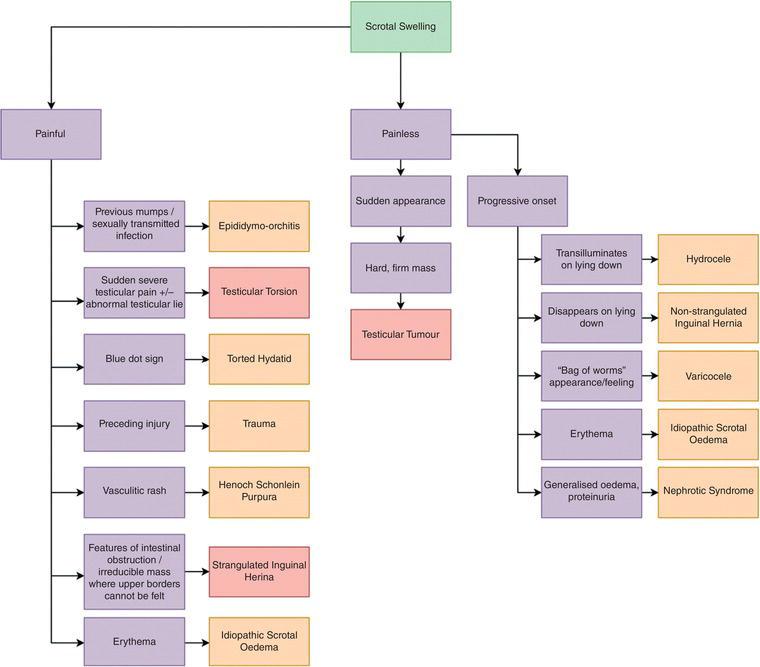
- Testicular torsion — surgical emergency; sudden onset, absent cremasteric reflex, high-riding testis, nausea/vomiting; salvage rate ~90% if surgery within 6 hours [3-4]
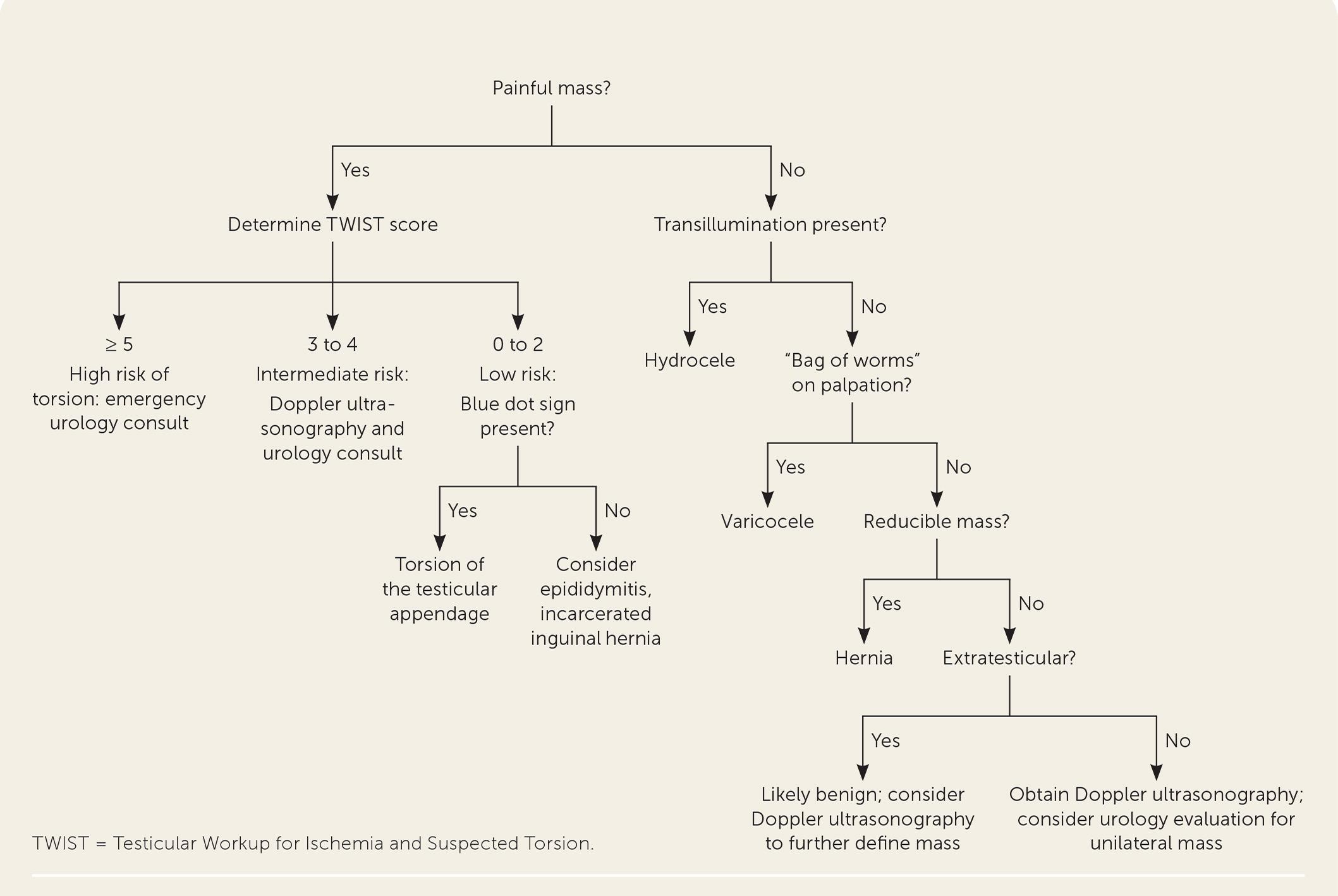
- Torsion of testicular appendage — gradual superior pole pain, "blue dot sign," normal cremasteric reflex; managed conservatively [3][7]
- Orchitis (mumps or viral) — testicular tenderness/swelling without primary epididymal involvement [5]
- Testicular tumor — painless mass, but can present with pain if hemorrhage occurs; evaluate with ultrasound [3]
- Inguinal hernia (incarcerated) — bowel sounds in scrotum, reducibility, abdominal symptoms [8]
- Fournier's gangrene — rapidly progressive scrotal erythema, crepitus, systemic toxicity [1]
- Testicular abscess or infarction [1]
- Idiopathic scrotal edema — bilateral painless edema, more common in children [8]
Past Medical History
- Prior episodes of epididymitis or orchitis (recurrent in prepubertal boys warrants GU workup) [5]
- History of STIs, UTIs, or prostatitis
- BPH or bladder outlet obstruction
- Recent urologic procedures or catheterization
- Immunosuppression, diabetes (risk for complicated disease) [1]
- TB exposure (chronic granulomatous epididymitis) [1]
Physical Exam
- Vital signs: Fever suggests more severe infection or alternative diagnosis
- Inspection: Unilateral scrotal swelling, erythema, edema [2-3]
- Palpation: Tender, swollen epididymis (posterior to testis); testis in normal anatomic position [2]
- Cremasteric reflex: Typically intact (absent in 14% of epididymitis vs. 100% of torsion) [4]
- Prehn sign: Pain relief with scrotal elevation — associated with epididymitis but insufficient sensitivity to rule out torsion [3]
- Urethral discharge: Milk the urethra; if present, obtain Gram stain [1]
- Blue dot sign: Absent (present in torsion of appendix testis) [7]
- Inguinal canal: Palpate for hernia [3]
- Transillumination: Reactive hydrocele may be present [3]
Lab Studies
- Urinalysis: Positive leukocyte esterase or ≥10 WBCs/HPF on spun first-void urine [1]
- Urine NAAT for C. trachomatis and N. gonorrhoeae — preferred specimen is first-void urine [1][5]
- Urine culture: To identify enteric organisms and guide susceptibility [1][5]
- Gram stain of urethral secretions: ≥2 WBCs per oil immersion field confirms urethritis; intracellular gram-negative diplococci diagnostic for gonorrhea [1]
- CBC, CRP: Elevated CRP and WBC may indicate more severe disease and need for hospitalization [1]
- HIV and syphilis screening if STI confirmed [9]
- Retest for GC/CT at 3 months [9]
Imaging
- First-line: Color Doppler ultrasound of the scrotum — imaging test of choice for acute scrotal pain [3][10]
- Torsion findings on US (to distinguish): Decreased/absent intratesticular blood flow, twisted spermatic cord ("whirlpool sign") [8][10]
- When imaging is unnecessary: If clinical presentation is classic for epididymitis (gradual onset, intact cremasteric reflex, tender epididymis, urinary symptoms) and torsion is low on the differential. However, if any diagnostic uncertainty exists, obtain US [10-11]
- Nuclear medicine scrotal scan: Largely replaced by Doppler US; sensitivity 89–98% for differentiating torsion from epididymitis [10]
Special Tests
- TWIST Score (Testicular Workup for Ischemia and Suspected Torsion): Used to risk-stratify acute scrotal pain for torsion — sensitivity 91%, specificity 95%, NPV 99% [3][12]
- Point-of-care ultrasound (POCUS): Highly accurate for acute scrotum evaluation by emergency physicians — sensitivity 96%, specificity 95% for torsion when assessing blood flow and whirlpool sign [11-12]
- Gram stain of urethral discharge: POC test to confirm urethritis and identify gonococcal infection [1]
- Mycoplasma genitalium testing: Consider in cases of persistent epididymitis not responding to standard therapy [13]
ECG
- Not routinely indicated for epididymitis
- Consider ECG if the patient is on amiodarone (a known cause of drug-induced epididymitis) to assess underlying cardiac condition and medication management [3]
Assessment
Acute epididymitis is a clinical diagnosis supported by gradual-onset unilateral scrotal pain, tender swollen epididymis, intact cremasteric reflex, and evidence of urethral inflammation or pyuria. [1-2] Etiology is age-dependent: STI-related in younger sexually active men, enteric organism-related in older men or those with urologic risk factors. [2][5] A causative pathogen is identified in approximately 88% of antibiotic-naive patients, with E. coli being the most common overall (56%) and STIs not restricted to patients <35 years. [14]
Complications include abscess formation, testicular infarction, chronic pain, infertility, and progression to epididymo-orchitis. [1-2] Chronic epididymitis (≥6 weeks) should raise suspicion for TB, fungal infection, or tumor. [1]
Treatment Plan
Initial stabilization
Antibiotic therapy — initiate empirically at the time of visit based on risk stratification (see Medications table above) [1][3]
STI-related management
- Abstain from intercourse until patient and partner(s) complete treatment and are asymptomatic; 7 days of abstinence after single-dose treatments [9]
- Notify and treat sexual partners from the prior 60 days [3]
- Screen for HIV and syphilis; retest GC/CT at 3 months [9]
If symptoms persist >72 hours: Reevaluate diagnosis and therapy; consider abscess, tumor, infarction, TB, or fungal epididymitis. [1] Additional diagnostic testing and follow-up recommended. [5]
Surgical consultation: Required for suspected torsion, abscess, Fournier's gangrene, or testicular infarction [1]
Disposition
- Discharge (majority of cases): Uncomplicated epididymitis with reliable follow-up, ability to tolerate oral medications, and no signs of systemic illness [1]
- Admission criteria:
- Severe pain or high fever suggesting alternative diagnosis (torsion, abscess, necrotizing fasciitis) [1]
- Inability to comply with outpatient antimicrobial regimen [1]
- Older age, diabetes, elevated CRP — markers of more severe disease [1]
- Suspected Fournier's gangrene or scrotal abscess requiring surgical intervention [1]
- Urology consultation: Diagnostic uncertainty, suspected torsion, abscess, recurrent epididymitis in prepubertal boys, or failure to improve [1][5]
Follow Up / Return Precautions
- Follow-up within 48–72 hours if symptoms are not improving [1][5]
- Complete resolution of discomfort may take several weeks after completing antibiotics — counsel patients accordingly [1]
- Return precautions: Worsening pain, new-onset fever, scrotal erythema spreading, nausea/vomiting, or failure to improve within 3 days [1]
- Persistent swelling/tenderness after completing antibiotics: Evaluate for tumor, abscess, infarction, testicular cancer, TB, or fungal infection [1]
- STI follow-up: Retest for GC/CT at 3 months; ensure partner treatment [9]
- Prepubertal boys with recurrent epididymitis: Evaluate for underlying genitourinary abnormalities [5]
Images
References
1. Sexually Transmitted Infections Treatment Guidelines, 2021. — Workowski KA, Bachmann LH, Chan PA, et al. MMWR. Recommendations and Reports : Morbidity and Mortality Weekly Report. Recommendations and Reports. 2021.
2. Epididymitis: An Overview. — McConaghy JR, Panchal B. American Family Physician. 2016.
3. Scrotal Masses. — Langan RC, Puente MEE. American Family Physician. 2022.
4. A Retrospective Review of Pediatric Patients With Epididymitis, Testicular Torsion, and Torsion of Testicular Appendages. — Kadish HA, Bolte RG. Pediatrics. 1998.
5. Guide to Utilization of the Microbiology Laboratory for Diagnosis of Infectious Diseases: 2024 Update by the Infectious Diseases Society of America (IDSA) and the American Society for Microbiology (ASM). — Miller JM, Binnicker MJ, Campbell S, et al. Clinical Infectious Diseases : An Official Publication of the Infectious Diseases Society of America. 2024.
6. The 2024 European Guideline on the Management of Epididymo-Orchitis. — Justice ED, Fricker J, Ross JDC, et al. Journal of the European Academy of Dermatology and Venereology : JEADV. 2025.
7. Differentiation of Epididymitis and Appendix Testis Torsion by Clinical and Ultrasound Signs in Children. — Boettcher M, Bergholz R, Krebs TF, et al. Urology. 2013.
8. Differential Diagnosis of Acute Scrotum in Childhood And Adolescence With High-Resolution Duplex Sonography. — Deeg KH. Ultraschall in Der Medizin. 2021.
9. Sexually Transmitted Infections: Updated Guideline From the CDC. — Klein DA, Valerio CR, Cofield ZN. American Family Physician. 2022.
10. ACR Appropriateness Criteria® Acute Onset of Scrotal Pain-Without Trauma, Without Antecedent Mass: 2024 Update. — Expert Panel on Urological Imaging, Gerena M, Allen BC, et al. Journal of the American College of Radiology : JACR. 2024.
11. Ultrasound Guidelines: Emergency, Point-of-Care, and Clinical Ultrasound Guidelines in Medicine. — American College of Emergency Physicians (2023). 2023.
12. Evaluating the TWIST Score and Point-of-Care Ultrasound for Paediatric Testicular Torsion. — Nakamura T, Kinoshita M, Ihara T, et al. Emergency Medicine Journal : EMJ. 2026.
13. Sexually Transmitted Infections: Updates From the 2021 CDC Guidelines. — Dalby J, Stoner BP. American Family Physician. 2022.
14. Acute Epididymitis Revisited: Impact of Molecular Diagnostics on Etiology and Contemporary Guideline Recommendations. — Pilatz A, Hossain H, Kaiser R, et al. European Urology. 2015.
Figures
More from Deep Dive
Reviewed by Dr. Lucas Mastropaolo. SymptomDx is an educational tool for medical professionals — it does not replace clinical judgment. Verify all clinical data and drug dosages with authoritative sources.