Erythema Infectiosum (Fifth Disease)
Erythema infectiosum is a common, generally self-limiting childhood exanthem caused by parvovirus B19, characterized by a biphasic illness with an initial nonspecific febrile prodrome followed ~1 week later by the classic "slapped-cheek" facial rash and a lace-like reticular body rash. [1-2] While benign in most immunocompetent children, it carries significant risk in specific populations including pregnant women, patients with hemoglobinopathies, and immunocompromised individuals. [2-3]
History
- Prodrome: Low-grade fever, malaise, headache, myalgia, coryza occurring 7–10 days before rash onset (during viremic phase) [1]
- Rash timing: Bilateral "slapped-cheek" erythema appears first, followed 1–4 days later by a lace-like, reticular, erythematous rash on trunk and extremities [1][4]
- Rash recurrence: Evanescent — can wax and wane for weeks, provoked by sunlight, heat, bathing, exercise, or emotional stress [1]
- Joint symptoms: Arthralgias/arthritis more common in adults (especially women), symmetric, involving small joints of hands, wrists, knees [3][5]
- Pruritus: May accompany the rash [4]
- Exposure history: Sick contacts at school/daycare, known community outbreak, household exposure (50% seroconversion risk with household contact vs. 20–50% in classroom) [5]
- Important negatives: Absence of vesicles, oral lesions, conjunctivitis, lymphadenopathy helps distinguish from other exanthems
Alarm Features
- Pallor, tachycardia, fatigue → suspect transient aplastic crisis (especially in sickle cell disease, spherocytosis, thalassemia, iron deficiency anemia) [2][6]
- Pregnancy exposure → risk of hydrops fetalis, fetal death (fetal loss 8–17% before 20 weeks) [5][7]
- Petechial/purpuric rash → atypical presentation; must rule out meningococcemia, ITP, leukemia [8]
- Chest pain, dyspnea, signs of heart failure → parvovirus B19 myocarditis, particularly in young children (median age ~32 months); associated with 19.7% mortality/transplant/LVAD rate during the 2024 outbreak [9-10]
- Neurological symptoms (seizures, encephalitis, ataxia) → reported in 17.8% of hospitalized children during the 2024 outbreak [10]
- Immunocompromised patient with persistent anemia → chronic pure red cell aplasia [1-2]
Medications
- Treatment is supportive in immunocompetent patients [3][11]
- Antipyretics/analgesics: Acetaminophen or ibuprofen for fever and arthralgias
- NSAIDs: Useful for adult arthropathy (symmetric polyarthritis may persist weeks to months)
- IVIG: Indicated for chronic pure red cell aplasia in immunocompromised patients and may be considered in severe myocarditis [3][12]
- RBC transfusion: For transient aplastic crisis with significant anemia [6][13]
- No antiviral therapy is available; no vaccine currently approved [14]
- Antihistamines: May help if pruritus is prominent
Diet
- No specific dietary triggers or restrictions
- Encourage adequate hydration, especially during febrile prodrome
- No evidence-based dietary interventions for this condition
Review of Systems
- Constitutional: Fever, malaise, fatigue (prodromal)
- Skin: Rash character, distribution, timing relative to fever, pruritus
- MSK: Joint pain/swelling (especially in adults — hands, wrists, knees)
- Heme: Pallor, easy bruising, petechiae
- Cardiac: Chest pain, dyspnea, exercise intolerance, palpitations (myocarditis screen)
- Neuro: Headache, seizures, altered mental status
- OB/GYN: Pregnancy status, gestational age, fetal movement
Collateral History and Family History
- Daycare/school outbreak history — parvovirus B19 spreads in epidemic waves, especially late winter/spring [15-16]
- Household contacts with sickle cell disease or other hemoglobinopathies — at risk for concurrent aplastic crisis [6]
- Pregnant household members — critical to identify; the infected child is no longer contagious once the rash appears [5]
- Family history of hemolytic anemias (spherocytosis, G6PD deficiency, sickle cell disease)
- Immunocompromised family members (transplant recipients, HIV, chemotherapy)
Risk Factors
- Age: Peak incidence in school-age children (5–15 years) [16]
- Season: Late winter through early spring
- Occupation/exposure: Teachers, daycare workers, healthcare workers
- Hemoglobinopathies: Sickle cell disease, thalassemia, spherocytosis → risk of aplastic crisis [6][13]
- Immunosuppression: HIV, transplant recipients, chemotherapy → chronic infection/pure red cell aplasia [1-2]
- Pregnancy: ~35–40% of reproductive-age women are seronegative and susceptible [5]
- Post-COVID-19 pandemic surge: A significant increase in parvovirus B19 cases was observed in 2023–2024 across Europe and the US, likely due to waning population immunity [10][17]
Differential Diagnosis
- Rubella — similar maculopapular rash; distinguished by postauricular/suboccipital lymphadenopathy, Forchheimer spots [1]
- Measles (rubeola) — cephalocaudal spread, Koplik spots, higher fever, cough/coryza/conjunctivitis
- Scarlet fever — sandpaper rash, pharyngitis, strawberry tongue, Pastia lines [4]
- Roseola (HHV-6) — rash appears after fever resolves (vs. fifth disease where rash appears with/after mild fever) [4]
- Drug eruption — temporal relationship to medication
- Kawasaki disease — prolonged fever ≥5 days, conjunctival injection, mucositis, extremity changes, lymphadenopathy [18]
- Meningococcemia — petechial/purpuric rash with toxic appearance (cannot-miss diagnosis) [19]
- Systemic lupus erythematosus — malar rash can mimic slapped cheek; distinguished by systemic features
- Hand-foot-mouth disease — vesicular lesions on palms, soles, oral mucosa
Past Medical History
- Hemolytic anemias (sickle cell, spherocytosis, thalassemia) — highest risk for aplastic crisis [6][13]
- Immunodeficiency (congenital or acquired) — risk of chronic infection and pure red cell aplasia [1]
- Prior parvovirus B19 infection — IgG provides lifelong immunity; reinfection is rare [2]
- Pregnancy history and current pregnancy status
- Transplant history — solid organ or bone marrow transplant recipients at risk
- Chronic kidney disease — baseline anemia may worsen
Physical Exam
- Vital signs: Low-grade fever (often resolved by time of rash); tachycardia if anemic
- Face: Bilateral, confluent erythema of cheeks with circumoral pallor ("slapped cheek") [1][4]
- Trunk/extremities: Lace-like, reticular, erythematous maculopapular rash; may be evanescent [1]
- Joints: Swelling, tenderness (especially in adults — hands, wrists, knees)
- Skin: Check for petechiae/purpura (atypical variant); rash may be difficult to see in dark skin [1][8]
- Pallor: Suggests significant anemia — check conjunctivae, palms
- Cardiac: Gallop, murmur, hepatomegaly → concern for myocarditis [9]
- Abdomen: Hepatosplenomegaly (aplastic crisis, myocarditis)
- Absent findings: No lymphadenopathy, no oral lesions, no vesicles (helps distinguish from other exanthems)
Lab Studies
- Routine cases in immunocompetent children: No labs needed — diagnosis is clinical [11]
- Parvovirus B19 IgM/IgG serology: Confirmatory test of choice; ~90% of patients with erythema infectiosum have detectable IgM at presentation [2]
- CBC with reticulocyte count: Essential if aplastic crisis suspected — look for reticulocyte count <1%, significant drop in hemoglobin from baseline [6]
- Parvovirus B19 PCR (NAAT): Preferred in immunocompromised patients (who may not mount IgM response) and in aplastic crisis [2]
- CMP, LDH, haptoglobin, bilirubin: If hemolysis suspected
- Troponin, BNP/NT-proBNP: If myocarditis suspected [9]
- Pregnancy test: In reproductive-age women with exposure
Imaging
- Not routinely indicated in classic erythema infectiosum
- Echocardiography: If myocarditis suspected (chest pain, heart failure signs, troponin elevation) — assess LV function [9][20]
- Cardiac MRI: Gold standard for myocarditis diagnosis in stable patients [21]
- Fetal ultrasound with MCA Doppler: In pregnant women with confirmed infection — serial monitoring for hydrops fetalis and fetal anemia for 8–12 weeks after maternal infection [5][16]
- Chest X-ray: If respiratory distress or heart failure suspected
Special Tests
- No validated clinical scoring system specific to erythema infectiosum
- Bone marrow biopsy: Rarely needed; may show giant pronormoblasts (pathognomonic) in aplastic crisis [2]
- Endomyocardial biopsy: Gold standard for parvovirus B19 myocarditis confirmation; shows lymphocytic myocarditis with viral DNA on PCR [9][21]
- Fetal blood sampling (cordocentesis): For suspected severe fetal anemia; allows intrauterine transfusion [7][16]
ECG
- Not routinely indicated in uncomplicated erythema infectiosum
- Obtain ECG if: Chest pain, dyspnea, tachycardia out of proportion to fever, signs of heart failure
- Parvovirus B19 myocarditis ECG findings: Sinus tachycardia, nonspecific ST-T wave changes, T-wave inversions (inferior/lateral leads), low QRS voltage, peaked P waves [21-22]
- Danger signs: ST-segment elevation — associated with 100% mortality in one pediatric series; AV block, ventricular tachycardia [20][22]
Assessment
Erythema infectiosum is a benign, self-limiting illness in the vast majority of immunocompetent children, resolving in 1–2 weeks. [3][7] The disease is biphasic: an initial viremic phase (fever, malaise — patient is contagious) followed ~1 week later by the immune-mediated rash phase (patient is no longer contagious). [1][5]
Key clinical pearls:
- By the time the classic rash appears, the patient is no longer infectious — isolation is not necessary once the rash is present [5]
- Adults more commonly present with arthropathy rather than the classic slapped-cheek rash [5][23]
- The rash may be difficult to appreciate in dark skin [1]
- Atypical presentations include petechial/purpuric rash, "gloves and socks" syndrome, and vesiculopustular eruptions [2][8][24]
- The 2023–2024 post-pandemic surge highlighted myocarditis as a serious complication, particularly in children ≤7 years [9-10]
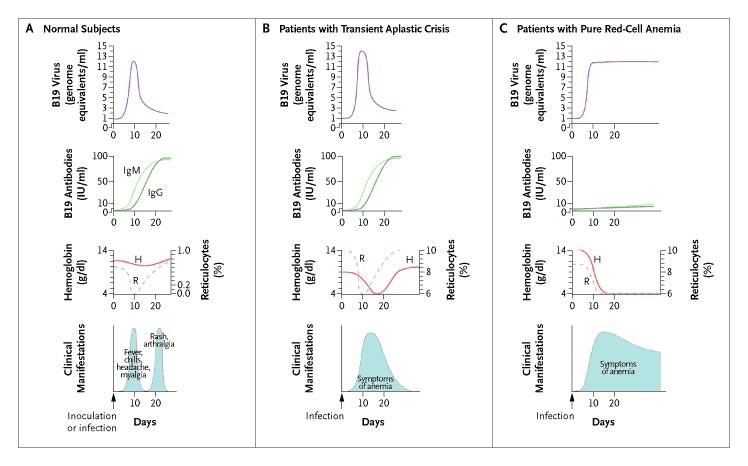
The following figure illustrates the pathophysiology of parvovirus B19 infection across different host populations — normal subjects, patients with hemolytic anemia (aplastic crisis), and immunocompromised patients (chronic anemia):
Treatment Plan
Immunocompetent children (classic fifth disease)
- Supportive care only — antipyretics (acetaminophen 15 mg/kg q4–6h or ibuprofen 10 mg/kg q6–8h), hydration, rest [3][11]
- Antihistamines for pruritus if needed
- Reassurance that the rash may recur for weeks with triggers (sun, heat, exercise) [1]
Adult arthropathy
Transient aplastic crisis (sickle cell, spherocytosis, etc.):
- RBC transfusion as needed for symptomatic anemia [6][13]
- Droplet isolation from pregnant women and other at-risk patients [6]
- Monitor siblings with hemoglobinopathies for concurrent aplastic crisis [6]
Immunocompromised patients with chronic pure red cell aplasia:
- IVIG (0.4 g/kg/day × 5–10 days or 1 g/kg/day × 2–3 days) [3][11]
- Reduction of immunosuppression if possible
Pregnancy
- Confirm infection with IgM/IgG serology [2]
- Serial fetal ultrasound + MCA Doppler every 1–2 weeks for 8–12 weeks [5][16]
- Referral to maternal-fetal medicine if hydrops or fetal anemia suspected [16]
- Intrauterine transfusion for severe fetal anemia (survival 67–85%) [14]
Myocarditis
- ICU-level care for hemodynamic instability [9]
- Standard heart failure management (inotropes, mechanical circulatory support including ECMO if needed) [20]
- IVIG and immunomodulatory therapy considered in select cases [12][21]
Disposition
Discharge criteria (majority of cases)
- Immunocompetent child or adult with classic presentation
- Well-appearing, hemodynamically stable
- No underlying hemoglobinopathy or immunodeficiency
- Adequate oral intake
Admission criteria
- Aplastic crisis with significant anemia requiring transfusion [6]
- Myocarditis — any signs of cardiac dysfunction (ICU admission in 71% of myocarditis cases during 2024 outbreak) [10]
- Severe anemia with hemodynamic compromise
- Neurological complications (encephalitis, seizures) [10]
- Diagnostic uncertainty with petechial rash requiring workup to exclude meningococcemia or leukemia [8]
Specialist consultation triggers
- Hematology: Aplastic crisis, chronic red cell aplasia
- Maternal-fetal medicine: Confirmed infection in pregnancy [16]
- Cardiology: Suspected myocarditis [9]
- Infectious disease: Immunocompromised patients with persistent infection
Follow Up / Return Precautions
Follow-up timing
- Routine cases: No specific follow-up needed unless symptoms persist >4 weeks
- Arthropathy in adults: PCP follow-up in 2–4 weeks if joint symptoms persist
- Pregnancy: Serial ultrasound/Doppler monitoring for 8–12 weeks post-infection [5][16]
- Post-aplastic crisis: Hematology follow-up with repeat CBC/reticulocyte count
Return precautions — advise return for
- New-onset pallor, fatigue, dizziness (worsening anemia)
- Chest pain, difficulty breathing, rapid heartbeat (myocarditis)
- Petechiae, purpura, or bleeding (thrombocytopenia)
- High fever, toxic appearance, neck stiffness
- Persistent or worsening joint swelling >6 weeks
Patient counseling
- The rash is not contagious once it appears — child may return to school/daycare [5]
- Rash may recur intermittently for weeks with sun, heat, or exercise — this is normal and does not indicate reinfection [1]
- Pregnant contacts should be informed and may need serologic testing [5]
- Lifelong immunity develops after infection [2]
- Expected recovery: 1–3 weeks for most cases; arthropathy may take longer in adults [23]
References
1. Parvovirus B19. — Young NS, Brown KE. The New England Journal of Medicine. 2004.
2. Guide to Utilization of the Microbiology Laboratory for Diagnosis of Infectious Diseases: 2024 Update by the Infectious Diseases Society of America (IDSA) and the American Society for Microbiology (ASM). — Miller JM, Binnicker MJ, Campbell S, et al. Clinical Infectious Diseases : An Official Publication of the Infectious Diseases Society of America. 2024.
3. Erythema Infectiosum and Other Parvovirus B19 Infections. — Kirchner JT. American Family Physician. 1994.
4. Common Skin Rashes in Children. — Allmon A, Deane K, Martin KL. American Family Physician. 2015.
5. Practice Bulletin No. 151: Cytomegalovirus, Parvovirus B19, Varicella Zoster, and Toxoplasmosis in Pregnancy. — Committee on Practice Bulletins—Obstetrics Obstetrics and Gynecology. 2015.
6. Health Supervision for Children and Adolescents With Sickle Cell Disease: Clinical Report. — Yates AM, Aygun B, Nuss R, Rogers ZR. Pediatrics. 2024.
7. Prenatal Parvovirus B19 Infection. — Kagan KO, Hoopmann M, Geipel A, Sonek J, Enders M. Archives of Gynecology and Obstetrics. 2024.
8. Generalized Petechial Rashes in Children During a Parvovirus B19 Outbreak. — Edmonson MB, Riedesel EL, Williams GP, Demuri GP. Pediatrics. 2010.
9. Clinical Spectrum of Children With Parvovirus B19-Associated Acute Myocarditis. — Ammirati E, Veronese G, Raimondi F, et al. Circulation. 2026.
10. Severe Presentations and Outcomes in Hospitalized Pediatric Patients With Parvovirus B19 Infection During the 2024 Outbreak: A Multicenter Prospective Study in Italy. — Venturini E, Tamborino AM, Arrichiello G, et al. The Pediatric Infectious Disease Journal. 2025.
11. Clinical Presentations of Parvovirus B19 Infection. — Servey JT, Reamy BV, Hodge J. American Family Physician. 2007.
12. Parvovirus B19-Associated Myocarditis in Children: A Systematic Review of Clinical Features, Management and Outcomes. — Veronese G, Colombo G, Garascia A, et al. European Journal of Clinical Investigation. 2025.
13. Significance of Parvovirus B19 Infection in Childhood - Collection of Demographic Data, Clinical Presentation, Diagnostic Findings and the Impact on Patients With Hemolytic Anemia. — Lawatsch L, Baier M, Milde T, Gruhn B. Diagnostic Microbiology and Infectious Disease. 2026.
14. Parvovirus B19 Infection in Pregnancy - A Review. — Gigi CE, Anumba DOC. European Journal of Obstetrics, Gynecology, and Reproductive Biology. 2021.
15. Academy Rash. A Probable Epidemic of Erythema Infectiosum ('Fifth Disease'). — Brass C, Elliott LM, Stevens DA. The Journal of the American Medical Association. 1982.
16. Parvovirus B19 in Pregnancy: A Case Review. — Hunter LA, Ayala NK. Journal of Midwifery & Women's Health. 2021.
17. Is Parvovirus B19 Infection Upsurge in 2023-2024 Associated With Adverse Pregnancy Outcome?. — Prasad S, Khalil A, Yinon Y, et al. Ultrasound in Obstetrics & Gynecology : The Official Journal of the International Society of Ultrasound in Obstetrics and Gynecology. 2025.
18. The Rash With Maculopapules and Fever in Children. — Muzumdar S, Rothe MJ, Grant-Kels JM. Clinics in Dermatology. 2019.
19. Evaluating the Febrile Patient With a Rash. — McKinnon HD, Howard T. American Family Physician. 2000.
20. Parvovirus B19 Myocarditis in Children: An Observational Study. — Vigneswaran TV, Brown JR, Breuer J, Burch M. Archives of Disease in Childhood. 2016.
21. Parvovirus B19 Myocarditis in Children: A Diagnostic and Therapeutic Approach. — Esmel-Vilomara R, Dolader P, Izquierdo-Blasco J, et al. European Journal of Pediatrics. 2022.
22. Diagnosis and Management of Myocarditis in Children: A Scientific Statement From the American Heart Association. — Law YM, Lal AK, Chen S, et al. Circulation. 2021.
23. Acute Parvovirus B19 Infection: Analysis of 46 Patients. — Tomás-Velázquez A, Escribano Á, Rodríguez-Garijo N, et al. Medicina Clinica. 2020.
24. Human Parvovirus B19-Induced Vesiculopustular Skin Eruption. — Naides SJ, Piette W, Veach LA, Argenyi Z. The American Journal of Medicine. 1988.
Figure
More from Deep Dive
Reviewed by Dr. Lucas Mastropaolo. SymptomDx is an educational tool for medical professionals — it does not replace clinical judgment. Verify all clinical data and drug dosages with authoritative sources.