Headache (Undifferentiated)
Headache disorders affect approximately 90% of people during their lifetime and are the fourth leading cause of ED visits in the US. [1] The primary goal in evaluating undifferentiated headache is to rapidly distinguish primary headaches (tension-type, migraine, cluster) from dangerous secondary causes requiring emergent intervention. [1-2]
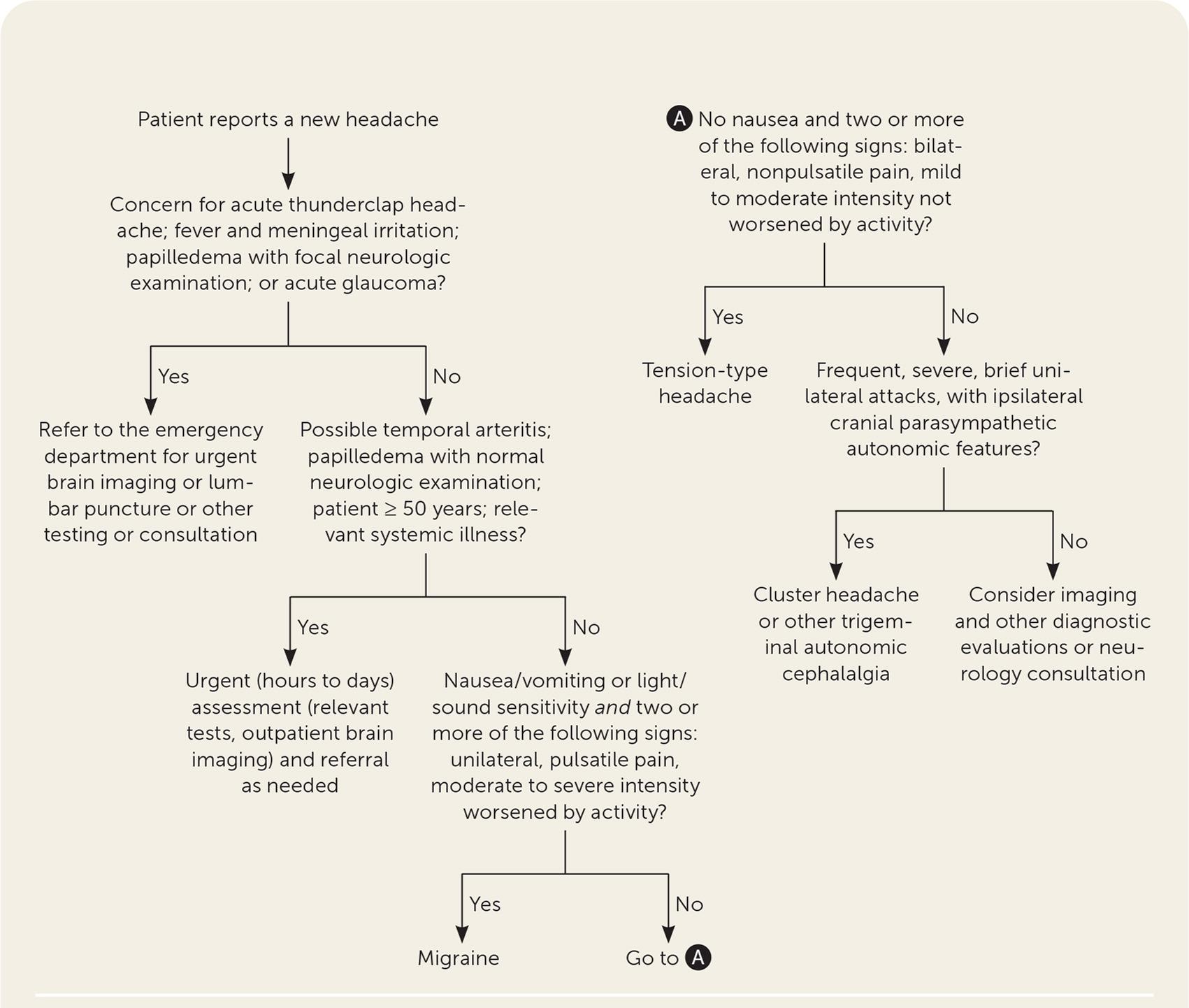
The following figure from the AAFP provides a clinical decision algorithm for evaluating new headache presentations:
History
- Onset: Sudden/thunderclap (peak within seconds–minutes) vs. gradual; age at first onset (new headache after age 50 is a red flag) [1][3]
- Location: Unilateral (migraine, cluster, TACs) vs. bilateral (tension-type); orbital/temporal (cluster) [2]
- Character: Pulsating/throbbing (migraine) vs. pressing/tightening (tension-type) vs. boring/stabbing (cluster) [2]
- Duration: 30 min–7 days (tension-type), 4–72 hours (migraine), 15 min–3 hours (cluster) [2]
- Severity: Mild-moderate (tension-type), moderate-severe (migraine), severe (cluster) [2]
- Associated symptoms: Nausea/vomiting, photophobia, phonophobia, aura, autonomic features (lacrimation, rhinorrhea, ptosis), neck stiffness, fever [1-2]
- Aggravating/alleviating factors: Worsened by activity (migraine), positional (intracranial hypo/hypertension), cough/Valsalva (posterior fossa lesion) [2]
- Timing: Predictable pattern (menstrual migraine), nocturnal clusters, morning headache (raised ICP) [2]
- Important negatives: No fever, no neck stiffness, no visual changes, no weakness, no altered consciousness, no recent trauma [2-3]
Alarm Features (Red Flags — SNNOOP10)
Use the SNNOOP10 mnemonic to screen for secondary causes: [2-3]
- Thunderclap headache (peak intensity within seconds): SAH, RCVS — >40% pretest probability for serious pathology [2]
- Fever + meningismus: Meningitis/encephalitis [4]
- Papilledema ± focal neurologic signs or impaired consciousness: Intracranial mass, IIH [2]
- New neurologic deficit: Stroke, mass lesion, CNS infection [2]
- Onset after age 50: Giant cell arteritis, neoplasm [1]
- Pattern change or new headache type: Mass lesion, medication overuse [2]
- Positional headache: CSF leak, intracranial hypo/hypertension [2]
- Precipitated by cough/exertion/Valsalva: Posterior fossa lesion (Chiari), SAH [2]
- Progressive headache: Mass lesion [2]
- Pregnancy/postpartum: Preeclampsia, CVT, RCVS [2][5]
- Painful eye with autonomic features: Acute angle-closure glaucoma, cavernous sinus pathology [2]
- Immunosuppression: Opportunistic infection, abscess [2][6]
- Anticoagulant use: Intracranial hemorrhage [1]
Medications
Medications that contribute to headache
- Medication overuse headache (MOH): Analgesics ≥15 days/month, triptans/ergots/opioids/combination analgesics ≥10 days/month [1][7]
- Opioids and barbiturate combinations carry the highest MOH risk; triptans carry relatively lower risk [7]
- Nitrates, PDE5 inhibitors, oral contraceptives, and calcium channel blockers can cause headache [2]
Common acute treatments
- Tension-type: Acetaminophen 1000 mg, ibuprofen 400 mg, naproxen 550 mg [1]
- Migraine (outpatient): NSAIDs first-line → triptans (rizatriptan 10 mg, sumatriptan 50–100 mg PO or 6 mg SC) → gepants (ubrogepant, rimegepant) or lasmiditan if triptans fail/contraindicated [1][8-9]
- Migraine (ED parenteral): Prochlorperazine 10 mg IV (Level A — must offer), metoclopramide 10 mg IV (Level B), ketorolac 15–30 mg IV, dexamethasone 8–10 mg IV for recurrence prevention [10]
- Cluster: High-flow O₂ (12–15 L/min via non-rebreather × 15 min), sumatriptan 6 mg SC [2]
Contraindicated medications
- Triptans/ergots: Contraindicated in CAD, prior stroke, PAD, uncontrolled HTN, multiple cardiovascular risk factors [1][8]
- Opioids: Must NOT be offered for migraine in the ED (Level A — must not offer per AHS 2025) [10]
- NSAIDs: Caution with renal disease, GI bleeding, cardiac comorbidities [8]
Diet
- Common dietary triggers (evidence strongest for alcohol and caffeine): Alcohol (especially red wine), caffeine withdrawal or excess (≥3 servings/day), aged cheeses, processed meats (nitrites), chocolate, MSG, artificial sweeteners (aspartame) [11-13]
- Caffeine: Withdrawal triggers headache; moderate intake (1–2 servings/day) may be protective; ≥3 servings/day associated with migraine onset [12]
- Hydration: Dehydration is an underrecognized trigger; increased water intake associated with reduced headache frequency [12]
- Dietary approaches: Ketogenic diet and DASH diet have average-quality evidence for reducing migraine frequency, duration, and severity [14]
- Patient beliefs about food triggers have low positive predictive value — food cravings may be premonitory symptoms misattributed as triggers [12]
Review of Systems
- Neurologic: Visual changes (aura, diplopia, field cuts), weakness, numbness, speech difficulty, altered consciousness, seizures
- Ophthalmologic: Eye pain, redness, blurred vision, halos (acute glaucoma)
- ENT: Nasal congestion, rhinorrhea, facial pressure (sinusitis vs. migraine autonomic features)
- Systemic: Fever, weight loss, night sweats (infection, malignancy, GCA)
- Vascular: Jaw claudication, scalp tenderness, visual loss (GCA in age >50) [1]
- Psychiatric: Depression, anxiety (comorbid with chronic migraine; risk factor for chronification) [1]
- Musculoskeletal: Neck pain, limited cervical ROM (cervicogenic headache) [7]
Collateral History and Family History
- Collateral: Witnessed LOC, seizure activity, behavioral changes, confusion — critical for SAH, meningitis, and encephalitis workup [15]
- Family history: Migraine has strong genetic predisposition; family history of aneurysmal SAH increases suspicion [1][16]
- Social context: Occupation, stress, sleep habits, substance use (alcohol, caffeine, illicit drugs), recent travel (infectious etiologies)
- Pregnancy/postpartum status — critical for CVT, preeclampsia, RCVS risk stratification [5][17]
Risk Factors
- Migraine: Female sex, age 20–50, family history, obesity, depression/anxiety, sleep disorders, excessive caffeine, medication overuse [1]
- Tension-type: Stress, poor posture, sleep deprivation, anxiety/depression [1]
- Cluster: Male sex (3:1), tobacco use, alcohol during cluster periods [2]
- SAH: Hypertension, smoking, heavy alcohol use, family history of aneurysm, polycystic kidney disease, connective tissue disorders [16]
- CVT: Oral contraceptives/estrogen (8-fold increased odds), pregnancy/puerperium, thrombophilia (factor V Leiden, protein C/S deficiency), malignancy, autoimmune disease, recent infection, dehydration [17-18]
- GCA: Age >50, polymyalgia rheumatica [1]
Differential Diagnosis
Most likely (primary headaches)
- Tension-type headache — most common overall; bilateral, pressing, mild-moderate, not worsened by activity [2]
- Migraine — most common disabling headache presenting to care; unilateral, pulsating, moderate-severe, with nausea/photo/phonophobia [1-2]
- Medication overuse headache — ≥15 headache days/month with regular overuse of acute medications [7]
- Cervicogenic headache — associated with neck pain and limited cervical ROM [7]
Cannot-miss (secondary headaches)
- Subarachnoid hemorrhage — thunderclap headache, "worst headache of life"; ~5% of acute-onset headaches in ED [16][19]
- Bacterial meningitis/encephalitis — headache + fever + neck stiffness + altered mental status (classic triad present in only 40–50%) [4]
- Intracranial mass (tumor, abscess) — progressive headache, focal deficits, papilledema [2]
- Cerebral venous sinus thrombosis — subacute progressive headache (90%), often in young women on OCP; may present with seizures, focal deficits [17-18]
- Acute angle-closure glaucoma — eye pain, injection, blurred vision, halos, mid-dilated fixed pupil [2]
- Giant cell arteritis — new headache in age >50, jaw claudication, scalp tenderness, visual symptoms; ESR/CRP elevated [1]
Other mimics
Past Medical History
- Prior headache type and pattern (established migraine vs. new headache — pattern change is a red flag) [2]
- Previous episodes of similar headache (strongly associated with primary headache; OR 2.7) [6]
- History of cancer (brain metastases), HIV/immunosuppression (opportunistic CNS infections) [1-2]
- Coagulopathy or anticoagulant use (intracranial hemorrhage risk) [1]
- Prior neurosurgery, LP, or head trauma (post-traumatic headache, CSF leak) [2]
- Psychiatric history (depression, anxiety — comorbid with chronic migraine) [1]
Physical Exam
Vital signs
Focused neurologic exam
- Mental status, cranial nerves (especially pupil reactivity, visual fields, extraocular movements, facial symmetry), motor/sensory, cerebellar testing, gait
- Fundoscopy: Papilledema (raised ICP), subhyaloid hemorrhage (SAH) [2]
- Neck: Stiffness/meningismus (meningitis, SAH); Kernig and Brudzinski signs have poor sensitivity (5–30%) but high specificity [4]
- Temporal arteries: Tenderness, reduced pulsation, nodularity (GCA) [1]
Focused exam maneuvers
- Jolt accentuation: Worsening of headache with rapid horizontal head rotation — sensitive but not specific for meningitis
- Cervical ROM: Limited ROM with provocation reproducing headache (cervicogenic) [7]
- Eye exam: Conjunctival injection, corneal haziness, mid-dilated fixed pupil (acute glaucoma) [2]
Expected vs. concerning findings
- Normal neurologic exam with recurrent stereotyped headache → likely primary headache [2]
- Any focal neurologic deficit, papilledema, or altered consciousness → warrants urgent imaging [1-2]
Lab Studies
Recommended labs (when secondary cause suspected)
- CBC, CMP: Baseline; infection, metabolic derangement
- ESR and CRP: Mandatory if GCA suspected (age >50 with new headache); ESR typically >50 mm/hr [1-2]
- Blood cultures: Before antibiotics if meningitis suspected [20]
- Coagulation studies: If LP planned or anticoagulant use
- Pregnancy test: All women of reproductive age (preeclampsia, CVT risk) [2]
- D-dimer: May have a role in CVT screening but not definitive [17]
CSF analysis (when LP indicated)
- Cell count, protein, glucose, Gram stain, culture, PCR panel (sensitivity ~90%, specificity ~97%) [20]
- Opening pressure (elevated in meningitis, IIH, CVT) [4]
- Xanthochromia (SAH — develops 6–12 hours post-hemorrhage; best detected by spectrophotometry) [21]
- RBC count that does not decline tube 1 to tube 4 (SAH vs. traumatic tap) [21]
Imaging
First-line
When CT is insufficient
- CT + LP: Standard pathway if SAH suspected and CT negative, especially >6 hours from onset [19][23]
- CT angiography (CTA): If SAH confirmed → identify culprit aneurysm; ACEP allows CT-CTA as alternative to CT-LP (weak recommendation), but AHA/ASA 2023 strongly favors CT-LP [19][23]
Gold standard / advanced imaging
- MRI brain with/without contrast: Preferred for non-emergent concerning features — mass lesions, posterior fossa pathology, CVT, encephalitis, cervicomedullary lesions [2]
- MR venography (MRV) or CT venography (CTV): Diagnostic for CVT [17]
- Digital subtraction angiography (DSA): Gold standard for aneurysm characterization [24]
When imaging is unnecessary
- 0.2% yield[2]
Special Tests
- Ottawa SAH Rule: Age ≥40, neck pain/stiffness, witnessed LOC, onset during exertion, thunderclap headache, limited neck flexion — 100% sensitive, 15% specific; rules out need for further testing if ALL criteria absent in alert patients ≥15 years with sudden severe headache [15][23]
- ID Migraine screening: Light sensitivity + nausea/vomiting + activity-limiting headache (≥2 of 3 positive = likely migraine) [2]
- Greater occipital nerve block (GONB): Level A — must offer in ED for migraine requiring parenteral therapy [10]
- Temporal artery biopsy: Gold standard for GCA diagnosis
- Lumbar puncture: Diagnostic for meningitis, SAH (post-CT), IIH; obtain CT first if focal deficits, seizures, immunocompromise, or altered consciousness [4]
ECG
- Indications: Before administering triptans in patients with cardiovascular risk factors; before IV prochlorperazine/haloperidol/droperidol (QTc prolongation risk) [10]
- Dangerous patterns: ST changes (if considering triptan use in borderline cardiovascular patients), prolonged QTc (dopamine antagonist use)
- Not routinely indicated for primary headache evaluation
Assessment
Clinical summary framework
- The vast majority (~60%) of ED headache presentations are primary headaches; ~32% are secondary [6]
- The key clinical task is risk stratification: Does this headache have features suggesting a life-threatening secondary cause?
- Fulfilling ICHD-3 criteria for a primary headache strongly predicts a primary etiology (OR 18.7) [6]
- History of similar prior episodes and known migraine diagnosis are strong "green flags" [6]
Severity stratification
- Emergent: Thunderclap headache, fever + meningismus, papilledema + focal deficits, impaired consciousness, acute glaucoma [2]
- Urgent: New headache age >50 (GCA), progressive/atypical pattern, positional, immunocompromised [2]
- Non-urgent: Recurrent stereotyped headache meeting primary headache criteria with normal exam [2]
Complications to consider
- Status migrainosus (migraine >72 hours)
- Migrainous infarction (rare)
- MOH from escalating analgesic use
- Rebleeding in missed SAH (4% within 24 hours, up to 50% within 6 months) [16]
Treatment Plan
Initial stabilization (ED)
- ABCs, IV access if ill-appearing
- Treat pain and nausea promptly — delays worsen outcomes
ED migraine treatment (per AHS 2025 guidelines): [10]
- Prochlorperazine 10 mg IV + diphenhydramine 25 mg IV (to prevent akathisia/EPS) — Level A
- Greater occipital nerve block — Level A
- Ketorolac 15–30 mg IV — Level B
- Metoclopramide 10 mg IV — Level B (if prochlorperazine unavailable)
- Sumatriptan 6 mg SC — Level B
- Dexamethasone 8–10 mg IV — Level C (for recurrence prevention, not acute pain)
- Avoid opioids (hydromorphone IV — Level A must NOT offer) [10]
Tension-type headache
Cluster headache
- High-flow O₂ 12–15 L/min × 15 min via non-rebreather
- Sumatriptan 6 mg SC or zolmitriptan 5 mg nasal spray [2]
Outpatient migraine
- Stepped care: NSAIDs → triptans → gepants/lasmiditan [1][9]
- Consider preventive therapy if ≥4 headache days/month, significant disability, or medication overuse [1]
MOH management
Disposition
Admission criteria
- Confirmed or suspected SAH, meningitis, encephalitis, CVT, intracranial mass with mass effect
- Status migrainosus refractory to ED treatment
- Altered mental status, new focal neurologic deficits
- Inability to tolerate oral intake (intractable vomiting)
- Need for serial neurologic exams or ongoing IV therapy
Observation indications
- Awaiting LP results or advanced imaging
- Partial response to ED treatment with need for repeat dosing
- Diagnostic uncertainty with concerning features
Discharge criteria
- Pain adequately controlled
- Able to tolerate PO
- Normal neurologic exam
- No red flags identified
- Reliable follow-up arranged
- Clear return precautions given
Specialist consultation triggers
- Neurosurgery: SAH, intracranial hemorrhage, mass with mass effect
- Neurology: New focal deficits, suspected CVT, refractory/atypical headache, status migrainosus, TACs
- Ophthalmology: Papilledema, suspected acute glaucoma [2]
- Infectious disease: CNS infection in immunocompromised patient
Follow Up / Return Precautions
Follow-up timing
- Primary headache with good ED response: PCP or headache specialist within 1–2 weeks
- New headache requiring outpatient MRI: Neurology follow-up within 1–4 weeks
- Post-LP headache evaluation: 48–72 hours [25]
Symptoms requiring immediate return
- Sudden severe "worst headache of life"
- New weakness, numbness, vision loss, speech difficulty, or confusion
- Fever with worsening headache or neck stiffness
- Seizure
- Worsening or persistent vomiting preventing oral intake
- Headache progressively worsening despite prescribed treatment
Patient counseling points
- Avoid overuse of OTC analgesics (≤2 days/week to prevent MOH) [7]
- Maintain regular sleep, hydration, meals, and exercise
- Identify and avoid personal triggers (headache diary recommended) [12]
- Migraine is a neurologic disease, not "just a headache" — effective preventive treatments exist [1]
Expected recovery course
- Tension-type and migraine attacks typically resolve within hours to days with appropriate treatment
- Referral to headache specialist if ≥4 headache days/month or escalating frequency [1][25]
Would you like me to expand on any specific section — for example, the ED treatment algorithm in more detail, preventive migraine therapies, or the workup for a specific secondary cause like SAH or CVT?
References
1. Diagnosis and Management of Headache: A Review. — Robbins MS. The Journal of the American Medical Association. 2021.
2. Acute Headache in Adults: A Diagnostic Approach. — Viera AJ, Antono B. American Family Physician. 2022.
3. Red and Orange Flags for Secondary Headaches in Clinical Practice: SNNOOP10 List. — Do TP, Remmers A, Schytz HW, et al. Neurology. 2019.
4. Community-Acquired Bacterial Meningitis. — van de Beek D, Brouwer MC, Koedel U, Wall EC. Lancet. 2021.
5. Diagnosis of Acute Neurological Emergencies in Pregnant and Post-Partum Women. — Edlow JA, Caplan LR, O'Brien K, Tibbles CD. The Lancet. Neurology. 2013.
6. Headache at the Emergency Room: Etiologies, Diagnostic Usefulness of the ICHD 3 Criteria, Red and Green Flags. — Munoz-Ceron J, Marin-Careaga V, Peña L, Mutis J, Ortiz G. PloS One. 2019.
7. Management of Headache (2023). — Jane Abanes PhD DNP MSN/Ed PMHCNS PMHNP-BC RN, Natasha M. Antonovich PharmD BCPS, Andrew C. Buelt DO, et al Department of Veterans Affairs. 2023.
8. Acute Treatments for Episodic Migraine in Adults: A Systematic Review and Meta-analysis. — VanderPluym JH, Halker Singh RB, Urtecho M, et al. The Journal of the American Medical Association. 2021.
9. Migraine. — Ashina M. The New England Journal of Medicine. 2020.
10. 2025 Guideline Update to Acute Treatment of Migraine for Adults in the Emergency Department: The American Headache Society Evidence Assessment of Parenteral Pharmacotherapies. — Robblee J, Minen MT, Friedman BW, et al. Headache. 2025.
11. Diet and Headache: Part 1. — Martin VT, Vij B. Headache. 2016.
12. Lifestyle Factors and Migraine. — Seng EK, Martin PR, Houle TT. The Lancet. Neurology. 2022.
13. The Role of Diet and Nutrition in Migraine Triggers and Treatment: A Systematic Literature Review. — Hindiyeh NA, Zhang N, Farrar M, et al. Headache. 2020.
14. Diet and Migraine: What Is Proven?. — Gazerani P. Current Opinion in Neurology. 2023.
15. Management of Patients With Aneurysmal Subarachnoid Hemorrhage: Guidelines From the AHA and ASA. — Arnold MJ. American Family Physician. 2024.
16. Spontaneous Subarachnoid Haemorrhage. — Claassen J, Park S. Lancet. 2022.
17. Diagnosis and Management of Cerebral Venous Thrombosis: A Scientific Statement From the American Heart Association. — Saposnik G, Bushnell C, Coutinho JM, et al. Stroke. 2024.
18. Cerebral Venous Thrombosis. — Ropper AH, Klein JP. The New England Journal of Medicine. 2021.
19. Shifts in Diagnostic Testing for Headache in the Emergency Department, 2015 to 2021. — Mark DG, Horton BH, Reed ME, Kaiser Permanente CREST Network Investigators. JAMA Network Open. 2024.
20. Aseptic and Bacterial Meningitis: Diagnosis, Treatment, and Prevention. — Krebs L, Durden B, Saguil A. American Family Physician. 2026.
21. Nontraumatic Subarachnoid Hemorrhage and Ruptured Intracranial Aneurysm: Recognition and Evaluation. — Kane SF, Butler E, Sindelar BD. American Family Physician. 2023.
22. Management of Patients Presenting to the Emergency Department With Sudden Onset Severe Headache: Systematic Review of Diagnostic Accuracy Studies. — Walton M, Hodgson R, Eastwood A, et al. Emergency Medicine Journal : EMJ. 2022.
23. 2023 Guideline for the Management of Patients With Aneurysmal Subarachnoid Hemorrhage: A Guideline From the American Heart Association/American Stroke Association. — Hoh BL, Ko NU, Amin-Hanjani S, et al. Stroke. 2023.
24. Subarachnoid Hemorrhage. — Lawton MT, Vates GE. The New England Journal of Medicine. 2017.
25. Acute Headache Management in Emergency Department. A Narrative Review. — Giamberardino MA, Affaitati G, Costantini R, Guglielmetti M, Martelletti P. Internal and Emergency Medicine. 2020.
Figure
More from Deep Dive
Reviewed by Dr. Lucas Mastropaolo. SymptomDx is an educational tool for medical professionals — it does not replace clinical judgment. Verify all clinical data and drug dosages with authoritative sources.