Hypertensive Urgency
Hypertensive urgency is defined as severely elevated blood pressure (SBP >180 and/or DBP >110–120 mm Hg) without evidence of new or worsening target-organ damage. [1-2] The 2024 AHA Scientific Statement recommends moving away from the term "hypertensive urgency" in favor of "asymptomatic markedly elevated BP" to avoid emotive language that may encourage unnecessary aggressive treatment. [2] The critical clinical task is distinguishing this from hypertensive emergency, which requires IV therapy and ICU admission. [1][3]
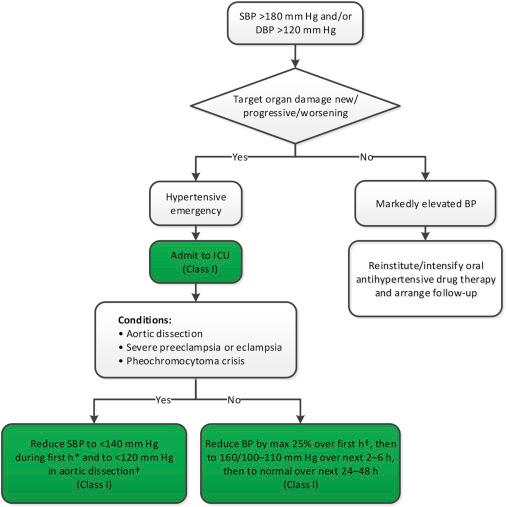
The following figure from the 2017 ACC/AHA guidelines illustrates the decision algorithm for managing hypertensive crises:
History
- Medication adherence: Nonadherence to prescribed antihypertensives is the most common precipitating factor — more than half of patients presenting with SBP ≥180 have already been prescribed ≥2 agents [3]
- Duration and chronicity of hypertension; baseline BP readings if available
- Timing of onset: sudden vs. gradual; any identifiable trigger (pain, anxiety, urinary retention, dietary indiscretion)
- Substance use: cocaine, amphetamines, sympathomimetics, NSAIDs, oral contraceptives, decongestants, high-dose glucocorticoids [3][5]
- Dietary sodium intake and recent changes
- Symptoms to characterize: headache, dizziness, epistaxis, anxiety — these are common but do NOT indicate end-organ damage [3]
- Important negatives: chest pain, dyspnea, focal neurologic deficits, visual changes, altered mental status, back/flank pain
Alarm Features (Ruling Out Hypertensive Emergency)
The BARKH mnemonic (Brain, Arteries, Retina, Kidney, Heart) helps identify target-organ damage: [2]
- Brain: encephalopathy (confusion, seizures, cortical blindness), focal neurologic deficits (stroke), severe headache with altered sensorium
- Arteries: tearing chest/back pain (aortic dissection), pulse differential between extremities
- Retina: papilledema, flame hemorrhages, cotton-wool spots
- Kidney: oliguria, hematuria, acute rise in creatinine
- Heart: acute pulmonary edema (dyspnea, orthopnea, crackles), chest pain with ischemic features (ACS)
- Any of these findings reclassifies the patient as hypertensive emergency requiring IV therapy and ICU admission [1][3]
Medications
Medications that can elevate BP: [3][5]
- NSAIDs (ibuprofen, naproxen, COX-2 inhibitors)
- Sympathomimetics/decongestants (pseudoephedrine)
- Oral contraceptives/estrogen
- Glucocorticoids
- Stimulants (amphetamines, methylphenidate)
- Illicit drugs (cocaine, methamphetamine)
- MAOIs (tyramine interaction)
- Erythropoietin, calcineurin inhibitors, VEGF inhibitors
- Tricyclic antidepressants, clozapine
Acute oral treatment options (if symptoms present but no end-organ damage): [3]
Contraindicated/avoid
- Sublingual nifedipine: unpredictable, excessive BP reduction with risk of cardiovascular events [3]
- IV hydralazine for urgency: unpredictable response, 18% risk of >80 mmHg SBP drop [3][6]
- IV medications in general are discouraged for hypertensive urgency [1][3]
Key pearl: Rapid-acting antihypertensives (oral clonidine, IV hydralazine, IV labetalol) produce excessive SBP reduction (>80 mmHg) in ~18–20% of patients and MAP reduction >25% in 38–46%, exceeding cerebral autoregulatory limits. [6] Long-acting oral agents (e.g., lisinopril, extended-release nifedipine) carry significantly lower risk of overshoot. [6]
Diet
- Sodium: Dietary sodium indiscretion is a common precipitant of acute severe hypertension [3]
- Counsel on DASH diet principles and sodium restriction (<2,300 mg/day, ideally <1,500 mg/day)
- Adequate hydration — volume depletion can worsen BP lability
- Avoid licorice (mineralocorticoid effect), excessive caffeine, and tyramine-rich foods if on MAOIs
Review of Systems
- Neuro: headache, visual changes, confusion, focal weakness/numbness, seizures
- Cardiac: chest pain, dyspnea, orthopnea, PND, palpitations, leg edema
- Vascular: tearing chest/back pain, claudication
- Renal: decreased urine output, hematuria, foamy urine
- Endocrine: episodic headache/sweating/palpitations (pheochromocytoma triad), weight gain, fatigue
- Psych: anxiety, panic symptoms
- ENT: epistaxis (common but not an end-organ damage marker)
Collateral History and Family History
- Confirm medication list and adherence from pharmacy records, family, or caregivers
- Family history of hypertension, early-onset CVD, stroke, renal disease
- Family history of pheochromocytoma/paraganglioma syndromes (MEN2, VHL, NF1) [7]
- Social context: access to medications, insurance status, health literacy — uninsured/underinsured patients are overrepresented [3]
Risk Factors
- Age >60 years [3]
- Black race (higher prevalence and severity) [3]
- Medication nonadherence — the single strongest predictor [3]
- Uninsured/underinsured status, lower-income areas [3]
- Obesity, sedentary lifestyle, insulin resistance [1]
- High sodium intake, low potassium intake [1]
- Obstructive sleep apnea [7]
- CKD, diabetes mellitus
- Alcohol overuse [1]
- Illicit drug use (cocaine, amphetamines) [3]
Differential Diagnosis
Cannot-miss diagnoses (i.e., hypertensive emergency masquerading as urgency):
- Acute aortic dissection — tearing pain, pulse differential, widened mediastinum
- Acute stroke (ischemic or hemorrhagic) — focal deficits, altered consciousness
- Hypertensive encephalopathy — confusion, seizures, papilledema
- Acute coronary syndrome — chest pain, ECG changes, troponin elevation
- Acute pulmonary edema/HF — dyspnea, crackles, B-lines on POCUS
- Eclampsia/preeclampsia — in pregnant or postpartum patients
- Pheochromocytoma crisis — paroxysmal HTN with headache, sweating, palpitations [1-2]
Mimics of hypertensive urgency
- Pain-driven hypertension (treat the pain)
- Anxiety/panic attack
- Medication withdrawal (clonidine, beta-blockers)
- White-coat effect
- Bladder distension/urinary retention
- Acute kidney injury from other causes
Past Medical History
- Prior hypertension diagnosis, duration, and baseline BP
- Previous hypertensive crises or ED visits for elevated BP
- History of CVD (MI, stroke, HF, PAD)
- CKD, diabetes, dyslipidemia
- Prior evaluation for secondary hypertension
- Surgical history (prior renal artery intervention, adrenalectomy, cardiac surgery)
- Pregnancy history (preeclampsia)
Physical Exam
Vital signs: Repeat BP in both arms using proper technique (seated, rested 5 min, correct cuff size); check for orthostasis [2]
Focused exam
- Fundoscopy: papilledema, hemorrhages, exudates (if present → emergency) [2]
- Neuro: mental status, cranial nerves, motor/sensory, gait — any focal deficit → emergency
- Cardiac: S3/S4 gallop, murmurs, JVD
- Lungs: crackles (pulmonary edema)
- Vascular: bilateral arm BPs, femoral pulses (coarctation), carotid/abdominal bruits (renovascular disease)
- Abdomen: renal bruits, pulsatile mass
Expected findings in urgency: Elevated BP with otherwise normal exam. BP often decreases with 30 minutes of quiet rest — in one study, ~1/3 of patients fell below 180/110 before any medication. [3]
Lab Studies
Recommended baseline workup: [2]
- BMP (creatinine, BUN, electrolytes — assess for AKI, hypokalemia suggesting hyperaldosteronism)
- CBC (microangiopathic hemolytic anemia in malignant HTN)
- Urinalysis (proteinuria, hematuria, casts)
- Troponin if chest pain or dyspnea present
Expected in urgency: Normal or at-baseline labs. Any acute abnormality (rising creatinine, elevated troponin, schistocytes) reclassifies as emergency.
Monitoring: Recheck creatinine and electrolytes at follow-up visit
Imaging
- Chest X-ray: Assess for cardiomegaly, pulmonary edema, widened mediastinum [2]
- CT angiography: Only if aortic dissection suspected (tearing pain, pulse differential)
- CT head: Only if neurologic symptoms present
- Renal ultrasound/Doppler: Consider outpatient if secondary hypertension suspected (renal artery stenosis, CKD)
- Imaging is generally unnecessary in asymptomatic hypertensive urgency without alarm features
Special Tests
- Point-of-care ultrasound (POCUS): Cardiac (LV function, pericardial effusion), lung (B-lines for pulmonary edema), IVC (volume status) — rapid bedside assessment to rule out emergency
- Fundoscopic exam: Critical for identifying malignant hypertension (papilledema, flame hemorrhages)
- Urine drug screen: If sympathomimetic use suspected
- Outpatient secondary HTN workup (if indicated): aldosterone/renin ratio, plasma/urine metanephrines, TSH, renal artery duplex, sleep study [1][7]
ECG
- Indications: Obtain in all patients with markedly elevated BP presenting to the ED [2]
- Expected findings: May show LVH (chronic hypertension), which is not acute end-organ damage
- Concerning patterns: ST-segment changes (ischemia/infarction), new T-wave inversions, arrhythmias, strain pattern with acute symptoms
- Normal ECG supports the diagnosis of urgency over emergency
Assessment
Clinical summary: Hypertensive urgency is a common, low-acuity presentation that is 2–3× more common than hypertensive emergency. [3] It is not associated with adverse short-term outcomes and can be managed in the ambulatory setting. [3]
Severity stratification
- Asymptomatic with SBP >180 → quiet rest, reassess, reinstitute/intensify oral meds
- Symptomatic (headache, epistaxis, anxiety) without end-organ damage → oral antihypertensive, observe, discharge with follow-up
- Any evidence of end-organ damage → reclassify as emergency
Complications to consider: While short-term risk is low, episodes of severe hypertension carry long-term cardiovascular implications and signal the need for improved chronic BP management. [3]
Treatment Plan
Initial management
- Quiet rest for 30 minutes with repeat BP — resolves ~1/3 of cases [3]
- Address precipitants: pain, anxiety, urinary retention, medication nonadherence
- Reinstitute or intensify oral antihypertensive medications — this is the guideline-recommended approach [1][3]
If symptomatic (headache, epistaxis) without end-organ damage:
- Oral captopril 25–50 mg, or oral labetalol 200–400 mg, or oral clonidine 0.1–0.2 mg [3]
- May repeat every 30 minutes until symptoms improve
- Prefer long-acting agents (lisinopril, amlodipine, extended-release nifedipine) to minimize overshoot risk [6]
What NOT to do
- Do not give IV antihypertensives for urgency [1]
- Do not use sublingual nifedipine [3]
- Do not target normalization of BP acutely — goal is symptom improvement and gradual reduction over days to weeks [1]
- Observational data show that initiation of as-needed IV or oral antihypertensives in hospitalized patients with asymptomatic severe HTN is associated with increased risk of AKI, in-hospital mortality, and prolonged stay [1]
Disposition
Discharge criteria (most patients)
- No evidence of target-organ damage on history, exam, and basic workup
- Symptoms improved (if present)
- BP trending down or stable (does not need to be "normal" — discharge is reasonable once below ~160–180/100–110 mm Hg) [3]
- Oral antihypertensive regimen prescribed or adjusted
- Follow-up arranged within 1–7 days [3]
Admission criteria
- Any evidence of new/worsening target-organ damage (→ hypertensive emergency)
- Inability to exclude end-organ damage
- Persistent symptoms despite treatment
- Unreliable follow-up or medication access
Specialist consultation triggers
- Suspected secondary hypertension (young patient, resistant HTN, hypokalemia)
- Suspected pheochromocytoma or renovascular disease
- Refractory BP despite multi-drug regimen
Follow Up / Return Precautions
Follow-up timing: Within 1–7 days with PCP or hypertension specialist [3]
Return precautions — instruct patients to return immediately for:
- Severe headache with confusion or vision changes
- Chest pain or shortness of breath
- Weakness or numbness on one side of the body
- Difficulty speaking
- Severe back or abdominal pain
Patient counseling
- Emphasize medication adherence as the single most important intervention [3]
- Discuss sodium restriction, weight management, alcohol moderation
- Home BP monitoring with a validated device
- Expected recovery: BP should be gradually controlled over days to weeks, not hours
Long-term considerations: Patients without a clear precipitant or with treatment-resistant hypertension should be evaluated for secondary causes (primary aldosteronism, renovascular disease, pheochromocytoma, OSA). [1][7]
References
1. 2025 AHA/ACC/AANP/AAPA/ABC/ACCP/ACPM/AGS/AMA/ASPC/NMA/PCNA/SGIM Guideline for the Prevention, Detection, Evaluation, and Management of High Blood Pressure in Adults: A Report of the American College of Cardiology/American Heart Association Joint Committee on Clinical Practice Guidelines. — Jones DW, Ferdinand KC, Taler SJ, et al. Journal of the American College of Cardiology. 2025.
2. The Management of Elevated Blood Pressure in the Acute Care Setting: A Scientific Statement From the American Heart Association. — Bress AP, Anderson TS, Flack JM, et al. Hypertension. 2024.
3. Acute Severe Hypertension. — Peixoto AJ. The New England Journal of Medicine. 2019.
4. 2017 ACC/AHA/AAPA/ABC/ACPM/AGS/APhA/ASH/ASPC/NMA/PCNA Guideline for the Prevention, Detection, Evaluation, and Management of High Blood Pressure in Adults: A Report of the American College of Cardiology/American Heart Association Task Force on Clinical Practice Guidelines. — Whelton PK, Carey RM, Aronow WS, et al. Journal of the American College of Cardiology. 2018.
5. Arterial Hypertension. — Brouwers S, Sudano I, Kokubo Y, Sulaica EM. Lancet. 2021.
6. Acute Blood Pressure Reduction Exceeding Safety and Autoregulatory Limits Following Rapid-Acting Antihypertensives for Hypertensive Urgency. — Preston RA, Caizapanta EV, Afshartous D, et al. Journal of Hypertension. 2026.
7. Diagnosis and Management of Resistant Hypertension. — Azizi M, Vongpatanasin W, Fisher NDL, et al. The Journal of the American Medical Association. 2026.
Figure
More from Deep Dive
Reviewed by Dr. Lucas Mastropaolo. SymptomDx is an educational tool for medical professionals — it does not replace clinical judgment. Verify all clinical data and drug dosages with authoritative sources.