Lightning Strike Injury
Lightning strike is a high-energy environmental injury with a mortality rate up to 30% and significant morbidity in up to 70% of survivors. [1-2] The primary cause of death is simultaneous cardiac and respiratory arrest. [3] Approximately 100 deaths and 400 injuries occur annually in the United States, predominantly in young, active individuals during outdoor activities between May and September. [4] Mechanisms include direct strike, side splash, contact injury, ground current, and upward streamer.
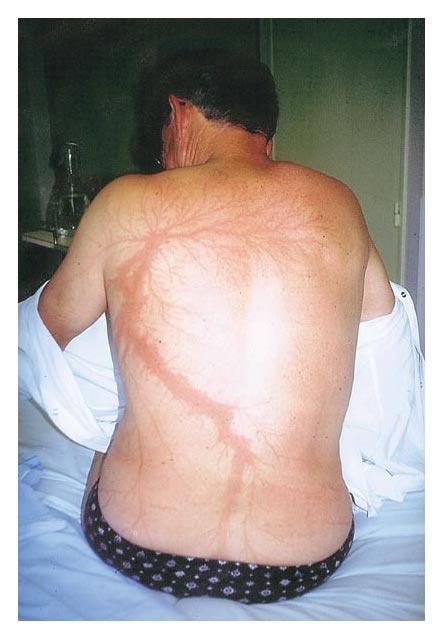
The following figure demonstrates the pathognomonic Lichtenberg figures — transient, fern-like cutaneous markings that are diagnostic of lightning strike and resolve within 24 hours. [3]
History
- Mechanism: Direct strike, side splash (current jumps from nearby object), contact (touching struck object), ground current (most common), or upward streamer
- Setting: Outdoor activity during thunderstorm — hiking, sports, farming, fishing, golf; also telephone use during storms [6]
- Loss of consciousness: Duration and whether witnessed; retrograde amnesia is extremely common [2][7]
- Symptoms to characterize: Confusion, amnesia, headache, chest pain, palpitations, dyspnea, vision or hearing changes, tinnitus, extremity weakness/numbness, pain
- Timing: Immediate vs. delayed symptom onset (delayed cardiac and neurologic effects reported up to 3 days) [3][8]
- Important negatives: No loss of consciousness, no chest pain, no syncope, no weakness, no visual changes
Alarm Features
- Cardiac arrest (asystole or VF) — the leading cause of immediate death [3]
- Respiratory arrest persisting after ROSC (medullary paralysis outlasts cardiac automaticity recovery → secondary arrest if ventilation not supported) [3]
- Loss of consciousness or persistent altered mental status [3]
- Cranial burns — predict 3-fold increase in mortality and 2x risk of cardiac arrest [3]
- Direct strike to the head — higher fatality rate [3]
- Focal neurologic deficits — may indicate intracranial hemorrhage (basal ganglia, brainstem) [3]
- Hemodynamic instability, cardiogenic shock [3][9]
- Tympanic membrane rupture with hearing loss [10]
- Rhabdomyolysis with risk of acute renal failure [11]
Medications
- Resuscitation: Standard ACLS pharmacotherapy (epinephrine, amiodarone for refractory VF/VT) [3][12]
- Amiodarone: Used successfully for lightning-induced atrial fibrillation with ventricular tachycardia [8]
- Tetanus prophylaxis: Administer per standard burn/wound protocol [7]
- Analgesics: Appropriate pain management for burns and musculoskeletal injuries
- Antibiotics: For contaminated wounds or burns as indicated [7]
- No specific antidote or targeted pharmacotherapy exists for lightning injury; treatment is supportive [2]
- Caution: Avoid medications that prolong QT interval given the risk of QT prolongation from the strike itself [3][13]
Diet
- No specific dietary triggers or recommendations unique to lightning injury
- Hydration: Aggressive IV fluid resuscitation is critical, particularly if rhabdomyolysis is present (target urine output 1–2 mL/kg/hr)
- Monitor and correct electrolyte abnormalities — hypokalemia and hypocalcemia are common [10]
Review of Systems
- Cardiovascular: Chest pain, palpitations, dyspnea, syncope
- Neurologic: Headache, confusion, amnesia, seizures, weakness, numbness, paresthesias, gait instability
- Ophthalmologic: Vision changes, photophobia, eye pain (cataracts may develop days to years later) [3]
- Otologic: Hearing loss, tinnitus, vertigo, ear pain (tympanic membrane perforation) [10]
- Psychiatric: Anxiety, sleep disturbance, emotional lability, depression, PTSD symptoms [3]
- Musculoskeletal: Myalgias, back pain (from fall/blast), dark urine (myoglobinuria)
- Dermatologic: Burns, skin markings, clothing damage
Collateral History and Family History
- Witnesses: Critical for establishing mechanism (direct vs. splash vs. ground current), duration of unresponsiveness, bystander CPR provided
- Scene details: Indoor vs. outdoor, proximity to struck object, water exposure, metal objects worn
- Multiple casualties: Lightning can injure multiple people simultaneously — apply reverse triage (prioritize those who appear dead, as they have the best chance of survival with resuscitation) [1][12]
- Family history: Generally not relevant to acute management; however, pre-existing cardiac conditions (long QT syndrome, Brugada) may complicate interpretation of post-strike ECG
Risk Factors
- Outdoor activities during thunderstorms (sports, farming, hiking, fishing, construction) [4]
- Geographic: Open fields, elevated terrain, near tall isolated objects (trees)
- Temporal: May–September; 10 AM–7 PM peak [4]
- Male sex (approximately 2:1 male predominance) [7]
- Young age — most victims are young, active individuals [7]
- Occupational: Outdoor workers (agriculture, construction, military)
- Proximity to metal objects or telephone/landline use during storms [6][14]
Differential Diagnosis
- High-voltage electrical injury: Longer contact time, deeper tissue destruction, higher amputation rate — distinct from lightning's brief, flashover mechanism [2]
- Cardiac arrest from other causes: Must consider primary cardiac event (MI, arrhythmia) if lightning strike is unwitnessed
- Stroke/intracranial hemorrhage: If found with focal deficits and no clear history of strike
- Seizure disorder: Post-ictal confusion may mimic lightning injury presentation
- Blast injury (explosion): Similar mechanism of barotrauma, TM perforation, pulmonary contusion
- Heat stroke: Outdoor setting, altered mental status — but no burns or Lichtenberg figures
- Assault/trauma: Unwitnessed event with burns and altered mental status
Past Medical History
- Pre-existing cardiac disease: Arrhythmia history, structural heart disease, pacemaker/ICD (device may be damaged by strike)
- Seizure disorder: May confound neurologic assessment
- Psychiatric history: Baseline for comparison given high rates of post-strike neuropsychiatric sequelae [3][15]
- Prior lightning or electrical injury: Increases index of suspicion for cumulative neurologic damage
Physical Exam
- Vital signs: Labile blood pressures and autonomic instability are common; tachycardia or bradycardia; hypothermia possible [3]
- Skin:
- Lichtenberg figures — pathognomonic fern-like, branching erythematous pattern; appears within 1 hour, resolves <24 hours; not a true burn [3]
- Linear burns — partial-thickness along sweat lines (axillae, inframammary folds) [3]
- Punctate burns — clustered small full-thickness burns, especially at toes ("tip-toe sign") [3]
- Contact burns — from heated metal objects (belt buckles, jewelry, zippers) [3]
- Singed body hair — pathognomonic finding, more common than Lichtenberg figures [16]
- Neurologic: GCS, pupil reactivity (fixed dilated pupils may be transient and NOT a reliable sign of death in lightning), motor/sensory exam, cerebellar testing
- HEENT: Otoscopy for TM perforation; fundoscopy for retinal injury; visual acuity
- Cardiovascular: Heart sounds, peripheral pulses (vasospasm may cause transient pulselessness)
- Musculoskeletal: Assess for fractures from fall/blast/muscular contraction; compartment syndrome
- Spine: Full spinal immobilization until cleared — blunt trauma from blast effect is common [12][17]
Lab Studies
- CBC, BMP (electrolytes — watch for hypokalemia, hypocalcemia) [10]
- Troponin (serial) — may be elevated with myocardial injury; however, troponin has limited predictive value for arrhythmia risk stratification [18-19]
- CK / CK-MB — assess for rhabdomyolysis and myocardial injury [13]
- Urinalysis — myoglobinuria (dark/tea-colored urine)
- Lactate — elevated lactate is an independent risk factor for arrhythmia [19]
- Coagulation studies — if concern for DIC or significant trauma
- ABG/VBG — if respiratory compromise
- Renal function — monitor for acute kidney injury from rhabdomyolysis [11]
Imaging
- CT head without contrast: Indicated for all patients with loss of consciousness or persistently abnormal neurologic exam — rule out intracranial hemorrhage (basal ganglia, brainstem predilection) [3]
- CT C-spine: If blunt trauma mechanism or unable to clinically clear
- Chest X-ray: Evaluate for pulmonary contusion, pneumothorax, rib fractures from blast effect [10]
- Echocardiography: If hemodynamically unstable, elevated troponin, or ECG abnormalities — assess for wall motion abnormalities, pericardial effusion, Takotsubo cardiomyopathy [9][13]
- Coronary angiography: ST elevation may be present but coronary arteries are often normal — clinical judgment required [3]
- Imaging is unnecessary for asymptomatic patients with normal exam and normal ECG
Special Tests
- Continuous cardiac monitoring: Minimum 24 hours for symptomatic patients, those with abnormal ECG, loss of consciousness, or direct strike [3][20-21]
- Formal audiometry: If hearing loss or tympanic membrane perforation
- Ophthalmology consultation with slit-lamp exam: For all high-risk strikes and any visual complaints — cataracts may develop 2 days to 4 years post-injury [3]
- Compartment pressure measurement: If clinical concern for compartment syndrome (tense extremity, pain with passive stretch)
- Neuropsychological testing: Consider in follow-up for cognitive complaints [3]
ECG
- Obtain 12-lead ECG on all lightning strike patients [1][3]
- Expected findings:
- Dangerous patterns:
- Most ECG changes resolve within 3 days, but delayed-onset arrhythmias have been reported [3][8]
Assessment
Lightning strike is a multisystem injury with primary lethality from simultaneous cardiac and respiratory arrest. [3] Key clinical pearls:
- Reverse triage: In mass casualty lightning events, prioritize patients who appear dead — cardiac automaticity often recovers but respiratory arrest persists, so early ventilation can prevent secondary arrest [1][3][12]
- Burns are typically superficial and less severe than high-voltage electrical injuries; deep tissue destruction and amputations are rare [2-3]
- Victims do NOT carry residual charge — safe to touch and resuscitate immediately [3]
- Fixed dilated pupils are NOT a reliable sign of death — may be transient from autonomic dysfunction; do not use to withhold resuscitation [12]
- Severity stratification: Direct strikes carry highest mortality; ground current injuries are most common but least severe [3]
- Complications to anticipate: Delayed arrhythmias (up to 3 days), delayed cataracts (days to years), progressive myelopathy (weeks to months), neuropsychiatric dysfunction (days to weeks) [3]
Treatment Plan
Initial Stabilization
- Airway/Breathing: Prioritize ventilatory support — respiratory arrest outlasts cardiac arrest; failure to ventilate causes secondary cardiac arrest [3]
- Circulation: Standard ACLS for cardiac arrest; aggressive and prolonged resuscitation is warranted given the young age and absence of underlying cardiac disease in most victims — survival with intact neurologic function is well-documented even after prolonged arrest [3][12][23]
- C-spine immobilization: Assume spinal injury until cleared [12]
- IV fluid resuscitation: Aggressive crystalloid if rhabdomyolysis suspected; target UOP 1–2 mL/kg/hr [7]
Cardiac
- Continuous telemetry monitoring for minimum 24 hours in symptomatic patients [3][20]
- Treat arrhythmias per standard ACLS protocols; amiodarone for VT/AF [8]
- Most cardiac dysfunction (including severe cardiomyopathy/Takotsubo) is reversible within 72 hours [9][13]
Burns
- Superficial burns: Standard wound care; most heal without grafting [3]
- Full-thickness burns (uncommon): Burn surgery consultation; only ~10% require skin grafting [3]
- Tetanus prophylaxis [7]
Neurologic
- CT head for LOC or abnormal neuro exam [3]
- Supportive care; neurorehabilitation for permanent deficits [3]
- Neurology referral for delayed-onset symptoms (progressive myelopathy, neuropathy) [3]
Ophthalmologic
Disposition
Admission Criteria
- Cardiac arrest or any arrhythmia
- Loss of consciousness or persistent altered mental status
- Abnormal ECG
- Significant burns (>20% TBSA or full-thickness)
- Elevated troponin or CK suggesting myocardial injury/rhabdomyolysis
- Hemodynamic instability or autonomic dysfunction
- Neurologic deficits
- Direct strike mechanism [1][3]
ICU Admission
- Post-cardiac arrest
- Cardiogenic shock / hemodynamic instability
- Intracranial hemorrhage
- Respiratory failure
- Severe rhabdomyolysis with AKI
Discharge Criteria
Specialist Consultation Triggers
- Cardiology: Persistent arrhythmia, cardiomyopathy, elevated troponin
- Neurology: Focal deficits, seizures, delayed neurologic symptoms
- Ophthalmology: Any visual complaints or high-risk strike
- Burns/Trauma surgery: Significant burns, compartment syndrome
- Psychiatry: Acute behavioral disturbance or PTSD symptoms
Follow-Up / Return Precautions
- Follow-up timing: PCP within 1–2 weeks; ophthalmology within 1–2 weeks for high-risk patients; cardiology and neurology as indicated
- Delayed cataracts: May develop 2 days to 4 years post-injury — counsel patients to report any vision changes [3]
- Delayed neurologic syndromes: Progressive myelopathy (weakness, sensory loss) can develop weeks to months later; delayed onset of epilepsy, neuropathy possible up to 5 years [3][24]
- Neuropsychiatric sequelae: Depression, insomnia (68%), anxiety (62%), PTSD (33%), memory/concentration deficits — typically develop days to weeks post-injury [3][15]
- Autonomic instability: Labile blood pressures may persist weeks to months [3]
- Chronic pain: Most common long-term complication in some series [7]
- Return precautions: Seek immediate care for chest pain, palpitations, syncope, new weakness/numbness, vision changes, seizures, severe headache, dark urine, or worsening confusion
- Support resources: Lightning Strike and Electric Shock Survivors International (www.lightning-strike.org) [3]
- Expected recovery: Death is rare if the patient survives the initial strike; most cardiac dysfunction resolves within 72 hours; burns typically heal well; however, neuropsychiatric morbidity can be substantial and prolonged [3][13][15]
References
1. A Shocking Injury: A Clinical Review of Lightning Injuries Highlighting Pitfalls and a Treatment Protocol. — van Ruler R, Eikendal T, Kooij FO, Tan ECTH. Injury. 2022.
2. Emergent Care of Lightning and Electrical Injuries. — Cooper MA. Seminars in Neurology. 1995.
3. Wilderness Medical Society Practice Guidelines for the Prevention and Treatment of Lightning Injuries: 2014 Update. — Davis C, Engeln A, Johnson EL, et al. Wilderness & Environmental Medicine. 2014.
4. National Athletic Trainers' Association Position Statement: Lightning Safety for Athletics and Recreation. — Walsh KM, Bennett B, Cooper MA, et al. Journal of Athletic Training. 2000.
5. Lichtenberg Figures Due to a Lightning Strike. — Domart Y, Garet E. The New England Journal of Medicine. 2000.
6. Lichtenberg Figures: Cutaneous Manifestation of Phone Electrocution From Lightning. — Mahajan AL, Rajan R, Regan PJ. Journal of Plastic, Reconstructive & Aesthetic Surgery : JPRAS. 2007.
7. Epidemiology, Morbidity, Mortality and Treatment of Lightning Injuries in a Turkish Burns Units. — Aslar AK, Soran A, Yildiz Y, Isik Y. International Journal of Clinical Practice. 2001.
8. Delayed Onset of Atrial Fibrillation and Ventricular Tachycardia After an Automobile Lightning Strike. — Drigalla D, Essler SE, Stone CK. The Journal of Emergency Medicine. 2017.
9. Takotsubo Cardiomyopathy Following Lightning Strike. — Dundon BK, Puri R, Leong DP, Worthley MI. Emergency Medicine Journal : EMJ. 2008.
10. Six Cases of Collective Lightning-Induced Arc Explosion Injuries: A Case Report. — Xiao H, Qiu Y, Li Y, Wang W, Li CQ. The American Journal of Emergency Medicine. 2025.
11. Acute Polyneuropathy Due to Lightning Injury. — Hawkes CH, Thorpe JW. Journal of Neurology, Neurosurgery, and Psychiatry. 1992.
12. Electrical Shock and Lightning Strike. — Fontanarosa PB. Annals of Emergency Medicine. 1993.
13. Cardiovascular Effects of Lightning Strikes. — Lichtenberg R, Dries D, Ward K, Marshall W, Scanlon P. Journal of the American College of Cardiology. 1993.
14. Telephone-Related Lightning Injury. — Johnstone BR, Harding DL, Hocking B. The Medical Journal of Australia. 1986.
15. Acute and Long-Term Clinical, Neuropsychological and Return-to-Work Sequelae Following Electrical Injury: A Retrospective Cohort Study. — Radulovic N, Mason SA, Rehou S, Godleski M, Jeschke MG. BMJ Open. 2019.
16. A 15-Year Review of Lightning Deaths in Germany-With a Focus on Pathognomonic Findings. — Bingert R, Bremer L, Büttner A, et al. International Journal of Legal Medicine. 2024.
17. Lightning Injuries. — Whitcomb D, Martinez JA, Daberkow D. Southern Medical Journal. 2002.
18. Arrhythmias and Laboratory Abnormalities After an Electrical Accident: A Single-Center, Retrospective Study of 333 Cases. — Seyfrydova M, Rokyta R, Rajdl D, Huml M. Clinical Research in Cardiology : Official Journal of the German Cardiac Society. 2023.
19. Prevalence and Risk Factors of Developing Cardiac Arrhythmia in Patients Presenting to the Emergency Department With Electrical Injuries. — Yazıcı R, Bulut B, Genç M, et al. PloS One. 2025.
20. Electrical Cardiac Injuries: Current Concepts and Management. — Waldmann V, Narayanan K, Combes N, et al. European Heart Journal. 2018.
21. Neurologic, Psychiatric, and Cardiovascular Complications in Children Struck by Lightning. — Kotagal S, Rawlings CA, Chen SC, Burris G, Npuriouri S. Pediatrics. 1982.
22. Risk of Cardiac Arrhythmias After Electrical Accident: A Single-Center Study of 480 Patients. — Pilecky D, Vamos M, Bogyi P, et al. Clinical Research in Cardiology : Official Journal of the German Cardiac Society. 2019.
23. Cardiac Arrest Secondary to Lightning Strike: Case Report and Review of the Literature. — Rotariu EL, Manole MD. Pediatric Emergency Care. 2020.
24. Neurological Symptoms and Disorders Following Electrical Injury: A Register-Based Matched Cohort Study. — Nielsen KJ, Carstensen O, Kærgaard A, Vestergaard JM, Biering K. PloS One. 2022.
Figure
More from Deep Dive
Reviewed by Dr. Lucas Mastropaolo. SymptomDx is an educational tool for medical professionals — it does not replace clinical judgment. Verify all clinical data and drug dosages with authoritative sources.