Malaria
Malaria is a potentially fatal parasitic disease caused by Plasmodium species, transmitted by the Anopheles mosquito. It is a medical emergency — clinical deterioration or death can occur within 24–36 hours in a non-immune patient. [1-2] Approximately 2,000 cases are diagnosed annually in the US, predominantly in returning travelers. [1]
History
- Travel history is the single most critical HPI element — destination, dates, duration, rural vs. urban exposure, and time since return [1-2]
- Chemoprophylaxis use: agent, adherence, timing of discontinuation
- Symptom onset relative to return: P. falciparum typically presents within 4 weeks; P. vivax/ovale can present months to >1 year later [1][3]
- Symptom characterization: fever (often paroxysmal), chills/rigors, headache, myalgias, malaise, nausea/vomiting, diarrhea, abdominal pain, cough, fatigue [1][4]
- Classic cyclical fevers (q48h for P. falciparum/vivax/ovale, q72h for P. malariae) are highly variable and should not be relied upon for diagnosis [2-3]
- Important negatives: rash (uncommon), neck stiffness (suggests meningitis), hemorrhage (suggests viral hemorrhagic fever) [2]
- Prior malaria episodes, blood transfusion history, organ transplant history [3]
Alarm Features
- Altered mental status / impaired consciousness (GCS <11) — cerebral malaria carries ~40% case fatality [3]
- Seizures (>2 in 24 hours)
- Respiratory distress (SpO₂ <92%, RR >30, labored breathing) — suggests acidosis or pulmonary edema [4]
- Prostration (unable to sit/stand/walk)
- Shock (capillary refill ≥3 sec, SBP <80 mmHg in adults, <70 mmHg in children) [4]
- Hypoglycemia (glucose <40 mg/dL)
- Significant bleeding (hematemesis, melena, mucosal bleeding)
- Jaundice with high parasitemia
- Parasitemia ≥2% in non-immune travelers or ≥5% by any measure defines severe disease [2][4]
- Inability to tolerate oral medications [4]
Medications
Uncomplicated malaria (chloroquine-resistant or unknown)
- Artemether-lumefantrine (Coartem) — first-line ACT; administer with fatty food; safe in all trimesters of pregnancy [4-5]
- Atovaquone-proguanil (Malarone) — alternative; contraindicated in pregnancy and infants <5 kg [5]
- Quinine + doxycycline/tetracycline/clindamycin — 7-day regimen [5]
Uncomplicated malaria (chloroquine-sensitive)
- Chloroquine phosphate[5]
Severe malaria
- IV artesunate — 2.4 mg/kg at 0, 12, and 24 hours, then q24h; for patients <20 kg use 3.0 mg/kg [1][4]
- Transition to oral ACT once parasitemia ≤1% and patient tolerates PO (minimum 24h IV) [4]
- If artesunate unavailable: IM artemether or IV quinine [4]
Relapse prevention (P. vivax/P. ovale)
- Primaquinetafenoquinemust check G6PD[5-6]
Medications to avoid
- Do not treat with the same agent used for prophylaxis [2]
- IV quinidine is no longer available in the US [1]
Key caution: Post-artemisinin delayed hemolysis can occur 1–3 weeks after IV artesunate (4.8% of US patients) — monitor hemoglobin, LDH, and haptoglobin for 4 weeks. [1]
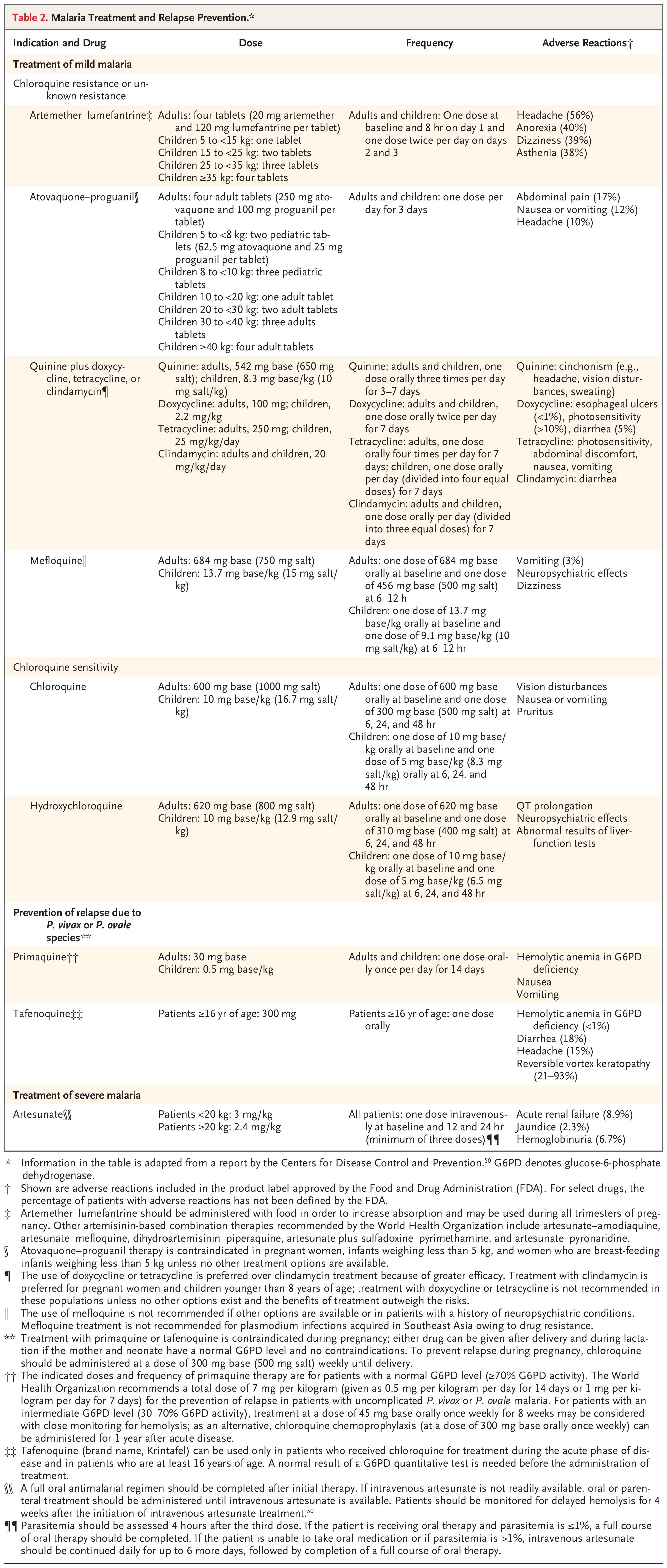
The following table from the 2025 NEJM review summarizes treatment regimens:
Diet
- Administer artemether-lumefantrine with fatty food or milk to optimize absorption — this is clinically significant and affects drug levels [4]
- Maintain adequate hydration, especially in febrile patients
- Monitor and correct hypoglycemia aggressively (glucose <40 mg/dL defines severe malaria) — quinine and severe malaria itself both cause hypoglycemia [4]
Review of Systems
- Neuro: headache, confusion, altered mentation, seizures, visual changes
- GI: nausea, vomiting, diarrhea, abdominal pain (can mimic gastroenteritis)
- Pulmonary: cough, dyspnea, chest tightness (ARDS can develop, often after treatment initiation) [4]
- Heme: pallor, easy bruising, dark urine (blackwater fever)
- MSK: myalgias, arthralgias
- GU: decreased urine output (AKI)
- OB: pregnancy status — pregnant women are at increased risk for hypoglycemia, severe anemia, and placental malaria [3-4]
Collateral History and Family History
- Confirm travel itinerary with companions; patients may underreport rural or nighttime mosquito exposure
- Immigration history — patients from endemic regions who have been in the US may have lost partial immunity (typically within ~6 months) [1][3]
- Blood transfusion or organ transplant history (rare non-mosquito transmission)
- Heritable protective factors: sickle cell trait (HbAS) provides 85–90% protection against severe P. falciparum; G6PD deficiency may confer some protection but is critical to identify before primaquine/tafenoquine use [4]
- Duffy-negative blood type (common in sub-Saharan Africans) provides near-total protection against P. vivax [4]
Risk Factors
- Travel to sub-Saharan Africa (highest risk; most P. falciparum) or South/Southeast Asia, Central/South America [1]
- Non-immune travelers (no prior malaria exposure)
- Visiting friends and relatives (VFR travelers) — often do not take prophylaxis
- Non-adherence or suboptimal chemoprophylaxis
- Pregnancy (especially primigravidas) [3]
- HIV/immunosuppression — increases parasitemia and severity [4]
- Children <5 years in endemic areas
- Splenectomy or functional asplenia
- Iron-replete status (iron deficiency is paradoxically protective) [4]
Differential Diagnosis
Past Medical History
- Prior malaria episodes (species, treatment, complications)
- Splenectomy — increased risk of severe parasitemia
- Sickle cell disease/trait — protective but important for management
- G6PD status — must be known before prescribing primaquine or tafenoquine [6]
- HIV status — affects immunity and drug interactions
- Pregnancy — alters treatment selection and risk profile [4]
- Chronic kidney or liver disease — affects drug dosing and severity assessment
- Prior chemoprophylaxis regimen and adherence
Physical Exam
- Vitals: Fever (often >39°C, may be absent between paroxysms), tachycardia, hypotension (severe), tachypnea
- General: Diaphoresis, rigors, prostration, pallor, jaundice [8]
- HEENT: Scleral icterus, pallor of conjunctivae
- Lungs: Crackles/crepitations (pulmonary edema, ARDS); deep labored breathing (Kussmaul — acidosis) [4]
- Abdomen: Hepatomegaly, splenomegaly (tender), RUQ tenderness [8]
- Neuro: GCS assessment, meningismus (absent in malaria — if present, consider meningitis), seizure activity, abnormal posturing [4]
- Skin: Petechiae (DIC), no rash expected (rash suggests alternative diagnosis)
- Extremities: Capillary refill (≥3 sec = compensated shock), cool peripheries [4]
Lab Studies
- Thick and thin blood smears (Giemsa-stained) — gold standard; species identification and parasitemia quantification [2][5]
- Rapid diagnostic test (BinaxNOW) — results in 2–15 minutes; sensitivity 99.7% for P. falciparum at >5,000 parasites/µL; less sensitive for non-falciparum species [1]
- Must be confirmed by microscopy[9]
- CBC: Anemia, thrombocytopenia (common and helps differentiate from viral illness), leukocytosis or leukopenia [5]
- CMP: Creatinine (AKI if >3 mg/dL), glucose (hypoglycemia <40 mg/dL), bilirubin (>3 mg/dL in severe), transaminases (elevated AST/ALT) [4-5]
- Lactate: ≥5 mmol/L defines severe disease [1]
- Coagulation studies: PT/INR, fibrinogen (DIC screen)
- LDH, haptoglobin, reticulocyte count — hemolysis markers
- Blood gas: Base deficit >8 mEq/L or bicarbonate <15 mmol/L = severe acidosis [4]
- G6PD level — before prescribing primaquine/tafenoquine [6]
- Type and screen — anticipate transfusion needs
- Blood cultures — to rule out concurrent bacteremia
Imaging
- Chest X-ray: Indicated if respiratory symptoms, SpO₂ <92%, or suspected ARDS/pulmonary edema [4]
- CT head: If altered mental status to rule out other intracranial pathology; cerebral malaria is a clinical diagnosis
- Routine imaging is not required for uncomplicated malaria
- Abdominal ultrasound: May show hepatosplenomegaly; consider if concern for splenic rupture
Special Tests
- PCR (nucleic acid testing): More sensitive than microscopy; useful for species confirmation and detecting mixed infections; results not immediately available — not for initial clinical decision-making [5][9]
- Point-of-care glucose: Check immediately and serially — hypoglycemia is both a complication and a treatment side effect (quinine) [4]
- Point-of-care lactate: Rapid severity assessment
- CDC Malaria Hotline (770-488-7788, after hours 770-488-7100): Available 24/7 for diagnostic and treatment guidance [2][9]
- CDC telediagnosis service: Assists with blood smear interpretation remotely [9]
ECG
- Obtain ECG if using quinine (QT prolongation risk), hydroxychloroquine (QT prolongation), or mefloquine (neuropsychiatric effects) [5]
- Monitor for QTc prolongation — particularly with quinine and chloroquine
- Assess for arrhythmias in severe malaria with acidosis, electrolyte derangements, or shock
Assessment
Severity stratification is the most critical assessment step and determines treatment pathway:
- Uncomplicated malaria: Symptomatic parasitemia without WHO severe criteria; can tolerate oral medications [1]
- Severe malaria (any one criterion): GCS <11, seizures, parasitemia ≥5% (or ≥2% in non-immune), AKI (Cr >3 mg/dL), hypoglycemia (<40 mg/dL), ARDS, shock, severe anemia (Hgb <7 in adults), acidosis (lactate ≥5, bicarb <15), jaundice with high parasitemia, DIC, prostration, inability to take PO [2][4]
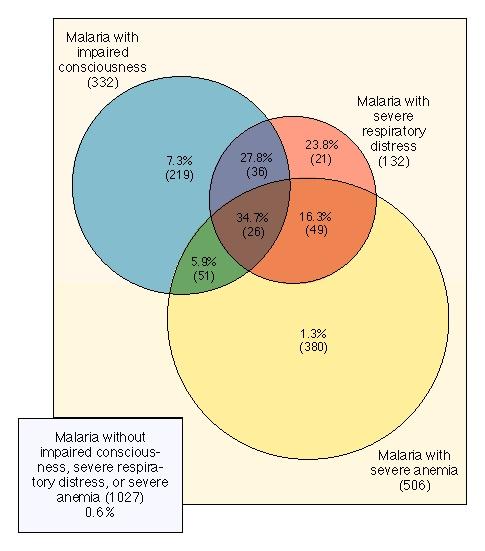
The presence of multiple complications dramatically increases mortality — from ~6% with one complication to ~43% with multiple. [4] Impaired consciousness and respiratory distress are the strongest predictors of death. [10]
Treatment Plan
Initial stabilization (severe malaria)
- ABCs, IV access, continuous monitoring
- IV artesunate 2.4 mg/kg at 0, 12, and 24 hours (minimum 3 doses), then q24h until PO tolerated and parasitemia ≤1% [1][4]
- Aggressive glucose monitoring and correction (D50 bolus PRN)
- IV fluids — use judiciously; avoid fluid overload (ARDS risk) [2]
- Blood transfusion for severe anemia (Hgb <5 g/dL in children, <7 g/dL in adults)
- Antipyretics (acetaminophen)
- Transition to full oral ACT course once criteria met [4]
Uncomplicated malaria
- Artemether-lumefantrine (with fatty food): 4 tablets BID × 3 days (adults) — first two doses 8 hours apart [4-5]
- OR Atovaquone-proguanil: 4 adult tablets daily × 3 days [5]
- OR Chloroquine (if chloroquine-sensitive species) [4]
Radical cure (P. vivax/P. ovale)
Consult infectious disease and contact the CDC Malaria Hotline for all confirmed cases. [2][9]
Disposition
Admit (ICU for severe)
- Any WHO severe malaria criteria [2]
- P. falciparum with parasitemia ≥2% in non-immune patients [4]
- Inability to tolerate oral medications
- Pregnant patients [2]
- Immunocompromised patients (HIV, asplenic) [2]
- Children and patients with no prior malarial immunity [2]
- Uncertain species identification with clinical concern
Outpatient treatment may be considered if
- Confirmed uncomplicated malaria with no severe criteria
- Able to tolerate oral medications
- Reliable follow-up ensured
- Non-P. falciparum species with low parasitemia [2]
Most patients will require admission for treatment initiation and monitoring. [8]
Follow Up / Return Precautions
- Post-treatment blood smears q12–24h until parasitemia clears (two consecutive negative smears) [1]
- Monitor for post-artemisinin delayed hemolysis for 4 weeks after IV artesunate — check CBC, LDH, haptoglobin at 1, 2, 3, and 4 weeks [1]
- P. vivax/P. ovale: Counsel on relapse risk if radical cure not completed; relapses can occur months later [3]
- Report all cases to the state health department [1][9]
Return precautions (patient counseling)
- Return immediately for recurrent fever, dark urine, jaundice, confusion, shortness of breath, or inability to keep medications down
- Complete the full course of antimalarials even if feeling better
- Fever after travel to an endemic area — even months later — warrants repeat evaluation [9]
- Expected recovery: uncomplicated malaria typically improves within 48–72 hours of appropriate treatment; fatigue may persist for weeks
References
1. Diagnosis, Treatment, and Prevention of Malaria in the US: A Review. — Daily JP, Minuti A, Khan N. The Journal of the American Medical Association. 2022.
2. Malaria: Prevention, Diagnosis, and Treatment. — Shahbodaghi SD, Rathjen NA. American Family Physician. 2022.
3. Guidelines for the Prevention and Treatment of Opportunistic Infections in Adults and Adolescents With HIV. — Constance Benson, John Brooks, Shireesha Dhanireddy, et al Infectious Diseases Society of America; Office of AIDS Research Advisory Council (2025). 2025.
4. Malaria. — Poespoprodjo JR, Douglas NM, Ansong D, Kho S, Anstey NM. Lancet. 2023.
5. Malaria. — Daily JP, Parikh S. The New England Journal of Medicine. 2025.
6. Guidelines for the Prevention and Treatment of Opportunistic Infections in Children With and Exposed to HIV. — Bill G. Kapogiannis, Franklin Yates, Wei Li, et al Office of AIDS Research Advisory Council (2025). 2025.
7. Case 4-2024: A 39-Year-Old Man with Fever and Headache after International Travel. — Ryan ET, Succi MD, Paras ML, Klontz EH. The New England Journal of Medicine. 2024.
8. Malaria: A Focused Review for the Emergency Medicine Clinician. — Long B, MacDonald A, Liang SY, et al. The American Journal of Emergency Medicine. 2024.
9. Malaria. — Alison D. Ridpath and Erika Wallender CDC Yellow Book. 2025.
10. Indicators of Life-Threatening Malaria in African Children. — Marsh K, Forster D, Waruiru C, et al. The New England Journal of Medicine. 1995.
Figures
More from Deep Dive
Reviewed by Dr. Lucas Mastropaolo. SymptomDx is an educational tool for medical professionals — it does not replace clinical judgment. Verify all clinical data and drug dosages with authoritative sources.