Marburg Virus Disease
Marburg Virus Disease is a highly lethal viral hemorrhagic fever with case fatality rates ranging from 24-90% (average 50-60%) caused by the Marburg virus, a filovirus in the same family as Ebola virus. [1-3] The disease is characterized by rapid progression from nonspecific febrile illness to multiorgan failure and has significant potential for nosocomial transmission, particularly affecting healthcare workers. [2]
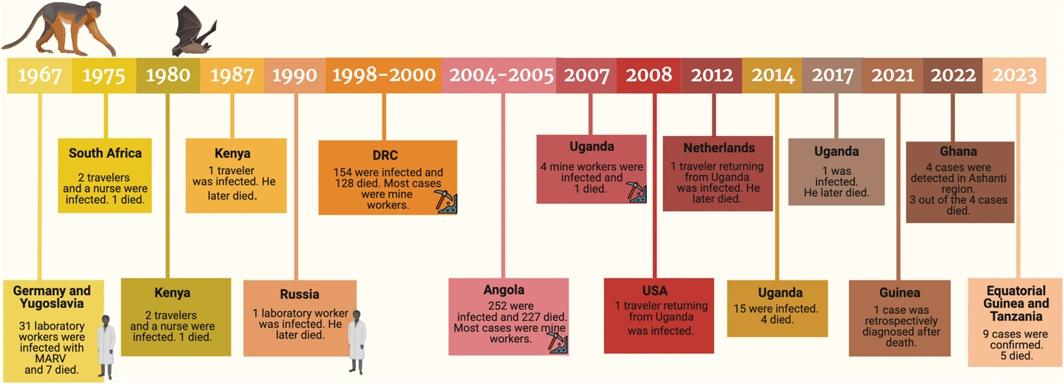
History
Key HPI Questions
• Fever onset, duration, and pattern
• Travel history to sub-Saharan Africa within 21 days
• Exposure to caves, mines, or bat habitats
• Contact with sick individuals or healthcare settings
• Occupational exposure (healthcare workers, laboratory personnel)
Symptom Characterization
• Fever (95% of patients) - high-grade, persistent [2]
• Fatigue (88%) and malaise [2]
• Headache (58%) - severe, persistent [5]
• Gastrointestinal symptoms (82%) - nausea, vomiting, diarrhea [2]
Timing and Progression
• Incubation period: 2-21 days (median 10 days, IQR 8-13) [2]
• Symptom onset to hospitalization: median 2 days (IQR 1-3) [2]
• Rapid progression from nonspecific symptoms to severe illness within 48-72 hours [2]
Important Negatives
• Absence of hemorrhagic symptoms early in disease course [1]
• Lack of respiratory symptoms initially [2]
Alarm Features
Red Flag Symptoms/Signs
• Hemorrhagic manifestations (42% of cases): epistaxis, gingival bleeding, GI hemorrhage [2]
• Neurologic symptoms (17%): confusion, altered mental status [2]
• Rapid clinical deterioration within 24-48 hours [1-2]
• Multiorgan failure signs [6]
Life-Threatening Features
• Respiratory failure requiring mechanical ventilation [2]
• Refractory shock [2]
• Progressive metabolic acidosis [2]
• Acute kidney injury requiring dialysis [2]
Urgent Escalation Indicators
• High viral load (Ct value <25) associated with 48% mortality vs 5% with Ct ≥25 [2]
• Healthcare worker exposure - 77% of cases in Rwanda outbreak were HCWs [2]
Medications
Investigational Therapeutics
• Remdesivir: Nucleotide analogue, IV administration to critically ill patients [1-2]
• MBP091: Monoclonal antibody targeting Marburg virus glycoprotein [2]
Contraindicated/Caution
• No approved antiviral treatments currently available [2]
• Avoid unnecessary invasive procedures due to bleeding risk and transmission concerns [7]
Supportive Medications
• Empirical broad-spectrum antibiotics for suspected secondary bacterial infections [2]
• Antifungal therapy for suspected fungal superinfections [2]
Diet
Acute Management
• NPO initially if severe GI symptoms or altered mental status
• Fluid losses can be substantial - up to 10 liters per day from GI symptoms [8]
Hydration Considerations
• Aggressive IV fluid resuscitation with crystalloids [2-3]
• Close monitoring of volume status essential [2]
Review of Systems
High-Yield ROS Questions
• Constitutional: fever, fatigue, malaise, weight loss
• GI: nausea, vomiting, diarrhea, abdominal pain, dysphagia [2][8]
• Neurologic: headache, confusion, altered mental status [2]
• Hematologic: easy bruising, bleeding from gums, nosebleeds [2]
• Musculoskeletal: myalgia, arthralgia [8]
• Dermatologic: rash (maculopapular) [1][8]
Collateral History and Family History
Important Collateral Information
• Travel companions with similar symptoms
• Household contacts - family clustering common [9]
• Healthcare exposures - nosocomial transmission accounts for majority of cases [2]
Relevant Hereditary Conditions
• No specific hereditary predisposition identified
Social Context
• Occupational exposure: mining, cave exploration, laboratory work [10-11]
• Funeral/burial practices - contact with deceased patients [11]
Risk Factors
Major Risk Factors
• Contact with confirmed MVD patient [11]
• Healthcare worker status (77% of Rwanda outbreak cases) [2]
• Travel to endemic areas (sub-Saharan Africa) [7]
• Exposure to bat habitats (caves, mines) [10-11]
• Funeral/burial service work [11]
Epidemiologic Factors
• Egyptian fruit bat (Rousettus aegyptiacus) exposure [10-11]
• Laboratory exposure to infected specimens [11]
• Inadequate infection control in healthcare settings [9]
Differential Diagnosis
Most Important Alternative Diagnoses
• Malaria - most common mimic in endemic areas [6][12]
• Typhoid fever [12]
• Viral hepatitis (fulminant) [12]
• Meningococcal septicemia [12]
Dangerous Cannot-Miss Diagnoses
• Other viral hemorrhagic fevers: Ebola, Lassa fever, CCHF [3][12]
• Septic shock from bacterial causes [12]
• Acute leukemia or other hematologic malignancies
• Thrombotic thrombocytopenic purpura (TTP)
Distinguishing Features
• Epidemiologic exposure history crucial for diagnosis [7]
• Rapid progression more characteristic than other febrile illnesses [6]
• Healthcare worker clustering highly suggestive [2]
Past Medical History
Relevant Prior Conditions
• Previous MVD exposure or recovery
• Immunocompromising conditions may worsen prognosis
• Chronic liver disease - may complicate hepatic involvement
Surgical History
• Recent invasive procedures may increase bleeding risk
Physical Exam
Key Exam Findings
• Vital signs: high fever, tachycardia, hypotension in severe cases
• Conjunctival injection [8]
• Maculopapular rash (may be present but not universal) [1][8]
Hemorrhagic Signs (Late Findings)
• Petechiae and ecchymoses
• Gingival bleeding [2]
• Subconjunctival hemorrhage [8]
• Bleeding from venipuncture sites [8]
Concerning Findings
• Altered mental status [2]
• Abdominal tenderness [8]
• Signs of volume depletion [8]
Lab Studies
Recommended Labs
• RT-PCR for Marburg virus - primary diagnostic test [7][13]
• Complete blood count: thrombocytopenia common [2][14]
• Comprehensive metabolic panel: electrolyte abnormalities [2]
• Liver function tests: AST/ALT elevation (>3x ULN in 33% initially, 70% during hospitalization) [2][14]
• Coagulation studies: PT/PTT, fibrinogen [2]
Expected Abnormalities
• Hyponatremia (88% of patients) [2]
• Hypokalemia (39%) [2]
• Hypoglycemia (30%) [2]
• Elevated creatinine [14]
• Lymphopenia initially, then lymphocytosis in recovery [14]
Monitoring Parameters
• Viral load (Ct values) - prognostic significance [2]
• Serial liver enzymes [14]
• Platelet count [14]
Imaging
First-Line Imaging
• Chest X-ray - assess for pulmonary complications
• Abdominal ultrasound - evaluate hepatosplenomegaly if clinically indicated
When Imaging is Unnecessary
• Routine CT scanning not indicated unless specific complications suspected
• Minimize unnecessary procedures due to transmission risk [7]
Special Tests
Diagnostic Tests
• Marburg virus antigen ELISA [13]
• IgM/IgG serology (for convalescent diagnosis) [13]
• Virus culture (specialized laboratories only) [13]
Point-of-Care Tests
• Rapid diagnostic tests under development but not widely available
ECG
ECG Indications
• Electrolyte abnormalities (hypokalemia, hyponatremia) [2]
• Suspected cardiac involvement in multiorgan failure
Assessment
Clinical Summary
• Highly lethal viral hemorrhagic fever with case fatality rates of 24-90% [1][3]
• Rapid progression from nonspecific febrile illness to multiorgan failure [6]
• High transmission risk to healthcare workers [2]
Severity Stratification
• High viral load (Ct <25): 48% mortality [2]
• Low viral load (Ct ≥25): 5% mortality [2]
• Early diagnosis and treatment associated with better outcomes [1]
Complications
• Multiorgan failure [6]
• Coagulopathy and hemorrhage [2]
• Secondary bacterial/fungal infections [2]
Treatment Plan
Initial Stabilization
• Immediate isolation with VHF precautions [7][15]
• Aggressive fluid resuscitation with crystalloids [2-3]
• Supportive care for organ dysfunction [2]
Investigational Treatments
• Remdesivir for critically ill patients (expanded access protocols) [1-2]
• MBP091 monoclonal antibody (limited availability) [2]
Supportive Interventions
• Blood product transfusion for hemorrhagic complications [2]
• Mechanical ventilation for respiratory failure [2]
• Hemodialysis for acute kidney injury [2]
Disposition
Admission Criteria
• All suspected MVD cases require immediate hospitalization [7][15]
• Isolation in specialized facility with VHF capabilities [2][15]
ICU Indications
• Respiratory failure [2]
• Hemodynamic instability [2]
• Multiorgan dysfunction [2]
• Altered mental status [2]
Specialist Consultation
• Infectious disease specialist immediately [7]
• Public health authorities for contact tracing [2]
• CDC or equivalent for diagnostic confirmation [7]
Follow Up / Return Precautions
Contact Tracing
• Identify all contacts within 21 days of exposure [2]
• Daily monitoring of contacts for fever and symptoms [2]
Return Precautions
• Any fever or constitutional symptoms
• Bleeding or bruising
• Severe headache or neurologic changes
• Respiratory distress
Recovery Monitoring
• Viral clearance confirmation before discharge
• Long-term sequelae monitoring in survivors
• Infection control measures until viral clearance confirmed
References
1. Case Series of Patients With Laboratory Confirmed Marburg Virus Disease, 2023 Equatorial Guinea. — Ndoho FAO, Fontana L, Avomo COO, et al. Clinical Infectious Diseases : An Official Publication of the Infectious Diseases Society of America. 2025.
2. Marburg Virus Disease in Rwanda, 2024 — Public Health and Clinical Responses. — Nsanzimana S, Remera E, Nkeshimana M, et al. The New England Journal of Medicine. 2025.
3. Standard of Care for Viral Haemorrhagic Fevers (VHFs): A Systematic Review of Clinical Management Guidelines for High-Priority VHFs. — Rigby I, Michelen M, Dagens A, et al. The Lancet. Infectious Diseases. 2023.
4. Reemergence of Marburgvirus disease: Update on current control and prevention measures and review of the literature. — Elsheikh R, Makram AM, Selim H, et al. Reviews in Medical Virology. 2023.
5. Refining Early Detection of Marburg Virus Disease (MVD) in Rwanda: Leveraging Predictive Symptom Clusters to Enhance Case Definitions. — Nsekuye O, Ntabana F, Mucunguzi HV, et al. International Journal of Infectious Diseases : IJID : Official Publication of the International Society for Infectious Diseases. 2025.
6. Marburg Virus Disease: Pathophysiology, Diagnostic Challenges, and Global Health Preparedness Strategies. — Francis DL, Reddy SSP, Logaranjani A, Sai Karthikeyan SS, Rathi M. Annals of Global Health. 2025.
7. Marburg Haemorrhagic Fever in Returning Travellers: An Overview Aimed At clinicians. — Bauer MP, Timen A, Vossen ACTM, van Dissel JT. Clinical Microbiology and Infection : The Official Publication of the European Society of Clinical Microbiology and Infectious Diseases. 2019.
8. Ebola. — Feldmann H, Sprecher A, Geisbert TW. The New England Journal of Medicine. 2020.
9. Outbreak of Marburg Virus Disease, Equatorial Guinea, 2023. — Ngai S, Evers ES, Seoane AKL, et al. Emerging Infectious Diseases. 2025.
10. Emergence of Marburg Virus: A Global Perspective on Fatal Outbreaks and Clinical Challenges. — Srivastava S, Sharma D, Kumar S, et al. Frontiers in Microbiology. 2023.
11. Marburg Virus Disease Outbreaks, Mathematical Models, and Disease Parameters: A Systematic Review. — Cuomo-Dannenburg G, McCain K, McCabe R, et al. The Lancet. Infectious Diseases. 2024.
12. Ebola Haemorrhagic Fever. — Feldmann H, Geisbert TW. Lancet. 2011.
13. Marburg Hemorrhagic Fever Associated with Multiple Genetic Lineages of Virus. — Bausch DG, Nichol ST, Muyembe-Tamfum JJ, et al. The New England Journal of Medicine. 2006.
14. Kinetics of Hematological and Biochemical Biomarkers Are Key Tools for Monitoring Disease Progression in Marburg Virus-Infected Patients in Rwanda. — Mugisha JC, Kayigi E, Gahamanyi N, et al. Scientific Reports. 2025.
15. Post-Travel Evaluation to Rule Out Viral Special Pathogen Infection. — Catherine Brown, Mary J. Choi, Susan McLellan, and Trevor Shoemaker CDC Yellow Book. 2025.
Figure
More from Deep Dive
Reviewed by Dr. Lucas Mastropaolo. SymptomDx is an educational tool for medical professionals — it does not replace clinical judgment. Verify all clinical data and drug dosages with authoritative sources.