Measles (Rubeola)
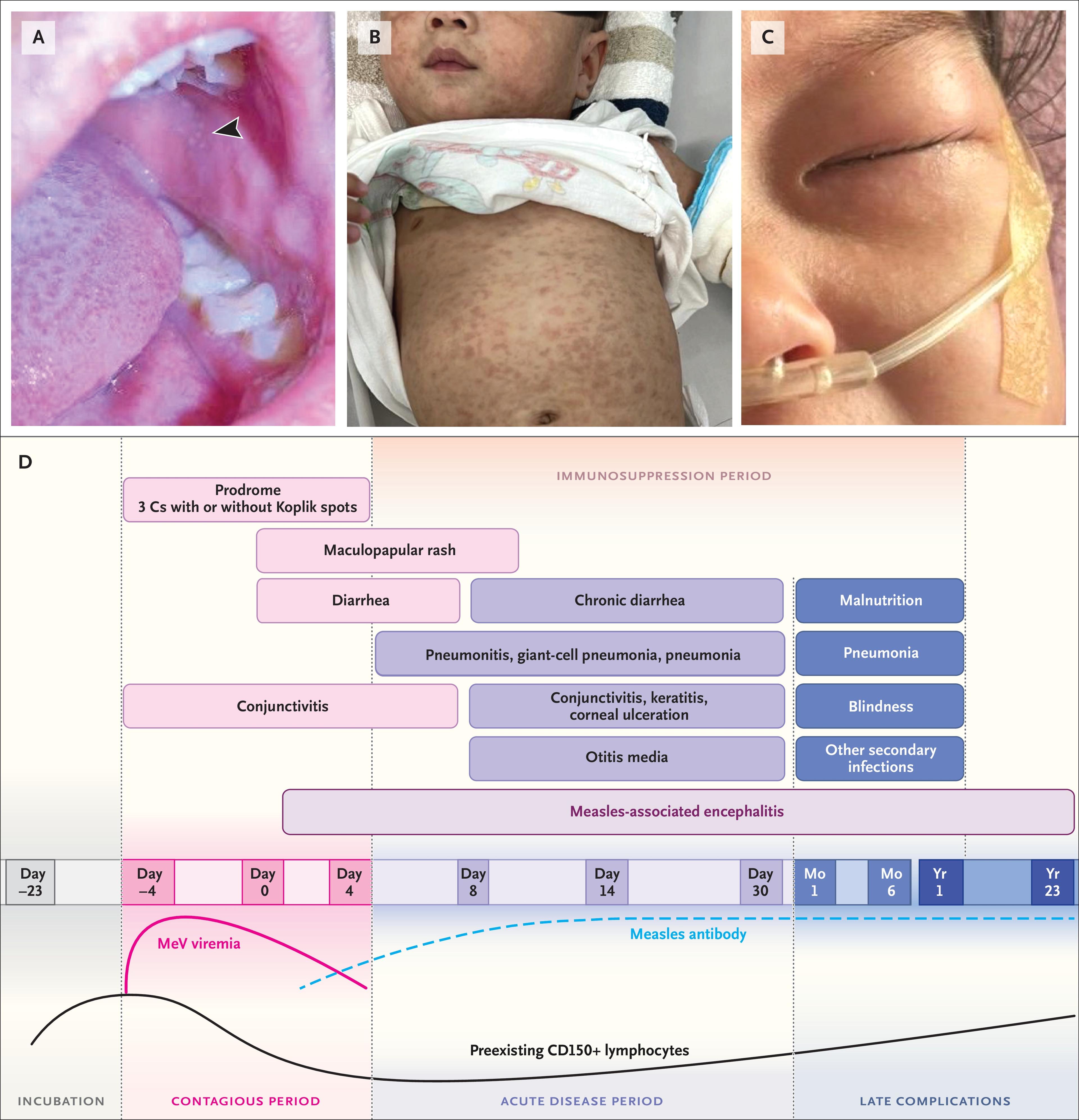
Measles is a highly contagious, vaccine-preventable viral illness caused by the measles virus (family Paramyxoviridae) that classically presents with fever, the "three Cs" (cough, coryza, conjunctivitis), and a cephalocaudal maculopapular rash. [1-2] Approximately 25% of patients require hospitalization, and complications occur in ~30% of cases. [1][3] The following figure illustrates the clinical features and disease timeline:
History
- Key HPI questions: Onset and duration of fever, rash characteristics and progression (face → trunk → extremities), presence of cough, runny nose, red/watery eyes, oral lesions
- Symptom characterization: Prodrome of 2–4 days with high fever (up to 40.6°C/105°F), malaise, and the three Cs, followed by rash onset 3–5 days later [2-3]
- Timing/triggers: Incubation period averages 10–14 days (range 7–23) from exposure to prodrome; rash appears ~14 days post-exposure [1][3]
- Associated symptoms: Diarrhea (early, may persist up to 1 month), photophobia, anorexia, malaise [1]
- Important negatives: Vaccination history (number of MMR doses and dates), recent international travel or travel to outbreak areas, known measles exposure within 21 days, immunocompromised state [4-5]
Alarm Features
- Respiratory distress — tachypnea, hypoxia, crackles (pneumonia is the most common cause of measles hospitalization and death) [1]
- Altered mental status, seizures, focal neurologic deficits → suspect encephalitis (~1 per 1,000 cases, 20% mortality) [2][6]
- Severe dehydration from persistent diarrhea/poor oral intake
- Signs of secondary bacterial sepsis — persistent high fever after rash onset, toxic appearance
- Corneal ulceration/visual changes — especially in vitamin A–deficient patients [6]
- Immunocompromised patients — may lack rash entirely, at risk for giant-cell (Hecht's) pneumonia (often fatal) and measles inclusion-body encephalitis (100% mortality) [1-2]
- Pregnancy — risk of spontaneous abortion, premature labor, maternal respiratory complications [6]
Medications
- No approved antiviral therapy exists for measles [1-2]
- Vitamin A (AAP/WHO-recommended, age-based dosing — see Treatment Plan below) — reduces mortality by 34–50% in children [1][7]
- Ribavirin — shows in vitro activity; not FDA-approved for measles; has been used off-label in severe/immunocompromised cases [4][8]
- Antibiotics — only if secondary bacterial infection (pneumonia, otitis media, sepsis) is identified; not recommended empirically [2]
- Antipyretics — acetaminophen or ibuprofen for fever/discomfort
- Contraindicated: Aspirin in children (Reye syndrome risk); high-dose vitamin A in pregnancy (teratogenic) [5]
- Post-exposure prophylaxis (PEP): MMR vaccine within 72 hours of exposure, or immunoglobulin (IG) within 6 days for those who cannot receive vaccine (infants <6 months, pregnant women, immunocompromised) [5-6]
Diet
- Maintain adequate hydration — oral rehydration solutions for mild dehydration; IV fluids if unable to tolerate PO or severe diarrhea
- Small, frequent, soft meals during acute illness (stomatitis may limit intake)
- Vitamin A–rich foods during recovery (eggs, dairy, orange/yellow vegetables) — though pharmacologic supplementation is the priority acutely
- No specific dietary restrictions; focus on caloric maintenance to prevent measles-associated malnutrition [1]
Review of Systems
- HEENT: Eye redness/discharge, photophobia, oral lesions (Koplik spots), ear pain/discharge, sore throat
- Respiratory: Cough (barking vs. productive), dyspnea, chest pain
- GI: Diarrhea (frequency, volume), vomiting, abdominal pain, oral intake
- Neurologic: Headache, confusion, seizures, focal weakness
- Constitutional: Fever pattern, weight loss, fatigue
- Skin: Rash onset location, spread pattern, pruritus, desquamation
Collateral History and Family History
- Vaccination records of patient and household contacts — critical for determining immunity and PEP eligibility [5]
- Exposure history: Daycare, school, healthcare facility, travel (especially international), contact with known cases
- Household contacts who are immunocompromised, pregnant, or unvaccinated infants — high-risk for severe disease
- Immigration history — recent arrival from endemic areas increases pre-test probability [2]
- Community outbreak status — check with local/state health department
Risk Factors
- Unvaccinated or incompletely vaccinated status (single most important risk factor) [5]
- Age: <5 years and >20 years at highest risk for complications [2][4]
- Immunocompromised: HIV/AIDS, active chemotherapy, organ transplant recipients, congenital immunodeficiency [2]
- Pregnancy [4][6]
- Vitamin A deficiency and malnutrition [1][6]
- International travel or contact with travelers from endemic regions [4]
- Born between 1957–1989 with only one MMR dose (suboptimal immunity)
Differential Diagnosis
- Rubella — milder prodrome, postauricular/suboccipital lymphadenopathy, shorter rash duration, no Koplik spots [2]
- Parvovirus B19 (fifth disease) — "slapped cheek" rash, reticular lace-like rash on extremities, no conjunctivitis [2]
- Roseola (HHV-6) — rash appears after fever resolves (opposite of measles) [9]
- Scarlet fever — sandpaper-textured rash, strawberry tongue, pharyngitis, Pastia lines [9]
- Kawasaki disease — prolonged fever, conjunctival injection without exudate, mucositis, extremity changes, lymphadenopathy (children <5 years)
- Drug reaction — temporal relationship to medication, eosinophilia
- Dengue/Zika/Chikungunya — travel to endemic areas, arthralgia, thrombocytopenia [6]
- Acute HIV seroconversion — morbilliform rash, oral ulcers, lymphadenopathy [10]
- Meningococcemia — cannot-miss; petechial/purpuric rash, rapid deterioration [11]
Past Medical History
- Prior measles infection (confers lifelong immunity)
- Number and dates of MMR vaccinations
- Immunosuppressive conditions or medications (biologics, chemotherapy, chronic steroids)
- History of vitamin A deficiency or malabsorption syndromes
- Pregnancy status in women of childbearing age
- Prior episodes of febrile exanthems
- Chronic lung disease (increases pneumonia risk)
Physical Exam
- Vitals: High fever (often ≥40°C/104°F), tachycardia; assess for tachypnea/hypoxia (pneumonia)
- HEENT:
- Skin: Erythematous maculopapular rash starting at hairline/face → trunk → extremities; may become confluent on face/upper body; initially blanching, later brownish with desquamation [2][4]
- Lungs: Crackles, rhonchi, decreased breath sounds (pneumonia)
- Neuro: Mental status, meningeal signs, focal deficits (if encephalitis suspected)
- Lymph nodes: Generalized lymphadenopathy may be present
Lab Studies
- Measles-specific IgM (serum) — sensitivity 83–98.8%, specificity 93.7–100%; may be negative in first 72 hours after rash onset; repeat if initially negative [2][4][12]
- Measles RT-PCR (NP or throat swab ± urine) — sensitivity 94%, specificity 99%; detectable ~3 days after rash onset; preferred early test [2][4]
- Urine PCR — adding urine to NP/throat swab improves sensitivity [4-5]
- CBC — leukopenia (especially lymphopenia) is common; may see secondary leukocytosis with bacterial superinfection
- CMP/BMP — assess hydration status, electrolytes (diarrhea/dehydration)
- Blood cultures — if secondary bacterial infection suspected
- CRP/procalcitonin — to help differentiate viral vs. bacterial complications
- Vitamin A levels are not routinely needed before supplementation [3]
Imaging
- Chest X-ray — indicated if respiratory distress, hypoxia, or clinical suspicion for pneumonia; findings may include interstitial infiltrates, lobar consolidation, or hilar lymphadenopathy [6]
- CT chest — rarely needed; consider for severe or atypical pneumonia in immunocompromised patients
- MRI brain — indicated if neurologic symptoms; acute disseminated encephalomyelitis (ADEM) shows T2/FLAIR hyperintensities in white matter [6]
- Imaging is unnecessary in uncomplicated measles
Special Tests
- CDC case definition: Generalized maculopapular rash + fever ≥38.3°C + cough, coryza, or conjunctivitis — sensitivity 75–90%, but low positive predictive value in low-incidence settings [2]
- Viral genotyping — performed by public health labs for epidemiologic tracking; not needed for clinical management [2]
- IgG avidity assay — distinguishes primary infection from secondary immune response in previously vaccinated individuals [6]
- CSF measles antibodies — indicated if SSPE suspected; compare CSF:serum ratio to confirm intrathecal synthesis [12]
- Lumbar puncture — if encephalitis suspected
ECG
- Myocarditis is a rare complication of measles; obtain ECG if chest pain, new heart failure symptoms, or unexplained tachycardia
- Look for: ST-segment changes, low voltage, conduction abnormalities, arrhythmias
- Routine ECG is not indicated in uncomplicated measles
Assessment
Clinical summary: Measles is one of the most contagious human diseases (R₀ = 12–18), transmitted via airborne droplets and remaining infectious in air for up to 2 hours. Patients are contagious from 4 days before to 4 days after rash onset. [1-2]
Severity stratification
- Uncomplicated: Self-limited; fever + rash + three Cs resolving within 7 days of rash onset [2]
- Complicated: Pneumonia (1–6%), otitis media (7–9%), diarrhea (8–10%), encephalitis (~1/1,000), death (~1–3/1,000 in developed countries) [1-2]
- Atypical presentations: Modified measles in previously vaccinated (milder/absent symptoms); absent rash in immunocompromised [6]
Immune amnesia: Measles causes immunosuppression lasting 2–3 years, increasing susceptibility to secondary infections — a critical counseling point. [4]
Treatment Plan
Initial stabilization
- Immediate airborne isolation (negative-pressure room if available; N-95 mask for all staff) [5][13]
- IV access and fluid resuscitation if dehydrated
- Supplemental O₂ if hypoxic
Vitamin A supplementation (AAP/WHO — 2 oral doses on consecutive days): [2-3][7]
A third age-specific dose at 2–4 weeks if clinical signs of vitamin A deficiency (xerophthalmia, Bitot spots). [2-3] Avoid high-dose vitamin A in pregnancy. [5]
Supportive care
- Antipyretics (acetaminophen/ibuprofen) for fever
- Oral or IV rehydration for diarrhea/dehydration
- Antibiotics only for confirmed secondary bacterial infections (pneumonia, otitis media, sepsis) [2]
Post-exposure prophylaxis for contacts: [5]
- MMR vaccine within 72 hours of exposure (for eligible contacts ≥6 months without evidence of immunity)
- Immunoglobulin (IG) within 6 days for infants <6 months, pregnant women, and immunocompromised individuals who cannot receive live vaccine
Mandatory reporting: Notify local/state health department immediately upon clinical suspicion — do not wait for lab confirmation. [2][5]
Disposition
Admission criteria
- Respiratory distress, hypoxia, or pneumonia
- Severe dehydration or inability to tolerate oral fluids
- Neurologic symptoms (altered mental status, seizures)
- Immunocompromised patients
- Pregnant patients with complications
- Infants <12 months with moderate-to-severe illness
- Social concerns (inability to isolate at home)
Discharge criteria
- Clinically stable, tolerating oral fluids, no respiratory distress
- Able to self-isolate at home for 4 days after rash onset
- Reliable follow-up arranged
Observation indications
- Borderline cases with mild dehydration or early respiratory symptoms
- Young children (<5 years) or adults (>20 years) given higher complication rates
Specialist consultation triggers
- Pulmonology/ICU for severe pneumonia or respiratory failure
- Neurology for encephalitis or seizures
- Ophthalmology for keratitis or corneal ulceration
- Infectious disease for immunocompromised patients
- OB/GYN for pregnant patients [4][6]
Follow Up / Return Precautions
Follow-up timing
- Primary care follow-up within 48–72 hours of ED discharge
- Recheck at 1–2 weeks to assess for late complications (pneumonia, otitis media)
- Immunocompromised patients require closer surveillance
Return immediately for
- Worsening or new-onset difficulty breathing, chest pain
- Persistent high fever (>5 days after rash onset) or fever recurrence after initial improvement
- Confusion, severe headache, seizures, neck stiffness
- Inability to keep fluids down, signs of dehydration (decreased urine output, dry mucous membranes)
- Eye pain, vision changes, or purulent eye discharge
- Ear pain or drainage
Patient counseling
- Isolation: Remain home and avoid contact with others for 4 days after rash onset [2]
- Notify anyone who may have been exposed (especially unvaccinated, pregnant, immunocompromised contacts)
- Expected course: fever resolves 2–3 days after rash onset; rash fades over 5–7 days in order of appearance; full recovery in uncomplicated cases within ~7–10 days [2]
- Immune amnesia — increased susceptibility to other infections for up to 2–3 years; ensure all other vaccinations are up to date [4]
- Ensure household contacts have evidence of immunity or receive PEP [5]
References
1. Measles 2025. — Do LAH, Mulholland K. The New England Journal of Medicine. 2025.
2. Measles. — Strebel PM, Orenstein WA. The New England Journal of Medicine. 2019.
3. Measles (Rubeola). — James L. Goodson and Thomas D. Filardo CDC Yellow Book. 2025.
4. Measles. — Stoneman EK. The Journal of the American Medical Association. 2025.
5. Expanding Measles Outbreak in the United States and Guidance for the Upcoming Travel Season. — United States Centers for Disease Control and Prevention (2025). 2025.
6. Measles. — Hübschen JM, Gouandjika-Vasilache I, Dina J. Lancet. 2022.
7. Measles and Measles Vaccination: A Review. — Bester JC. JAMA Pediatrics. 2016.
8. Acute Management of Measles: A Systematic Review of Therapeutic Strategies. — Kaur A, Alaribe U, Varon J, Hassaan S, Halma M. Antiviral Research. 2026.
9. Common Skin Rashes in Children. — Allmon A, Deane K, Martin KL. American Family Physician. 2015.
10. Post-Travel Dermatologic Conditions. — Karolyn A. Wanat and Scott A. Norton CDC Yellow Book. 2025.
11. Clinical Features, Diagnosis, and Management of Enterovirus 71. — Ooi MH, Wong SC, Lewthwaite P, Cardosa MJ, Solomon T. The Lancet. Neurology. 2010.
12. Guide to Utilization of the Microbiology Laboratory for Diagnosis of Infectious Diseases: 2024 Update by the Infectious Diseases Society of America (IDSA) and the American Society for Microbiology (ASM). — Miller JM, Binnicker MJ, Campbell S, et al. Clinical Infectious Diseases : An Official Publication of the Infectious Diseases Society of America. 2024.
13. An Update and Review of Measles for Emergency Physicians. — Alves Graber EM, Andrade FJ, Bost W, Gibbs MA. The Journal of Emergency Medicine. 2020.
Figure
More from Deep Dive
Reviewed by Dr. Lucas Mastropaolo. SymptomDx is an educational tool for medical professionals — it does not replace clinical judgment. Verify all clinical data and drug dosages with authoritative sources.