Pellagra
Pellagra is a systemic disease caused by deficiency of niacin (vitamin B3) or its amino acid precursor tryptophan, classically presenting with the "4 Ds": dermatitis, diarrhea, dementia, and death if untreated. [1-2] It remains underdiagnosed, particularly in developed countries, where a high index of suspicion is critical — the full classic triad is present in only a minority of cases. [3-4]
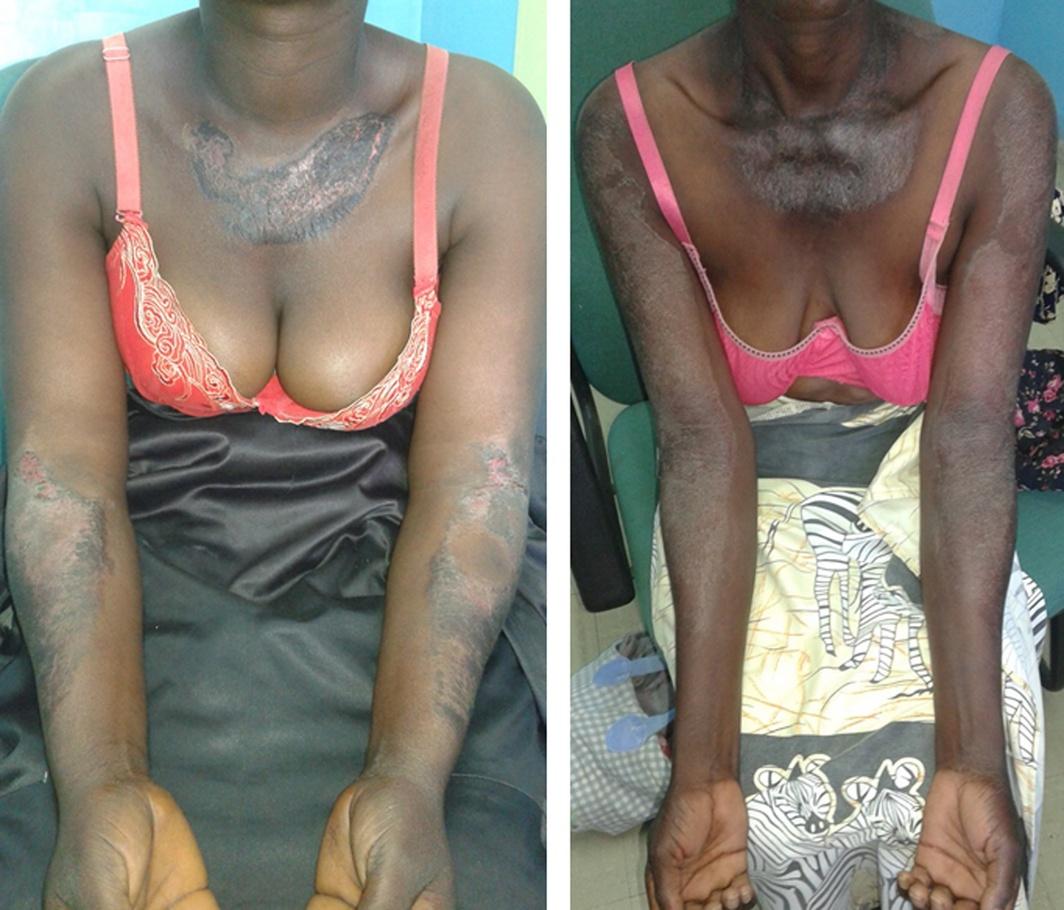
The following figure demonstrates the characteristic photodistributed dermatitis and Casal's necklace seen in pellagra:
History
- Dietary intake: Ask about diet composition — maize/corn-based diets, food insecurity, restrictive diets, anorexia, failure to eat regularly [2][6]
- Alcohol use: Quantity, frequency, duration — chronic alcohol use is a major cause in developed countries (35% of reported cases in literature review) [7-8]
- Medication history: Isoniazid (leading drug cause, 14.3% of cases), pyrazinamide, ethionamide, 5-fluorouracil, 6-mercaptopurine, phenobarbital, phenytoin, chloramphenicol, carbidopa/benserazide [1][9-10]
- Symptom characterization: Onset and progression of skin changes (photosensitive distribution), GI symptoms (diarrhea, dysphagia, nausea), and neuropsychiatric symptoms (confusion, memory loss, depression, insomnia)
- Timing: Seasonal worsening in spring/summer with sun exposure; isoniazid-associated cases onset median 5–9 months after initiation [11]
- Associated symptoms: Fatigue, apathy, insomnia, weight loss, burning/pruritus of skin lesions [9][12]
- Important negatives: Not all components of the triad need be present — dermatitis alone (98.6%), GI symptoms (59.4%), or neurological signs (54.2%) may occur in isolation [1]
Alarm Features
- Encephalopathy / delirium: Confusion, disorientation, hallucinations, stupor — indicates severe/advanced disease; fatal if untreated [12-13]
- Concurrent Wernicke's encephalopathy: Co-occurs in ~26% of alcoholic pellagra cases [3]
- Seizures: Reported in 16% of alcohol-dependent patients with pellagra [3]
- Cachexia / severe malnutrition: BMI <18.5 in 54% of alcoholic pellagra patients [3]
- Altered mental status not responding to thiamine: Should prompt consideration of pellagra, especially in alcoholic patients [13]
- Progressive worsening despite multivitamins that lack niacin: A key diagnostic clue [13]
Medications
Causative medications (interfere with tryptophan-to-niacin conversion or niacin metabolism):
- Isoniazid — most common drug cause (aOR 42.6 for pellagra risk); inhibits tryptophan-to-niacin conversion [11][14]
- Pyrazinamide, ethionamide (other anti-TB drugs)
- 5-Fluorouracil, 6-mercaptopurine (chemotherapy)
- Phenytoin, phenobarbital (anticonvulsants)
- Chloramphenicol
- Carbidopa/benserazide (Parkinson's drugs) — biochemical evidence of niacin depletion, though clinical pellagra is less common [10]
Treatment medications
- Nicotinamide (niacinamide): Preferred over nicotinic acid (avoids flushing); 300–1,000 mg/day PO for mild-moderate disease [9][15]
- Parenteral niacin: Mean dose ~1,500 mg/day for severe/alcoholic pellagra encephalopathy [3]
- Co-administer other B vitamins (thiamine, riboflavin, pyridoxine) — concurrent deficiencies are common and required for tryptophan-to-niacin conversion [8][12]
Caution: High-dose niacin carries risk of hepatotoxicity; blood levels are unreliable measures of deficiency [15]
Diet
- Maize/corn-dependent diets: Niacin in corn is bound (not bioavailable without nixtamalization); primary driver of pellagra globally (85% of cases) [1-2]
- Tryptophan-poor diets: Sorghum-based diets, severely restricted protein intake
- Excessive leucine intake: Inhibits tryptophan-to-niacin conversion [12]
- Niacin-rich foods for recovery/prevention: Eggs, peanuts, meat, poultry, fish, legumes, seeds, bran [9]
- Adequate protein nutrition is essential — tryptophan is the precursor to niacin [8]
- Hydration: Important given diarrhea-related losses
Review of Systems
- Dermatologic: Photosensitive rash, burning, pruritus, hyperpigmentation, scaling, fissuring
- GI: Diarrhea (watery, occasionally bloody/mucoid), nausea, anorexia, dysphagia, glossitis, stomatitis, epigastric discomfort [9][16]
- Neuropsychiatric: Insomnia, fatigue, apathy → depression, anxiety, irritability → confusion, hallucinations, memory loss → psychosis, stupor, coma [9][12]
- Musculoskeletal: Weakness, tremors
- Neurologic: Peripheral neuropathy (32% in alcoholic pellagra), hyporeflexia [3][16]
- Genitourinary: Vaginitis (mucosal inflammation) [12]
Collateral History and Family History
- Collateral: Assess housing status (homelessness is a major risk factor), access to meals/shelter-based food programs, social isolation, caregiver neglect [6]
- Alcohol use history from family/friends — patients may underreport
- Dietary habits: Who prepares meals, food access, food insecurity
- Family history: Hartnup disease (autosomal recessive disorder of tryptophan transport) — a rare hereditary cause of pellagra-like symptoms [17]
- Carcinoid syndrome: Family or personal history — diverts tryptophan to serotonin synthesis [17]
Risk Factors
- Dietary deficiency / food insecurity — 85% of cases; 93% in humanitarian crisis settings [1]
- Chronic alcoholism — 9.6–35% of cases depending on the population studied [1][7]
- Isoniazid therapy — especially without pyridoxine supplementation [11][14]
- Poverty / low socioeconomic status — 64.5% from low-income groups [3]
- Homelessness [6]
- Malabsorption: Celiac disease, IBD, bariatric surgery, chronic GI disorders [7][18]
- HIV infection — independent risk factor, often co-occurs with isoniazid use [11]
- Lactation (in women) — increased niacin requirements [11]
- Anorexia nervosa / restrictive eating disorders
- Maize-dependent diets without nixtamalization [2]
Differential Diagnosis
- Photodermatitis / phototoxic drug reaction: Lacks GI and neuropsychiatric features; medication history key
- Systemic lupus erythematosus: Malar rash, but different distribution; check ANA
- Dermatomyositis: Heliotrope rash, Gottron's papules; proximal muscle weakness
- Porphyria cutanea tarda: Blistering on sun-exposed areas; check urine porphyrins
- Zinc deficiency (acrodermatitis enteropathica): Periorificial and acral distribution
- Hartnup disease: Pellagra-like rash with aminoaciduria — consider in children/young adults [17]
- Carcinoid syndrome: Flushing, diarrhea, wheezing — diverts tryptophan to serotonin [17]
- Wernicke's encephalopathy: Confusion, ataxia, ophthalmoplegia — frequently co-occurs with pellagra in alcoholics [3]
- Contact dermatitis / eczema: Distribution not photosensitive; no systemic features
- Kwashiorkor: Edema, skin changes, but different pattern
Past Medical History
- Prior episodes of pellagra or nutritional deficiency
- Alcohol use disorder — most important in developed countries [7][13]
- Tuberculosis and anti-TB medication history [11][14]
- Bariatric surgery (Roux-en-Y, sleeve gastrectomy) [18]
- GI surgery or chronic GI disease causing malabsorption [1]
- HIV/AIDS [11]
- Cancer — chemotherapy with 5-FU or 6-MP [9]
- Eating disorders
- Chronic liver disease / cirrhosis [15]
Physical Exam
Vital signs: Tachycardia (if dehydrated/malnourished), low BMI
Skin (most common finding, 98.6% of cases): [1]
- Casal's necklace: Broad band of hyperpigmented, scaling dermatitis around the neck — pathognomonic [19]
- "Gauntlet" distribution: Symmetric, well-demarcated erythema/hyperpigmentation on dorsal hands and forearms [19]
- Photosensitive distribution: face, neck, chest (V-sign), dorsal feet, extensor surfaces
- Acute: Erythema resembling sunburn, may have vesicles/bullae [9]
- Chronic: Hyperpigmentation, hyperkeratosis, thickened/leathery skin with sharp demarcation [16]
Oral: Glossitis (bright red, beefy tongue), stomatitis, angular cheilitis [9][12]
Neurologic: Altered mental status, confusion, tremors, hyporeflexia, peripheral neuropathy, ataxia [3][16]
General: Cachexia, muscle wasting, signs of other nutritional deficiencies
Lab Studies
- Pellagra is primarily a clinical diagnosis — no definitive confirmatory lab test [20]
- Urinary N1-methylnicotinamide (1-MN) and 2-pyridone: Low levels support niacin deficiency, but not widely available [9][21]
- Serum niacin/NAD levels: Blood levels are unreliable measures of deficiency [15]
- CBC: Anemia (nutritional), macrocytosis if concurrent folate/B12 deficiency
- CMP: Electrolyte abnormalities from diarrhea/malnutrition, hepatic function
- Albumin/prealbumin: Assess nutritional status
- Thiamine level: Rule out concurrent Wernicke's (co-occurs in 26% of alcoholic cases) [3]
- B12, folate, zinc: Assess for concurrent deficiencies
- Serum tryptophan: May be low but not routinely measured
- Urine 5-HIAA: If carcinoid syndrome suspected as cause
Imaging
- Imaging is generally not required for diagnosis of pellagra
- Brain MRI: Consider if encephalopathy is present — may show symmetric signal changes in the caudate nuclei (described in pellagra encephalopathy), but findings are nonspecific
- CT abdomen: Only if evaluating for malabsorption etiology or carcinoid tumor
- Chest imaging: If tuberculosis is suspected as the underlying context for isoniazid use
Special Tests
- Therapeutic trial of niacin: The most practical "test" — dramatic clinical improvement within days to weeks strongly supports the diagnosis [13][20]
- Skin biopsy: Nonspecific findings (hyperkeratosis, epidermal atrophy, perivascular inflammation); may help exclude other diagnoses [20]
- Urine amino acid analysis: If Hartnup disease is suspected (neutral aminoaciduria)
- 24-hour urine 5-HIAA: If carcinoid syndrome is in the differential
ECG
- Pellagra itself does not produce specific ECG findings
- ECG is indicated in malnourished/alcoholic patients to assess for:
- Electrolyte-related changes (hypokalemia, hypomagnesemia from diarrhea)
- QTc prolongation (nutritional deficiencies, electrolyte derangements)
- Concurrent thiamine deficiency (wet beriberi — tachycardia, high-output failure) [22]
- Rule out other nutritional cardiomyopathies in severely malnourished patients
Assessment
- Pellagra is a clinical diagnosis based on the combination of characteristic photosensitive dermatitis, GI symptoms, and/or neuropsychiatric findings in a patient with risk factors for niacin deficiency [9][20]
- The classic triad is present in a minority of cases — isolated dermatitis or partial presentations are far more common [1][3]
- Severity stratification:
- Mild: Dermatitis only
- Moderate: Dermatitis + GI symptoms (diarrhea, glossitis, dysphagia)
- Severe: Neuropsychiatric involvement (encephalopathy, psychosis, delirium) — medical emergency
- Complications: Cachexia, secondary infections of skin lesions, aspiration (from dysphagia/encephalopathy), death if untreated [2]
- In alcoholic patients, always consider concurrent Wernicke's encephalopathy — altered mental status not improving with thiamine alone should prompt niacin supplementation [3][13]
Treatment Plan
Initial stabilization (severe/encephalopathic)
- Parenteral niacin (nicotinamide): 100–500 mg IV/IM three times daily (mean ~1,500 mg/day) for 7–10 days, then transition to oral [3]
- Concurrent thiamine 500 mg IV (if alcoholic — treat presumptive Wernicke's) [3]
- IV fluids and electrolyte repletion
- Nutritional support with adequate protein
Mild-moderate (outpatient)
- Nicotinamide 300–1,000 mg/day PO in divided doses [15][18]
- Alternatively, nicotinic acid 50–500 mg PO three times daily (causes flushing — nicotinamide preferred)
- Multi-B vitamin supplementation (riboflavin, thiamine, pyridoxine) — required cofactors for tryptophan-to-niacin conversion [8][12]
- Zinc and magnesium supplementation [9]
- High-calorie, protein-rich diet [9]
Skin care: Emollients, sun protection; topical corticosteroids with salicylic acid for symptomatic relief of dermatitis [18]
Address underlying cause: Discontinue offending medication (e.g., isoniazid — consider rifamycin-based alternative for TB prevention), treat alcohol use disorder, address food insecurity [11]
Expected response: Complete symptom resolution on average within 27 days of niacin supplementation; skin and GI symptoms improve within days, neuropsychiatric symptoms may take longer [1][13]
Disposition
Admit if
- Encephalopathy, delirium, psychosis, or seizures [3][13]
- Severe dehydration from diarrhea
- Inability to tolerate oral intake
- Concurrent Wernicke's encephalopathy or complicated alcohol withdrawal [3]
- Severe malnutrition (BMI <18.5) with hemodynamic instability
Observation: Mild confusion with ability to take oral medications; monitor for clinical response to niacin
Discharge if
- Isolated dermatitis without neuropsychiatric or severe GI involvement
- Able to tolerate oral niacin and adequate diet
- Reliable follow-up and access to medications/nutrition
Consult
- Dermatology — if diagnosis uncertain or skin biopsy needed
- Psychiatry — if significant neuropsychiatric symptoms
- Nutrition/dietetics — for dietary counseling and meal planning
- Addiction medicine — if alcohol use disorder is the underlying cause
Follow Up / Return Precautions
- Follow-up in 1–2 weeks to assess clinical response to niacin supplementation
- Dermatitis should begin improving within days; complete resolution expected within 3–4 weeks [1]
- GI symptoms typically resolve within 1–2 weeks
- Neuropsychiatric symptoms may take weeks to fully resolve; some cognitive deficits may persist if treatment was delayed
Return precautions — seek immediate care for
- Worsening confusion, hallucinations, or inability to care for self
- Inability to eat or drink
- Bloody diarrhea or severe dehydration
- New seizures
Patient counseling
- Importance of dietary diversification — include niacin-rich foods (meat, fish, poultry, eggs, peanuts, legumes) [9]
- Alcohol cessation
- If on isoniazid: discuss with prescribing provider about niacin co-supplementation or alternative regimens [11]
- Continue niacin supplementation as directed; do not stop prematurely
References
1. Pellagra in Contemporary Clinical Practice (2000-2023): A Systematic Review. — Litaiem N, Sboui K, Zeglaoui F. International Journal of Dermatology. 2026.
2. An Outbreak of Pellagra in the Kasese Catchment Area, Dowa, Malawi. — Matapandeu G, Dunn SH, Pagels P. The American Journal of Tropical Medicine and Hygiene. 2017.
3. Pellagra and Alcohol Dependence Syndrome: Findings From a Tertiary Care Addiction Treatment Centre in India. — Narasimha VL, Ganesh S, Reddy S, et al. Alcohol and Alcoholism. 2019.
4. Pellagra, an Almost-Forgotten Differential Diagnosis of Chronic Diarrhea: More Prevalent Than We Think. — Cao S, Wang X, Cestodio K. Nutrition in Clinical Practice : Official Publication of the American Society for Parenteral and Enteral Nutrition. 2020.
5. Pellagra a review exploring causes and mechanisms, including isoniazid‐induced pellagra. — Prabhu D, Dawe RS, Mponda K. Photodermatology, Photoimmunology & Photomedicine. 2021.
6. Pellagra in 2 Homeless Men. — Kertesz SG. Mayo Clinic Proceedings. 2001.
7. Pellagra Secondary to Medication and Alcoholism: A Case Report and Review of the Literature. — Li R, Yu K, Wang Q, et al. Nutrition in Clinical Practice : Official Publication of the American Society for Parenteral and Enteral Nutrition. 2016.
8. Pellagra and Alcoholism: A Biochemical Perspective. — Badawy AA. Alcohol and Alcoholism. 2014.
9. Pellagra. — Pitche PT. Sante. 2005.
10. Inhibition in Vitro of the Enzymes of the Oxidative Pathway of Tryptophan Metabolism and of Nicotinamide Nucleotide Synthesis by Benserazide, Carbidopa and Isoniazid. — Bender DA. Biochemical Pharmacology. 1980.
11. Isoniazid-Associated Pellagra During Mass Scale-Up of Tuberculosis Preventive Therapy: A Case-Control Study. — Nabity SA, Mponda K, Gutreuter S, et al. The Lancet. Global Health. 2022.
12. A.S.P.E.N. Position Paper: Recommendations for Changes in Commercially Available Parenteral Multivitamin and Multi-Trace Element Products. — Vanek VW, Borum P, Buchman A, et al. Nutrition in Clinical Practice : Official Publication of the American Society for Parenteral and Enteral Nutrition. 2012.
13. Alcoholic Pellagra as a Cause of Altered Mental Status in the Emergency Department. — Luthe SK, Sato R. The Journal of Emergency Medicine. 2017.
14. Pellagra Encephalopathy Among Tuberculous Patients: Its Relation to Isoniazid Therapy. — Ishii N, Nishihara Y. Journal of Neurology, Neurosurgery, and Psychiatry. 1985.
15. Malnutrition, Frailty, and Sarcopenia in Patients With Cirrhosis: 2021 Practice Guidance by the American Association for the Study of Liver Diseases. — Lai JC, Tandon P, Bernal W, et al. Hepatology. 2021.
16. Case Report: Pellagra Presentation With Dermatitis and Dysphagia. — Mengistu SB, Ali I, Alemu H, Melese EB. Frontiers in Medicine. 2024.
17. Pellagra. — DesGroseilliers JP, Shiffman NJ. Canadian Medical Association Journal. 1976.
18. Pellagra in Zanzibar: A Rare Diagnosis. — Hassan HS, Pandu SM, Said SS. International Journal of Dermatology. 2023.
19. The "Gauntlet" of Pellagra. — Isaac S. International Journal of Dermatology. 1998.
20. Pathophysiology and Clinical Management of Pellagra - A Review. — Hołubiec P, Leończyk M, Staszewski F, et al. Folia Medica Cracoviensia. 2021.
21. Protocol for a Case-Control Study to Investigate the Association of Pellagra With Isoniazid Exposure During Tuberculosis Preventive Treatment Scale-Up in Malawi. — Nabity SA, Mponda K, Gutreuter S, et al. Frontiers in Public Health. 2020.
22. Nutritional Heart Disease And Cardiomyopathies: JACC Focus Seminar 4/4. — Sliwa K, Viljoen CA, Hasan B, Ntusi NAB. Journal of the American College of Cardiology. 2022.
Figure
More from Deep Dive
Reviewed by Dr. Lucas Mastropaolo. SymptomDx is an educational tool for medical professionals — it does not replace clinical judgment. Verify all clinical data and drug dosages with authoritative sources.