Pleural Effusion
Pleural effusion affects 1.5 million patients in the United States annually, with the leading causes being heart failure (29%), malignancy (26%), pneumonia (16%), and pulmonary embolism. [1-2] A systematic and expeditious evaluation is essential, as delays in diagnosis (e.g., empyema) are associated with increased morbidity and mortality. [3]
History
- Onset and progression: Acute vs. insidious dyspnea; rate of symptom development correlates with speed of fluid accumulation rather than volume alone [1][4]
- Symptom characterization: Progressive dyspnea (most common), dry cough, pleuritic chest pain; patients may be entirely asymptomatic with small effusions [1]
- Key HPI questions:
- Orthopnea, PND, lower extremity edema → heart failure
- Fever, productive cough, rigors → parapneumonic/empyema
- Weight loss, night sweats, smoking history → malignancy or TB
- Recent surgery, immobilization, DVT symptoms → PE
- Alcohol use, jaundice, abdominal distension → cirrhosis/hepatic hydrothorax
- Medication changes (see Medications section)
- Important negatives: Absence of hemoptysis, trauma history, chest wall pain, joint symptoms, asbestos exposure [5]
Alarm Features
- Hemodynamic instability: Hypotension from massive effusion causing cardiac tamponade physiology (transmitted intrapleural pressure compressing the heart) [6]
- Respiratory failure: Severe hypoxia, tachypnea, accessory muscle use
- Empyema indicators: High fever, toxic appearance, purulent sputum with concurrent effusion; pH <7.2 or frank pus on aspiration mandates urgent drainage [1][7]
- Esophageal rupture (Boerhaave syndrome): Sudden chest pain after vomiting with subcutaneous emphysema — surgical emergency [1]
- Hemothorax: Pleural hematocrit >50% of peripheral hematocrit; requires urgent surgical consultation [1]
- Massive unilateral effusion with mediastinal shift: Suggests malignancy or large parapneumonic collection; risk of contralateral lung compression
- Tension hydrothorax: Rare but can cause obstructive shock physiology similar to tension pneumothorax
Medications
Medications that cause pleural effusion: [1][3][8]
- Common culprits: Amiodarone, dasatinib (~20% incidence), methotrexate, nitrofurantoin, phenytoin, clozapine, β-blockers, ergot alkaloids, valproic acid
- Immune checkpoint inhibitors: Pleural effusion reported as an immune-related adverse event in ~22% of serositis cases [9]
- Tyrosine kinase inhibitors: Dasatinib is the most notable; once-daily dosing reduces incidence vs. twice-daily [10]
- Drug-induced lupus: Hydralazine, procainamide, isoniazid — can cause exudative effusion with positive ANA/anti-histone antibodies
Treatment medications (see Treatment Plan section)
- Diuretics for transudative effusions
- Antibiotics (including anaerobic coverage with metronidazole) for complicated parapneumonic effusions [1]
- tPA/DNase for loculated infected effusions [1]
Caution: Pleural fluid eosinophilia should raise suspicion for drug-induced etiology; a detailed medication history is essential before pursuing extensive diagnostic workup [11]
Diet
- Sodium restriction: Critical in heart failure and cirrhotic effusions to optimize diuresis
- Fluid restriction: Typically 1.5–2 L/day in decompensated heart failure
- Alcohol cessation: Essential in cirrhotic hepatic hydrothorax
- Nutritional support: Important in empyema and malignant effusions; hypoalbuminemia (<1.5 g/dL) itself can cause transudative effusions [3]
- Protein supplementation: Consider in nephrotic syndrome and chronic illness with hypoalbuminemia
Review of Systems
- Pulmonary: Dyspnea, cough, hemoptysis, pleuritic chest pain
- Cardiac: Orthopnea, PND, leg swelling, palpitations
- Constitutional: Fever, night sweats, weight loss (malignancy, TB, empyema)
- GI: Abdominal distension/ascites (cirrhosis), dysphagia/vomiting (esophageal rupture), epigastric pain (pancreatitis)
- MSK/Rheumatologic: Joint pain, rash, oral ulcers (SLE, RA)
- GU: Foamy urine, periorbital edema (nephrotic syndrome)
- Hematologic: Easy bruising, lymphadenopathy (lymphoma)
- Gynecologic: Menstrual history (catamenial effusion), ovarian symptoms (Meigs syndrome, ovarian hyperstimulation)
Collateral History and Family History
- Collateral: Occupational exposures (asbestos → mesothelioma, benign asbestos effusion), travel history (TB-endemic areas), IV drug use (septic emboli), recent procedures/surgery [2]
- Family history: Malignancy (lung, breast, lymphoma), autoimmune disease (SLE, RA), familial Mediterranean fever, alpha-1 antitrypsin deficiency (cirrhosis)
- Social context: Alcohol use (cirrhosis), smoking (lung cancer, COPD), immunosuppression (HIV → TB, Kaposi sarcoma)
Risk Factors
- Heart failure: Most common cause overall; bilateral effusions, right > left [2-3]
- Pneumonia: 20–40% of hospitalized pneumonia patients develop parapneumonic effusion; up to 62% in ICU [1]
- Malignancy: Lung cancer is the most common cause of malignant effusion, followed by breast cancer and lymphoma [12]
- Cirrhosis/liver disease: Hepatic hydrothorax, typically right-sided
- Chronic kidney disease/nephrotic syndrome: Hypoalbuminemia, fluid overload
- Autoimmune disease: SLE (lupus pleuritis), RA (rheumatoid effusion with very low glucose)
- Post-surgical: Especially post-CABG; prevalence ~6.6% requiring intervention [2]
- Asbestos exposure: Benign asbestos effusion or mesothelioma
- Immunosuppression: TB, fungal infections
Differential Diagnosis
The differential is organized by the transudate vs. exudate framework: [3]
Transudative (systemic process)
- Congestive heart failure (>80% of transudates)
- Hepatic cirrhosis / hepatic hydrothorax
- Nephrotic syndrome
- Peritoneal dialysis
- Hypoalbuminemia
- Atelectasis, myxedema, SVC obstruction, trapped lung
Exudative (local/inflammatory process)
- Parapneumonic effusion / empyema (most common exudate)
- Malignancy (lung, breast, lymphoma, mesothelioma)
- Pulmonary embolism (can be transudate or exudate)
- Tuberculosis
- Autoimmune (SLE, RA)
- Pancreatitis, esophageal rupture
- Drug-induced
- Chylothorax (thoracic duct injury, lymphoma)
- Post-cardiac injury syndrome (Dressler syndrome)
Cannot-miss diagnoses
- Empyema — delay increases mortality
- Hemothorax — trauma, iatrogenic, coagulopathy
- Esophageal rupture — surgical emergency
- Pulmonary embolism — can present with effusion alone
- Malignancy — especially in unilateral, rapidly recurring effusions
Note: Multiple etiologies may coexist in up to 30% of pleural effusions. [2]
Past Medical History
- Heart failure, cirrhosis, CKD/nephrotic syndrome: Most common transudative causes
- Prior malignancy: Especially lung, breast, lymphoma — recurrence with malignant effusion
- Prior TB or TB exposure: Lymphocytic exudate with high ADA
- Autoimmune disease: SLE, RA
- Prior thoracic surgery or CABG: Post-surgical effusions common [2]
- Prior pleural effusion episodes: Recurrence pattern helps narrow etiology
- Asbestos exposure history: Latency period can be decades
- Coagulopathy or anticoagulant use: Risk of hemothorax
Physical Exam
Classic triad over the effusion: [13-14]
- Dullness to percussion — most accurate sign (positive LR 8.7) [13]
- Decreased/absent breath sounds
- Decreased tactile fremitus — absence makes effusion less likely (negative LR 0.21) [13]
Additional findings
- Asymmetric chest expansion (positive LR 8.1) [13]
- Decreased vocal resonance, egophony at the superior border of the effusion
- Tracheal deviation away from the effusion (massive effusion)
- Pleural friction rub (early or resolving effusion)
Systemic clues: [14]
- JVD, S3 gallop, peripheral edema → heart failure
- Ascites, spider angiomata, jaundice → cirrhosis
- Lymphadenopathy, cachexia → malignancy
- Joint swelling, malar rash → SLE
- Unilateral leg swelling → DVT/PE
Pearl: Physical exam has a lower positive likelihood ratio for detection compared to imaging; POCUS should be used early. [3][15]
Lab Studies
Serum labs (send concurrently with pleural fluid)
- CBC with differential, CMP, LDH, total protein, albumin
- NT-proBNP (>1500 pg/mL accurate for cardiac etiology without need for thoracentesis) [2-3]
- Coagulation studies (if thoracentesis planned)
- Blood cultures (if infection suspected)
Routine pleural fluid analysis (when thoracentesis performed): [1]
- Protein and LDH (with concurrent serum levels for Light's criteria)
- Cell count with differential
- Gram stain and culture (inoculate blood culture bottles at bedside)
- Cytology (send 50–60 mL if possible; 60% sensitivity for malignancy)
- pH (collect in ABG syringe; <7.2 = complicated parapneumonic effusion)
- Glucose
Light's Criteria — exudate if any one is met: [1][3]
- Pleural fluid protein / serum protein >0.5
- Pleural fluid LDH / serum LDH >0.6
- Pleural fluid LDH >2/3 upper limit of normal serum LDH
Sensitivity ~98% for exudates; specificity ~72% (25% of transudates misclassified, especially with diuretic use). [2] If heart failure suspected but Light's criteria suggest exudate, check serum-pleural albumin gradient >1.2 g/dL to reclassify as transudate. [2-3]
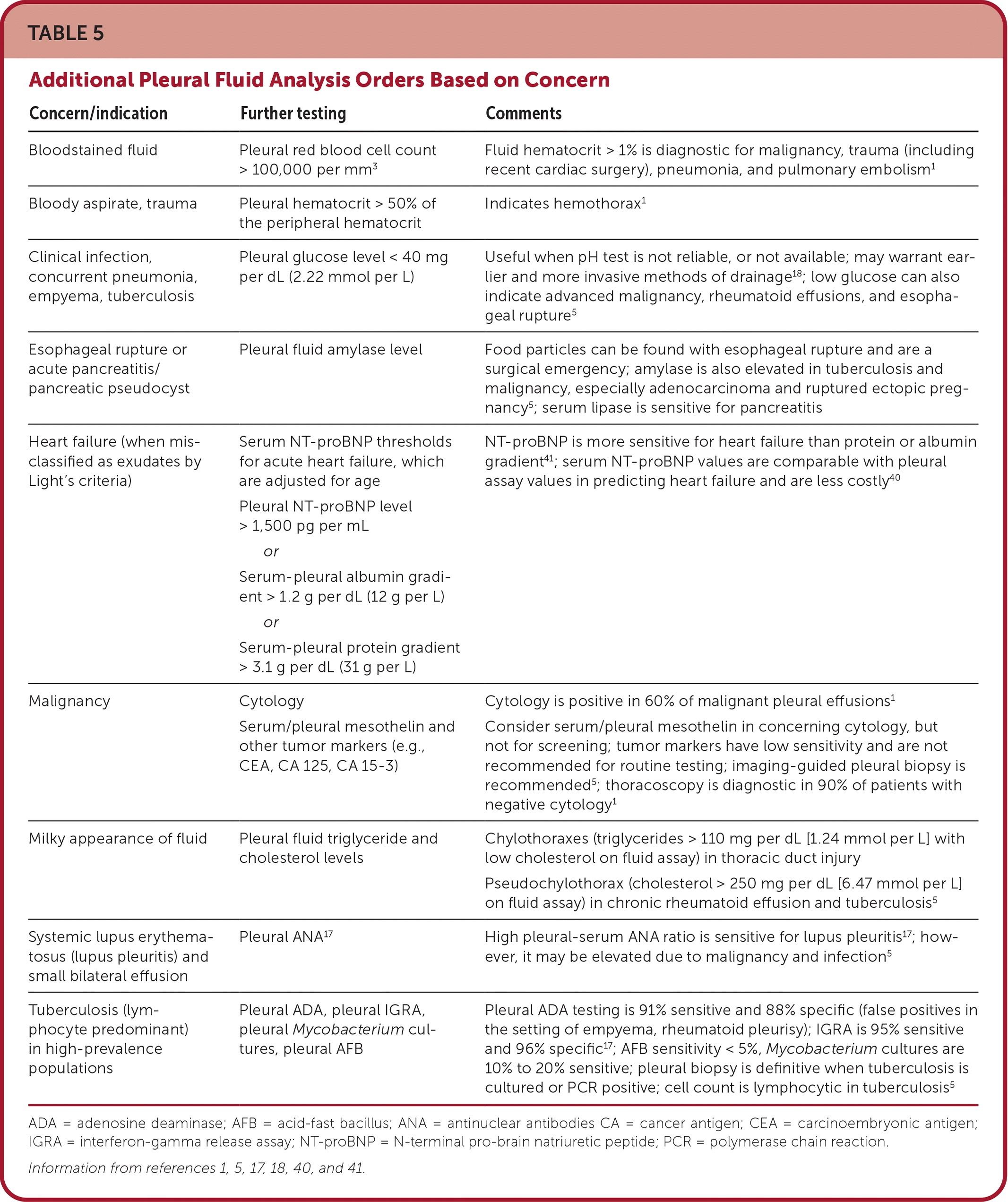
The following table summarizes additional pleural fluid tests based on clinical suspicion:
Imaging
Chest radiograph (first-line): [15]
- Detects >75 mL on lateral view, >175 mL on frontal view
- Blunting of costophrenic angle (earliest sign), meniscus sign, opacification of hemithorax
- Bilateral effusions with cardiomegaly suggest heart failure
Point-of-care ultrasound (POCUS) — strongly recommended: [1][3]
- Detects as little as >20 mL of fluid [15]
- Identifies septations, loculations, and pleural nodularity better than CT
- Guides thoracentesis (reduces complications including pneumothorax)
- Complex echogenic fluid suggests exudate; pleural nodularity has 97% specificity for malignancy [2]
CT chest with contrast: [2][15]
- Reference standard for imaging (detects >10 mL)
- Evaluates underlying parenchyma, mediastinum, pleural thickening/nodularity
- Loculations, thickened parietal pleura suggest complicated parapneumonic or malignant effusion
- Indicated when etiology unclear, malignancy suspected, or complex effusion
When imaging is unnecessary: Small bilateral effusions in known decompensated heart failure responding to diuresis do not require further imaging beyond CXR [1]
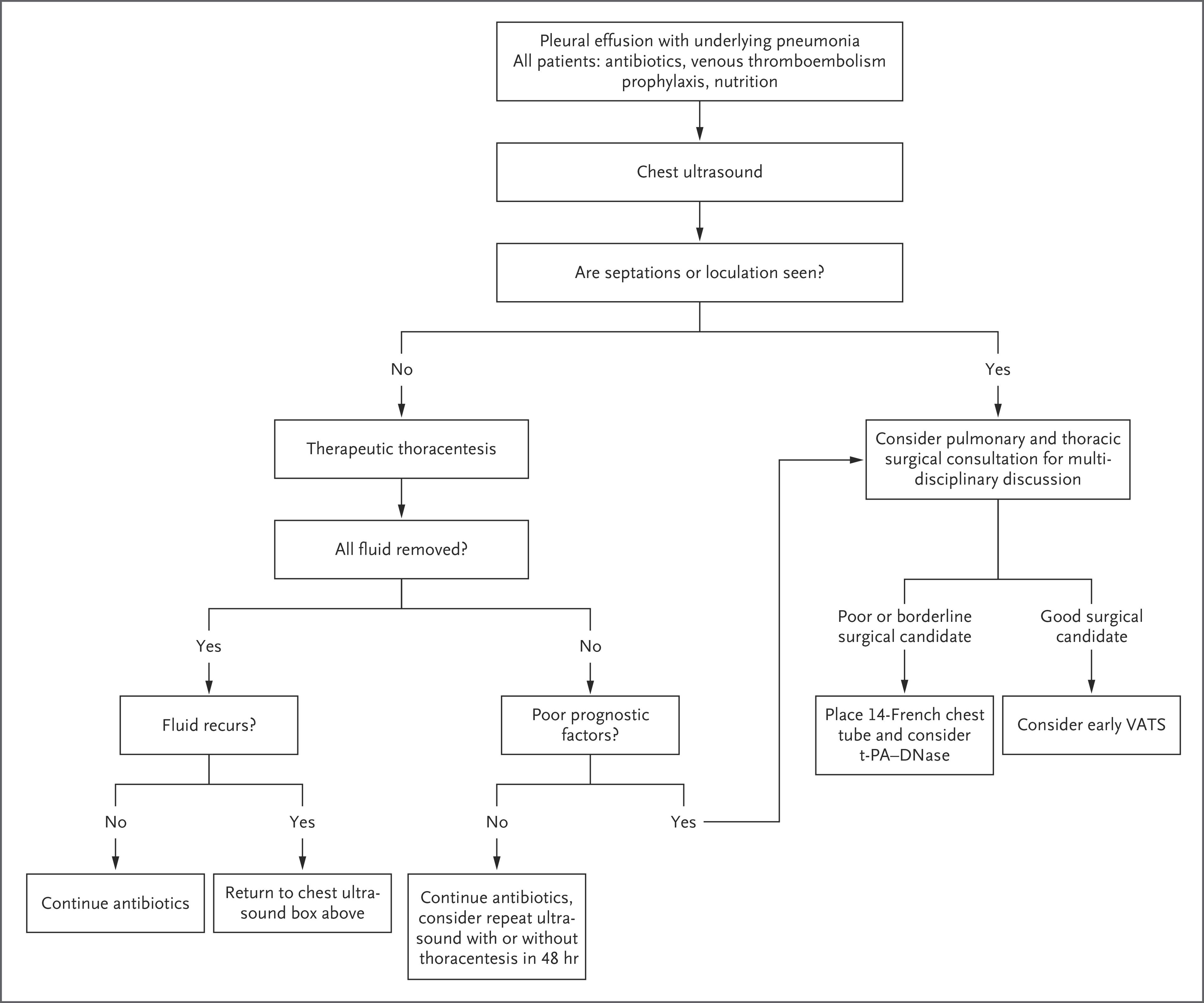
The following figure from the NEJM illustrates a management algorithm for parapneumonic effusions:
Special Tests
Diagnostic scoring
- Light's criteria — cornerstone for transudate vs. exudate differentiation [1]
- Porcel clinical scoring model — score ≥7 identifies cardiac etiology with 92% accuracy when Light's criteria suggest exudate [2]
Point-of-care tests
- Bedside POCUS — real-time assessment of effusion size, complexity, and procedural guidance [3]
- Pleural fluid pH — most accurate predictor for need for chest tube drainage in parapneumonic effusions; pH <7.2 = complicated [7]
Specialty tests
- Pleural ADA (adenosine deaminase): 91% sensitive, 88% specific for TB pleuritis [1]
- Pleural IGRA: 95% sensitive, 96% specific for TB [1]
- Pleural fluid triglycerides >110 mg/dL: Diagnostic for chylothorax [1]
- Pleural fluid cholesterol >250 mg/dL: Pseudochylothorax [1]
- Pleural biopsy (CT-guided or thoracoscopic): Indicated when cytology negative but malignancy or TB suspected; thoracoscopy diagnostic in 90% of cytology-negative malignant effusions [1]
ECG
- Sinus tachycardia: Most common ECG finding with large effusions [16]
- Low-voltage QRS complexes: Due to fluid insulating the heart from chest wall electrodes [16]
- Electrical alternans: Rare; more associated with pericardial effusion but can occur with massive pleural effusion causing cardiac swinging [16]
- Extreme QRS axis deviation: Reported to mimic acute MI patterns; resolves after thoracentesis [17]
- Indications for ECG: All patients with new pleural effusion to evaluate for heart failure, PE, pericarditis, or arrhythmia as contributing etiology
- Pearl: Large left-sided effusions can cause cardiac tamponade physiology with left ventricular diastolic collapse on echo, even without pericardial effusion [6][18]
Assessment
Severity stratification
- Small: Blunting of costophrenic angle only; <10 mm on ultrasound — often observation
- Moderate: Opacification of lower 1/3 of hemithorax
- Large/massive: >1/2 hemithorax; risk of respiratory compromise and hemodynamic effects
Typical presentation: Insidious dyspnea with dullness to percussion; often incidental on imaging [1]
Atypical presentations
- Elderly with empyema may present only with fatigue, weight loss, and failure to thrive [1]
- PE-associated effusion may be small and overlooked
- Hepatic hydrothorax can occur without clinically apparent ascites
Complications
- Empyema (progression from simple to complicated parapneumonic effusion) [19]
- Trapped/entrapped lung
- Fibrothorax from chronic inflammation
- Re-expansion pulmonary edema (after rapid large-volume drainage)
- Cardiac tamponade physiology from massive effusion [6]
Treatment Plan
Initial stabilization
- Supplemental O₂, positioning (upright), IV access
- Hemodynamic support if tamponade physiology present
Transudative effusions — treat the underlying cause: [2]
- Heart failure: Diuresis (furosemide), sodium/fluid restriction, guideline-directed medical therapy
- Cirrhosis: Diuretics (spironolactone + furosemide), sodium restriction, TIPS if refractory [20]
- Nephrotic syndrome: Diuretics, treat underlying glomerular disease
- Therapeutic thoracentesis for symptomatic relief if refractory; limit to 1–1.5 L per session to avoid re-expansion pulmonary edema
Exudative effusions — etiology-specific: [1]
- Simple parapneumonic: Antibiotics alone; monitor for progression
- Complicated parapneumonic (pH <7.2, glucose <40, positive Gram stain/culture): Chest tube drainage (small-bore 14–16 Fr) + antibiotics with anaerobic coverage (metronidazole) [7][20]
- Empyema (frank pus): Urgent chest tube drainage; consider tPA 10 mg + DNase 5 mg instilled via chest tube if loculated [1][19]
- Failure of medical management: VATS (video-assisted thoracoscopic surgery) for decortication; ~30% of patients may require surgical intervention [1]
- Malignant effusion: Therapeutic thoracentesis for symptom relief; for recurrent effusions, indwelling pleural catheter (IPC) or talc pleurodesis [12][20]
- TB pleuritis: Standard anti-TB therapy
Disposition
Admission criteria
- Complicated parapneumonic effusion or empyema requiring drainage
- Large effusion with respiratory distress or hemodynamic compromise
- New effusion with suspected malignancy requiring expedited workup
- Effusion in setting of sepsis or hemodynamic instability
- Need for chest tube placement
Observation indications
- Moderate effusion with stable vitals awaiting thoracentesis results
- Heart failure exacerbation with effusion responding to diuresis
Discharge criteria
- Small, asymptomatic transudative effusion with clear etiology (e.g., stable heart failure)
- Simple parapneumonic effusion with reliable follow-up and oral antibiotics
- Post-thoracentesis with no pneumothorax and symptom improvement
Specialist consultation triggers
- Pulmonology/interventional pulmonology: Complicated or loculated effusion, recurrent effusion, need for thoracoscopy or IPC [3]
- Thoracic surgery: Failed medical management, empyema requiring decortication
- Oncology: Confirmed or suspected malignant effusion
- Interventional radiology: Loculated effusion not amenable to bedside drainage
Follow Up / Return Precautions
Follow-up timing
- Post-thoracentesis: Repeat CXR within 24 hours (or sooner if symptomatic) to rule out pneumothorax
- Simple parapneumonic effusion on antibiotics: Reassess clinically and with imaging in 1–2 weeks [1]
- Undiagnosed exudative effusion: Follow-up within 1–2 weeks with pulmonology for possible repeat thoracentesis, biopsy, or thoracoscopy
- Malignant effusion: Ongoing palliative management with IPC or pleurodesis planning
Return precautions — instruct patients to return immediately for:
- Worsening shortness of breath or new chest pain
- Fever, chills, or rigors (especially post-procedure)
- Sudden sharp chest pain with dyspnea (pneumothorax)
- Hemoptysis or coughing up blood-tinged sputum
- Lightheadedness, syncope, or signs of hemodynamic compromise
Patient counseling
- Effusions often recur if the underlying cause is not addressed
- Importance of medication adherence (diuretics, antibiotics, anti-TB therapy)
- Smoking cessation if applicable
- Expected recovery: Simple effusions resolve in days to weeks with treatment; complicated effusions may require prolonged drainage and weeks of antibiotics [19]
References
1. Pleural Effusion: Diagnostic Approach in Adults. — Shen-Wagner J, Gamble C, MacGilvray P. American Family Physician. 2023.
2. ERS Statement on Benign Pleural Effusions in Adults. — Sundaralingam A, Grabczak EM, Burra P, et al. The European Respiratory Journal. 2024.
3. Pleural Disease. — Feller-Kopman D, Light R. The New England Journal of Medicine. 2018.
4. Diagnostic Approach to Pleural Effusion. — Saguil A, Wyrick K, Hallgren J. American Family Physician. 2014.
5. Clinical Approach to a Pleural Effusion. — Chopra A, Hu K, Judson MA, Feller-Kopman D. Chest. 2025.
6. Clinical, Echocardiographic, and Hemodynamic Evidence of Cardiac Tamponade Caused by Large Pleural Effusions. — Kaplan LM, Epstein SK, Schwartz SL, Cao QL, Pandian NG. American Journal of Respiratory and Critical Care Medicine. 1995.
7. ERS/ESTS Statement on the Management of Pleural Infection in Adults. — Bedawi EO, Ricciardi S, Hassan M, et al. The European Respiratory Journal. 2023.
8. Drugs and the Pleura. — Morelock SY, Sahn SA. Chest. 1999.
9. Edema and serositis as an adverse event in patients with cancer receiving immune checkpoint blockade: Systematic review to evaluate this immune-related adverse event and associated treatment strategie. — Elias E, Rohs N, Koseki M, et al. Journal of Clinical Oncology. 2023.
10. Pleural Effusions Due to Dasatinib. — Brixey AG, Light RW. Current Opinion in Pulmonary Medicine. 2010.
11. Drug-Induced Pleural Disease. — Huggins JT, Sahn SA. Clinics in Chest Medicine. 2004.
12. Pleural Effusion in Adults-Etiology, Diagnosis, and Treatment. — Jany B, Welte T. Deutsches Arzteblatt International. 2019.
13. Does This Patient Have a Pleural Effusion?. — Wong CL, Holroyd-Leduc J, Straus SE. The Journal of the American Medical Association. 2009.
14. Pleural Effusion. — Light RW. The New England Journal of Medicine. 2002.
15. ACR Appropriateness Criteria® Workup of Pleural Effusion or Pleural Disease. — Morris MF, Henry TS, Raptis CA, et al. Journal of the American College of Radiology : JACR. 2024.
16. Role of a 12‐Lead Electrocardiogram in the Diagnosis of Cardiac Tamponade as Diagnosed by Transthoracic Echocardiography in Patients With Malignant Pericardial Effusion. — Argula RG, Negi SI, Banchs J, Yusuf SW. Clinical Cardiology. 2015.
17. Pleural Effusion Masquerading as Myocardial Infarction. — Manthous CA, Schmidt GA, Hall JB. Chest. 1993.
18. Left Ventricular Diastolic Collapse and Late Regional Cardiac Tamponade Postcardiac Surgery Caused by Large Left Pleural Effusion. — Bilku RS, Bilku DK, Rosin MD, Been M. Journal of the American Society of Echocardiography : Official Publication of the American Society of Echocardiography. 2008.
19. Optimizing the Management of Complicated Pleural Effusion: From Intrapleural Agents to Surgery. — Sorino C, Mondoni M, Lococo F, Marchetti G, Feller-Kopman D. Respiratory Medicine. 2022.
20. Nonmalignant Pleural Effusions. — Porcel JM. Seminars in Respiratory and Critical Care Medicine. 2022.
Figures
More from Deep Dive
Reviewed by Dr. Lucas Mastropaolo. SymptomDx is an educational tool for medical professionals — it does not replace clinical judgment. Verify all clinical data and drug dosages with authoritative sources.