Priapism
Priapism is a prolonged penile erection lasting >4 hours, unrelated to sexual stimulation, and is classified as ischemic (low-flow, 95% of cases), non-ischemic (high-flow), or stuttering (recurrent ischemic). Ischemic priapism is a true urological emergency — a compartment syndrome of the penis — requiring time-sensitive intervention to prevent irreversible erectile dysfunction. [1-3]
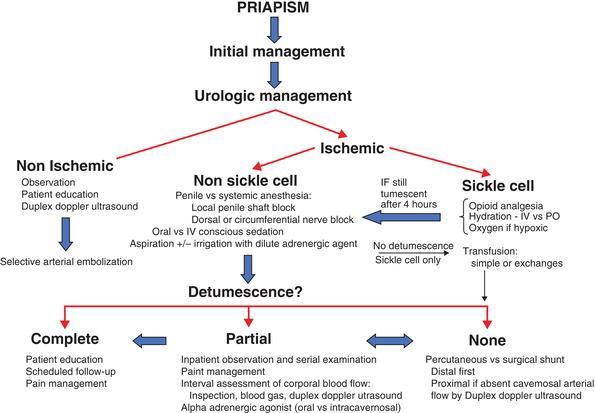
The following algorithm outlines the stepwise management approach:
History
- Duration of erection — the single most critical factor; >4 hours defines priapism, >24 hours associated with 30–70% ED rates, >36–48 hours often requires surgical intervention [5-6]
- Presence/absence of pain (ischemic = painful and rigid; non-ischemic = typically painless and partially tumescent) [1][7]
- Sexual stimulation or arousal preceding onset
- Prior episodes of priapism or stuttering episodes (<3 hours, self-resolving) — a risk factor for major ischemic events [8]
- Medication history: intracavernosal injections (alprostadil, papaverine), antipsychotics, recreational drugs (cocaine, marijuana)
- History of sickle cell disease or other hemoglobinopathy
- Recent perineal/penile trauma (suggests non-ischemic) [7][9]
- Timing: stuttering priapism often occurs during early morning hours or sleep [10]
Alarm Features
- Erection lasting >4 hours — irreversible tissue damage begins [2][10]
- Fully rigid corpora with painful erection and soft glans (classic ischemic priapism) [11]
- Duration >24 hours: widespread smooth muscle necrosis, nerve attrition, and trabecular fibrosis become progressive [2]
- Duration >36–48 hours: high likelihood of permanent ED; surgical intervention (shunt or prosthesis) should be strongly considered [1][6]
- Dark, deoxygenated blood on aspiration (pO₂ <30 mmHg, pH <7.25) confirms ischemia [11]
- Signs of systemic toxicity in SCD patients (acute chest syndrome, sepsis)
Medications
Causative medications
- Antipsychotics (especially those with high α₁-adrenergic affinity): risperidone, chlorpromazine, olanzapine, quetiapine [1][12]
- Intracavernosal vasoactive agents: alprostadil, papaverine, phentolamine [7]
- Trazodone, SSRIs, anticoagulants (heparin, warfarin)
- Recreational drugs: cocaine, marijuana, alcohol [12]
- PDE5 inhibitors (rare, but reported)
- Testosterone replacement therapy
Treatment medications
- Intracavernosal phenylephrine (first-line): 100–500 mcg every 3–5 minutes (dilute 1 mg in 19 mL NS = 500 mcg/mL); 74–94% success rate [2][13-14]
- Oral terbutaline (0.25–0.5 mg SQ or 5 mg PO) — modest efficacy (~25%), may be tried while preparing for aspiration [13]
- Oral pseudoephedrine (60 mg) and midodrine (15–30 mg) — limited evidence, inconsistent results [7]
Prophylaxis for stuttering priapism: PDE5 inhibitors (sildenafil/tadalafil), ketoconazole + prednisone, baclofen, dutasteride, hydroxyurea (SCD), self-injection phenylephrine at home [7]
Contraindicated: RBC transfusion is not indicated as primary treatment for acute priapism in SCD [8]
Diet
- Hydration is critical, especially in SCD patients — oral and IV fluids are part of initial supportive management [8][11]
- Avoid alcohol and recreational drug use (cocaine, marijuana) as triggers [12]
- No specific dietary triggers for idiopathic priapism, but dehydration and cold exposure may precipitate SCD-related episodes
Review of Systems
- Hematologic: fatigue, jaundice, bone pain (SCD crisis), easy bruising
- Genitourinary: prior erectile dysfunction, urinary symptoms, hematuria
- Neurologic: spinal cord symptoms, perineal numbness (cauda equina can cause priapism)
- Psychiatric: medication changes (antipsychotics, antidepressants)
- Oncologic: weight loss, lymphadenopathy, abdominal fullness (leukemia, pelvic malignancy)
- Trauma: recent perineal/penile injury, straddle injury, cycling
Collateral History and Family History
- Sickle cell disease or sickle cell trait — priapism affects ~35–40% of males with SCD [8][11]
- Family history of hemoglobinopathies (HbSS, HbSC, HbS-β thalassemia)
- G6PD deficiency [12]
- History of prior priapism episodes and how they resolved
- Psychiatric history and current psychotropic medications
- Substance use history (cocaine, marijuana, alcohol)
Risk Factors
- Sickle cell disease — most common cause in children and a leading cause in adults [9][15]
- Antipsychotic medications — especially risperidone, chlorpromazine [12]
- Intracavernosal injection therapy for ED [7]
- Hematologic malignancies (leukemia, multiple myeloma)
- G6PD deficiency [12]
- Cocaine and recreational drug use
- Spinal cord injury or neurologic disease
- Perineal/penile trauma (non-ischemic type) [7]
- Age: bimodal peak — 5–10 years and 20–50 years [9]
Differential Diagnosis
- Ischemic (low-flow) priapism — 95% of cases; painful, rigid corpora, soft glans; urologic emergency [16]
- Non-ischemic (high-flow) priapism — post-traumatic arterio-cavernosal fistula; painless, partially tumescent; NOT an emergency [7]
- Stuttering priapism — recurrent self-limited ischemic episodes (<3–4 hours) [7]
- Prolonged iatrogenic erection — following intracavernosal injection; distinct pathology from true priapism [7]
- Sleep-related painful erections — distinct from ischemic priapism, no underlying ischemia [7]
- Penile fracture — acute pain with detumescence, not erection
- Peyronie's disease — curvature without prolonged erection
- Malignant priapism — metastatic infiltration of corpora (bladder, prostate, rectal cancer)
- Cauda equina syndrome — may present with priapism plus neurologic deficits
Past Medical History
- Sickle cell disease or other hemoglobinopathy
- Prior priapism episodes — number, duration, treatment, and outcome
- Erectile dysfunction (pre-existing vs. post-priapism)
- Hematologic malignancy
- Spinal cord injury or neurologic disease
- Psychiatric illness requiring antipsychotics
- Use of intracavernosal injection therapy
- Prior penile surgery or shunt procedures
Physical Exam
- Penile exam: fully rigid corpora cavernosa with a soft glans is pathognomonic for ischemic priapism [11]
- Non-ischemic: partially tumescent, non-tender penis
- Assess for perineal ecchymosis or trauma (suggests non-ischemic etiology)
- Vital signs: monitor BP and HR closely during phenylephrine administration; hypertension, bradycardia, and arrhythmia are potential complications [2]
- Abdominal exam: hepatosplenomegaly (SCD, leukemia)
- Neurologic exam: lower extremity strength, sensation, rectal tone (rule out cauda equina)
- Lymph node exam: inguinal lymphadenopathy (malignancy)
Lab Studies
- Corporal blood gas analysis (diagnostic gold standard for subtyping): [1][16]
- Ischemic: pO₂ <30 mmHg, pCO₂ >60 mmHg, pH <7.25 (dark blood)
- Non-ischemic: pO₂ >90 mmHg, pCO₂ <40 mmHg, pH 7.35–7.45 (bright red blood)
- CBC with differential — evaluate for leukemia, sickle cell anemia, polycythemia
- Hemoglobin electrophoresis — if SCD not previously diagnosed
- Reticulocyte count — hemolysis assessment in SCD
- Coagulation studies (PT/INR, PTT) — if coagulopathy suspected
- Urine toxicology screen — cocaine and other substances
- Metabolic panel — baseline renal/hepatic function
- LDH, haptoglobin, bilirubin — hemolysis markers in SCD
Imaging
- Color Doppler ultrasound (CDUS) — first-line imaging; differentiates ischemic (absent/minimal cavernosal arterial flow) from non-ischemic (high-velocity turbulent flow at fistula site) [17-18]
- Point-of-care ultrasound (POCUS) — rapid bedside assessment of cavernosal arterial flow in the ED; can confirm high-flow priapism noninvasively [18-19]
- Penile MRI — useful in delayed presentations to assess extent of corporal necrosis and guide decision-making regarding prosthesis vs. shunt [17]
- CT/MRI — indicated when malignant priapism is suspected (pelvic mass, metastatic disease) [17]
- Catheter angiography — reserved for non-ischemic priapism when embolization is planned [17]
- Imaging is often unnecessary in straightforward acute ischemic priapism where history and corporal blood gas are diagnostic [16]
Special Tests
- Corporal blood gas analysis — both diagnostic and therapeutic (aspiration is part of treatment) [1][16]
- Penile duplex Doppler ultrasound — for equivocal cases, non-ischemic priapism evaluation, and post-treatment follow-up [7][17]
- STIFF protocol (Sonography to Identify Forward Flow) — novel dynamic POCUS technique applying controlled glans pressure while monitoring cavernosal flow [19]
- Selective pudendal arteriography — for non-ischemic priapism prior to embolization [20]
- No validated clinical scoring systems exist specifically for priapism severity, though duration >36 hours and non-SCD etiology predict need for shunting [21]
ECG
- ECG monitoring is recommended during intracavernosal phenylephrine administration, particularly in patients with cardiovascular disease [2]
- Watch for reflex bradycardia, hypertension, and arrhythmias secondary to phenylephrine
- Baseline ECG if the patient has known cardiac disease or is on QT-prolonging medications (many antipsychotics that cause priapism also prolong QT)
Assessment
Priapism is classified into three subtypes with distinct urgency levels:
Complications: Permanent erectile dysfunction (most feared), penile fibrosis, penile shortening/deformity, corporeal necrosis, and penile gangrene in extreme cases. [2][23]
Treatment Plan
Ischemic priapism — stepwise approach: [1-2][24]
- Supportive care: IV fluids, analgesia (opioids as needed), anxiolysis
- Corporal aspiration ± irrigation with normal saline — use a 16–18G needle inserted into the lateral corpus cavernosum at 2 or 10 o'clock position; aspirate until bright red blood returns
- Intracavernosal phenylephrine (first-line sympathomimetic):
- Dilute: 1 mg phenylephrine in 19 mL NS (= 50 mcg/mL) or use higher concentrations per institutional protocol
- Inject 100–500 mcg every 3–5 minutes; max ~1000 mcg in 1 hour
- Monitor BP and HR continuously
- Success rate: 74–94% [13-14]
- Surgical shunt (if aspiration + phenylephrine fails within first 24–48 hours):
- Penile prosthesis — indicated for refractory priapism >36–48 hours or failed shunting; early implantation preferred over delayed [1][6][26]
Non-ischemic priapism: [7]
- Observation for 4 weeks initially (not an emergency)
- Selective arterial embolization if persistent and bothersome (success 85.7–100%) [25]
SCD-specific considerations: [7-8]
- Do NOT delay urologic intervention for exchange transfusion
- IV hydration, oxygen, analgesia concurrent with urologic management
- Simple transfusion to Hgb 9–10 g/dL if general anesthesia required for shunting
- Hydroxyurea or chronic transfusion program for recurrence prevention
Disposition
- Admission criteria: priapism >4–6 hours requiring aspiration/phenylephrine, failed initial treatment, need for surgical intervention, SCD patients requiring monitoring, hemodynamic instability during treatment [7]
- Observation: partial detumescence after treatment — serial exams, interval assessment of corporal blood flow [4]
- Discharge criteria: complete detumescence achieved, stable vitals, pain controlled, underlying etiology addressed or follow-up arranged
- Urology consultation: all cases of ischemic priapism >4 hours; emergent for failed aspiration/phenylephrine [7][10]
- Hematology consultation: SCD patients, suspected hematologic malignancy [7]
Follow Up / Return Precautions
- Follow-up with urology within 1–2 weeks for erectile function assessment and counseling [4]
- Return immediately if erection recurs and lasts >2–4 hours (especially in stuttering priapism patients) [7]
- Counsel on home self-injection of phenylephrine for patients with recurrent ischemic priapism, per urologist guidance [7]
- Discuss medication changes with prescribing psychiatrist if antipsychotic-induced (switch to agents with lower α₁ affinity, e.g., amisulpride) [12]
- Counsel that erectile dysfunction is a common sequela, especially with prolonged episodes; early follow-up for assessment and potential prosthesis discussion [5][26]
- SCD patients: reinforce hydration, avoidance of triggers (cold, dehydration, stress), and adherence to hydroxyurea or transfusion program [8][11]
- Expected recovery: if treated within 12–24 hours, erectile function preservation is more likely; beyond 24–48 hours, ED rates rise significantly (30–70%) [5]
References
1. An Update on Mechanisms and Treatment Options for Priapism. — Pang KH, Alnajjar HM, Lal A, Muneer A. Nature Reviews. Urology. 2025.
2. An Overview of Emergency Pharmacotherapy for Priapism. — Graham BA, Wael A, Jack C, Rohan MA, Wayne HJG. Expert Opinion on Pharmacotherapy. 2022.
3. Management of Priapism: 2021 Update. — Ericson C, Baird B, Broderick GA. The Urologic Clinics of North America. 2021.
4. Priapism. — Akash A. Kapadia, Kevin Ostrowski, Thomas J. Walsh A Clinical Guide to Urologic Emergencies. 2021.
5. Conservative and Medical Treatments of Non-Sickle Cell Disease-Related Ischemic Priapism: A systematic Review by the EAU Sexual and Reproductive Health Panel. — Capogrosso P, Dimitropolous K, Russo GI, et al. International Journal of Impotence Research. 2024.
6. Non-Surgical vs Surgical Management for Major Ischemic Priapism of 36 hours Duration. — El-Achkar A, Arbuiso A, Filho NM, et al. The Journal of Sexual Medicine. 2025.
7. The Diagnosis and Management of Recurrent Ischemic Priapism, Priapism in Sickle Cell Patients, and Non-Ischemic Priapism: An AUA/SMSNA Guideline. — Bivalacqua TJ, Allen BK, Brock GB, et al. The Journal of Urology. 2022.
8. Sickle Cell Disease: A Review. — Kavanagh PL, Fasipe TA, Wun T. The Journal of the American Medical Association. 2022.
9. Treatments for Priapism in Boys and Men With Sickle Cell Disease. — Chinegwundoh FI, Smith S, Anie KA. The Cochrane Database of Systematic Reviews. 2020.
10. Health Supervision for Children and Adolescents With Sickle Cell Disease: Clinical Report. — Yates AM, Aygun B, Nuss R, Rogers ZR. Pediatrics. 2024.
11. Evidence-Based Management of Sickle Cell Disease: Expert Panel Report, 2014. — National Heart, Lung, and Blood Institute. 2014.
12. Risperidone-Induced Priapism: A Systematic Review of Risk Factors, Comprehensive Assessment, and Management Recommendations. — Owusu-Antwi P, Muhialdain M, Atodaria P, et al. Journal of Clinical Psychopharmacology. 2026.
13. Effect of Phenylephrine and Terbutaline on Ischemic Priapism: A Retrospective Review. — Martin C, Cocchio C. The American Journal of Emergency Medicine. 2016.
14. Use of High-Dose Phenylephrine in the Treatment of Ischemic Priapism: Five-Year Experience at a Single Institution. — Ridyard DG, Phillips EA, Vincent W, Munarriz R. The Journal of Sexual Medicine. 2016.
15. Priapism in the Paediatric and Adolescent Population. — Mushtaq A, Jayasimha S, To WKL, Mushtaq I. International Journal of Impotence Research. 2024.
16. Standard Operating Procedures for Priapism. — Burnett AL, Sharlip ID. The Journal of Sexual Medicine. 2013.
17. Review of the Role of Imaging in the Diagnosis of Priapism. — von Stempel C, Walkden M, Kirkham A. International Journal of Impotence Research. 2024.
18. Point-of-Care Ultrasound Diagnosis of High Flow Priapism. — McHugh K, Gibbons RC. The Journal of Emergency Medicine. 2022.
19. A Novel Approach to Priapism Doppler Assessment: Sonography to Identify Forward Flow (STIFF Protocol). — Leamon A, Montoya K, Shokoohi H. The Journal of Emergency Medicine. 2025.
20. Diagnosis and Treatment of Priapism: Experience With 5 Cases. — Goto T, Yagi S, Matsushita S, et al. Urology. 1999.
21. Using Artificial Intelligence to Predict Surgical Shunts in Men With Ischemic Priapism. — Masterson TA, Parmar M, Tradewell MB, et al. The Journal of Urology. 2020.
22. Evaluation and Management of Priapism: 2009 Update. — Huang YC, Harraz AM, Shindel AW, Lue TF. Nature Reviews. Urology. 2009.
23. The Surgical Management of Ischaemic Priapism. — Johnson MJ, Kristinsson S, Ralph O, Chiriaco G, Ralph D. International Journal of Impotence Research. 2020.
24. A Narrative Review of Initial Treatment for Ischemic Priapism. — Lumbiganon S, Moukhtar Hammad MA, Azad B, Yafi FA. International Journal of Impotence Research. 2024.
25. Surgical and Minimally Invasive Treatment of Ischaemic and Non-Ischaemic Priapism: A Systematic Review by the EAU Sexual and Reproductive Health Guidelines Panel. — Milenkovic U, Cocci A, Veeratterapillay R, et al. International Journal of Impotence Research. 2024.
26. Early Penile Prosthesis Implantation in Refractory Ischaemic Priapism: A Narrative Review. — Calopedos R, Trubbia D, Ralph D, Lee WG. International Journal of Impotence Research. 2025.
Figure
More from Deep Dive
Reviewed by Dr. Lucas Mastropaolo. SymptomDx is an educational tool for medical professionals — it does not replace clinical judgment. Verify all clinical data and drug dosages with authoritative sources.