Tension Headache
Tension-Type Headache (TTH)
Tension-type headache is the most prevalent primary headache disorder worldwide (lifetime prevalence 30–78%), characterized by bilateral, pressing/tightening, mild-to-moderate intensity pain that is not aggravated by routine physical activity.[1-3] Despite its high prevalence, TTH is frequently overdiagnosed in the ED — one study found only 5 of 211 patients discharged with a TTH diagnosis actually fulfilled ICHD-3 criteria, with 6.1% ultimately having a life-threatening disorder.[4]
History
- Quality: Bilateral, pressing or tightening ("band-like"), non-pulsating
- Intensity: Mild to moderate (not severe)
- Duration: 30 minutes to 7 days per episode
- Aggravating factors: Not worsened by routine physical activity (walking, climbing stairs) — this is a key distinguishing feature from migraine[5]
- Associated symptoms: No nausea or vomiting; may have photophobia OR phonophobia but not both[5-6]
Frequency classification
- Infrequent episodic: <1 day/month (<12 days/year)
- Frequent episodic: 1–14 days/month for >3 months
- Chronic: ≥15 days/month for >3 months[5]
- Key HPI questions: Onset timing, prior similar episodes, recent stressors, sleep changes, medication use (frequency of OTC analgesics), caffeine intake, trauma history
- Important negatives: No thunderclap onset, no fever, no focal neurologic symptoms, no visual changes, no neck stiffness, no weight loss
Alarm Features
- Red flags warranting urgent workup (use the SNNOOP10 mnemonic):[7]
- Thunderclap onset (peak intensity in seconds) → SAH
- Fever + meningismus → meningitis/encephalitis
- Focal neurologic deficits → stroke, mass lesion, vascular malformation
- Papilledema → intracranial hypertension, mass lesion
- New headache in age >50 → giant cell arteritis, neoplasm
- Progressive or changing pattern → mass lesion, medication overuse headache
- Positional component → intracranial hypo-/hypertension
- Immunosuppression → opportunistic infection
- Impaired consciousness or seizure
- First or worst headache of life
- A single or first-time headache should always prompt evaluation for secondary causes[6]
Medications
Acute treatment
- Ibuprofen 400 mg or acetaminophen 1,000 mg — first-line for acute episodes. Lower doses of acetaminophen are not effective.[3][6][8]
- Aspirin and combination analgesics with caffeine are also effective[3]
- Triptans are NOT effective for TTH unless the patient also has migraine[3]
- Preventive treatment (for frequent episodic or chronic TTH):
- Amitriptyline 10–25 mg nightly — first-line preventive; benefits seen after 3 months[3][8]
- Mirtazapine 15–30 mg at bedtime — second-line[2-3]
- Venlafaxine up to 150 mg daily — third-line[2-3]
- OnabotulinumtoxinA is NOT effective for TTH (unlike chronic migraine)[8]
Medication cautions
- Limit OTC analgesic use to ≤2 days per week (or ≤10 days/month) to prevent medication overuse headache (MOH)[6][9]
- NSAIDs: monitor for GI, renal, and cardiac risks with chronic use[6]
- Chronic TTH is associated with acute medication overuse[3]
Diet
- No specific dietary triggers are well-established for TTH (unlike migraine)
- Regular meals — skipping meals may contribute to headache[9]
- Adequate hydration — dehydration is a common headache precipitant
- Caffeine: moderate intake may help acutely (included in some combination analgesics), but excessive use or withdrawal can trigger headache
- Alcohol is a recognized precipitant in some patients[10]
Review of Systems
- Neurologic: Visual changes, focal weakness, numbness, speech difficulty, gait disturbance (to rule out secondary causes)
- Psychiatric: Anxiety, depression, sleep disturbance — strongly associated with chronic TTH[3][11-12]
- Musculoskeletal: Neck pain, jaw clenching, TMJ symptoms
- Ophthalmologic: Vision changes, eye pain (rule out glaucoma, refractive error)
- Constitutional: Fever, weight loss, night sweats (rule out infection, malignancy)
- ENT: Sinus pressure, nasal congestion (rule out sinusitis)
Collateral History and Family History
- Prior headache diagnoses and treatments tried
- Family history of migraine (TTH and migraine frequently coexist; migraine has a stronger genetic component)[5]
- Occupational and psychosocial stressors — stress and mental tension are the most common precipitating factors[10][12]
- Screen for domestic violence, substance use, and workplace ergonomics
- Medication history from pharmacy records (to assess for MOH)
Risk Factors
- Stress and mental tension — most conspicuous precipitating factor[10][12-13]
- Poor sleep quality/insomnia — particularly associated with chronic TTH[14-16]
- Anxiety and depression — strongly comorbid with chronic TTH[3][11-12]
- Sedentary lifestyle — higher prevalence of TTH in men with exclusively sedentary activity[10]
- Medication overuse — risk factor for chronification[3][5]
- Age 30–39 years — peak prevalence[3]
- Sex: TTH is slightly more common in men than women (unlike migraine)[3]
Differential Diagnosis
Cannot-miss diagnoses
- Subarachnoid hemorrhage — thunderclap onset, worst headache of life
- Meningitis/encephalitis — fever, neck stiffness, altered mental status
- Intracranial mass/neoplasm — 23.5% of patients with intracranial malignancy present with TTH-like symptoms[3]
- Cerebral venous thrombosis — progressive headache, especially postpartum or with hypercoagulable state
- Cervical artery dissection — neck pain, Horner syndrome, focal deficits
- Giant cell arteritis (age >50) — jaw claudication, visual symptoms, elevated ESR/CRP[7]
- Idiopathic intracranial hypertension — obesity, visual obscurations, papilledema[3]
Common mimics
- Migraine without aura — the most common diagnostic difficulty; distinguished by pulsating quality, moderate-severe intensity, aggravation by activity, nausea/vomiting, and both photophobia AND phonophobia[5]
- Medication overuse headache — headache ≥15 days/month with regular overuse of acute headache medications for >3 months[5]
- Cervicogenic headache — unilateral, associated with neck movement
- Sinusitis — facial pressure, purulent discharge, fever
- TMJ dysfunction — jaw pain, clicking, tenderness over TMJ
- Refractive error/eye strain
Past Medical History
- Prior headache types and frequency (headache diary is valuable)[5][9]
- History of head/neck trauma
- Depression, anxiety, or other psychiatric conditions
- Sleep disorders (insomnia, OSA)
- Fibromyalgia (shares pathophysiological features with chronic TTH)[12]
- Prior neuroimaging results
- Medication list with focus on analgesic frequency
Physical Exam
- Vital signs: Blood pressure (hypertensive emergency can cause headache), temperature (fever → secondary cause)
- Neurologic exam: Must be normal in TTH — cranial nerves, motor, sensory, reflexes, coordination, gait. Any focal deficit mandates further workup[3][7]
- Fundoscopy: Assess for papilledema (intracranial hypertension)[3]
- Pericranial tenderness: The most significant abnormal finding in TTH — palpate frontal, temporal, masseter, pterygoid, sternocleidomastoid, splenius, and trapezius muscles bilaterally using small rotating movements with firm pressure. Score 0–3 per muscle to generate a total tenderness score. Tenderness increases with headache frequency and intensity.[5][12]
- Cervical spine: Range of motion, paraspinal tenderness
- TMJ: Palpation, range of motion, clicking
- Temporal arteries: Tenderness, reduced pulsation (if age >50)
Lab Studies
- No routine labs are needed for typical TTH with normal neurologic exam[7]
If red flags present
- ESR and CRP — if age >50 (giant cell arteritis)[7]
- CBC — infection, anemia
- BMP — metabolic derangement
- Blood cultures — if febrile
- Coagulation studies — if hemorrhage suspected
- Pregnancy test — reproductive-age women (changes differential and treatment)
- TSH — if chronic/atypical headache
- LP with opening pressure — if SAH suspected after negative CT, or if meningitis/IIH suspected[7][17]
Imaging
- Primary headache disorders without red flags or abnormal exam findings do NOT need neuroimaging[7]
When indicated
- Non-contrast CT head — first-line for emergent evaluation (thunderclap headache, suspected hemorrhage, mass effect)[7][17]
- MRI brain with/without contrast — preferred for less urgent concerning features (progressive headache, new neurologic symptoms, suspected neoplasm, infection, IIH)[3][7]
- CTA or MRA — if vascular pathology suspected (dissection, aneurysm, CVT)
- Consider MRI in patients >50 with new-onset TTH-like headache given risk of intracranial malignancy mimicking TTH[3]
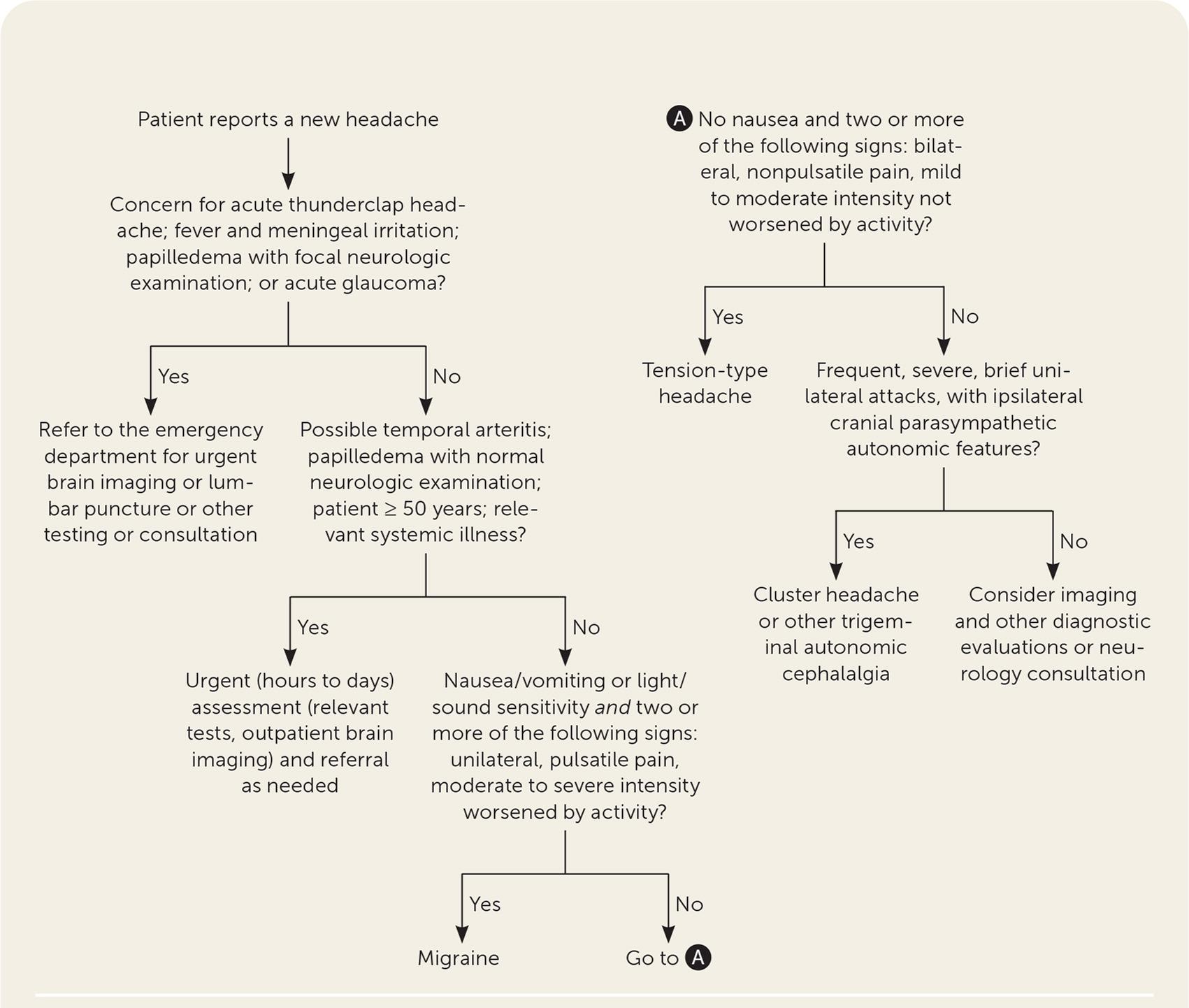
- The following figure outlines a systematic approach to headache evaluation:
- View full figure Figure 1. Evaluation of headache. Acute Headache in Adults: A Diagnostic Approach. Am Fam Physician. August 31, 2022.
Special Tests
- SNNOOP10 mnemonic — systematic screening tool for secondary headache red flags[7]
- ID Migraine screener — 3-question validated tool to distinguish migraine from TTH (disability, nausea, photophobia)[7]
- Total Tenderness Score (TTS) — manual palpation of pericranial muscles; recommended by ICHD-3 for subclassifying TTH[5][18]
- Headache diary — essential for tracking frequency, severity, medication use, and triggers; helps distinguish TTH from migraine and identify MOH[5][9]
ECG
- ECG is not routinely indicated for tension-type headache
Consider ECG if
- Hypertensive emergency with headache
- Syncope or presyncope associated with headache
- Concern for cardiac etiology (e.g., exertional headache with chest pain)
- Pre-treatment screening if starting medications with cardiac effects (e.g., amitriptyline — QT prolongation risk)
Assessment
- TTH is a clinical diagnosis based on ICHD-3 criteria — requires ≥10 episodes with characteristic features and absence of migraine-defining symptoms[5-6]
- The primary clinical challenge is distinguishing TTH from mild migraine without aura, as these frequently coexist[5]
- Chronic TTH (≥15 days/month) causes significant disability — average 27 missed workdays per year[3]
- Peripheral mechanisms (myofascial pain, trigger points) likely drive episodic TTH, while central sensitization contributes to chronification[2][11]
- Always consider secondary causes when headache is new-onset, changing in pattern, or accompanied by any red flag features[3-4]
Treatment Plan
Acute management
- Ibuprofen 400 mg PO or acetaminophen 1,000 mg PO[6][8]
- Combination analgesics with caffeine are an alternative[3]
- Limit acute medication use to ≤2 days/week to prevent MOH[6]
Non-pharmacologic (all patients)
- Stress management, regular sleep hygiene, regular meals, regular physical activity[9][19]
- Manual therapy/physical therapy — modestly reduces TTH frequency[8]
- CBT, biofeedback, relaxation therapy — evidence-based adjuncts, especially for chronic TTH[3][9][19]
- Acupuncture — may be helpful[3]
- Preventive pharmacotherapy (initiate when ≥10 attacks/month, significant disability, or chronic TTH):
- Amitriptyline 10–25 mg nightly (titrate as tolerated) — first-line; expect benefit after ~3 months[3][8]
- Mirtazapine 15–30 mg at bedtime — second-line[3]
- Venlafaxine up to 150 mg daily — third-line[3]
Disposition
Discharge criteria (vast majority of TTH patients)
- Normal neurologic exam
- No red flag features
- Pain adequately controlled
- Able to tolerate PO
Admission/observation criteria
- Abnormal neurologic exam or red flag features requiring workup
- Intractable headache not responding to ED treatment
- Concern for secondary headache disorder pending imaging/LP results
- New neurologic findings
Specialist consultation triggers
- Chronic daily headache refractory to first-line preventive therapy
- Diagnostic uncertainty (TTH vs. migraine vs. secondary cause)
- Medication overuse headache requiring structured withdrawal
- Abnormal neuroimaging findings → neurology or neurosurgery
Follow Up / Return Precautions
Follow-up timing
- Episodic TTH managed with OTC analgesics: follow up with PCP if headaches increase in frequency or severity
- Chronic TTH started on preventive therapy: follow up in 4–6 weeks to assess tolerability, then at 3 months to evaluate efficacy[8]
- Headache diary should be maintained between visits[5][9]
- Return precautions — instruct patients to return immediately for:
- Sudden severe "worst headache of life"
- Fever with stiff neck
- New weakness, numbness, vision changes, speech difficulty, or confusion
- Headache after head trauma
- Headache that is progressively worsening despite treatment
- Seizure
Expected recovery
- Episodic TTH is self-limiting; most episodes resolve within hours with simple analgesics[20]
- Chronic TTH may require months of multimodal therapy before significant improvement[8][19]
- Educate patients that overuse of acute medications can paradoxically worsen headache frequency[6][9]
References
1. Global, Regional, and National Burden of Headache Disorders, 1990-2023: A Systematic Analysis for the Global Burden of Disease Study 2023. — GBD 2023 Headache Collaborators. The Lancet. Neurology. 2025.
2. Tension-Type Headache. — Ashina S, Mitsikostas DD, Lee MJ, et al. Nature Reviews. Disease Primers. 2021.
3. Diagnosis and Management of Headache: A Review. — Robbins MS. The Journal of the American Medical Association. 2021.
4. Tension-Type Headache in the Emergency Department Diagnosis and Misdiagnosis: The TEDDi Study. — García-Azorín D, Farid-Zahran M, Gutiérrez-Sánchez M, et al. Scientific Reports. 2020.
5. Management of Headache (2023). — Jane Abanes PhD DNP MSN/Ed PMHCNS PMHNP-BC RN, Natasha M. Antonovich PharmD BCPS, Andrew C. Buelt DO, et al Department of Veterans Affairs. 2023.
6. Acute Headache in Adults: A Diagnostic Approach. — Viera AJ, Antono B. American Family Physician. 2022.
7. Outpatient Primary Care Management of Headaches: Guidelines From the VA/DoD. — Ford B, Dore M, Harris E. American Family Physician. 2021.
8. Educational and Supportive Self-Management Program for the Treatment of Chronic Headache. — Preston J. Neurology. 2023.
9. Migraine and Tension-Type Headache in a General Population: Precipitating Factors, Female Hormones, Sleep Pattern and Relation to Lifestyle. — Rasmussen BK. Pain. 1993.
10. Hallmarks of Primary Headache: Part 2- Tension-Type Headache. — Pan LH, Ling YH, Wang SJ, et al. The Journal of Headache and Pain. 2025.
11. Tension-Type Headache: Current Research and Clinical Management. — Fumal A, Schoenen J. The Lancet. Neurology. 2008.
12. Cognitive or Daily Stress Association With Headache and Pain Induction in Migraine and Tension-Type Headache Patients: A Systematic Review. — Viero FT, Rodrigues P, Trevisan G. Expert Review of Neurotherapeutics. 2022.
13. Pathofysiological and Clinical Correlates of Sleep in Primary Headache Disorders: A Narrative Review. — van Liefland M, Munday V, van Tilborg P, et al. Sleep Medicine. 2026.
14. Sleep and Tension-Type Headache. — Cho SJ, Song TJ, Chu MK. Current Neurology and Neuroscience Reports. 2019.
15. Stress and Sleep Duration Predict Headache Severity in Chronic Headache Sufferers. — Houle TT, Butschek RA, Turner DP, et al. Pain. 2012.
16. Clinical Policy: Critical Issues in the Evaluation and Management of Adult Patients Presenting to the Emergency Department With Acute Headache. — Godwin SA, Cherkas DS, Panagos PD, et al. Annals of Emergency Medicine. 2019.
17. Pericranial Total Tenderness Score in Patients With Tension-Type Headache and Migraine. A Systematic Review and Meta-Analysis. — Castien R, Duineveld M, Maaskant J, De Hertogh W, Scholten-Peeters G. Pain Physician. 2021.
18. Assessment and Management of Tension-Type Headaches. — Steelquist J, Pham A, Vu K, Eapen BC. Physical Medicine and Rehabilitation Clinics of North America. 2025.
19. Tension-Type Headache in Childhood and Adolescence. — Anttila P. The Lancet. Neurology. 2006.
Figure
More from Deep Dive
Reviewed by Dr. Lucas Mastropaolo. SymptomDx is an educational tool for medical professionals — it does not replace clinical judgment. Verify all clinical data and drug dosages with authoritative sources.